






Thermal image visible light camera target tracking AI board for Betaflight
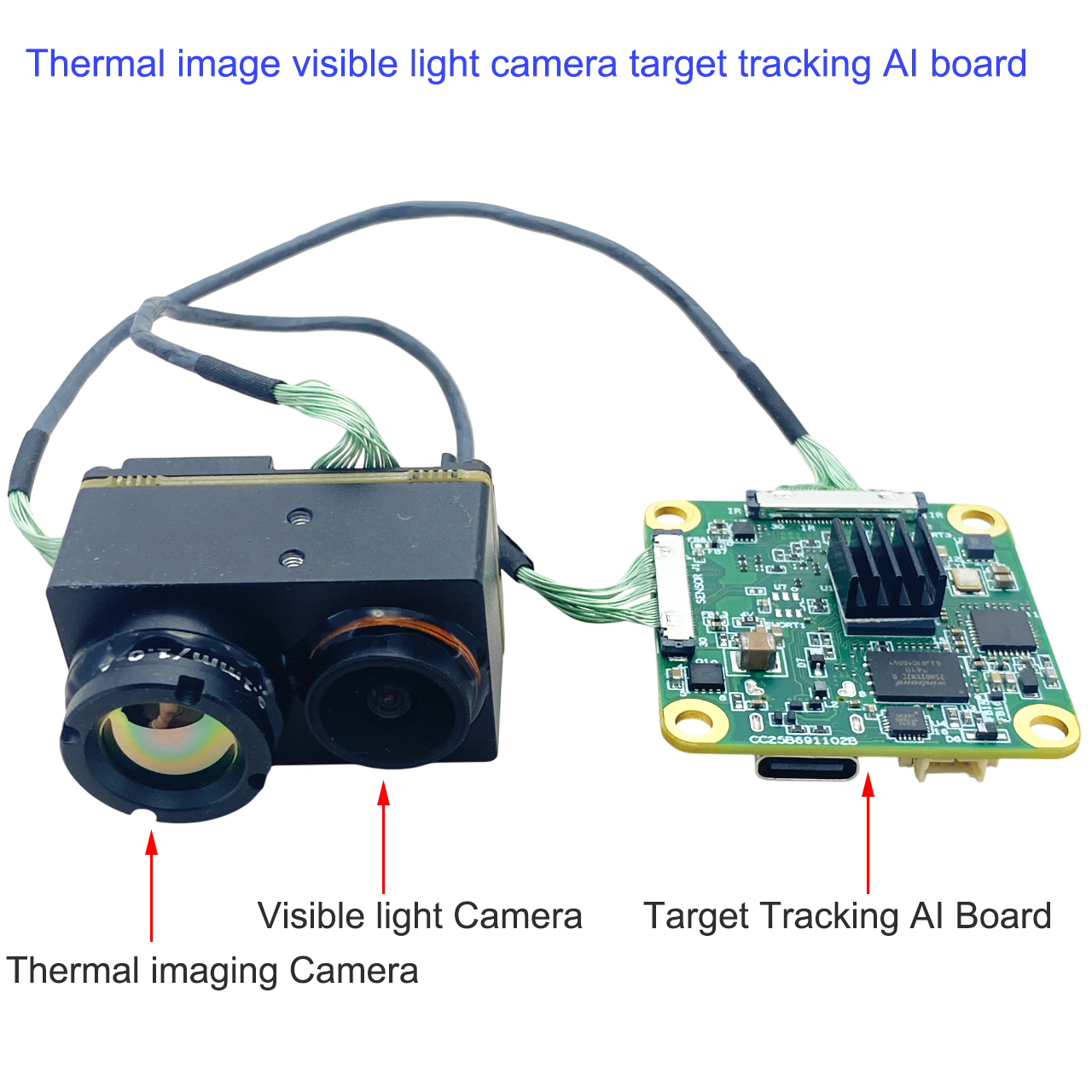
AI-Powered All-Weather Target Detection and Recognition up to 200 Meters
Table of Contents
Introduction
Thermal + Digital Dual Cam
-
Dual-light Fusion Imaging
-
Visible / Thermal / Fast Recognition / Clear Insight
-
Ultra-compact / Ultra-light / Ultra-stable
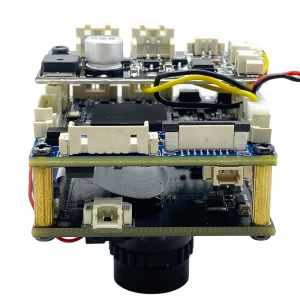
The Visible-Thermal Dual lens Camera is a dual-mode imaging fusion module specifically engineered for drones. It seamlessly integrates visible light imaging, infrared thermal imaging, and dual-spectrum fusion imaging into a single compact unit. Featuring advanced motion stabilization and all-weather imaging capabilities, it ensures reliable performance in dynamic environments.
When mounted on a drone, the module enables accurate pedestrian and vehicle detection within a range of 10 to 200 meters, making it ideal for FPV racing drones, small UAVs, drone gimbals, and other aerial applications.
Key Feature
-
High-sensitivity vanadium oxide uncooled detector
-
Supports AI Super-Resolution, output resolution up to 720 × 576
-
Built-in AI processing capability
-
Low latency imaging performance
-
Ultra-low power consumption: < 0.8W
-
Compact design with high integration: 20 × 20 × 36 mm
The product adopts a modular design for flexibility and ease of integration.
-
Dual-spectrum imaging module: 23 × 36 mm
-
Image processing module: 36 × 36 mm
-
Ultra-lightweight: < 37 g
It is fully compatible with open-source flight controllers such as Beta flight, and others, and can be mounted on a drone in less than 5 minutes, ensuring quick deployment and user convenience.
DUAL CAM MODULE
-
Flexible switching between visible light, infrared, and dual-light fusion video
-
Supports electronic zoom for enhanced detail
-
Ultra-low latency (<60 milliseconds) analog output for real-time decision-making
-
Integrated AI capabilities for intelligent imaging
IMAGE AI PROCESSING MODULE
-
Image Enhancement: Incorporates advanced algorithms including 3D noise reduction, wide dynamic range (WDR), and non-uniformity correction (NUC)
-
High-Frequency Vibration Suppression: Supports electronic 3D anti-shake and image stabilization for clear and stable visuals
-
Dual-Spectrum Fusion: Enables real-time fusion of visible and thermal imaging video, delivering superior situational awareness
By integrating deep learning algorithms with high-performance AI chips, the system delivers full-field automatic target recognition and tracking. This not only reduces pilot workload but also enhances autonomous navigation and ensures precise mission execution.
ELECTRONIC IMAGE STABILIZATION
-
Multi-axis correction: Effectively eliminates horizontal, vertical, and rotational vibrations
-
Sub-pixel motion compensation: Achieved through precise coordination of IMU and image sensor data for smoother, clearer imaging
MULTI-TARGET RECOGNITION
-
Automatically detects and identifies pedestrians and vehicles within 200 meters
-
Capable of recognizing 30+ targets in real time across the field of view
Pin Define
| Terminal Number | Signal Code | Signal Name |
| 1 | DCIN_5V-12V | Power Supply |
| 2 | GND | Ground |
| 3 | UART3_TX_3V3 | UART Transmit |
| 4 | UART3_RX_3V3 | UART Receive |
| 5 | USB_DP | USB Positive |
| 6 | USB_DN | USB Negative |
| 7 | GND | Ground |
| 8 | PAL_OUT | CVBS Video |
Specification
DUAL-SENSOR CAMERA MODULE
Module Dimensions: 36.0mm×22.4mm×26.5mm (L×W×H)
Video Output: 720×576 CVBS Analog Video
DIGITAL THERMAL
Sensor 1920×1080 @50Hz Sensor: 640×512@50Hz
Field of View: 130°(H)×109°(V) Field of View: 35°(H)×28°(V)
Low-light Performance: 0.01 lux NEDT: <40mk
AI IMAGE PROCESSING MODULE
Firmware Support: Betaflight (sample only for Betaflight, not support Ardupilot yet)
Display Mode: Digital,Thermal,Dual-sensor Fusion
Interface: CVBS Video,UART,USB2.0
Module dimensions: 36.0mm × 36.0mm × 9.2mm (L×W×H)
Power Supply: 5~25V
Mounting Hole Positions: 15.5mm × 25.5mm
|
Performance Specifications |
Detector Type | Vanadium oxide uncooled infrared focal plane |
| Resolution | 384×288,720×576(AI Super-Resolution) | |
| Core frame rate | 25Hz、50Hz | |
| Response band | 8-14um | |
| NEDT | ≤40mk@25℃,F#1.0 | |
|
Functional Specifications |
Power-on time | <5s |
| Brightness/Contrast Adjustment | Manual/Automatic | |
| Polarity | White hot (default)/Black hot/Pseudocolor | |
| Crosshair | Display/Hidden(default)/Move | |
| Image Processing | Filtering noise reduction,DDE,Mirroring(up/down/left/right) | |
|
Electrical Parameters |
Digital Video Output | USB/BT.656 |
| Analog Video Output | CVBS Interface(PAL:720×576) | |
| Communication Interface | UART | |
| Power Supply Range | DC 4.5-5V | |
| Typical Power Consumption | <0.8W@25Hz | |
| Physical
Characteristics |
Core Size | 20mm×20mm×36mm |
| Weight | 24g(including lens) | |
| Operating Temperature | -40℃~+65℃ | |
|
Optical Lens |
Focal Length 9.1mm(default) | 28°(H)×21°(V) |
| Focal Length 5.0mm | 49°(H)×38°(V) | |
| Focal Length 4.6mm | 53°(H)×41°(V) |
Weight


Accessory
FPV AI DB-Vision ATR x1
Flight Controller Connection Cable x 2
Hex Socket Cylindrical Head Screw M2*6 x 4
FAQ
Q: Can I get digital video output through the USB-C port?
A: No. The USB-C port on this device is mainly used for debugging and maintenance purposes.
Q: How can I access the video stream from the device?
A: The video stream is provided through the network via RTSP. You can access the digital video by connecting the device to the network and viewing the RTSP stream using compatible software (such as VLC or other RTSP-supported players).
Q: What is the RTSP address to view the video stream?
A: The RTSP stream can be accessed using the following address:
rtsp://192.168.3.100/live.sdp
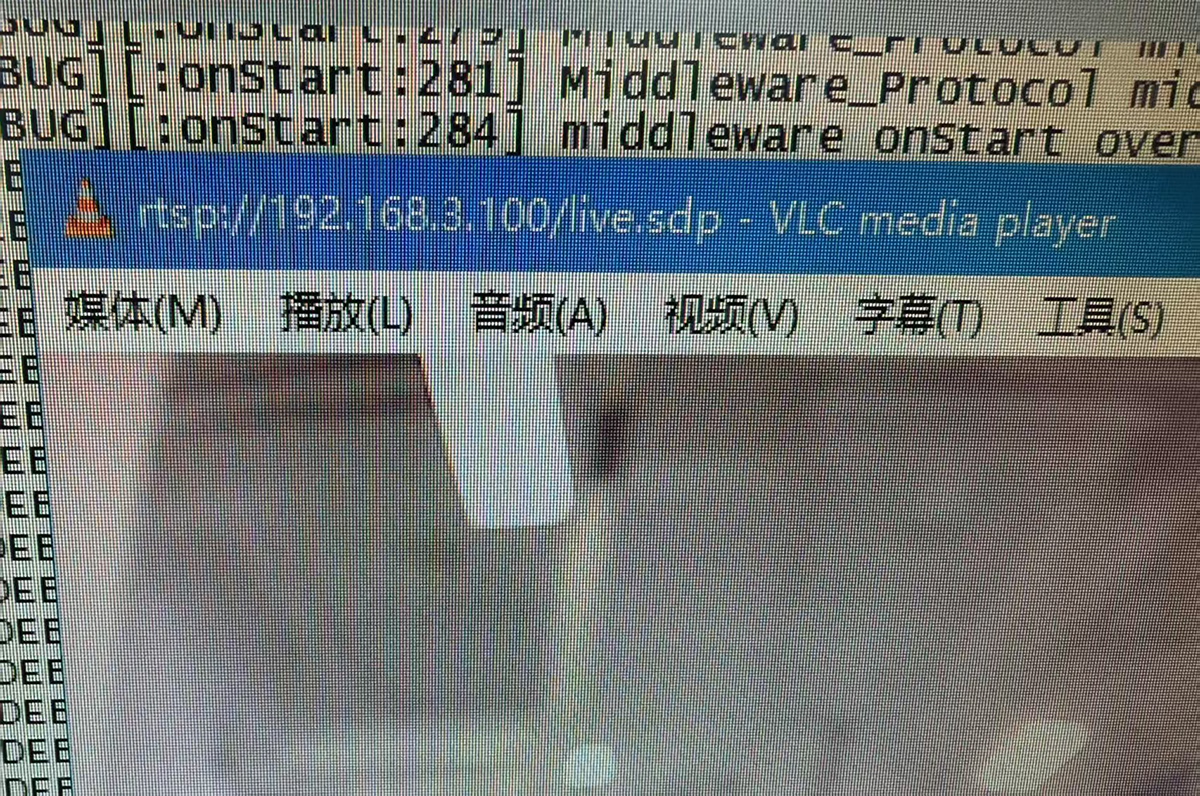
Q: Do I need to set my computer’s IP address to 192.168.3.xxx?
A: Yes. Your computer and the video source must be on the same network segment. Please set your computer’s IP address to 192.168.3.xxx (for example, 192.168.3.101). This ensures that your computer and the video source are on the same subnet and can communicate properly.
Q: How can I switch to the thermal camera?
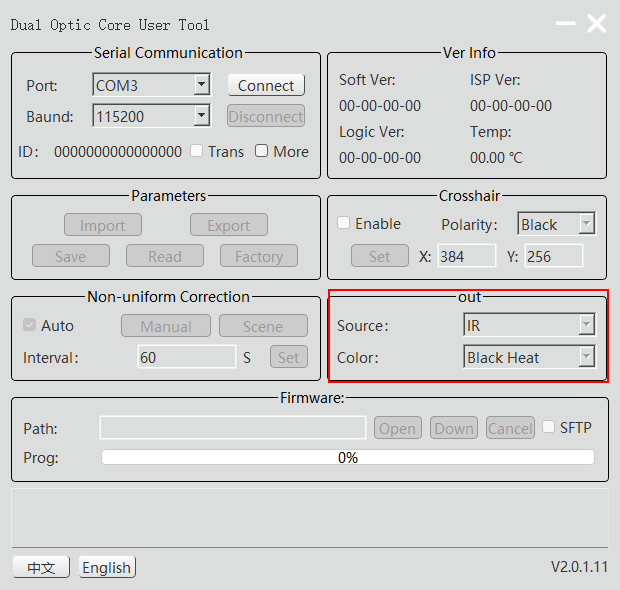
A: You need to use the PC control software IRUserTool.exe.
- Open IRUserTool.exe on your computer.
- Go to Output Settings.
- Select the Video Source as Thermal Camera or Visible Camera depending on your needs.
- Choose the desired pseudo-color (palette) for the thermal image.
After selecting the thermal camera, the video stream will output the thermal image.
Q: Is the camera interface LVDS? Can I connect another LVDS camera to the same board?
A: No. The camera interface is MIPI, not LVDS. Currently, the board does not support connecting an additional LVDS camera. The board is designed to work with the built-in MIPI camera interface, and it does not provide support for external LVDS camera connections.
Q: I can ping the device, but there is no video output. What should I do?
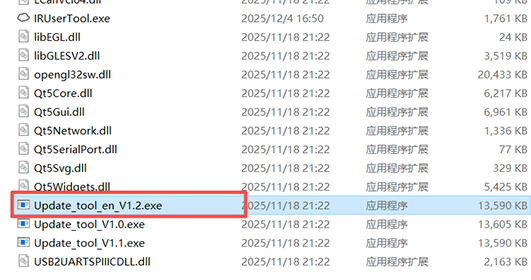
A: You need to update the device software using the PC update tool:
- Run Update_tool_en_V1.2.exe on your computer.
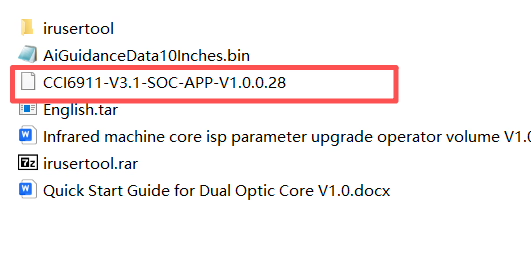
- Upgrade the device twice with the software package:
CCI6911-V3.1-SOC-APP-V1.0.0.28.
After completing these updates, the video output should work correctly.
Q: Do I need the file AiGuidanceData5inches.bin to install it on the flight controller?
A: Yes. The file AiGuidanceData5inches.bin is required for the installation.
You need to use the PC configuration tool irusertool.exe to upload and install this file to the flight controller. The installation is completed through this upper-computer software by connecting the flight controller to your computer.
1. What is the Dual Cam Module?
The Dual Cam Module is a compact visible-thermal fusion camera designed for drones, supporting visible light, infrared, and dual-spectrum imaging in one unit.
2. How does dual-light fusion imaging work?
Dual-light fusion imaging combines visible light video with thermal infrared imaging to provide clearer situational awareness in various environments.
3. What are the key advantages of dual-spectrum fusion?
Dual-spectrum fusion improves target recognition, depth perception, and visibility in low-light or foggy conditions.
4. How compact is the camera module?
The camera features a 23 × 36 mm dual-spectrum module and a 36 × 36 mm image processing module, with total weight under 50g.
5. Can the module be installed quickly on drones?
Yes, the module is plug-and-play and can be installed on a drone in less than 5 minutes.
6. Is the system compatible with open-source flight controllers?
The camera supports popular flight controllers like Betaflight, Ardupilot, and other open-source platforms.
7. What is the maximum detection range?
The system can detect and recognize pedestrians and vehicles up to 200 meters.
8. How many targets can be recognized simultaneously?
The AI engine can recognize and track over 30 targets in real time within the field of view.
9. Does the system support AI-powered recognition?
Yes, it integrates deep learning algorithms with AI chips for automatic target recognition and tracking.
10. What is the latency of the video output?
The module delivers ultra-low latency (<60 ms) analog output, ensuring real-time decision-making.
11. Does the system support electronic zoom?
Yes, the Dual Cam Module includes electronic zoom functionality for flexible viewing.
12. What algorithms are used for image enhancement?
The AI processing module integrates 3D noise reduction, wide dynamic range (WDR), and non-uniformity correction (NUC).
13. How does electronic image stabilization work?
It uses multi-axis correction and sub-pixel motion compensation by combining IMU and sensor data.
14. Does the system reduce drone vibration effects?
Yes, electronic 3D de-shake technology suppresses high-frequency vibrations for smooth imaging.
15. Can the module operate in all weather conditions?
Yes, the AI all-weather detection system ensures reliable operation in fog, rain, and low-light conditions.
16. What type of sensor is used for thermal imaging?
It features a high-sensitivity vanadium oxide uncooled detector.
17. What is the thermal resolution of the camera?
The module supports 384 × 288 thermal resolution, enhanced to 720 × 576 with AI Super-Resolution.
18. Is this module suitable for FPV racing drones?
Yes, its ultra-lightweight (<50g) and low-latency output make it ideal for FPV racing drones.
19. Can it be used on drone gimbals?
Yes, the module is compatible with small drone gimbals for stabilized imaging.
20. Does the system support autonomous navigation?
Yes, AI-powered target tracking supports autonomous navigation and mission execution.
21. How does this module reduce pilot workload?
By automating target recognition and tracking, the system minimizes manual monitoring.
22. What is the power consumption of the module?
The system is energy efficient, consuming less than 0.8W.
23. Does the module support analog video output?
Yes, the camera supports low-latency analog output for FPV systems.
24. Can the module detect targets at night?
Yes, the thermal infrared imaging works in complete darkness.
25. Is this camera suitable for hunting applications?
Yes, it is ideal for outdoor hunting, offering thermal and visible dual imaging.
26. Can it be used in vehicle assistance and autonomous driving?
Yes, the system supports pedestrian and vehicle detection, making it suitable for ADAS applications.
27. Is the module resistant to vibrations during drone flight?
Yes, it features electronic image stabilization and vibration suppression.
28. Can the system recognize multiple moving targets?
Yes, the AI processor can track more than 30 moving targets simultaneously.
29. What is the main benefit of thermal imaging for drones?
Thermal imaging allows drones to see heat signatures, enabling night operations and hidden target detection.
30. How does AI Super-Resolution improve image quality?
AI Super-Resolution upscales thermal images from 384×288 to 720×576, improving clarity and detail.
31. Is the module lightweight enough for small drones?
Yes, weighing less than 50g, it is suitable for mini and micro drones.
32. Can the module support precision missions?
Yes, the AI recognition and tracking system is optimized for precision mission execution.
33. What kind of stabilization does it support?
It supports multi-axis stabilization, reducing blur caused by horizontal, vertical, and rotational movements.
34. Does the module require additional cooling?
No, it is based on an uncooled thermal detector, ensuring low power and simple integration.
35. What applications benefit most from this module?
Key applications include drones, FPV racing, hunting, vehicle assistance, and surveillance.
36. Can it operate in foggy conditions?
Yes, the dual-light fusion imaging enhances visibility in fog and low-contrast environments.
37. How does it perform in daylight?
In daylight, visible imaging provides detailed clarity, while fusion mode combines with thermal data for reliability.
38. Is the system modular?
Yes, it has a modular design with separate dual-spectrum imaging and image processing modules.
39. How quickly can the system start working?
It supports rapid deployment, operational within minutes of installation.
40. Can it be integrated with AI-based drone software?
Yes, it is compatible with AI navigation and computer vision platforms.
41. Is the module suitable for security surveillance?
Yes, it is well-suited for surveillance drones and perimeter monitoring.
42. Can the module be used for SAR (Search and Rescue)?
Yes, the thermal detection up to 200m helps in locating missing persons.
43. Does the system support real-time decision-making?
Yes, thanks to <60ms latency, it provides real-time situational awareness.
44. What kind of output does the image processing module provide?
The module outputs fused visible-thermal video with stabilization and AI enhancement.
45. How does wide dynamic range help?
WDR algorithms improve clarity in scenes with high contrast lighting.
46. Can it be used in agriculture drones?
Yes, thermal and visible fusion assists in crop monitoring and livestock tracking.
47. Does it support autonomous drone navigation?
Yes, it enhances autonomous drone navigation with target recognition and tracking.
48. What industries can benefit from this module?
Industries include defense, security, hunting, drones, surveillance, and autonomous driving.
49. Is the module suitable for hobbyist drone pilots?
Yes, its easy installation and lightweight design make it attractive for hobbyists and professionals alike.
50. Why choose this Visible-Thermal Fusion Camera Module?
Because it combines AI-powered imaging, dual-light fusion, low latency, compact design, and all-weather performance, making it one of the most versatile modules for drones.
51. Is it compatible with Ardupilot?
This sample is designed just for Betaflight flight control; Ardupilot is not supported. Ardupilot is harder to debug, has slower response times, and doesn’t perform as well as Betaflight. As a result, the AI board sample hasn’t been used with Ardupilot so far. Adapting probably will not be immediate.
51. Is it compatible with Ardupilot?
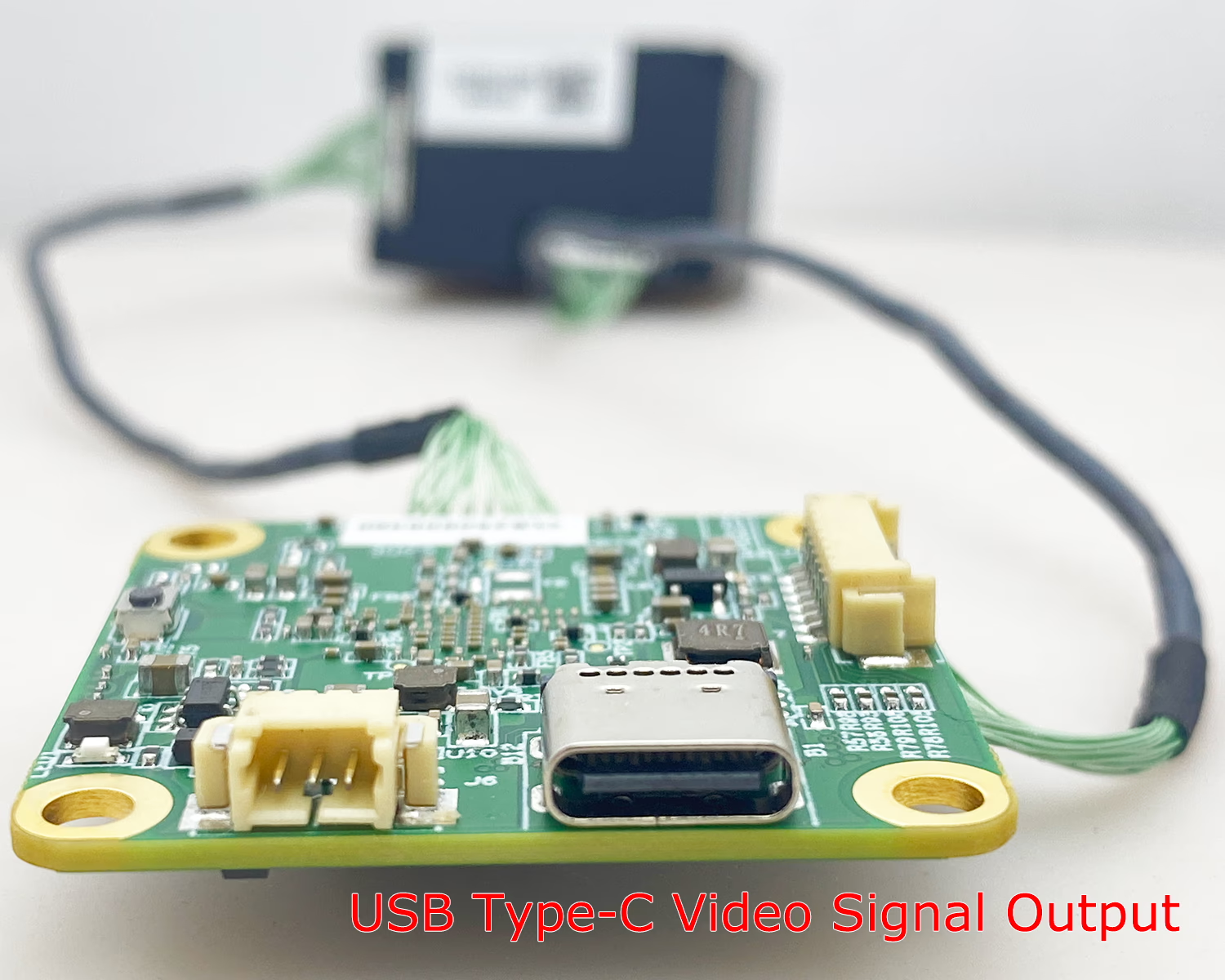
Yes, it has USB Type-C Video Signal Output to Raspberry Pi. To switch the video output, you can use UART commands to switch the output. It can be picture-in-picture, fusion, single visible light, single thermal imaging camera video. Our AI board can provide the target’s location information to the Raspberry Pi board. Our AI board can output the miss distance information of people and vehicles in visible light and thermal imaging modes to the Raspberry Pi board.

How a Dual Thermal Imaging & Daylight Camera with AI Target Tracking Board for FPV Works
fusion demo of thermal image visible light camera target tracking AI board for Betaflight FPV drone
From the above video, Physical display of dual-fusion camera module
1. Fusion mode: visible light and thermal imaging fusion (picture in picture)
2. Visible light mode
3. Thermal imaging mode
4. Al target recognition
Dual light fusion mode, visible light mode, thermal imaging mode, and AI recognition mode can be switched!
Q52: If we connect your camera module to a SpeedyBee F405 flight controller running Betaflight, does the camera module communicate with the flight controller via UART using the MSP protocol? Can we use your camera module to control the SpeedyBee F405 flight controller?
QA: Yes. Our camera module supports communication with the SpeedyBee F405 flight controller through a UART interface using the MSP protocol. Once connected correctly, the camera module can control the Betaflight-based SpeedyBee F405 without any issues.




iVcan.com –
I have been using the Visible-Thermal Fusion Dual Cam Module on my FPV racing drone for several weeks, and it has completely exceeded my expectations. The dual-light fusion imaging provides incredibly clear visuals both during the day and at night, while the AI-powered target recognition accurately tracks multiple moving objects in real time. Its ultra-low latency ensures smooth, responsive control, and the compact, lightweight design makes installation effortless. The electronic image stabilization keeps footage steady even in high-speed maneuvers, making it perfect for drone racing, outdoor exploration, and autonomous navigation. Overall, this module has significantly enhanced my flying experience and mission efficiency.