






Table of Contents
Do you have a video transmitter and receiver support distance of 10km LOS, a Bitrate of 10Mbps? Ethernet SBUS and Uart ports, 2.4Ghz or 5.8Ghz?
For the distance of 10km, the bitrate can not reach 10Mbps, only 5~6Mbps.
The full-duplex function is OFDM, which supports downloading video from the transmitter to the receiver, also supports uploading data to the transmitter from the receiver, for example, PTZ control signal to adjust camera view angle via the joystick.
The half-duplex function is COFDM: only download video from transmitter to the receiver. It can not upload the data to the drone transmitter from the receiver.
Video Transmitter and Receiver Supporting 10km LOS with Ethernet, SBUS, and UART Ports
If you are looking for a wireless video transmission system that supports a distance of up to 10 kilometers line-of-sight (LOS) with integrated data ports such as Ethernet, SBUS, and UART, there are a few technical considerations to understand before selecting the right equipment. Wireless video transmission over long distances involves a trade-off between bitrate, frequency band, modulation type, and latency.
For example, while a 10km LOS distance is achievable with both 2.4GHz and 5.8GHz wireless links, the bitrate is limited at this distance. In practical deployment scenarios, the maximum achievable data rate for 10km LOS is typically 5 to 6Mbps, rather than the 10Mbps requested. This limitation is due to the effects of free-space path loss, environmental interference, and regulatory transmission power restrictions. Attempting to push 10Mbps over such long distances could result in unstable transmission, frequent packet loss, or reduced image quality. Therefore, system designers often recommend bitrate optimization to ensure a stable and reliable connection, even if the peak theoretical speed is higher.
Full-Duplex vs Half-Duplex Wireless Transmission
When choosing a video transmitter and receiver, one of the critical decisions is whether to use full-duplex or half-duplex transmission. Both systems employ COFDM or OFDM modulation, which provides robust, long-distance performance, even in challenging environments.
Full-Duplex Function:
A full-duplex system allows two-way communication between the transmitter and receiver simultaneously. This is especially useful for applications like drone operation, PTZ camera control, or remote robotic control, where video needs to be downloaded from the transmitter to the receiver, while control data (such as camera pan, tilt, zoom commands) is uploaded from the receiver to the transmitter. Full-duplex systems use OFDM (Orthogonal Frequency Division Multiplexing), which splits the data into multiple subcarriers, allowing simultaneous transmission in both directions with minimal interference.
In practical terms, this means that the operator can:
- View live video from the UAV, drone, or remote camera in real-time.
- Send control signals back to the transmitter, such as adjusting the camera angle via PTZ commands, controlling robotic movements, or modifying flight parameters through SBUS or UART interfaces.
- Use multiple data interfaces such as Ethernet for network communication, UART for serial data telemetry, and SBUS for remote control signals, all while maintaining a stable video stream.
Full-duplex systems are ideal for professional UAV operations, robotics, industrial monitoring, and security applications because they allow continuous two-way communication with low latency and high reliability.
Half-Duplex Function:
In contrast, a half-duplex system only allows one-way communication from the transmitter to the receiver. This mode is also based on COFDM (Coded Orthogonal Frequency Division Multiplexing), which ensures robust video downlink performance even in non-line-of-sight (NLOS) scenarios.
Half-duplex COFDM systems are suitable when:
- Only video and audio download from the transmitter to the receiver is required.
- No control commands or data upload to the transmitter are needed.
- Cost and simplicity are important considerations, as half-duplex modules tend to be cheaper and easier to deploy than full-duplex systems.
For example, in a CCTV security camera application or a simple point-to-point video link, half-duplex transmission provides reliable real-time video streaming without the complexity of two-way communication. However, it cannot support sending control data such as PTZ camera commands or flight telemetry back to the transmitter.
Frequency Band Considerations
For long-range wireless video transmission, the choice of frequency band is critical:
- 2.4GHz Band:
- Advantages: Better penetration through obstacles such as trees, buildings, and walls; lower free-space path loss over long distances; widely available compatible hardware.
- Disadvantages: More crowded spectrum, potential interference from Wi-Fi, Bluetooth, and other consumer devices.
- 5.8GHz Band:
- Advantages: Higher available bandwidth, less interference from consumer devices, potentially lower latency.
- Disadvantages: Reduced penetration through obstacles; more affected by rain or foliage; slightly shorter range than 2.4GHz under NLOS conditions.
Selecting the frequency band depends on your operating environment, the presence of obstacles, and interference sources. Some modern systems allow adjustable frequencies or auto-frequency selection to avoid local interference and optimize signal quality.
Ports and Interfaces
The ideal transmitter and receiver system for UAVs, drones, or industrial applications should include multiple interfaces:
- Ethernet Port: For IP camera integration, network telemetry, or connection to an NVR (Network Video Recorder).
- SBUS Port: To control UAV flight parameters or other remote-controlled devices.
- UART Port: For serial communication, telemetry, or integration with additional sensors or controllers.
These interfaces allow the module to act as a flexible video and data transceiver, capable of supporting both video streaming and command/control signals over the same wireless link.
In conclusion, while achieving a 10km LOS distance with a 10Mbps bitrate may not be feasible due to physical limitations, it is possible to implement a stable 5–6Mbps link with either full-duplex OFDM or half-duplex COFDM. Full-duplex systems provide two-way video and control communication, suitable for UAVs, PTZ cameras, and robotics, while half-duplex systems provide reliable one-way video transmission suitable for security cameras and point-to-point video links. Choosing the correct frequency band, modulation type, and interface options ensures optimal performance for your specific application.
-
 Best FPV Video Transmitter Module 170-860Mhz Wireless RF audio video Transmitter for FPV Camera 3W PA 50km
 -
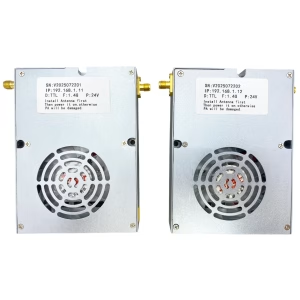 drone swarm mesh network 100km 60Mbps radio link 4-nodes 2X frequency hopping 2X 5-watt power amplifier
 -
 IP Mesh 100Mbps wireless video data transceiver 2X5W PA 16 hop
 -
 Drone Link for long-range Video Data Radio Telemetry Wireless transmission between UAV and Ground Control Station
 -
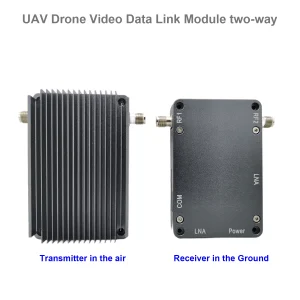 UAV drone video data link module wireless video transmitter and receiver for camera long-range TDD transceiver two-way vcan1401
 -
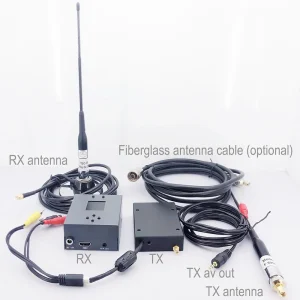 COFDM video transmitter-receiver AV in HDMI out FPV, Wireless 10km-15km-30km long-range cheaper and longer COFDM-912T
 -
 1740-1840Mhz 2WPA 30KM long range drone video transmitter and receiver with Sbus TTL
 -
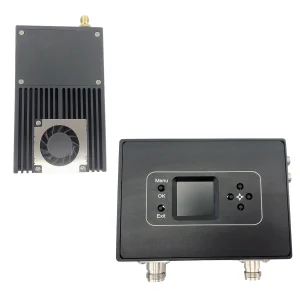 30Km long distance COFDM HDMI Wireless Video Transmitter Receiver full Set Audio Video TX RX for UAV Drone 1080P 908T
 -
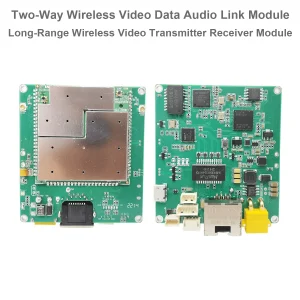 Two-way UAV Wireless Video Data RC Control Link module long-range bidirectional transceiver Transmitter-Receiver Vcan1681
 -
 long range wireless video data transmitter and receiver for drone UAV robot
 -
 Wireless Video Transmitter and Receiver for Camera, HDMI HD H265 264 encoder 1W/2.5W PA 1080P60 Vcan1726
 -
 22km 55km 80km 100km 150km long-distance wireless video transmitter receiver transmission transceiver PA 2W 5W 10W
 -
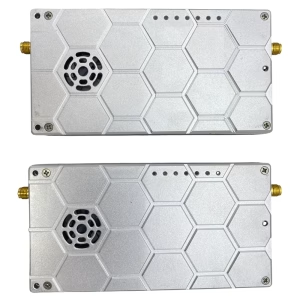 drone video data telemetry transmitter-receiver UAV radio link tdd transceiver
 -
 10W PA 150KM airborne video data link long-range UAV wireless transmission transmitter receiver broadband tactical handhold
 -
 30-millisecond Drone UAV HDMI Wireless video transmitter Ultra-low-latency wireless transmission system Vcan1729
 -
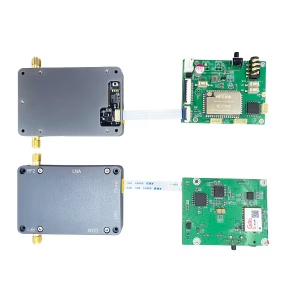 ip mesh MANET transceiver with bidirectional audio-IP board for robot UAV Drone
 -
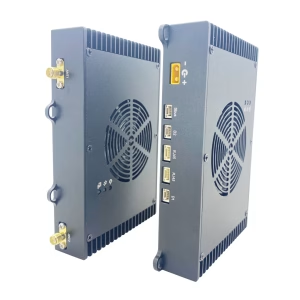 150km 100Mpbs frequency hopping at 2bands UAV radio link high transmission rate and anti-interference
 -
 Drone mesh wireless video data link 150-200km longe-range centerless ad hoc network transceiver
Ask A Question
Thank you for your response. ✨