






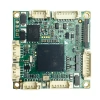
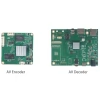
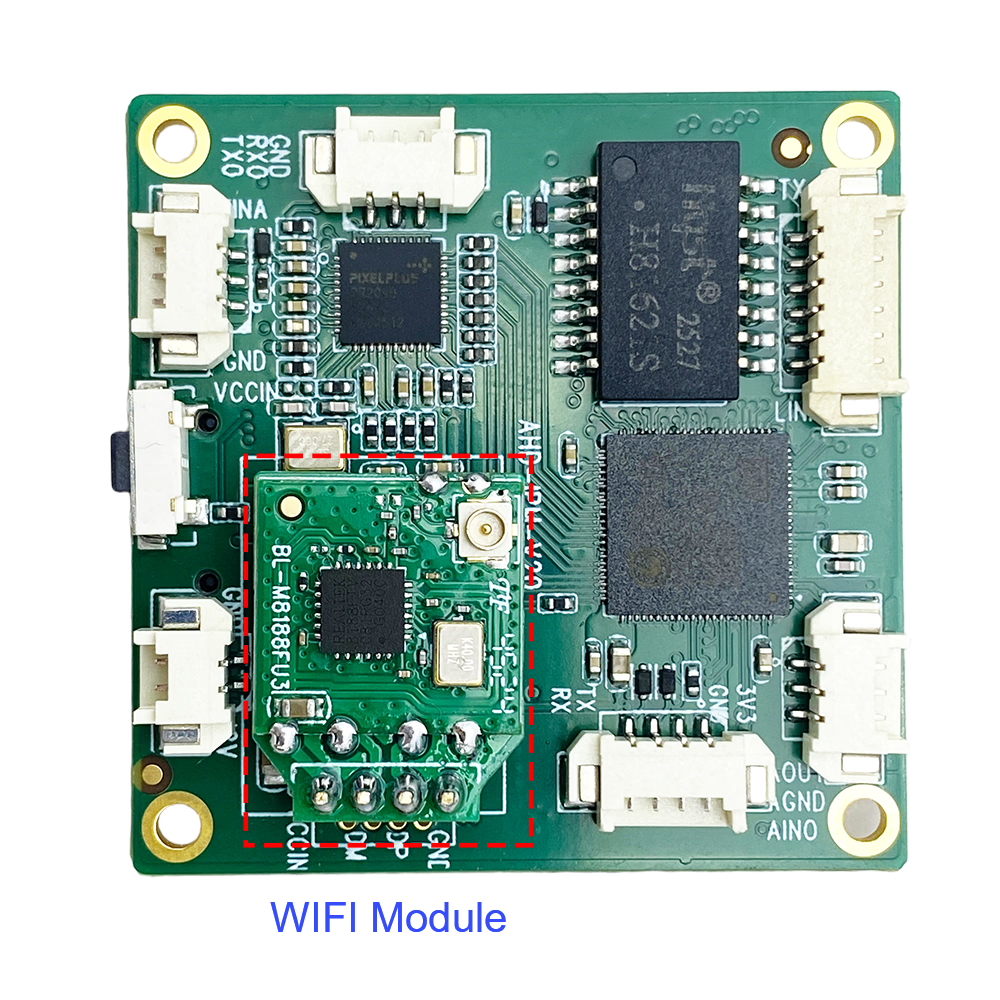
CVBS AV Analog to IP Ethernet Video Encoder Wi-Fi Module
Convert Analog CVBS/AV Video to IP Stream with Built-in Wi-Fi Transmission — Lightweight, Low-Latency, Ideal for Drone FPV and Industrial Applications
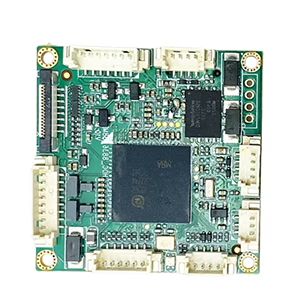
Upgrade your analog video systems to IP streaming with our compact CVBS AV Analog Video Encoder + Wi-Fi Module, designed for real-time encoding and wireless video transmission. Whether you’re working on drone FPV systems, vehicle monitoring, IoT devices, or analog CCTV upgrades, this solution provides H.265 ultra-low bitrate encoding, Wi-Fi connectivity, and ONVIF/RTSP compatibility — all in a 9.5-gram, 38×38mm board.
This board transforms legacy CVBS or AV analog video signals into high-quality IP network streams. With optional Wi-Fi or 4G modules, it can stream video wirelessly over LAN, WAN, or mobile networks. Ideal for developers and system integrators who need compact, efficient, and flexible analog-to-IP conversion.
Table of Contents
Overview
The CVBS AV Analog Video Encoder + Wi-Fi Module is a real-time H.265/H.264 encoding board that converts analog CVBS video input into IP video streams and transmits them over Ethernet or Wi-Fi. It is specially optimized for drone FPV transmission, mobile video surveillance, industrial monitoring, and IoT video networking.
With its lightweight PCB design (only 9.5g) and low power consumption, it’s ideal for airborne or embedded environments where space and weight are critical. It features a powerful SSC335 main control chip and PR2000K video capture processor, offering 1080p@30fps encoding with bitrates adjustable from 0.1Mbps to 8Mbps.
The encoder supports RTSP, ONVIF, UDP multicast, and WebRTC protocols for flexible integration with NVRs, PCs, or mobile devices. With the Wi-Fi module expansion, it can stream video wirelessly without the need for an Ethernet cable — perfect for portable or aerial systems.
Key Features
-
CVBS AV Analog Video Input
Compatible with standard composite analog signals (PAL/NTSC), auto-detecting video format. -
Real-Time IP Video Conversion
Converts analog video to IP network streams instantly with minimal latency. -
Supports H.265/H.264 Encoding
High-efficiency video compression reduces bandwidth while maintaining image quality. -
Wi-Fi Wireless Transmission
Integrated or optional 2.4GHz Wi-Fi module supports RTSP, UDP, and ONVIF streaming without cables. -
Ultra-Light and Compact
PCB measures only 38.8×38.8mm and weighs 9.5 grams, perfect for drones and embedded systems. -
High Resolution Output
Supports Full HD 1920×1080@30fps, 1280×720@30fps, and D1/VGA sub-streams. -
ONVIF & RTSP Compatible
Easily connects with NVRs, VMS platforms, and third-party IP camera software. -
Two-Way Audio Intercom
Built-in MIC input and LINE_OUT with G.711/AAC encoding. -
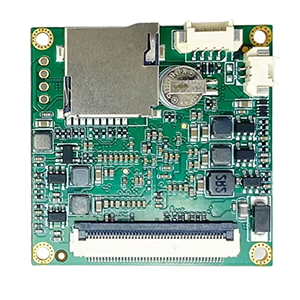
TF Card Recording
Supports local recording up to 256GB for standalone operation. -
Multi-Protocol Support
RTSP / RTMP / UDP / HTTP / MQTT / WebRTC / GB28181 supported. -
Dual Stream Output
Main stream (Full HD) and sub-stream (VGA/D1) for different viewing devices. -
Open SDK for Developers
Provides secondary development SDK for customized applications. -
Wide Power Range
Operates on DC 6V–24V, optional PoE support. -
Industrial Reliability
Designed for -20°C~+70°C environments with anti-static and lightning protection.
Specification
| Item | Description |
|---|---|
| Main Processor | SSC335 industrial-grade SoC |
| Video Capture Chip | PR2000K (AHD/TVI/CVBS compatible) |
| Video Input | 1 × CVBS AV composite input (2-pin or 3-pin header) |
| Video Output | IP stream over Ethernet (RJ45) or Wi-Fi |
| Encoding Format | H.264 / H.265 / MJPEG |
| Resolution | 1920×1080@30fps, 1280×720@30fps, 720×576@25fps |
| Bitrate | Adjustable 0.1Mbps – 8Mbps |
| Frame Rate | Adjustable 1 – 30fps |
| Audio Input/Output | 1 × MIC input, 1 × LINE_OUT |
| Audio Codec | G.711 / AAC |
| Network Interface | 1 × RJ45 (10/100M adaptive) |
| Wi-Fi Module | Optional USB 2.4GHz module, supports RTSP/ONVIF/UDP |
| Protocols Supported | RTSP, RTMP, HTTP, UDP, TCP/IP, ONVIF, MQTT, GB28181, WebRTC |
| Recording | TF card (up to 256GB) |
| Serial Interface | 1 × TTL UART port for data transmission / IoT control |
| Power Supply | DC 6–24V input (PoE optional) |
| Operating Temperature | -20°C to +70°C |
| Dimensions | 38.8 × 38.8 mm |
| Weight | 9.5 g |
| Reset | 1 × hardware reset button |
| Default IP | 192.168.1.188 |
| Cooling | Passive, no fan required |
Connection
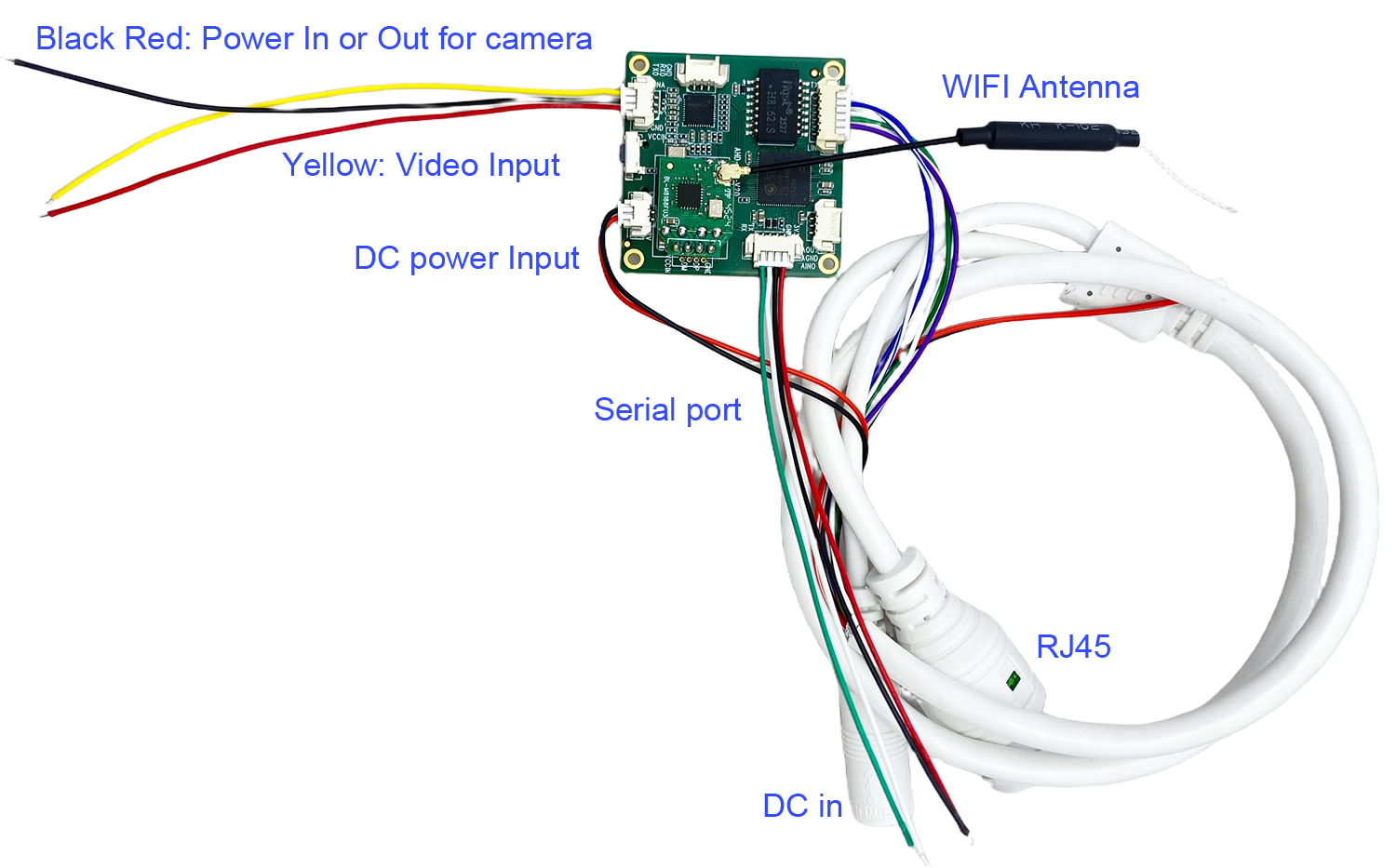
Wi-Fi Module Expansion
The integrated or optional Wi-Fi module enables wireless video streaming without relying on Ethernet cables.
-
Supports 2.4GHz Wi-Fi transmission
-
Supports RTSP, UDP, and ONVIF streaming protocols
-
Range: up to 50–100 meters (depending on antenna and environment)
-
Antenna: external SMA or PCB antenna
-
Optional 4G SIM + GPS module for mobile applications
-
USB interface expansion for plug-and-play connectivity
This feature is ideal for drone FPV video, vehicle surveillance, and portable monitoring systems where wired connections are impractical.
Applications
1. Drone FPV and UAV Systems
Convert analog FPV camera video into IP streams and transmit over Wi-Fi or 4G.
Use for long-range drone telemetry, ground station display, or network-based video relay.
2. Wireless Video Transmission
Send CVBS/AV video signals wirelessly via Wi-Fi to PC, mobile phone, or NVR in real-time.
3. Analog CCTV Upgrade
Modernize existing analog CCTV systems by converting old CVBS cameras into IP cameras with ONVIF support.
4. Vehicle Monitoring
Install on vehicles for front/rear camera transmission, integrating with Wi-Fi routers or mobile networks.
5. Industrial and IoT Applications
Monitor industrial processes, sensors, or robotic arms. Use TTL port and MQTT protocol for IoT device integration.
6. Broadcasting and Live Streaming
Connect analog video sources (mixers, camcorders) to RTMP servers for live streaming over Wi-Fi or LAN.
7. Medical and Educational Systems
Stream analog camera feeds from microscopes, endoscopes, or classroom systems directly to the network.
8. Smart Home Integration
Connect analog door cameras or intercoms to IP-based smart home control systems.
Customizable Options
1. Video Input / Output
-
CVBS, AHD, TVI inputs (auto-detect)
-
HDMI or SDI optional (custom models)
-
Output via Ethernet, Wi-Fi, or 4G
-
Dual-stream output supported
2. Network & Protocol
-
RTSP / RTMP / HTTP / UDP / ONVIF / WebRTC / GB28181
-
Static IP or DHCP configuration
-
Adjustable bitrate and frame rate
-
UDP multicast and unicast support
3. Hardware & Form Factor
-
Custom PCB size and connector layout
-
Optional shielding or metal enclosure
-
2-pin or 3-pin CVBS video input
-
Optional GPS tracking board
4. Functional Features
-
OSD overlay (time, text, logo) [Supported. OSD functions can be implemented.]
-
Motion and human detection
-
Audio intercom and alarm trigger [Supported. GPIO-triggered alarm input and recording can be implemented.]
-
SDK for integration with external systems
-
Firmware upgrade via web interface [Supported. The device can be upgraded via the local network (LAN upgrade)]
5. Power and Environment
-
DC 6–24V wide voltage support
-
PoE power input optional
-
Industrial-grade design: -20°C~+70°C
-
Optional weatherproof casing for outdoor use
Connection Guide
1. Connect the CVBS Video Input
Use either the 2-pin or 3-pin video connector (only one required).
2. Power Supply
Connect DC 6–24V to the power pins (reverse-polarity protected).
3. Network Setup
Connect via Ethernet cable or enable Wi-Fi through web interface.
4. Streaming Access
Open RTSP stream in VLC or compatible software using:rtsp://192.168.1.188:554/stream1
5. Multicast Setup (Optional)
Enable UDP multicast for broadcasting to multiple clients simultaneously.
6. Reset
If the IP or video format is changed, press reset or power cycle to re-detect input.
FAQ
Q: Is it possible to have a digital zoom function in this encoder?
A: No, our CVBS to Ethernet IP encoder does not support a digital zoom function. This device is designed to convert analog CVBS video signals into Ethernet (RTSP) streams. It does not process or modify the video content itself.
Digital zoom is typically a function of the camera or the video management software (VMS), not the encoder. Therefore, if digital zoom is required, it should be implemented at the camera side or within the software used to view the video stream.
Q: Can you provide the serial port (UART) commands available for IoT?
A: Our encoder board supports UART (serial port) data transmission, but it works in a transparent pass-through mode.This means the encoder does not define or generate specific UART commands itself. Instead, it simply transfers serial data between devices over the network.
The actual UART command set depends on your camera or connected device. If your camera supports serial control, those commands can be transmitted through our encoder without modification.
For example, some of our thermal imaging cameras support UART commands to adjust settings such as color palettes and zoom in levels. You can refer to this example for more details: https://ivcan.com/how-to-modify-color-zoom-of-fpv-thermal-imaging-camera
Q: Why did the image become black and white during testing, but return to color after rebooting?
A: If the video source or camera is changed during operation, the encoder may need to restart in order to correctly detect and initialize the new video source. During this process, the image may temporarily appear in black and white. After rebooting or restarting the encoder, the system re-detects the video source and the color image should return to normal.
Q: I’m looking for a composite AV (CVBS) to IP video converter with 4G SIM, WiFi, and GPS support. I need a P2P video transmitter for a CVBS camera that can create a WiFi hotspot for connection with a Windows tablet. Does it support RTSP streaming? Can I connect using VLC player?
A: Yes. Our CVBS-to-IP video encoder board supports an optional WiFi module that can be configured for P2P server functionality. The device also supports RTSP video streaming, allowing remote video access through a standard network connection. You can connect and view the video stream using VLC Media Player or other compatible RTSP clients on a Windows tablet or PC.
Q: What is the function of the red and black wires next to the video input cable?
A: The red and black wires are used for DC 5V–12V power input or output. When the encoder board is powered through the DC red/black power wires, the 3Pin wires can also provide power output to an external camera. This allows the encoder board and camera to share a single power source, simplifying the wiring and installation. Red wire: Positive (+) power, Black wire: Ground (GND).
Q: What does the button on the analog video-to-network video streaming encoder board do?
A: The button is a configuration reset button. If many settings have been changed and you want to restore the original factory configuration, you can press this button to reset the device to its factory default settings. This function is useful for troubleshooting, reconfiguration, or recovering from incorrect parameter settings.
Q: What is the default WiFi password for the CVBS-over-IP encoder board, and what is the RTSP video stream URL?
A: The default WiFi password is: 88888888. The default RTSP video stream URL is: rtsp://192.168.1.188:554/0. You can open the RTSP stream using VLC Media Player or any other compatible RTSP client on your PC, tablet, or mobile device.
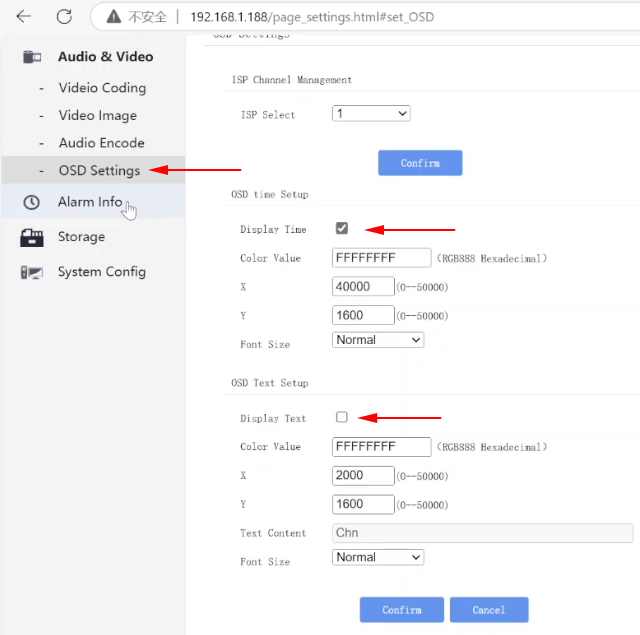
Q: Can I remove the timestamp from the video? Can I add custom text or OSD information?
A:Yes. The encoder board supports both timestamp display control and custom OSD (On-Screen Display) text settings. You can configure these options from the web configuration page: Web Page Settings → Audio Video Setting → OSD Setting

Q: What are the default login credentials for the encoder board web configuration page?
A: The default login credentials are: Username: admin Password: admin You can use these credentials to access the encoder board’s web configuration interface through a web browser.
Q: What connector type does the encoder board use, and what are its power consumption specifications?
A: The encoder board uses the following specifications:
- Connector type: JST-GH 1.25mm
- Wire current capacity: Approximately 100–150 mA
- Recommended power supply: 12V / 1A DC
- Encoder board power consumption: Approximately 2W
Q: I would like to control the on-screen display (OSD), including text position, color, and content, via UART or HTTP API. Could you provide the OSD command reference or API documentation?
A:Yes. The OSD control functions (including text content, position, color, size, and transparency) are supported through the device’s JSON-based control protocol.Please refer to the official documentation: Video Encoder Board TCP JSON Protocol RTSP API Guide
This guide includes detailed API references for: OSD text configuration (enable/disable, content editing), OSD position control (X/Y coordinates), Font size and style settings, Text and background color configuration (ARGB format), Multiple OSD text layers support, TCP/JSON command structure for remote control. If you are using UART or HTTP interface, the same JSON command structure can generally be reused depending on your integration method.
Q: How can I log in to the encoder at 192.168.1.188 and the router at 192.168.1.1?
A: You can access the device settings through a web browser using either a wired connection or WiFi hotspot mode.
Method 1: Wired Connection (Recommended)
- Connect your computer to the encoder board using an Ethernet cable.
- Ensure your PC is on the same network segment (e.g., 192.168.1.x).
- Open a web browser and enter the encoder IP address:http://192.168.1.188
- Log in to access the WEB configuration page.
Method 2: WiFi AP Hotspot Mode
- Connect your computer or tablet to the encoder’s WiFi hotspot (AP mode).
- Once connected, open a web browser.
- Enter the encoder IP address:http://192.168.1.188
- Access the WEB configuration interface.
Router Access (192.168.1.1)
If a router is part of the system, you can access it by connecting to the same network and entering: http://192.168.1.1 This allows you to configure network settings, WiFi parameters, and device routing options.
Q1. Does this board support both CVBS and AHD input?
Yes, but not simultaneously. You must power off and restart when switching input formats.
Q2. Can I stream video wirelessly without Ethernet?
Yes, the Wi-Fi module supports RTSP, ONVIF, and UDP streaming wirelessly.
Q3. What’s the default IP address?
192.168.1.188 — if forgotten, use the IP Search Tool to rediscover the device.
Q4. What is the latency performance?
Latency is typically below 120ms on Ethernet and 150–200ms over Wi-Fi (depends on network conditions).
Q5. Can I connect multiple devices on the same network?
Yes. Each board can be configured with a unique IP address.
Q6. Is it compatible with NVR or VMS software?
Yes. It supports ONVIF and RTSP, compatible with mainstream NVRs like Hikvision, Dahua, Blue Iris, and iSpy.
Q7. Can I use this with a drone analog FPV receiver?
Yes. The encoder converts FPV analog receiver output into digital IP stream for real-time display or transmission.
Q8. Does it support audio?
Yes. Supports MIC input, LINE_OUT, and two-way intercom via G.711/AAC.
Q9. What is the power consumption?
Typically 1.5–2.5W, depending on resolution and Wi-Fi module load.
Q10. Can I view the stream on my phone?
Yes, via RTSP-capable apps or using the provided Android App R380_1.1.3.
Q11. Does it support motion detection?
Yes, motion and sound detection are available with optional alert settings.
Q12. Is encryption available?
The stream itself is not encrypted, but protocols like WebRTC provide built-in secure transmission, and the web UI is password-protected.
Q13. Does it work with 5V battery power?
No. It requires 6–24VDC. 5V or 3.7V power is not supported directly without a boost converter.
Q14. Can I record video locally?
Yes, you can record on a TF card up to 256GB or stream to a network NVR.
Q15. Does it support SDK or customization?
Yes, SDK is available for developers for player-side secondary development.
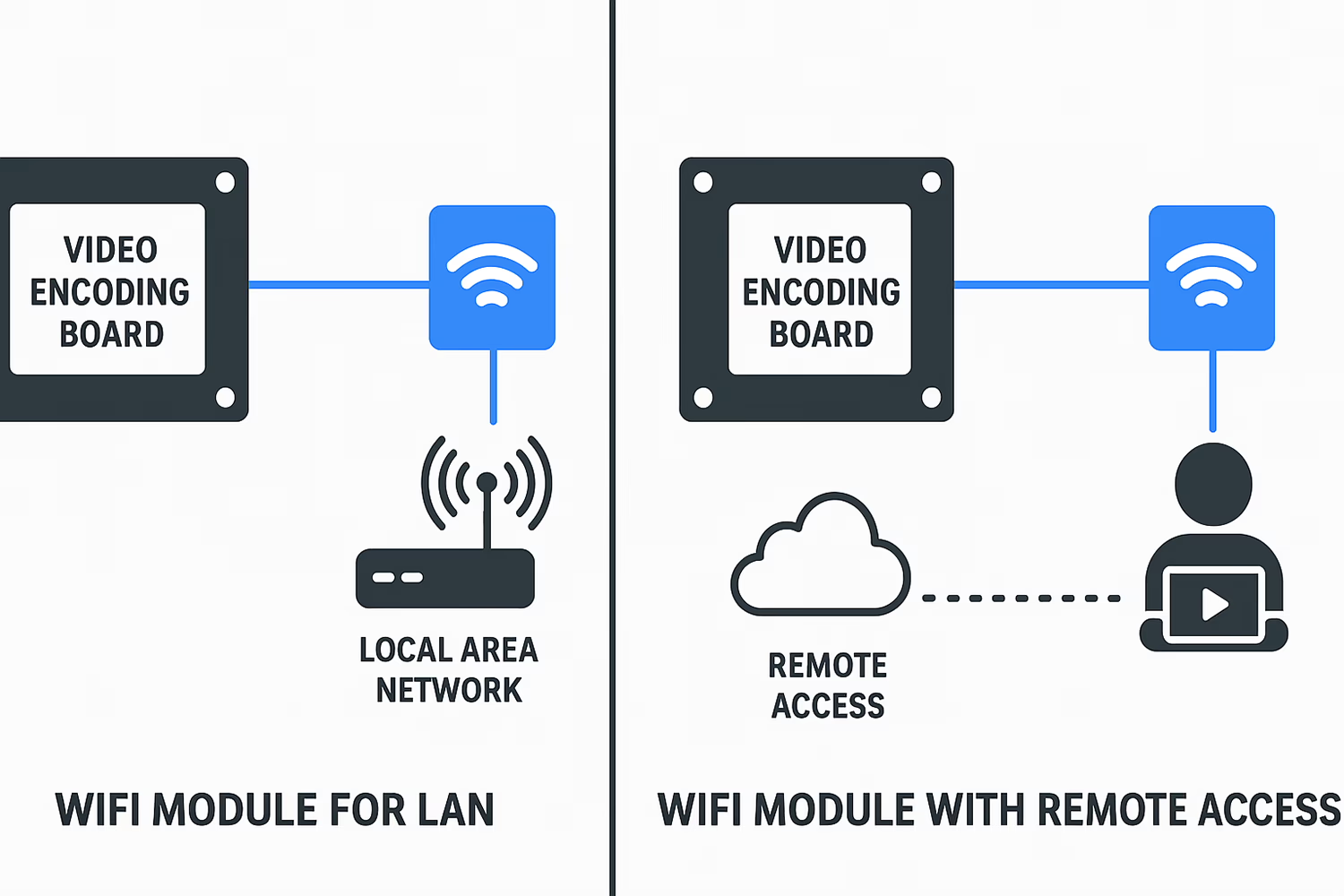
Q16. What is the difference between AP and STA modes in a Wi-Fi module?
AP vs STA Wi-Fi Mode on CVBS to IP Encoder Module
Q17: Does your video encoder board support the NDI protocol?
A: Thank you for your question. Could you please clarify what you mean by NDI protocol?
-
If you are referring to the functionality:
Our video encoder board does support high-quality, low-latency IP video transmission over a single Ethernet cable. It can send encoded video streams through standard network protocols, making it suitable for broadcasting, live streaming, and multi-camera production environments. -
If you are referring to official NDI® protocol licensing from NewTek:
At the moment, our product does not include official NDI® licensing. If your application specifically requires certified NDI / NDI|HX compatibility, please let us know—we can evaluate potential customization options.
Q18: Which millisecond-precision player or tool do you use to test the latency of the CVBS-to-Ethernet video encoder?
A: We use OnlyStopwatch to perform millisecond-level latency measurements.
It provides a clear, fast-refreshing timer display that allows us to accurately compare the time shown in the live video stream with the actual system time. This helps us evaluate end-to-end latency and verify the performance of the encoder under different configurations. Download OnlyStopWatch
Q19: I have enabled the motion detection settings, but recording does not start. Can I also receive notifications in the mobile app?
A: At the moment, the encoder does not support motion detection–triggered recording or alarm functions. Specifically:
-
Motion detection–based recording is not available
-
Motion detection alarms are not supported
-
Push notifications or alert messages in the mobile phone app are not supported
These functions have not yet been added to the encoder’s firmware/software. Currently, recording must be started manually or through other supported control methods.
Q20: Are the FTP settings shown in the system currently active?
A: No. The FTP configuration page is for reference only and is not active at the moment.
Q21: Will FTP upload work if I fill in the FTP server information?
A: No. In the current firmware version: FTP upload is not enabled. Snapshot or file upload via FTP will not take effect. The FTP settings page is reserved for future functionality.
Q22: Can I connect a USB flash drive in parallel?
A: Yes, the device supports recording to a USB flash drive (U-disk).
Q23: What is the pinout of the 4-contact connector?
A: The 4-pin connector has a 2.0 mm pitch. From top to bottom, the pins are:
-
GND
-
D+
-
D-
-
VCCIN / 12 VDC
Q24: Does this board support a battery to save settings when the power is turned off?
A: Yes. All settings on the board are saved automatically when power is lost. You can also use a 2–3 cell lithium battery to maintain the saved settings during power interruptions.
Q25: Will the USB interface support direct connection of a 4G module?
A: The board does support 4G modules, but only when using our compatible 4G module. Direct connection with other 4G modules is not supported.
Q26: Can you explain the LED light indications on the board?
A: The board has four LED indicators with the following functions:
-
First LED (Red, steady on): Power indicator.
-
Second LED: Function currently undefined; lights up when powered, then turns off.
-
Third LED (Blinking): Indicates the system is operating normally.
-
Fourth LED: Function currently undefined; lights up when powered and remains on.
Summary
The CVBS AV Analog Video Encoder + Wi-Fi Module is a powerful, ultra-compact solution that bridges traditional analog video systems with modern IP networks. Featuring H.265 encoding, dual-stream output, ONVIF/RTSP/UDP support, and wireless transmission, it’s ideal for drones, vehicles, surveillance systems, and IoT video applications.
Whether you’re building a portable FPV system, retrofitting legacy CCTV cameras, or developing custom embedded video devices, this board provides a reliable, low-latency, and developer-friendly platform for real-time analog-to-IP video transmission.
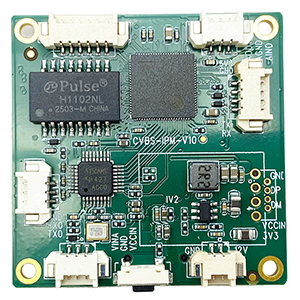
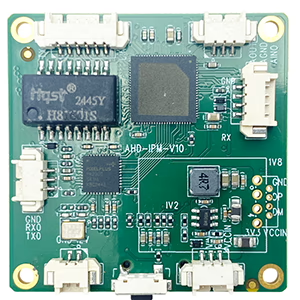
Encoder Modules Boards
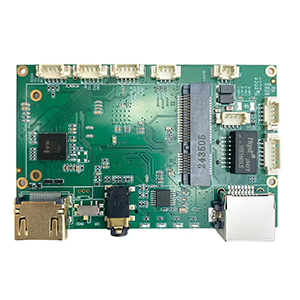
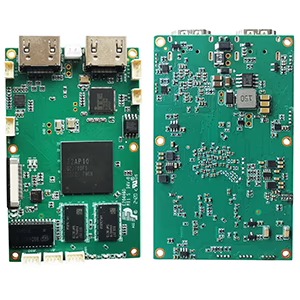
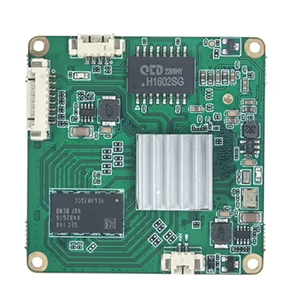
Decoder Modules Boards
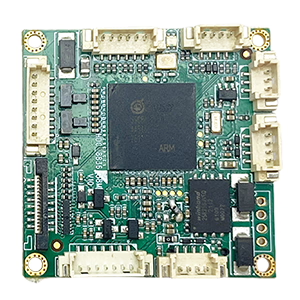
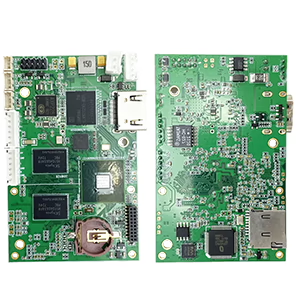
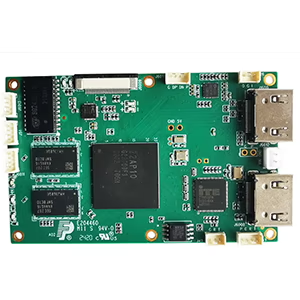
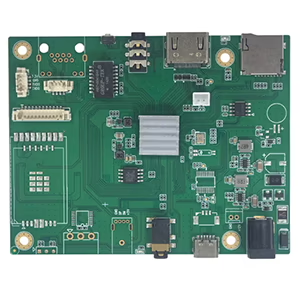
Available for Customization
New Encoder Products
| No. | Product Name | Configuration | Key Features | Status |
|---|---|---|---|---|
| 1 | Dual-Channel USB UVC Visible Light Video Encoder | 2× USB input | Supports dual USB camera video encoding, and RTSP streaming; local CVBS/HDMI output; switchable display modes | Mass Production |
| 2 | Dual-Channel Encoder (1× USB Visible Light + 1× USB Thermal Imaging camera) | 2× USB input | Supports dual USB camera (visible + thermal) capture, encoding, and RTSP streaming; local CVBS/HDMI output; switchable display modes | Mass Production |
| 3 | RTSP Decoder HDMI/CVBS Display Module | HDMI + CVBS output | Supports up to 4×1080P@30fps RTSP stream decoding; Support video streaming protocol forwarding; HDMI/CVBS output display | Sample Available |
| 4 | RTSP Decoder HDMI/CVBS Display Module with 4.3"/5" LCD | HDMI output + LCD screen | Supports up to 4×1080P@30fps RTSP stream decoding; protocol forwarding; HDMI/CVBS output display | Debugging |
| 5 | Dual-Channel Encoder (1× USB Visible Light + 1× CVBS Analog) | 1× CVBS + 1× USB UVC input | Dual video (USB + CVBS), encoding and RTSP streaming; local CVBS/HDMI output; switchable display modes | Debugging |
| 6 | Dual-Channel Encoder (1× USB UVC + 1× AHD Analog) | 1× AHD + 1× USB UVC input | Dual video capture (USB + AHD), encoding and RTSP streaming; local CVBS/HDMI output; switchable display modes | Debugging |
| 7 | Dual-Channel Encoder (1× CVBS + 1× AHD Analog Video) | CVBS + AHD 2 video input | Dual analog video capture, encoding and RTSP streaming; local CVBS/HDMI output; switchable display modes | Debugging |
| 8 | Dual-Channel Encoder (1× CMOS Camera + 1× USB Thermal Imaging camera) | 1× USB interface | Supports CMOS + USB thermal camera capture, encoding and RTSP streaming; local CVBS/HDMI output; switchable display modes | Mass Production |
For customized video input/output conversion solutions not listed in our products, please contact us for OEM/ODM support. We can develop tailored products based on your requirements.


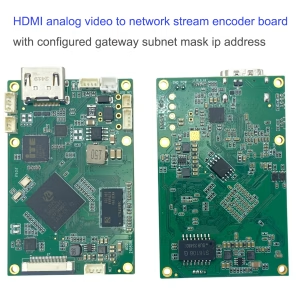


iVcan.com –
This is Madhusoodan. We are looking for a compact, lightweight CVBS/HDMI to IP/Ethernet/LAN Encoder PCBA with recording feature. We understand that iVcan has such encoders, so please suggest the suitable encoder PCBA for the below mentioned requirements. Please share the datasheet/specifications of the same. IP Encoder Requirements: Input channel: CVBS or HDMI (v1.4 or higher) Input Video Resolution: 640 x 480 Output channel: Ethernet/LAN 100 Base-T min. Output Protocols: srt/utp/http/rtsp/rtmp/udp/onvif/tcp/ip etc Compression standard: H.264/H.265 Recording Feature: Yes Temperature grade: Industrial Grade Dimension and Weight: As low as possible Appreciate your quick response. Warm Regards, Madhusoodan