






In modern defense, emergency response, and commercial operations, reliable communication is the backbone of success. Whether coordinating drone swarms, enabling unmanned ground vehicles, or supporting disaster relief teams, maintaining a robust, adaptable network is essential. One technology has proven uniquely suited to this challenge: MANET radios.
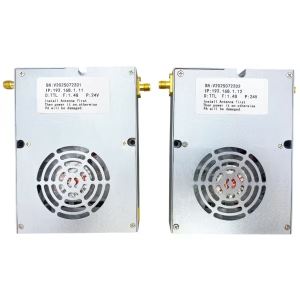
Wireless Video Transmission

Wireless Video Transmission
IP Mesh 100Mbps wireless video data transceiver 2X5W PA 16 hop
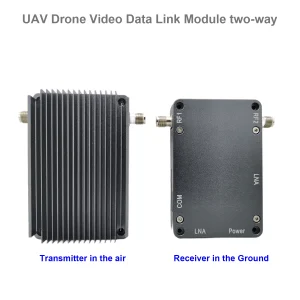

Bidirectional Two-Ways
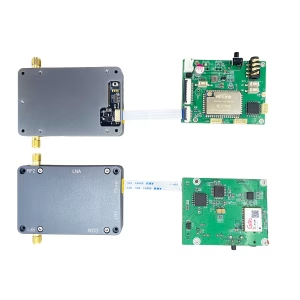
Wireless Video Transmission
ip mesh MANET transceiver with bidirectional audio-IP board for robot UAV Drone
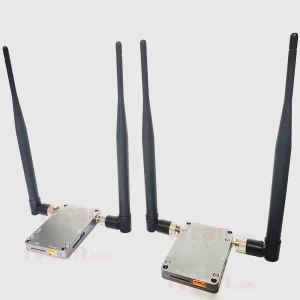
Video Transmitter

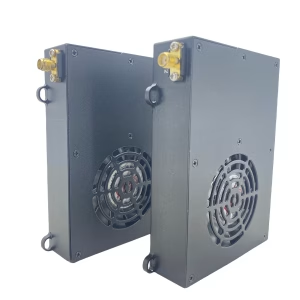
Wireless Video Transmission
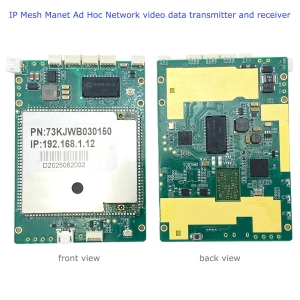

Wireless Video Transmission
Mesh 2X 10 watts Power Amplifier 250km drone video data link long Range UAV Transmitter and Receiver


Wireless Video Transmission
2x20W PA IP mesh drone video data transmitter and receiver 260km
This article provides an in-depth look at MANET (Mobile Ad Hoc Network) technology, its advantages, and its applications in drones and unmanned systems. We’ll explore the fundamentals, practical use cases, and how tactical MANET radios keep missions connected under the most demanding conditions.
Understanding Mobile Ad Hoc Networks (MANET)
A Mobile Ad Hoc Network (MANET), sometimes also referred to as a Wireless Ad Hoc Network (WANET), is a type of decentralized wireless communication system. Unlike traditional networks, a MANET does not rely on fixed infrastructure such as routers, cellular towers, or base stations. Instead, each node in the network is capable of routing data and relaying messages to other nodes.
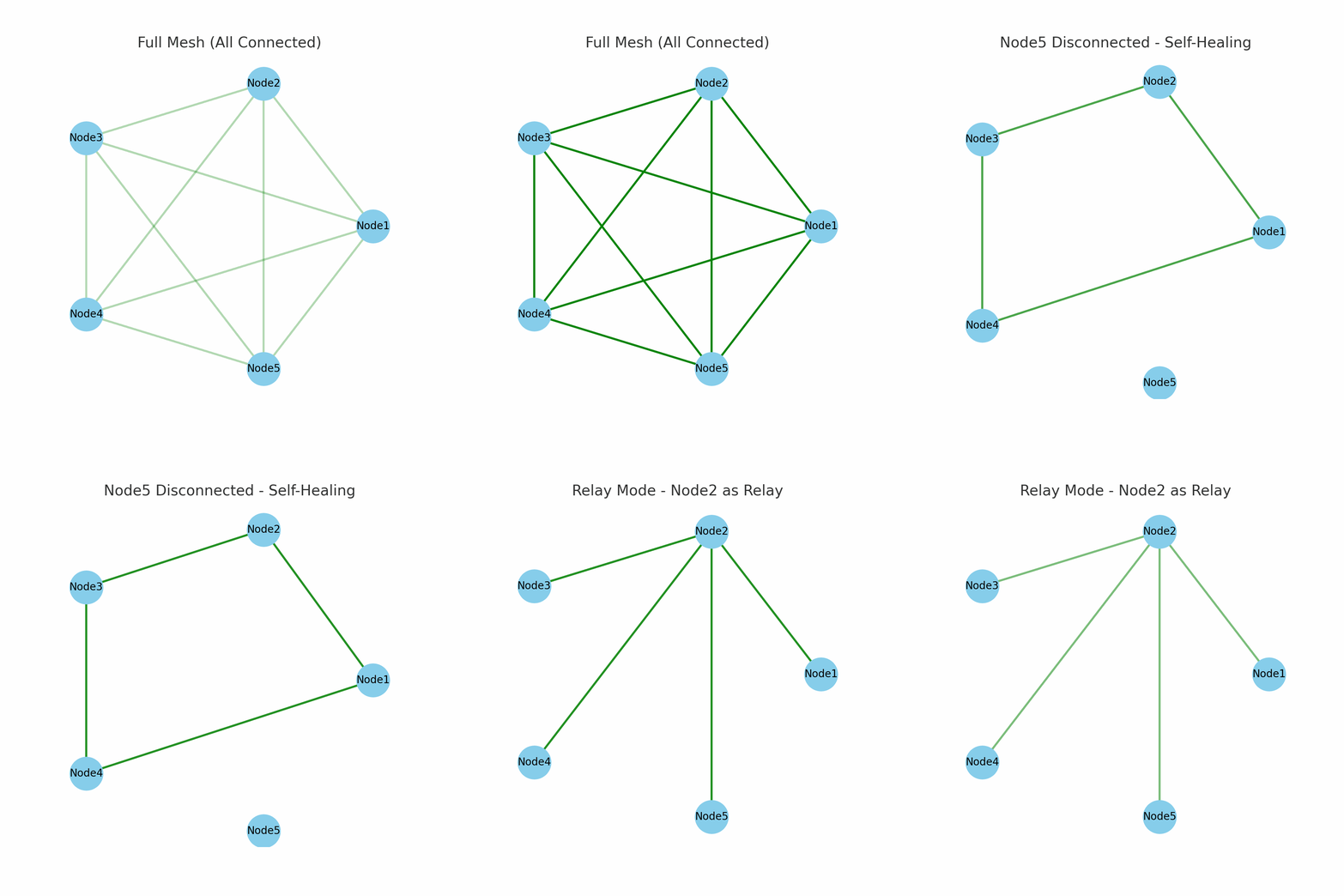
This architecture creates a system that is:
- Decentralized: No single point of failure exists, making the network more resilient.
- Self-configuring: New nodes can join automatically, and existing nodes can leave without disrupting overall connectivity.
- Self-healing: If one node fails, data is dynamically rerouted across alternative paths.
- Flexible: The network can be quickly deployed in locations where no infrastructure exists.
While MANETs can be connected to the internet, they are not dependent on it. This independence makes them particularly valuable in austere or denied environments where conventional communications may not be available.
How MANETs Work
Every node in a MANET—whether a soldier’s handheld radio, a drone, or a vehicle-mounted unit—acts as both a transmitter and a router. Routing algorithms continually evaluate available paths, ensuring the most efficient route is used to deliver information.
For example, if a drone in a fleet flies out of range of the ground control station, its data can hop from one nearby drone to another until it reaches its destination. This multi-hop communication allows MANETs to cover larger areas and maintain reliable connections without requiring line-of-sight between every node.
MANET Networks for Drones and UAVs
Unmanned systems—air, ground, and maritime—rely heavily on uninterrupted data links. MANET radios have become a game-changing technology for these platforms due to their:
- Ease of Setup: A MANET can be deployed on-demand, without prior network planning or physical infrastructure.
- Robustness: Nodes can move, be destroyed, or be added, and the network automatically adjusts.
- Versatility: MANETs can carry voice, video, telemetry, sensor data, and more.
Table of Contents
Integration with Drones
For UAVs, MANET networks enable real-time video streaming, command and control, and sensor sharing between aircraft and ground stations. They can also link with laptops, tablets, and smartphones, allowing field operators to access data on the go.
Some MANET systems are designed with transparent IP networking, meaning that any device with an Ethernet connection can be seamlessly integrated. This makes it easy to connect ground control software, situational awareness platforms, or even third-party mission systems.
Practical Applications of MANET Radios
The ability to create a network spontaneously, without fixed infrastructure, makes MANET radios indispensable in a wide range of scenarios:
1. Disaster Response
In the aftermath of earthquakes, hurricanes, or floods, conventional communication systems may be destroyed or unavailable. MANET radios allow emergency responders and drones to instantly form a communications network, enabling situational awareness, live video feeds, and coordination of rescue teams.
2. Battlefield Operations
In contested environments, forces cannot rely on civilian infrastructure. MANET networks allow soldiers, vehicles, and UAVs to maintain secure, redundant communications. If one unit is lost, the network quickly reorganizes to preserve connectivity.
3. Search and Rescue (SAR)
Drones equipped with thermal cameras and MANET radios can relay real-time imagery to ground teams searching for missing persons. Multiple drones can extend coverage over mountains, forests, or oceans, all connected through the same self-healing network.
4. Industrial and Commercial Use
Beyond defense, MANETs are finding applications in industrial inspections, mining operations, and oil and gas exploration, where connectivity is required in remote, infrastructure-free zones.
Tactical MANET Radios: Designed for the Toughest Environments
Not all MANET radios are equal. Systems designed for tactical or military applications incorporate advanced technologies that allow them to operate in harsh and contested conditions:
- Resilience Against Interference and Jamming
Advanced RF waveforms enable these radios to withstand intentional or unintentional interference, keeping communications intact even in hostile environments. - Non-Line-of-Sight (NLOS) Performance
Drones flying through urban areas or forests often encounter obstacles that block direct radio signals. Tactical MANET radios use adaptive waveforms and mesh networking to maintain links under NLOS conditions. - Flexible Bandwidth Options
Many radios allow users to select different channel bandwidths. Narrower channels may increase range, while wider channels provide higher data throughput. This flexibility lets operators balance range, data rate, and spectrum efficiency depending on mission needs. - Security Through Encryption
Given the sensitive nature of battlefield or emergency response data, most tactical MANET radios incorporate strong encryption standards. This ensures that video, telemetry, and voice communications remain confidential and protected from adversarial intrusion. - Scalability
Tactical MANET systems can support dozens—or even hundreds—of nodes without sacrificing performance, making them suitable for large-scale drone swarms or multi-unit operations.
Case Study: Unmanned Systems Working as a Team
Imagine a military operation where a fleet of UAVs, several unmanned ground vehicles, and a command center must coordinate in real time. MANET radios enable:
- UAVs to relay live video of enemy positions.
- Ground vehicles to transmit sensor data on terrain or chemical threats.
- Command units to receive and analyze information instantly, sending instructions back to field units.
If one UAV is lost, the network automatically reroutes communications through remaining assets. Tasks can be reassigned, and situational awareness continues without interruption.
This ability to self-heal and self-organize transforms a group of individual unmanned systems into a cohesive, resilient team.
The Future of MANET for Drones
As unmanned systems continue to evolve, MANET technology is expected to play an even greater role. Trends shaping the future include:
- Integration with 5G and Beyond: Combining MANET with next-generation cellular technologies may deliver unprecedented bandwidth and ultra-low latency.
- AI-Powered Routing: Machine learning could optimize routing decisions, improving efficiency and reducing latency under dynamic conditions.
- Miniaturization: Compact, lightweight MANET modules will make it easier to integrate radios into smaller UAVs and sensors.
- Hybrid Networks: Future systems may blend satellite, cellular, and MANET communications, ensuring coverage across any environment.
Conclusion
From disaster zones to battlefields, from industrial inspection sites to large-scale drone swarms, MANET radios are redefining connectivity for unmanned systems. Their decentralized, self-healing architecture provides unmatched resilience, while tactical variants ensure performance even under interference, jamming, or NLOS conditions.
For organizations deploying UAVs, UGVs, or USVs, adopting MANET technology means greater reliability, flexibility, and mission success. As the unmanned systems ecosystem grows more complex, MANET radios will remain at the heart of secure and adaptive communications.
Ask A Question
Thank you for your response. ✨