





RF Combiner vs. RF Multiplexer: Understanding the Difference in Multi-Channel RF Systems
In multi-channel RF communication systems, engineers often need to combine several RF channels into a single antenna path. Two common solutions are the RF Combiner and the RF Multiplexer. Although both devices can merge multiple RF signals, their operating principles, insertion losses, and system requirements are significantly different.
Understanding these differences is essential when designing DMR, TETRA, P25, railway communication, public safety radio, and industrial wireless systems.
Table of Contents
What Is an RF Combiner?
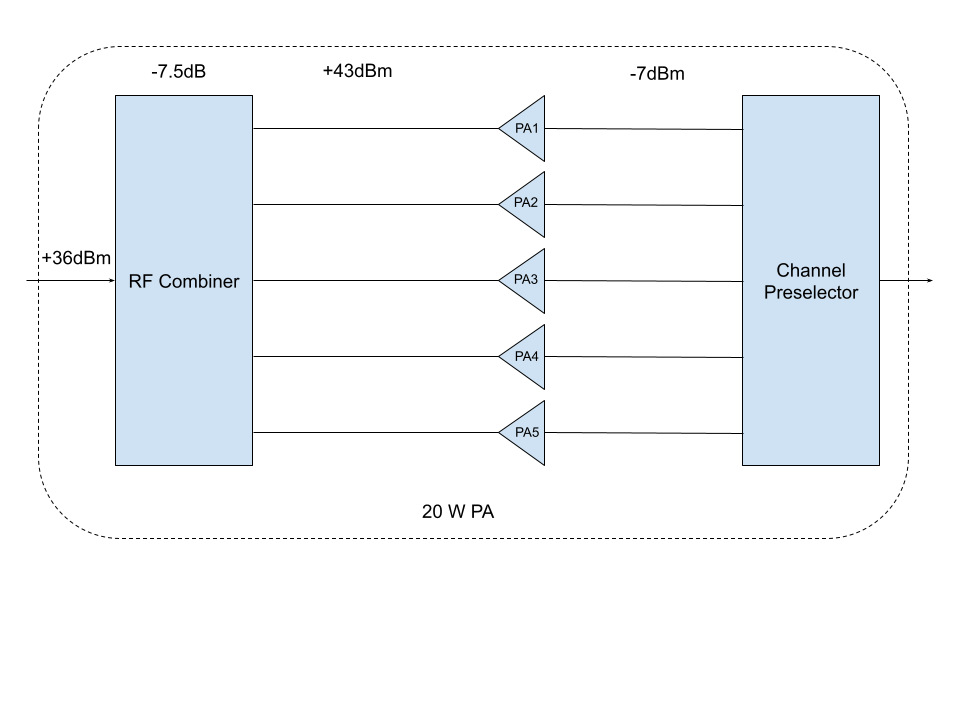
An RF Combiner is designed to merge the output power of multiple transmitters or power amplifiers into a common output port.
In a typical architecture:
- Multiple RF channels are amplified independently.
- The amplified signals are combined through a power combining network.
- The combined signal is fed to a shared antenna system.
Advantages
- Simpler architecture
- Compact design
- Suitable for broadband applications
- Lower initial hardware cost
Limitations
Because power combining is not frequency-selective, significant combining losses are unavoidable.
For example, a five-channel combiner may introduce approximately 7–8 dB of insertion loss. To compensate for this loss, each channel often requires a higher-power amplifier.
In many systems, a 20 W power amplifier per channel may be necessary to achieve the desired antenna output power.
What Is an RF Multiplexer?
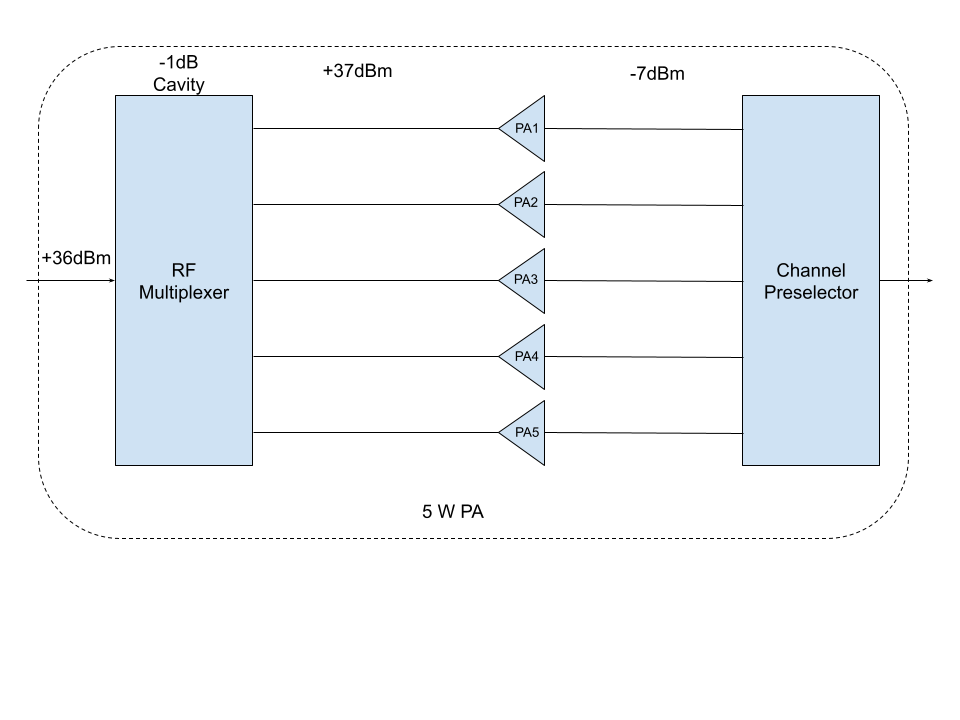
An RF Multiplexer combines multiple channels by using highly selective cavity filters.
Each channel operates at a different frequency and passes through its own tuned cavity. The cavity network provides excellent isolation between channels while allowing all channels to share a common antenna.
Advantages
- Very low insertion loss
- Excellent channel isolation
- Improved spectral performance
- Reduced power amplifier requirements
A well-designed cavity multiplexer may introduce only about 1 dB of insertion loss.
As a result, a system can often achieve the same effective radiated power using only 5 W power amplifiers instead of 20 W amplifiers.
Limitations
- Larger physical size
- More complex tuning requirements
- Higher manufacturing cost
- Frequency-specific design
Performance Comparison
| Parameter | RF Combiner | Cavity RF Multiplexer |
|---|---|---|
| Operating Principle | Power Combining | Frequency-Selective Combining |
| Typical Insertion Loss | 7–8 dB | 0.5–2 dB |
| Channel Isolation | Moderate | Very High |
| PA Power Requirement | Higher | Lower |
| Physical Size | Smaller | Larger |
| Cost | Lower | Higher |
| Efficiency | Lower | Higher |
| Frequency Flexibility | Broadband | Frequency-Specific |
Example: 5-Channel RF System
Consider a five-channel communication system operating through a common antenna.
Solution 1: RF Combiner
- Five independent 20 W power amplifiers
- RF power combiner
- Typical insertion loss: 7.5 dB
While this solution is compact, much of the amplifier power is lost in the combining process.
Solution 2: Cavity Multiplexer
- Five independent 5 W power amplifiers
- High-Q cavity multiplexer
- Typical insertion loss: approximately 1 dB
Despite the lower amplifier power, the reduced insertion loss allows the system to achieve similar antenna output performance.
This approach significantly improves overall RF efficiency.
Which Solution Should You Choose?
An RF Combiner is often preferred when:
- Broadband operation is required
- Space is limited
- Lower initial investment is important
A Cavity Multiplexer is often preferred when:
- Maximum RF efficiency is required
- Antenna sharing is critical
- Low insertion loss is a priority
- High channel isolation is required
Custom RF Combiner and Multiplexer Design
Every communication network has unique frequency plans, channel spacing requirements, power levels, and environmental constraints.
For this reason, many professional radio systems require custom-designed RF combiners, cavity multiplexers, channel filters, and power amplifier assemblies.
Our engineering team specializes in:
- Custom RF Combiner Design
- Cavity Multiplexer Design
- Channel Preselector Filters
- Multi-Channel RF Systems
- DMR, TETRA, P25 Solutions
- High-Power RF Assemblies
- Custom Frequency Band Development
Whether you need a compact combiner solution or a low-loss cavity multiplexer system, we can design and manufacture a solution tailored to your exact requirements.
Contact us to discuss your next RF project.
Ask A Question
Thank you for your response. ✨