




User Case: CVBS to IP Video Encoder Board for UGV Remote Robot Camera System
Modern unmanned ground vehicles (UGVs) are widely used in military, security, EOD, firefighting, and hazardous environment applications. These robotic systems allow operators to complete dangerous missions remotely while staying at a safe distance.
One of our customers, ICP NewTech, specializes in the design and manufacturing of advanced UGV robotic solutions for demanding applications including EOD, IEDD, CBRNE, mine clearance, and emergency response.
For remote robot operation, real-time video transmission is one of the most important functions. Operators need stable and low-latency video feedback from cameras installed on the robot.
Table of Contents
Customer Requirement
The customer’s robotic platform uses onboard cameras to provide visual feedback to the remote operator.
The challenge was how to integrate traditional analog cameras into a modern IP-based communication system.
The existing camera output was:
- CVBS analog video signal
- Standard composite video interface
- Real-time monitoring requirement
However, the robot communication system required:
- Ethernet connectivity
- IP video streaming
- H.264/H.265 compression
- Long-distance wireless transmission capability
Solution: CVBS to IP Video Encoder Board
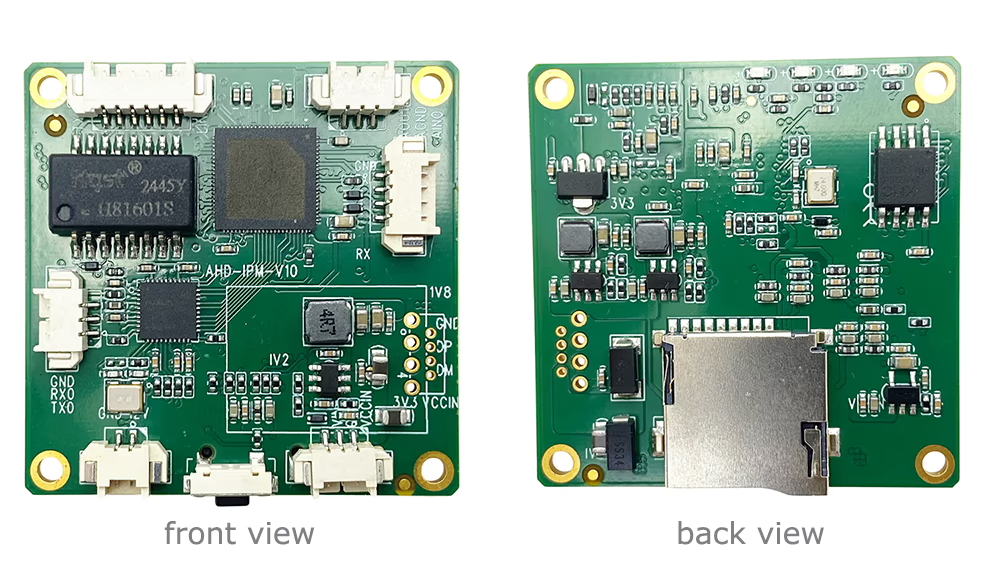
To solve this integration challenge, our CVBS to IP Video Encoder Board was used to convert the analog camera signal into a digital network video stream.
The system architecture becomes:
CVBS Camera
       |
       |
CVBS to IP Encoder Board
       |
       |
H.264 / H.265 IP Video Stream
       |
       |
Ethernet / Wireless Network
       |
       |
Remote Control Station
The encoder board receives the CVBS video signal, compresses the video, and outputs an IP stream that can be transmitted through Ethernet or wireless communication systems.
Key Benefits
1. Easy Integration with Existing Cameras
Many industrial and robotic systems already use reliable CVBS cameras.
Replacing all cameras with new digital cameras can increase development cost and engineering time.
A CVBS to IP encoder provides a practical upgrade path by keeping existing cameras while adding IP networking capability.
2. Real-Time Remote Video Transmission
For UGV operation, operators depend on live video feedback.
The encoder supports low-latency video transmission, helping operators control robots in real-world environments.
3. Flexible Network Communication
After conversion to IP video, the camera stream can be transmitted through:
- Ethernet
- Fiber communication
- Wireless data links
- Private networks
This makes the solution suitable for robots, vehicles, and remote monitoring systems.
4. Multi-Camera System Expansion
A UGV platform may require multiple video channels.
Using IP-based video architecture allows easier expansion and centralized management of multiple cameras.
Application Fields
This CVBS to IP video encoder solution can be used in:
- UGV unmanned ground vehicles
- EOD robots
- Security robots
- Inspection robots
- Industrial vehicles
- Remote monitoring systems
- Emergency response equipment
Conclusion
Converting CVBS cameras into IP video streams provides a reliable method for upgrading existing robotic platforms.
For UGV manufacturers, a compact CVBS to IP Video Encoder Board helps bridge the gap between traditional analog cameras and modern Ethernet-based remote control systems.
It enables faster integration, flexible communication, and reliable real-time video transmission for mission-critical robotic applications.
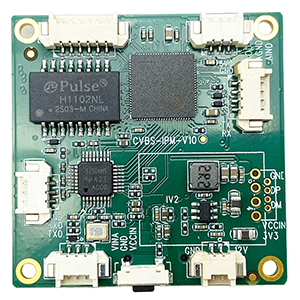
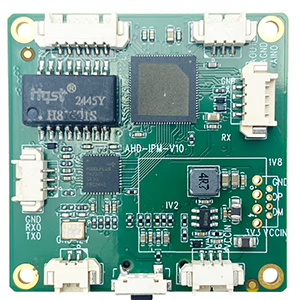
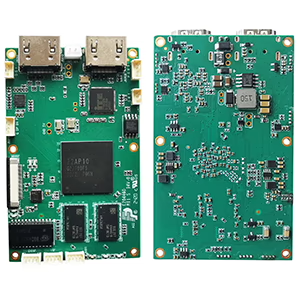
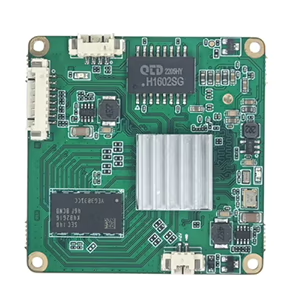
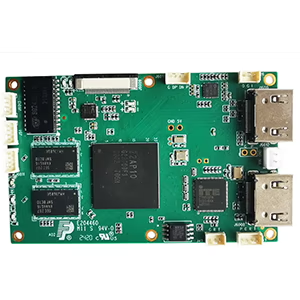
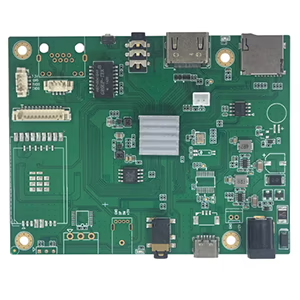
Encoder Modules Boards
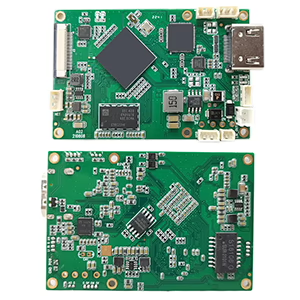
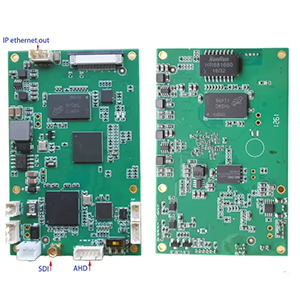
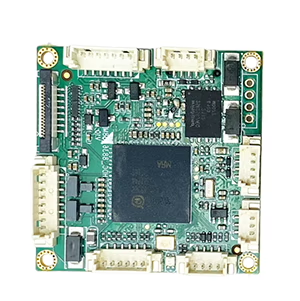
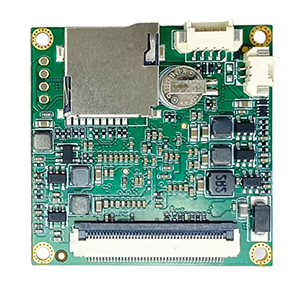
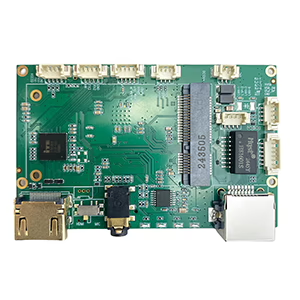
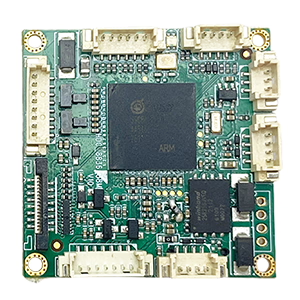
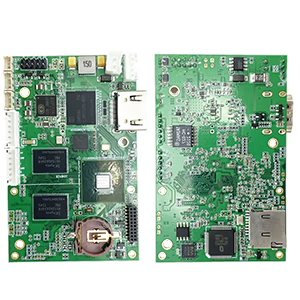
Decoder Modules Boards
Available for Customization
New Encoder Products
| No. | Product Name | Configuration | Key Features | Status |
|---|---|---|---|---|
| 1 | Dual-Channel USB UVC Visible Light Video Encoder | 2× USB input | Supports dual USB camera video encoding, and RTSP streaming; local CVBS/HDMI output; switchable display modes | Mass Production |
| 2 | Dual-Channel Encoder (1× USB Visible Light + 1× USB Thermal Imaging camera) | 2× USB input | Supports dual USB camera (visible + thermal) capture, encoding, and RTSP streaming; local CVBS/HDMI output; switchable display modes | Mass Production |
| 3 | RTSP Decoder HDMI/CVBS Display Module | HDMI + CVBS output | Supports up to 4×1080P@30fps RTSP stream decoding; Support video streaming protocol forwarding; HDMI/CVBS output display | Sample Available |
| 4 | RTSP Decoder HDMI/CVBS Display Module with 4.3"/5" LCD | HDMI output + LCD screen | Supports up to 4×1080P@30fps RTSP stream decoding; protocol forwarding; HDMI/CVBS output display | Debugging |
| 5 | Dual-Channel Encoder (1× USB Visible Light + 1× CVBS Analog) | 1× CVBS + 1× USB UVC input | Dual video (USB + CVBS), encoding and RTSP streaming; local CVBS/HDMI output; switchable display modes | Debugging |
| 6 | Dual-Channel Encoder (1× USB UVC + 1× AHD Analog) | 1× AHD + 1× USB UVC input | Dual video capture (USB + AHD), encoding and RTSP streaming; local CVBS/HDMI output; switchable display modes | Debugging |
| 7 | Dual-Channel Encoder (1× CVBS + 1× AHD Analog Video) | CVBS + AHD 2 video input | Dual analog video capture, encoding and RTSP streaming; local CVBS/HDMI output; switchable display modes | Debugging |
| 8 | Dual-Channel Encoder (1× CMOS Camera + 1× USB Thermal Imaging camera) | 1× USB interface | Supports CMOS + USB thermal camera capture, encoding and RTSP streaming; local CVBS/HDMI output; switchable display modes | Mass Production |
For customized video input/output conversion solutions not listed in our products, please contact us for OEM/ODM support. We can develop tailored products based on your requirements.
ts
Ask A Question
Thank you for your response. ✨