






Here are some FAQ for CVBS over IP video stream converter of drone or industrial use.

Price range: $118.00 through $178.00
- Q: What is a CVBS to IP converter?
A: A CVBS to IP converter (also called AV encoder board or composite to IP encoder) encodes analog composite video & audio signals into digital IP streams for transmission over Ethernet networks. - Q: Can this converter turn my old CCTV cameras into IP cameras?
A: Yes! It acts as a camera to IP transformer, allowing legacy CVBS cameras to connect to modern IP-based NVRs or video management software.
- Q: What video resolutions does a CVBS to IP encoder support?
A: Most support NTSC/PAL standards (up to 720×576@25fps or 720×480@30fps), ideal for composite video input. - Q: Does it support audio encoding?
A: Yes! Audio over IP is enabled via RCA audio input alongside CVBS video, synced in the IP stream. - Q: What is the typical latency of a CVBS to IP converter?
A: Professional-grade AV encoder boards achieve <150ms latency, suitable for real-time monitoring. - Q: Can multiple encoders work on one network?
A: Yes! Assign unique IP addresses to each device for multi-camera IP streaming.
- Q: How do I set up a CVBS to IP converter for security cameras?
A: Connect CVBS camera output to the encoder’s RCA/BNC input, then link its Ethernet port to a PoE switch (or use DC power). - Q: Does it require special software?
A: Many support ONVIF protocol, working with VLC, Blue Iris, or Milestone NVRs without extra software. - Q: Can I power the encoder via Ethernet (PoE)?
A: No, our compact AV encoders does not support PoE.
- Q: Will this work with my analog VCR or DVD player?
A: Absolutely! Use it to digitize composite AV sources (VCRs, DVD players) for live streaming or archiving over IP. - Q: Is it compatible with existing NVR systems?
A: Yes! ONVIF-compliant encoders integrate with IP NVRs like Hikvision, Dahua, or Synology.
- Q: What streaming protocols are supported?
A: Common protocols include RTSP, UDP, RTMP, and HTTP, enabling live video feeds on websites or apps. - Q: How much bandwidth does a CVBS to IP stream use?
A: Adjustable bitrate control (e.g., 500Kbps–8Mbps) allows optimization for network constraints. - Q: Can I access video over the internet?
A: Yes! Configure port forwarding or use P2P cloud services for remote monitoring.
- Q: Why use this for retail store surveillance?
A: Cost-effectively upgrade analog CCTV to IP cameras without replacing coaxial cables. - Q: Can I use this for live church broadcasts?
A: Yes! Encode composite video feeds (e.g., from mixers) for YouTube/Facebook streaming via RTMP.
- Q: Why is my video stream choppy?
A: Check network bandwidth, reduce encoder bitrate, or enable H.265 encoding (if supported) for efficiency. - Q: No video after setup – what to check?
A: Verify CVBS input connections, power supply, and IP configuration (use ARP/Ping tools).
- Q: Can I add motion detection?
A: Some encoders include video analytics for motion-triggered recording or alerts. - Q: Is two-way audio supported?
A: Sorry, this model supported only one-way audio encoder,it does not support two-way audio input/output for intercom systems over IP.
- Q: What’s the price range for a compact CVBS encoder?
A: Budget encoders start at $300, while professional AV boards with 4K downscaling cost $300+. - Q: Where to buy CVBS to IP converters?
A: Our website https://ivcan.com supports shop on line. Or please click contact or WhatsApp button to get more support from us.
- Q: How to integrate with home automation (e.g., Home Assistant)?
A: Use RTSP feeds in Home Assistant via the Generic Camera Platform. - Q: Does it work with wireless networks?
A: Use an Ethernet-to-WiFi adapter for wireless IP video transmission.
- Q: Can I record video directly to an SD card?
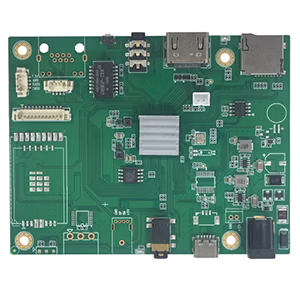
A: Our AV encoder boards Vcan1746 include microSD slots for standalone recording. - Q: What’s the maximum cable length for CVBS input?
A: Analog video degrades beyond 100m – place the encoder board near the source. - Q: Is there a web interface for configuration?
A: Yes! Access settings via embedded web GUI using any browser. - Q: Can multiple users view the stream simultaneously?
A: Most support 10+ concurrent RTSP viewers (varies by model). - Q: Does temperature affect encoder performance?
A: Industrial-grade -20°C~60°C operation ensures reliable surveillance in harsh environments. - Q: How to secure the video stream from hacking?
A: Enable HTTPS, IP whitelisting, and change default admin passwords. - Q: Can I stream to multiple platforms at once?
A: Yes! Use RTMP simulcasting to YouTube, Twitch, and Facebook simultaneously. - Q: What’s the difference between a CVBS encoder and a video capture card?
A: Encoders output Ethernet/IP streams; capture cards (e.g., USB) connect to PCs for local processing. - Q: Do I need a static IP address?
A: No – use DDNS services (like No-IP) for dynamic IP networks. - Q: Can I control PTZ cameras through the encoder?
A: Only if the encoder has RS485 ports for PTZ protocol support (e.g., Pelco-D). If the PTZ of your camera is serial port control, you can use the transparent serial port on our CVBS over IP video stream converter (used with the codec board); if it is network port control, you can control it yourself through the wireless link without the need for a codec board. - Q: Why choose H.265 over H.264?
A: H.265 encoding reduces bandwidth usage by 50% at similar quality. H.264 encoding offer the super low latency if you need it for drone use. - Q: Is de-interlacing supported for analog video?
A: Yes! Auto de-interlacing converts interlaced CVBS to progressive scan for smoother IP video. - Q: How many encoders can a network handle?
A: Depends on switch capacity – a 24-port Gigabit switch supports 20+ encoders comfortably. - Q: Can I use this with a Raspberry Pi?
A: Yes! Some encoder boards interface with Raspberry Pi GPIO for DIY projects. - Q: Does it output 4K video?
A: No – CVBS input is SD resolution (max 720×576). For HD, use Vcan1746-4K-HDMI encoders instead. - Q: What’s the power consumption?
A: Typical 150mA@12V – ideal for energy-efficient IP systems. - Q: Can I integrate with Alexa/Google Home?
A: Via third-party tools like Home Assistant using RTSP feeds. - Q: How to reset to factory settings?
A: Press the hardware reset button for 10 seconds (refer to encoder manual). - Q: Is there a mobile app for viewing?
A: Use ONVIF-compatible apps (e.g., TinyCam Pro, ONVIF Viewer) on iOS/Android. - Q: Can it overlay timestamps on video?
A: Yes! Enable OSD (On-Screen Display) for time/date/text overlays. - Q: What if my camera has no audio output?
A: Add an external microphone to the encoder’s audio input port. - Q: Do encoders support multicast streaming?
A: Another models vcan1746 do – support Dual video streaming over IP Ethernet (CVBS+HDMI or CVBS + SDI or CVBS+AHD). - Q: How long do these devices last?
A: Industrial-grade components ensure 50,000+ hours MTBF (5+ years continuous use). - Q: Where to find SDKs for custom integration?
A: Manufacturers provide SDKs for Linux/Windows – search “CVBS encoder SDK” for downloads.
Table of Contents
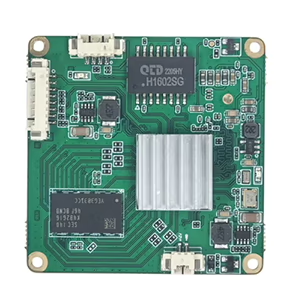
Encoder Modules Boards
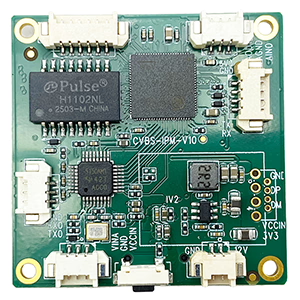
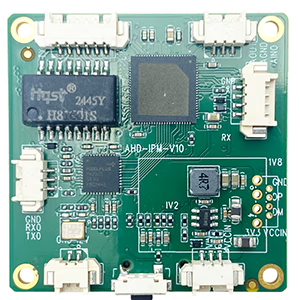
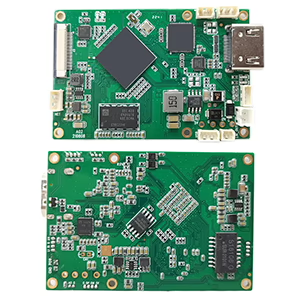
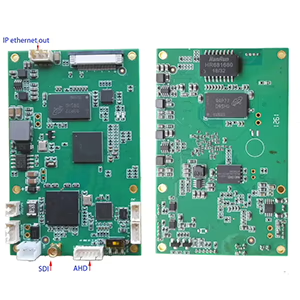
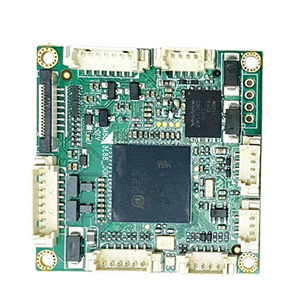
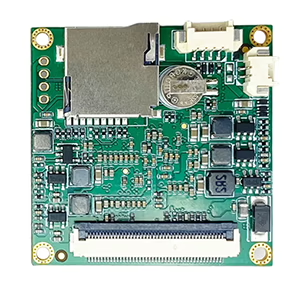
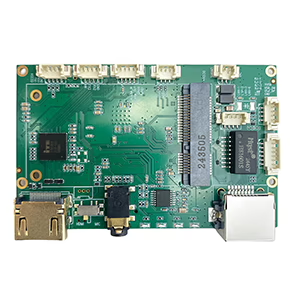
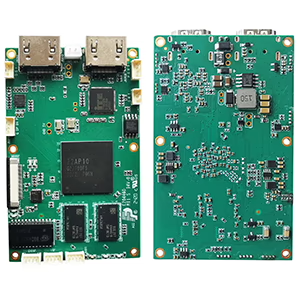
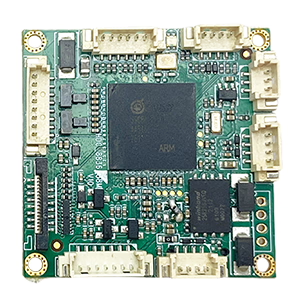
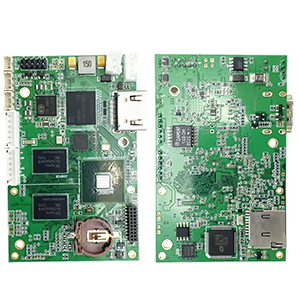
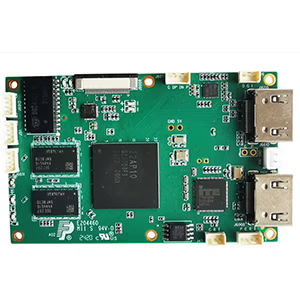
Decoder Modules Boards
Available for Customization
New Encoder Products
| No. | Product Name | Configuration | Key Features | Status |
|---|---|---|---|---|
| 1 | Dual-Channel USB UVC Visible Light Video Encoder | 2× USB input | Supports dual USB camera video encoding, and RTSP streaming; local CVBS/HDMI output; switchable display modes | Mass Production |
| 2 | Dual-Channel Encoder (1× USB Visible Light + 1× USB Thermal Imaging camera) | 2× USB input | Supports dual USB camera (visible + thermal) capture, encoding, and RTSP streaming; local CVBS/HDMI output; switchable display modes | Mass Production |
| 3 | RTSP Decoder HDMI/CVBS Display Module | HDMI + CVBS output | Supports up to 4×1080P@30fps RTSP stream decoding; Support video streaming protocol forwarding; HDMI/CVBS output display | Sample Available |
| 4 | RTSP Decoder HDMI/CVBS Display Module with 4.3"/5" LCD | HDMI output + LCD screen | Supports up to 4×1080P@30fps RTSP stream decoding; protocol forwarding; HDMI/CVBS output display | Debugging |
| 5 | Dual-Channel Encoder (1× USB Visible Light + 1× CVBS Analog) | 1× CVBS + 1× USB UVC input | Dual video (USB + CVBS), encoding and RTSP streaming; local CVBS/HDMI output; switchable display modes | Debugging |
| 6 | Dual-Channel Encoder (1× USB UVC + 1× AHD Analog) | 1× AHD + 1× USB UVC input | Dual video capture (USB + AHD), encoding and RTSP streaming; local CVBS/HDMI output; switchable display modes | Debugging |
| 7 | Dual-Channel Encoder (1× CVBS + 1× AHD Analog Video) | CVBS + AHD 2 video input | Dual analog video capture, encoding and RTSP streaming; local CVBS/HDMI output; switchable display modes | Debugging |
| 8 | Dual-Channel Encoder (1× CMOS Camera + 1× USB Thermal Imaging camera) | 1× USB interface | Supports CMOS + USB thermal camera capture, encoding and RTSP streaming; local CVBS/HDMI output; switchable display modes | Mass Production |
For customized video input/output conversion solutions not listed in our products, please contact us for OEM/ODM support. We can develop tailored products based on your requirements.
Ask A Question
Thank you for your response. ✨