






5W vs 10W Drone Video Radio Links: Real Differences Behind the “100km Range”
Many drone operators and system integrators often ask: if both 5W and 10W wireless video radio links claim to reach 100km, what’s the real difference? The truth lies in how they achieve that distance, not just how far they can go.
Let’s break down what changes when you double the RF output power and why that matters in real-world drone video transmission.
Table of Contents
1. Transmit Power and Link Budget
| Parameter | 5W Amplifier | 10W Amplifier |
|---|---|---|
| Output Power | +37 dBm | +40 dBm |
| Power Increase | — | +3 dB (≈ 2x signal strength) |
| Practical Range Gain | — | About 1.4× stronger field strength |
An increase of 3dB means the transmitter’s power doubles. In radio propagation, this doesn’t double the distance but improves the link margin — meaning the 10W system maintains a stronger, more stable signal at the same distance or through mild obstacles.
2. Why Both Claim “100km Range”
The “100km” figure is usually based on ideal test conditions:
- Clear line of sight (LOS)
- High gain directional antennas (e.g., 20dBi)
- Elevated drone altitude (1000m+)
- Low data rate (1–2 Mbps)
- Clean, low-interference environment
Under those conditions, both 5W and 10W drone video radio links can indeed achieve 100km transmission.
However, in real flight scenarios — low altitude, multipath reflection, or urban noise — the results differ greatly:
- 5W version: stable up to 40–60 km
- 10W version: stable up to 70–100 km
So both can “reach” 100km, but only the 10W version can sustain it under non-ideal conditions.
3. Signal Stability and Anti-Interference
| Feature | 5W Amplifier | 10W Amplifier |
|---|---|---|
| Anti-Interference | Moderate | Strong |
| Link Margin | Narrow | Wider |
| FEC (Error Correction) | Depends on signal quality | More effective with stronger SNR |
The 10W drone video radio link has better penetration, resilience to multipath fading, and ability to suppress other nearby signals. This matters especially for drones operating in cities, near base stations, or in military and public safety missions.
4. Power Consumption and Heat Dissipation
| Factor | 5W System | 10W System |
|---|---|---|
| Power Consumption | 15–20W | 30–40W |
| Cooling Needs | Normal heatsink | Larger heatsink or fan cooling |
| Weight | Lighter | Heavier |
The 10W unit requires more power and generates more heat. It’s best suited for vehicle-mounted or large UAV applications, while 5W fits better for compact drones that prioritize flight time and weight efficiency.
5. Application Scenarios
| Application | Recommended Power |
|---|---|
| Lightweight multicopter drone | 1–5W |
| Long-endurance fixed-wing UAV | 5–10W |
| Vehicle/shipborne drone video link | 10W |
| Military or high-interference area | 10W or above |
The key trade-off is simple: 5W offers portability; 10W offers reliability.
6. Marketing vs. Reality
Manufacturers tend to unify their specifications for marketing simplicity. Both may list “up to 100km” range, but:
- The 5W drone video radio link achieves that in theory;
- The 10W version maintains usable video quality at that same range.
So, in practice, they are not equal — 10W simply provides more headroom and stability for real missions.
7. Summary
5W can reach far, but 10W stays strong.
In clear-sky, long-distance tests, both perform similarly.
But in dynamic real-world environments with interference, obstacles, and low flight altitudes, a 10W drone video radio link offers a noticeably stronger and more reliable video link.
If your mission values endurance and lightweight setup, choose 5W.
If your mission demands reliability and consistent performance over long distances, go with 10W.
FAQ
Q1: Why do both 5W and 10W drone video radio links claim 100km range?
Because “100km” is a theoretical, line-of-sight maximum under ideal test conditions. In real-world use, 10W offers a more stable and interference-resistant link at that same range.
Q2: Does higher power always mean longer range?
Not always. Power helps, but antenna gain, frequency band, environment, and data rate all significantly affect range and stability.
Q3: Will a 10W drone video radio link overheat easily?
It generates more heat, yes — but with proper heatsinking or airflow, it operates reliably. Many ground stations use 10W units for this reason.
Q4: Is 10W suitable for small drones?
Not usually. The added weight and power consumption reduce flight time. A 5W or even 2W module is often a better fit for compact UAVs.
Q5: When should I choose 10W over 5W?
Choose 10W for long-distance, high-interference, or mission-critical environments where stable video transmission is more important than power efficiency.

Wireless Video Transmission

Wireless Video Transmission
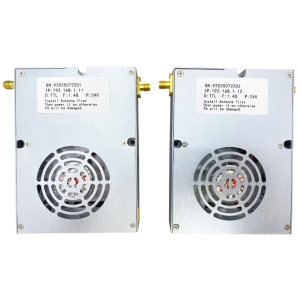
IP Mesh 100Mbps wireless video data transceiver 2X5W PA 16 hop


Wireless Video Transmission
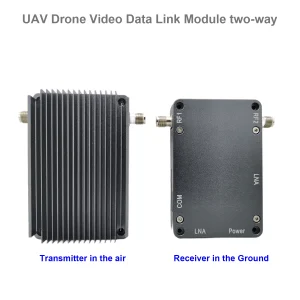
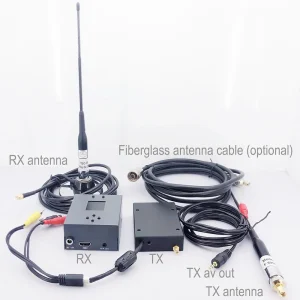
1740-1840Mhz 2WPA 30KM long range drone video transmitter and receiver with Sbus TTL
Bidirectional Two-Ways

Wireless Video Transmission
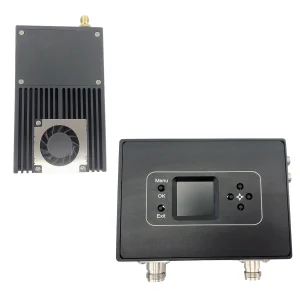
long range wireless video data transmitter and receiver for drone UAV robot


Bidirectional Two-Ways
Ask A Question
Thank you for your response. ✨