





Understanding COFDM Frequency Ranges for UAVs and Unmanned Vehicles
Wireless video transmission is one of the most critical technologies in modern UAV (Unmanned Aerial Vehicle), UGV (Unmanned Ground Vehicle), and remote surveillance applications.
Among all digital transmission technologies, COFDM (Coded Orthogonal Frequency Division Multiplexing) stands out for its stability, anti-interference ability, and strong resistance to multipath fading.
However, many users are unsure how the working frequency range affects system performance — particularly when using transmitters and receivers with different supported frequency bands.
This article explains the principles and practical differences between frequency ranges in COFDM systems, and how to extend the receiver range with a down converter (BDC) for high-frequency applications.
Table of Contents
How Frequency Affects Wireless Video Transmission
Every wireless signal operates at a certain radio frequency (RF). The frequency determines how well the signal propagates through air, penetrates obstacles, and maintains quality over distance.
Lower frequencies usually travel farther and penetrate obstacles better, while higher frequencies carry more data but have shorter range and require line-of-sight (LOS).
| Frequency Band | Range | Key Features | Typical Application |
|---|---|---|---|
| 50–300 MHz (VHF) | Long | Large wavelength, strong penetration, low data rate | Special long-range systems, underground use |
| 300–900 MHz (UHF) | Long to Medium | Good penetration, wide coverage, stable link | Tactical COFDM links, long-range UAVs |
| 1–1.5 GHz (L Band) | Medium | Balance between range and image quality | Drone-to-ground systems |
| 2–2.5 GHz (S Band) | Short–Medium | High data rate, compact antenna, slightly less penetration | HD drone video, industrial robots |
| 5–6 GHz (C Band) | Short | Very high bandwidth, small antenna, short range | Line-of-sight HD streaming |
In essence:
- Low frequency = long range, strong penetration
- High frequency = high speed, low latency
Trade-Offs Between Low and High Frequencies
When designing a UAV or UGV wireless video system, engineers must balance range, penetration, antenna size, and video quality.
Low Frequency (Below 1 GHz)
- Long transmission distance, even with obstacles.
- Strong signal penetration through walls, trees, and terrain.
- Less attenuation from rain or fog.
- Larger antennas required due to longer wavelength.
- Limited bandwidth, leading to moderate video quality.
High Frequency (Above 1 GHz)
- Wider bandwidth allows higher video bitrates (HD or Full HD).
- Smaller antennas — easier integration on drones and small vehicles.
- More sensitive to obstacles and reflection loss.
- Shorter range, best in open or line-of-sight conditions.
For example:
A 700 MHz link might reach several kilometers through light foliage, while a 5.8 GHz link may provide crystal-clear HD video but only within 1 km in open space.
COFDM Transmitter and Receiver Frequency Ranges
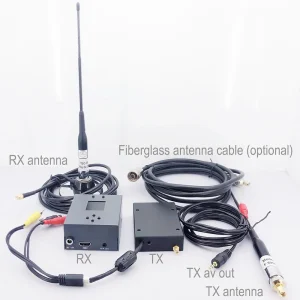
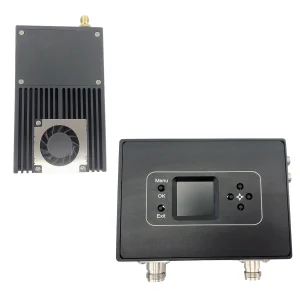
Our COFDM wireless video transmitter supports a very wide RF tuning range from 50 MHz to 6000 MHz.
This allows flexible deployment across VHF, UHF, L, S, and C bands according to different mission requirements.
However, the receiver module — especially its internal demodulator chipset — has a native supported frequency range of 170 MHz to 860 MHz.
That means the receiver can directly receive and demodulate COFDM signals only within this range.
Summary:
| Device | Supported Range | Note |
|---|---|---|
| Transmitter | 50 MHz – 6000 MHz | Full-spectrum tuning capability |
| Receiver | 170 MHz – 860 MHz | Native support range of the COFDM demodulator |
If both devices operate within 170–860 MHz, they communicate directly without additional hardware.
When to Use a Frequency Down Converter (BDC)
When the application requires transmission above 860 MHz — for instance, in the 2.4 GHz, 3.5 GHz, or 5.8 GHz bands — the receiver cannot directly demodulate the signal.
In this case, a frequency down converter (also known as BDC, Block Down Converter, or RF Frequency Shifter) must be added in front of the receiver.
How It Works:
A frequency down converter receives a high-frequency COFDM signal and mixes it with a local oscillator signal.
It then outputs the same signal at a lower, intermediate frequency (IF) within the receiver’s operating band.
Example:
- Working frequency: 3500 MHz
- Down converter output: 500 MHz
- Receiver demodulates the 500 MHz signal as normal
In short, the converter shifts the frequency from 3500 MHz → 500 MHz, without altering the modulation or data content.
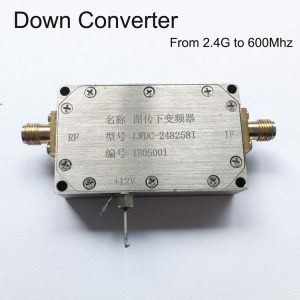
BDC Block Down Converter

BDC Block Down Converter
3200-3800MHz to 200-800MHz COFDM Down Converter BDC – RF Frequency Shifter
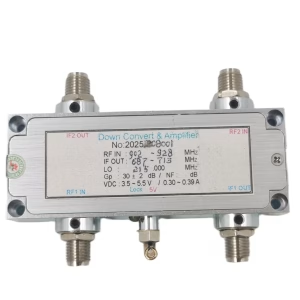
BDC Block Down Converter
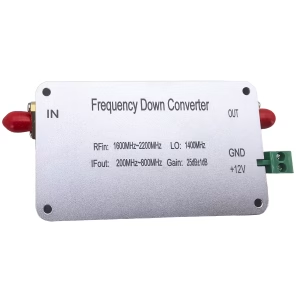
BDC Block Down Converter
1600-2200 MHz frequency down converter to 200-800 MHz mixer BDC
BDC Block Down Converter

BDC Block Down Converter
BDC Block Down Converter
Frequency 2100-2500Mhz down to 350-750Mhz COFDM RF Down Converter BDC

Frequency UP Down Converter
200W Ku Band Block Up Converter BUC 1-2G to 10.7-12.7GHz for Satellite Uplink
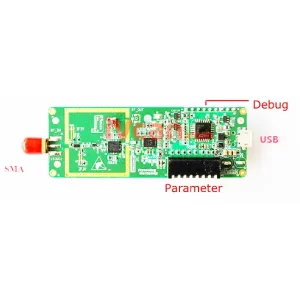
BDC Block Down Converter
Frequency Down Converter 2.4G to 250Mhz DVB-T COFDM Digital HDTV RF Microwave Module Board
Example: 3500 MHz COFDM Video Link
Let’s look at a practical system setup:
| Component | Description | Frequency |
|---|---|---|
| COFDM Transmitter | Tuned to 3500 MHz | 3500 MHz |
| RF Down Converter (BDC) | Converts 3500 MHz → 500 MHz | Input: 3500 MHz / Output: 500 MHz |
| COFDM Receiver Module | Native range: 170–860 MHz | Receives 500 MHz |
| Output | HD or Full HD video stream | — |
This configuration allows the system to operate on high-frequency bands (e.g., 3.5 GHz) without changing the receiver hardware design.
Advantages of Using High Frequencies with Down Conversion
Even though the receiver’s native range stops at 860 MHz, there are several good reasons to operate higher and use a down converter:
- Avoid Spectrum Congestion
The 2.4 GHz and 5.8 GHz bands are heavily used by Wi-Fi, Bluetooth, and FPV systems. Custom frequencies such as 3.5 GHz can offer a clean, interference-free channel. - Smaller Antenna Size
Higher frequencies allow smaller and lighter antennas — a major advantage for UAVs where size and weight matter. - Higher Bandwidth for HD Video
Wider channels at 3–6 GHz enable high-bitrate, low-latency COFDM transmission suitable for 1080p or even 4K real-time video. - Flexible Spectrum Utilization
Some clients (military, law enforcement, industrial) use licensed or private bands above 1 GHz for secure communications.
By combining a wideband transmitter (up to 6 GHz) and a down-converted receiver (170–860 MHz), the system achieves both flexibility and stability.
Frequency Selection Recommendations
The choice of frequency directly impacts system behavior. The following guidelines can help users select the best band for their application:
| Application | Recommended Frequency | Benefits |
|---|---|---|
| Long-range drone video link | 300–900 MHz | Strong penetration, long distance |
| Tactical vehicle or robot link | 700–900 MHz | Reliable non-line-of-sight (NLOS) operation |
| Urban or indoor monitoring | 1.2–2.4 GHz | Balanced range and bandwidth |
| HD short-range transmission | 5.8 GHz | High bitrate, low latency |
| Special licensed spectrum | 3.5 GHz + Down Converter | Avoids interference, higher quality |
If your target frequency is, for example, 3500 MHz, you can use a 3500 MHz to 500 MHz down converter to make it compatible with standard COFDM receivers.
System Integration Considerations
When designing a system that includes a down converter, consider the following:
- Power Supply – The BDC typically requires 5V–12V DC input, depending on model.
- Gain and Noise Figure – Ensure that conversion loss or gain does not degrade signal quality.
- IF Output Level – Must match the receiver’s input sensitivity range (commonly -70 to -20 dBm).
- Local Oscillator Stability – Frequency drift in the LO can impact synchronization; use a stable crystal reference.
- Shielding – Proper grounding and shielding reduce RF leakage or feedback noise.
These parameters ensure a stable COFDM link with minimal distortion.
The Role of COFDM Modulation
Unlike analog video transmission, COFDM uses hundreds of orthogonal subcarriers to transmit data in parallel.
This makes it highly resistant to multipath interference — a common challenge in UAV or ground environments where signals reflect off terrain or buildings.
Even when part of the signal is delayed or scattered, COFDM reconstructs the original video stream with minimal error.
The system’s FEC (Forward Error Correction) and GI (Guard Interval) further improve reliability over long distances or in noisy environments.
Summary
- COFDM Transmitter Frequency Range: 50 MHz – 6000 MHz
- COFDM Receiver Frequency Range: 170 MHz – 860 MHz
- High-Frequency Operation: Requires a down converter (BDC) to shift high RF signals into receiver’s valid range.
- Example: For 3500 MHz operation, use a 3500 MHz → 500 MHz down converter.
- Low Frequency: Better distance and penetration.
- High Frequency: Better video quality, lower latency, shorter range.
- Down Conversion: Allows flexible operation in any band up to 6 GHz without changing the receiver chipset.
By understanding these principles, users can design optimized COFDM transmission systems for drones, unmanned vehicles, and mobile surveillance — achieving both reliability and flexibility in various RF environments.
Frequently Asked Questions (FAQ)
Q1: Why can the COFDM transmitter cover 50–6000 MHz, but the receiver only supports 170–860 MHz?
A: The transmitter uses a wideband RF design capable of generating high-frequency signals, while the receiver’s demodulator chipset is optimized for the UHF band (170–860 MHz). For higher bands, an external down converter is required.
Q2: What is a frequency down converter, and when should I use it?
A: A down converter (BDC) shifts a high-frequency signal (e.g., 3.5 GHz) down to a lower intermediate frequency (e.g., 500 MHz) that the receiver can handle. You need it whenever your operating frequency exceeds 860 MHz.
Q3: Can I use the COFDM system at 5.8 GHz for drones?
A: Yes, but you must add a 5.8 GHz → 500 MHz down converter to the receiver. This setup enables high-bitrate, low-latency HD transmission suitable for short-range UAV applications.
In summary:
Choosing the right frequency range — and understanding when to use a down converter — ensures your COFDM system delivers stable, high-quality wireless video, whether for drones, unmanned vehicles, or tactical field deployments.




Ask A Question
Thank you for your response. ✨