




Our software team recently received several client questions regarding the performance and limitations of our thermal cameras:
- “What is the exact FOV for the 9.7 mm and 6.8 mm thermal cameras?”
- “Assuming a 30×30 cm square object at 150°C, what is the maximum distance for accurate temperature reading?”
- “How long can the camera be exposed to direct sunlight without damage? We previously observed artifacts on the 9.7 mm thermal cam without the temperature module.”

To address these concerns, we compiled a comprehensive FAQ covering lens field of view, optimal measurement distance for different targets, and safe usage guidelines under direct sunlight. This guide provides clear, data-driven answers to help users maximize the performance and longevity of their thermal imaging equipment.
Table of Contents
Q1: What is the exact FOV for the 9.7 mm and 6.8 mm thermal cameras?
A: The typical field of view (FOV) for standard LWIR thermal cameras is approximately:
| Lens | Horizontal FOV | Vertical FOV | Diagonal FOV |
|---|---|---|---|
| 6.8 mm | ~26° | ~20° | ~32° |
| 9.7 mm | ~18° | ~14° | ~22° |
Note: The actual FOV depends on the specific sensor size and lens design. Please refer to the camera’s datasheet for precise numbers.
Q2: For a 30×30 cm square object at 150°C, what is the maximum distance for accurate temperature measurement?
A: Accurate measurement requires that the target covers a sufficient number of pixels on the thermal sensor. Using the 640×512 resolution sensor and assuming at least 3×3 pixels per target for stable readings:
- 9.7 mm lens: maximum distance ≈ 200 m
- 6.8 mm lens: maximum distance ≈ 140 m
Note: These are ideal estimates. Actual effective distance may be lower due to atmospheric absorption, target emissivity, and environmental conditions. For more accurate readings, consider using 5×5 pixel coverage as a conservative threshold.
Q3: How long can the camera be exposed to direct sunlight without damage?
A: Thermal sensors are sensitive to infrared radiation and are not designed for prolonged exposure to direct sunlight or intense heat sources.
- Prolonged direct exposure can cause image artifacts, noise, or permanent sensor degradation.
- Most manufacturers advise avoiding continuous direct sunlight on the lens, especially without protective filters or temperature modules.
- Short exposures may be safe, but exact safe durations depend on the lens coating, sensor type, and cooling design.
Recommendation: Always minimize direct sunlight exposure and use sunshields or shading when possible.


Thermal Camera
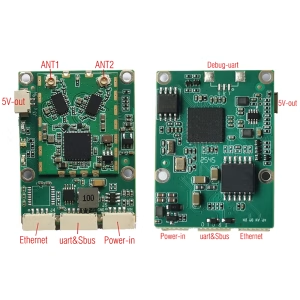
5.8GHz Long-Range Wireless Data Link Module 100Mbps MIMO | Ethernet UART SBUS | 5-15km UAV Telemetry

FPV camera
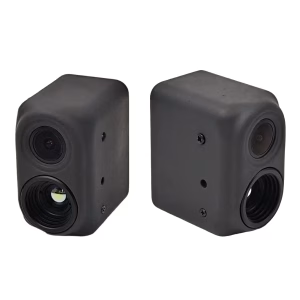
fpv dual lens night thermal imaging and daylight camera for drones, HD vision, low-light real-time
Thermal Camera

Thermal Camera
Ask A Question
Thank you for your response. ✨