





Wireless Live Video & Audio Communication Solution for Urban Robot Applications
In urban robotic and unmanned ground vehicle (UGV) applications, maintaining a stable live video and audio communication link is often challenging due to obstacles such as buildings, reinforced concrete walls, and electromagnetic interference. This article introduces a wireless video, audio, and data transmission solution that is well-suited for such environments and aligns with typical operational requirements.
Table of Contents
Application Requirements Overview
The system discussed in this article is designed to meet the following core requirements:
- Live video and audio transmission with a minimum video quality of 480p
- Reliable communication in urban environments
- Communication range requirements:
- Line of Sight (LOS): approximately 400 meters
- Non-Line of Sight (NLOS): approximately 150 meters
- Ability to maintain communication in NLOS scenarios with multiple obstacles, such as reinforced concrete (RCC) walls
- Video and audio output formats compatible with Raspberry Pi, enabling live display, recording, and further processing
- Compatibility with commonly used cameras and audio devices for robotic systems
Recommended Wireless Communication System
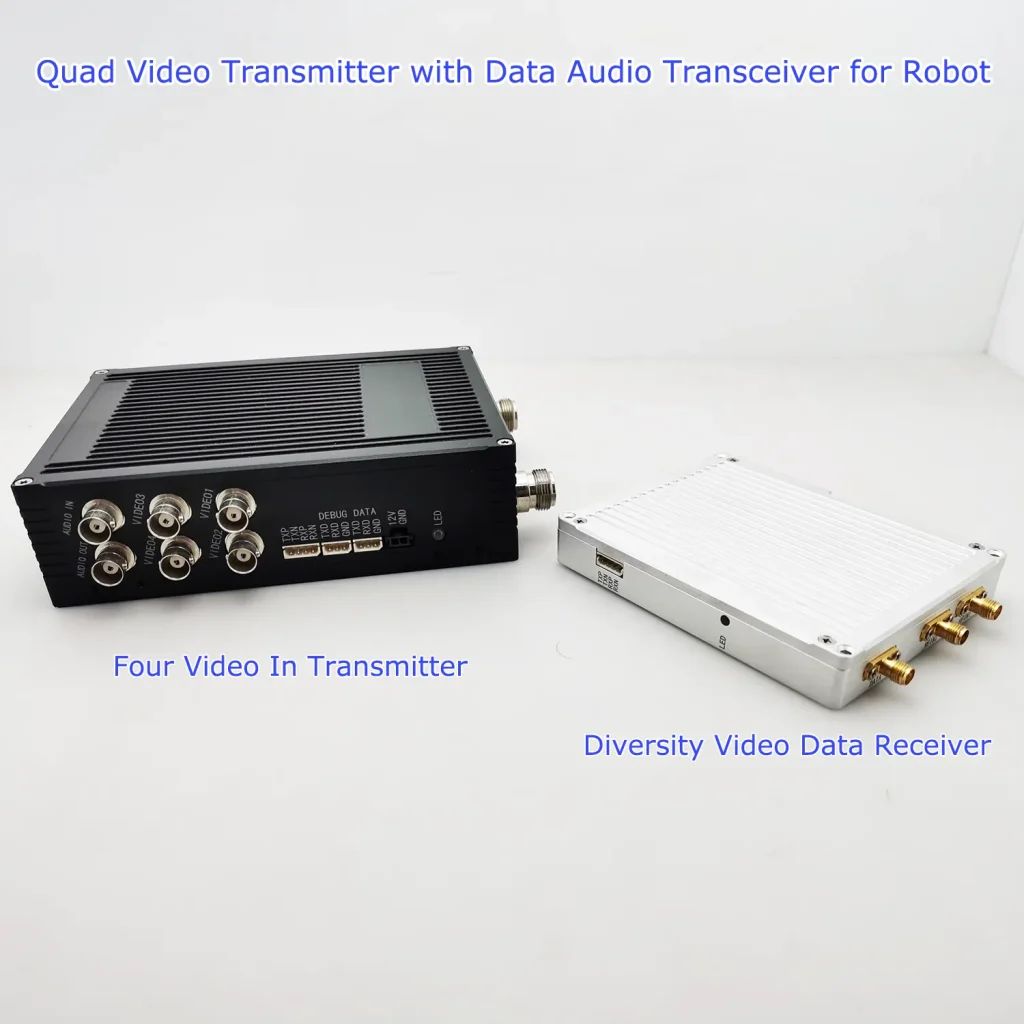
To address these needs, we recommend a Quad Video Transmitter with Integrated Data and Audio Transceiver, specifically designed for robotic and UGV platforms.
This system is an all-in-one wireless communication solution that integrates:
- Multi-channel video transmission
- Two-way audio communication
- Bidirectional data (telemetry/control) transmission
It is widely used in mobile robotics, inspection robots, surveillance platforms, and other unmanned systems operating in complex environments.
Video and Audio Performance
- Video Quality:
The system supports high-definition video transmission up to 1080p, well above the minimum 480p requirement. Video is encoded using efficient digital compression, ensuring clear images with stable performance. - Multi-Camera Support:
Up to four video inputs are supported, allowing the integration of multiple visible-light cameras or a combination of visible and thermal cameras. This is particularly useful for robots requiring multi-angle or situational awareness. - Audio Transmission:
Built-in two-way audio enables real-time voice communication between the robot and the control station. Analog microphones and speakers can be connected directly to the system. - Latency:
Typical end-to-end latency is in the range of 150–300 milliseconds, suitable for live monitoring and operator feedback.
Wireless Reliability in Urban Environments
The system uses COFDM (Coded Orthogonal Frequency Division Multiplexing) modulation, which provides strong resistance to interference and excellent diffraction capability.
- Line of Sight (LOS):
In open or semi-open environments, the system can easily meet and exceed the 400-meter LOS requirement when properly configured with suitable antennas. - Non-Line of Sight (NLOS):
In urban environments with buildings and obstacles, COFDM technology offers improved penetration and reflection handling compared to traditional analog systems.
While exact performance depends on wall thickness, materials, and layout, this technology is well-suited for scenarios involving multiple concrete walls within a 150-meter range.
Note: As with all wireless systems, actual penetration through reinforced concrete structures depends on environmental conditions, antenna placement, and transmission power. However, COFDM provides a strong foundation for stable NLOS communication.
Raspberry Pi Integration
The receiver side of the system provides standard digital outputs suitable for Raspberry Pi integration:
- Video Output: HDMI and Ethernet interfaces allow direct connection to a Raspberry Pi or external display.
- Audio Output: Analog audio output can be routed to the Raspberry Pi for recording or processing.
- Processing & Recording:
On the Raspberry Pi, video and audio streams can be displayed, recorded, or further processed using common tools such as GStreamer or FFmpeg, making the system suitable for AI, computer vision, or data-logging applications.
This flexibility enables developers to build custom applications on top of the live video and audio feed.
Camera and Audio Device Compatibility
- Camera Support:
The system supports standard analog HD camera inputs (e.g., 576p, 720p, 1080p formats), including widely used machine-vision and industrial camera modules. - Thermal Cameras:
Thermal imaging cameras with compatible video output formats can also be integrated. - Audio Devices:
Standard analog microphones and speakers are supported on both the transmitter and receiver sides.
If specific camera or audio models are required, compatibility can be verified based on their output specifications.
Conclusion
This quad-channel wireless video, audio, and data transmission system is a strong match for robotic and UGV applications operating in urban environments. It provides:
- Video quality exceeding 480p requirements
- Robust LOS and NLOS wireless performance
- Multi-camera and two-way audio support
- Flexible integration with Raspberry Pi for display, recording, and processing
Overall, it is a reliable and scalable communication solution for real-time robotic operations in complex environments.
Ask A Question
Thank you for your response. ✨