






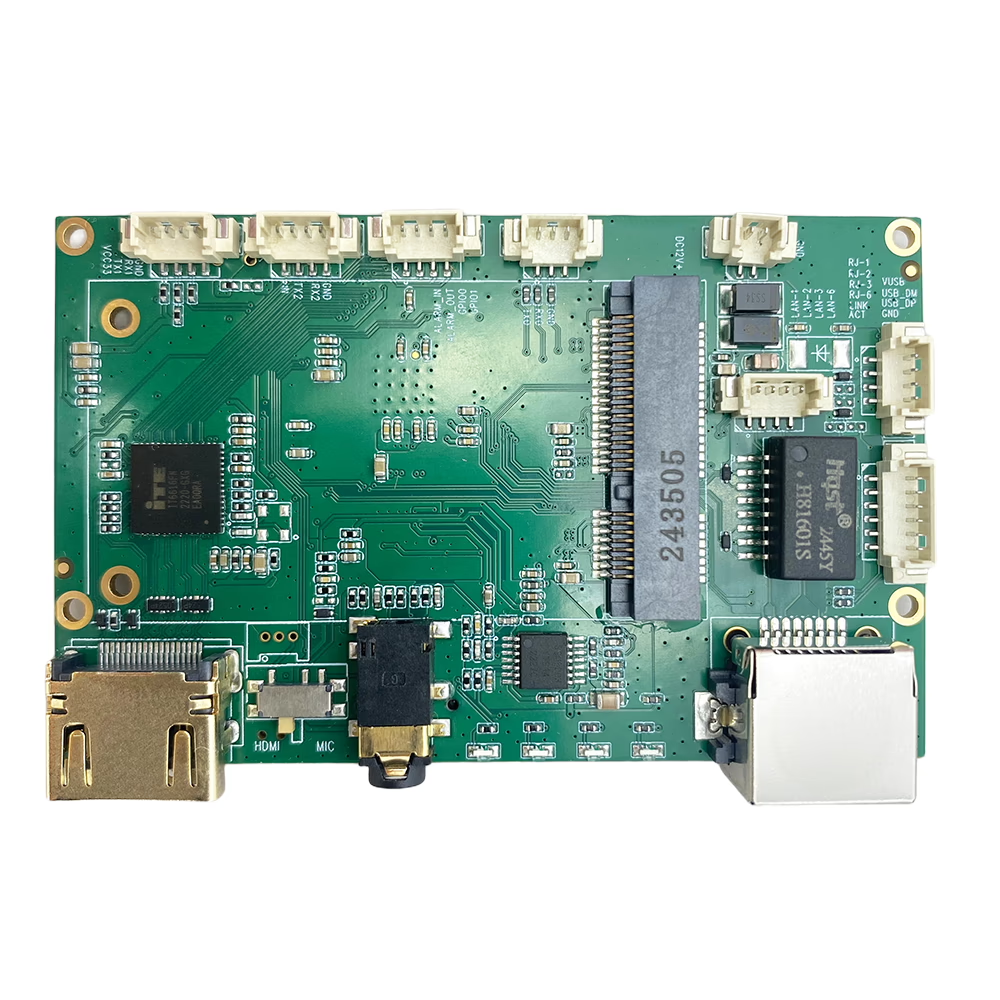
low-latency HDMI over Ethernet IP video stream converter
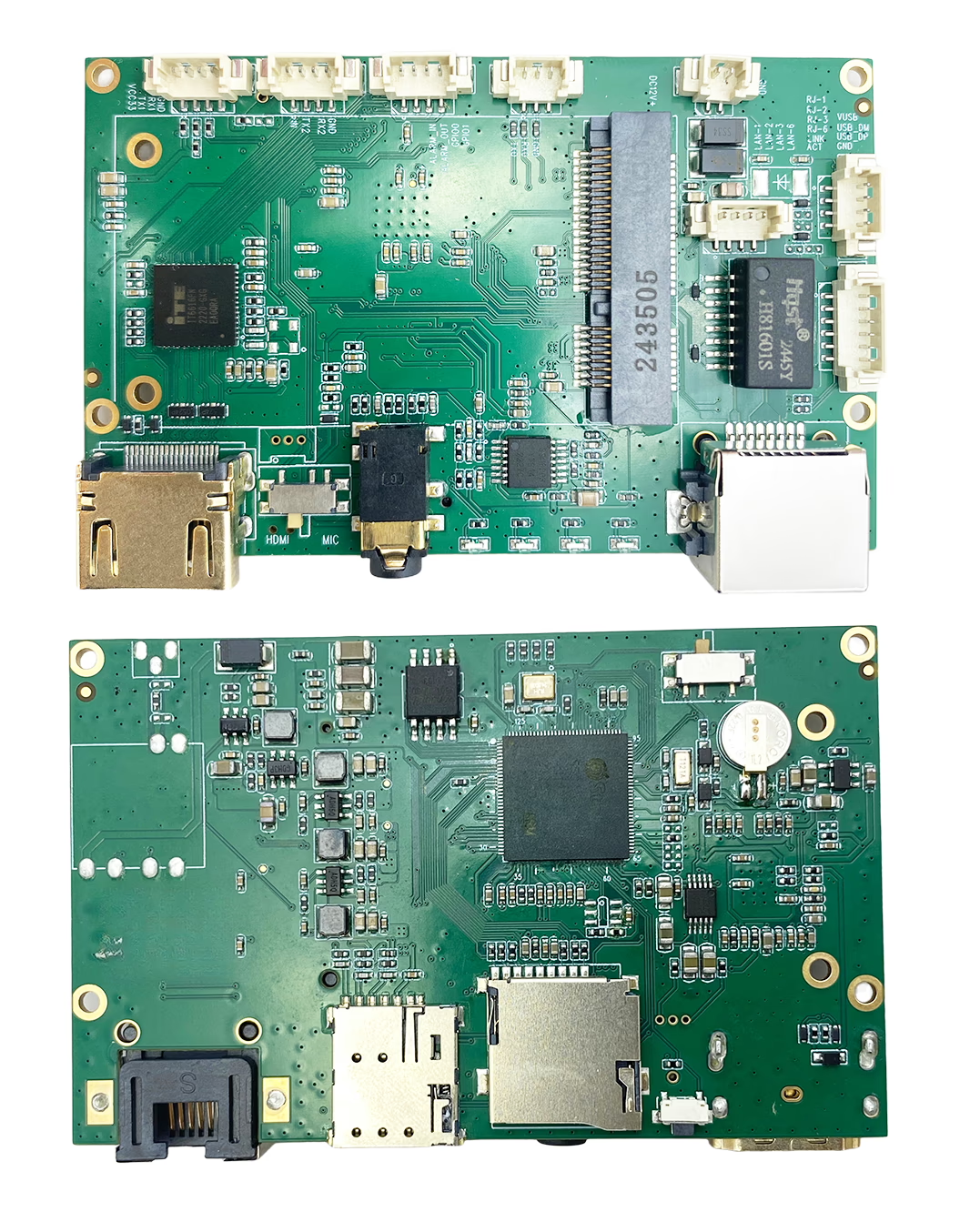
Table of Contents
Application Scenarios
This HDMI to IP video stream converter is suitable for a wide range of industries and environments that require efficient, stable, and high-quality video transmission. Typical applications include:
-
Broadcasting & Live Events
Used for live streaming concerts, conferences, sports events, and church services, delivering high-definition HDMI video over wired or wireless networks. -
Security & Surveillance
Integrates with IP cameras and monitoring platforms to transmit HDMI video from DVRs, NVRs, or other security systems for remote surveillance and centralized control. -
Industrial & UAV Video Transmission
Enables real-time HDMI video streaming from unmanned aerial vehicles (UAVs), robots, or industrial machines for remote inspection, monitoring, and control. -
Medical Imaging & Telemedicine
Supports the transmission of high-definition medical imaging (such as ultrasound or endoscopy) to remote specialists for diagnosis, training, and consultation. -
Education & Training
Facilitates video transmission for e-learning, distance education, and training sessions, allowing teachers or trainers to share HDMI content seamlessly with remote participants. -
Government, Military & Emergency Response
Provides reliable video transmission in mission-critical environments such as command centers, field operations, disaster response, and law enforcement. -
Corporate & Business Presentations
Simplifies video distribution for boardrooms, large displays, and remote meetings by streaming HDMI content directly over wired or wireless networks.
Features
-
Advanced Video Encoding
Supports H.265 and H.264 compression standards, delivering high-definition video quality at ultra-low bitrates. -
Flexible Video Input Resolutions
Compatible with multiple resolutions, including 1920×1080 @ 60/50/30/25 fps and 1280×720 @ 60/30/25 fps, ensuring wide adaptability for different video sources. -
Automatic HDMI Source Detection
Automatically recognizes and switches between HDMI video sources for seamless operation. -
Two-Way Audio Intercom
Built-in support for bi-directional voice communication, enabling interactive monitoring and remote coordination. -
Multiple Protocols Supported
Fully compatible with RTSP, ONVIF, GB28181, MQTT, WebRTC, and other streaming and IoT protocols for easy integration. -
Remote Monitoring & SDK Support
Provides real-time remote viewing via mobile phones and PCs, with an open SDK for secondary development and customization. -
Flexible Power Options
Supports DC 6–12V input and Power-over-Ethernet (PoE) for simplified deployment. -
Wired & Wireless Networking
Comes with Ethernet connectivity by default, expandable to Wi-Fi, 4G, or 5G networks depending on application needs. -
Local Storage Capability
Supports TF card recording up to 512GB for local video storage and backup.
Specifications
-
Main Processor
SSC338Q with 0.5T computing power -
Video Conversion Chip
Dedicated HDMI HD video conversion chip -
Video Processing
-
Supports H.264 / H.265 encoding
-
Bitrate adjustable: 0.1 Mbps – 8 Mbps
-
Frame rate adjustable: 1 – 60 fps
-
-
Video Output
-
Main Stream: 1920×1080@60fps, 1280×720@60fps, 1280×1024@30fps
-
Sub Stream: D1, VGA, 640×360
-
-
Audio Processing
-
G.711 / AAC encoding
-
Supports two-way audio intercom
-
-
Image Capture
-
Supports continuous, scheduled, and event-triggered snapshots
-
-
Business Functions
-
OSD overlay
-
Motion detection
-
Human shape detection
-
Customizable intelligent algorithms
-
-
Interfaces
-
Reset Button: 1 × hardware reset interface
-
USB Port: 1 × USB, supports Wi-Fi / 4G / 5G modules, customizable UVC function
-
Network Port: 1 × RJ45 (10/100M adaptive), with surge and ESD protection
-
Audio Port: 1 × 4-pole headphone jack, supports headphone output and microphone input
-
Serial Ports: 2 × TTL, support Beidou / GPS positioning and transparent data transmission for IoT integration
-
TF Card Slot: 1 × TF card, up to 256GB
-
-
Network Protocols
TCP/IP, IPv4, RTSP, HTTP, DHCP, NTP, RTMP, MQTT, WebRTC -
Remote Monitoring
-
Supports mobile phone and PC remote monitoring
-
Open SDK for P2P / WebRTC integration with multiple platforms
-
-
Power Supply
DC 5.5V – 24V input or PoE power supply -
Operating Environment
-
Temperature: -20℃ ~ +80℃
-
-
Physical Dimensions
80 × 50 × 12 mm (customized board shapes available)

Customizable Options
-
Video Encoding & Processing
-
Choice of H.264 / H.265 codec optimization
-
Adjustable bitrate, frame rate, and resolution profiles
-
Custom intelligent video analytics (motion detection, human detection, AI algorithms)
-
-
Video Input & Output
-
Resolution and frame rate configurations (Main/Sub stream)
-
Flexible stream formats to match specific application needs
-
-
Audio Features
-
Codec selection (G.711 / AAC)
-
Two-way intercom customization and noise reduction algorithms
-
-
Network & Protocols
-
Support for additional streaming protocols beyond RTSP, RTMP, ONVIF, GB28181, MQTT, WebRTC
-
Private/custom protocol integration for specific platforms
-
-
Hardware Interfaces
-
USB interface functions (Wi-Fi, 4G, 5G module integration, UVC customization)
-
Serial port expansion and IoT data integration (GPS, Beidou, sensor data)
-
Network port protection and interface type (RJ45 / industrial connectors)
-
-
Power Supply
-
Wide voltage input range adjustment
-
PoE customization (standard or non-standard)
-
-
Storage Options
-
TF card maximum capacity expansion (beyond 256G, up to 512G if required)
-
Recording formats and storage management functions
-
-
Mechanical & Form Factor
-
Board size and structure customization (80×50×12mm standard, or tailored PCB/metal housing design)
-
Heat dissipation and ruggedized design for industrial or UAV applications
-
-
Software & SDK
-
Secondary development SDK customization (API, P2P, WebRTC integration)
-
Cloud platform docking and mobile app integration
-
-
Wireless Transmission
-
Expansion to Wi-Fi, 4G, or 5G modules depending on customer needs
-
Antenna options and frequency band customization
-
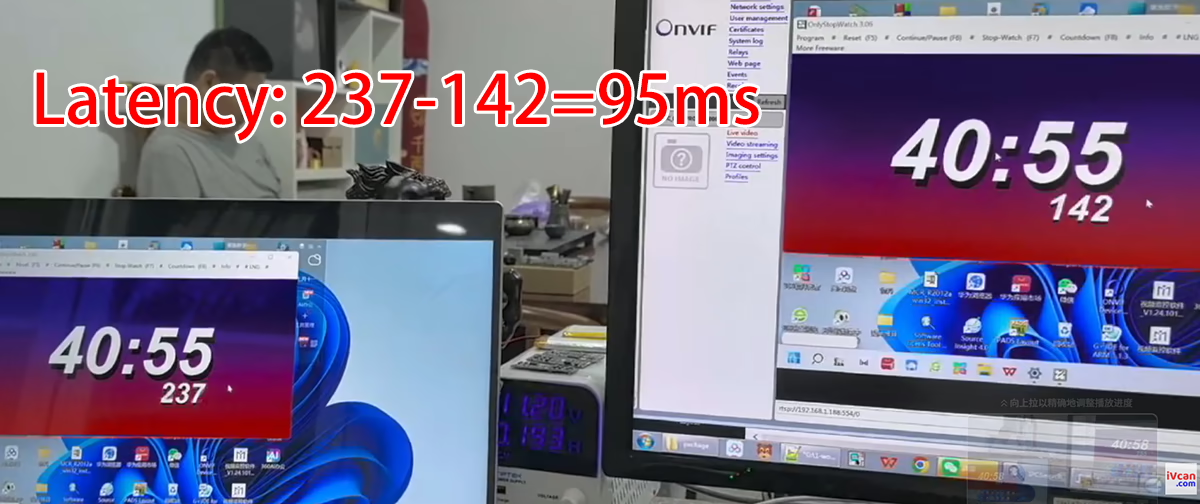
How to test the latency
To evaluate the transmission latency of the HDMI to IP video stream converter, the following test setup and method were used:
-
Test Setup
-
Video Source: A computer running a stopwatch application with millisecond precision.
-
Display 1 (Reference): The computer monitor directly showing the stopwatch (real-time source).
-
Display 2 (Test): A video player connected via wired Ethernet, receiving the HDMI-to-IP video stream output from the converter.
-
-
Testing Method
-
Play the stopwatch on the computer (source).
-
Observe both Display 1 (direct HDMI output) and Display 2 (network video stream playback) simultaneously.
-
Pause the video at any frame where both stopwatch displays are visible.
-
Record the time shown on Display 1 (source) and Display 2 (network playback).
-
Subtract the two values to obtain the end-to-end latency of the HDMI to IP video stream.
-
-
Result Interpretation
-
The difference in milliseconds represents the actual transmission latency.
-
Multiple measurements at different time points should be taken and averaged for higher accuracy.
-
This test method is suitable for evaluating real-time streaming performance in applications such as UAV transmission, live broadcasting, remote monitoring, and interactive video systems.
-
How to test the latency
The following video demonstrates a latency test for converting HDMI video to a network stream. A millisecond-level stopwatch is shown on one computer, whose HDMI output is connected to the converter board. The board encodes the video and transmits it over the network to a second computer. Using an RTSP player, the video stream—including the stopwatch—can be viewed in real time. Playback can be paused at any moment to compare the timestamps on both screens; the difference between them reflects the latency introduced by the HDMI-to-network encoder.
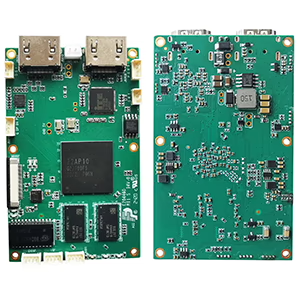
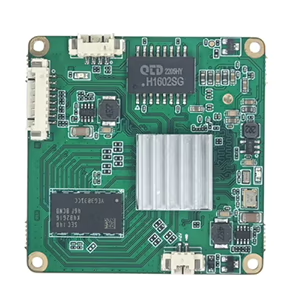
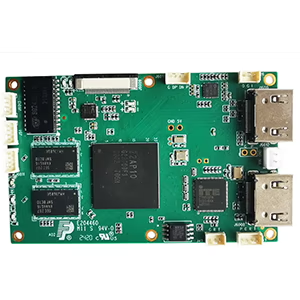
Encoder Modules Boards
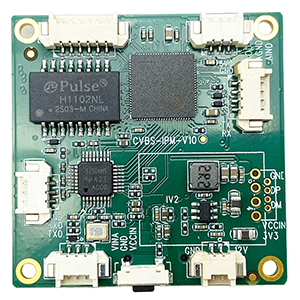
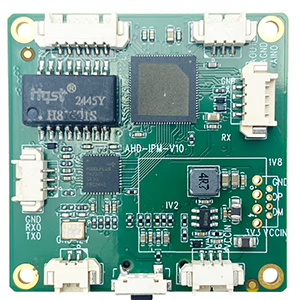
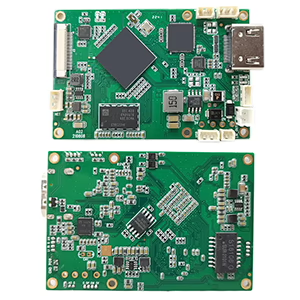
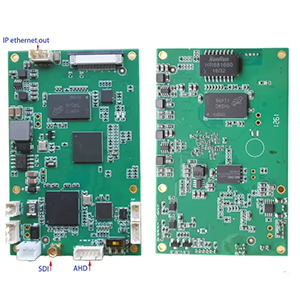
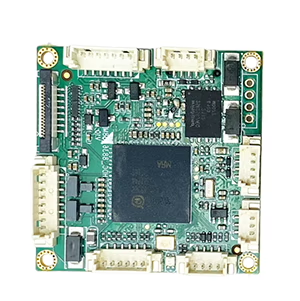
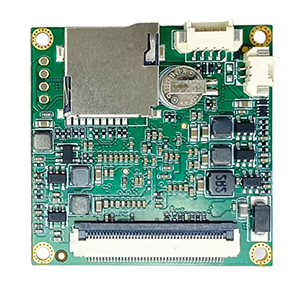
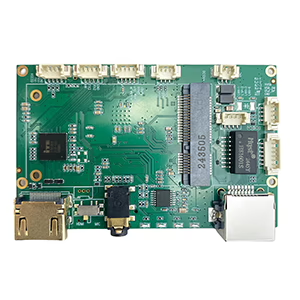
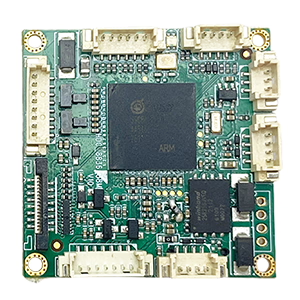
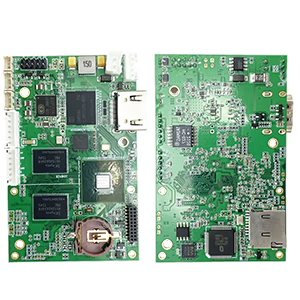
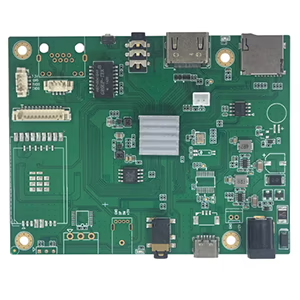
Decoder Modules Boards
Available for Customization
New Encoder Products
| No. | Product Name | Configuration | Key Features | Status |
|---|---|---|---|---|
| 1 | Dual-Channel USB UVC Visible Light Video Encoder | 2× USB input | Supports dual USB camera video encoding, and RTSP streaming; local CVBS/HDMI output; switchable display modes | Mass Production |
| 2 | Dual-Channel Encoder (1× USB Visible Light + 1× USB Thermal Imaging camera) | 2× USB input | Supports dual USB camera (visible + thermal) capture, encoding, and RTSP streaming; local CVBS/HDMI output; switchable display modes | Mass Production |
| 3 | RTSP Decoder HDMI/CVBS Display Module | HDMI + CVBS output | Supports up to 4×1080P@30fps RTSP stream decoding; Support video streaming protocol forwarding; HDMI/CVBS output display | Sample Available |
| 4 | RTSP Decoder HDMI/CVBS Display Module with 4.3"/5" LCD | HDMI output + LCD screen | Supports up to 4×1080P@30fps RTSP stream decoding; protocol forwarding; HDMI/CVBS output display | Debugging |
| 5 | Dual-Channel Encoder (1× USB Visible Light + 1× CVBS Analog) | 1× CVBS + 1× USB UVC input | Dual video (USB + CVBS), encoding and RTSP streaming; local CVBS/HDMI output; switchable display modes | Debugging |
| 6 | Dual-Channel Encoder (1× USB UVC + 1× AHD Analog) | 1× AHD + 1× USB UVC input | Dual video capture (USB + AHD), encoding and RTSP streaming; local CVBS/HDMI output; switchable display modes | Debugging |
| 7 | Dual-Channel Encoder (1× CVBS + 1× AHD Analog Video) | CVBS + AHD 2 video input | Dual analog video capture, encoding and RTSP streaming; local CVBS/HDMI output; switchable display modes | Debugging |
| 8 | Dual-Channel Encoder (1× CMOS Camera + 1× USB Thermal Imaging camera) | 1× USB interface | Supports CMOS + USB thermal camera capture, encoding and RTSP streaming; local CVBS/HDMI output; switchable display modes | Mass Production |
For customized video input/output conversion solutions not listed in our products, please contact us for OEM/ODM support. We can develop tailored products based on your requirements.



iVcan.com –
I have been using this low-latency HDMI over Ethernet IP video stream converter for several months, and it performs exceptionally well. The video quality is consistently sharp and smooth, with minimal end-to-end latency, making it ideal for UAV video transmission, live broadcasting, and remote monitoring applications. H.264/H.265 encoding ensures efficient bandwidth usage without sacrificing clarity, and the built-in two-way audio intercom is very convenient for interactive setups. Setup is straightforward via Web UI or SDK, and it supports both wired and wireless networks. Highly reliable and professional-grade for any real-time HDMI streaming application.