





Table of Contents
Real Customer Requirement
Recently, a customer approached us with the following application scenario:
- Application: Underground mining camera communication
- Installation depth: Receiver placed at 60 meters underground
- Transmission distance: Approx. 300 meters between TX and RX
- Environment: Underground mine tunnel
- Certification requirement: FLP (Flameproof) certified
- Purpose: Real-time video monitoring
This is a highly specialized and challenging wireless communication environment. In this article, we will explain whether COFDM wireless video transmission can work in underground mines, what system components are required, and how customers should select the right solution.
1. Can COFDM Wireless Video Work in Underground Mines?
Short Answer:
Yes — but only with proper engineering design and safety certification.
COFDM (Coded Orthogonal Frequency Division Multiplexing) is widely used in professional wireless video systems because it:
- Performs well in non-line-of-sight (NLOS) environments
- Handles multipath reflections effectively
- Provides stable digital video transmission
- Supports low latency real-time monitoring
Underground tunnels typically have severe multipath reflections, which makes COFDM technically suitable compared to analog systems.
However, underground mining environments introduce additional challenges:
- Rock and soil RF attenuation
- Tunnel bends and obstacles
- High humidity
- Metal equipment interference
- Explosive gas presence
Wireless propagation underground is much harsher than open-space NLOS environments.
If the tunnel is relatively straight, 300 meters may be achievable.
If there are multiple turns or rock obstructions, signal degradation can be significant.
Field testing is strongly recommended. COFDM-912T


2. The Most Critical Requirement: FLP Certification
In mining environments, especially coal mines, equipment must comply with explosion protection standards.
FLP (Flameproof) certification means:
- The equipment enclosure can withstand internal explosions
- It prevents ignition of surrounding flammable gases
- It is approved for hazardous environments
Most commercial COFDM wireless video transmitters used for UAVs, robotics, or industrial monitoring:
- Are NOT FLP certified
- Cannot be directly deployed underground in mines
- Do not meet intrinsic safety requirements
If FLP is mandatory, you must choose:
- A transmitter and receiver designed with flameproof housing
- Or an intrinsically safe certified system
- Or integrate the module into an approved explosion-proof enclosure
Without proper certification, the system cannot legally or safely operate underground.

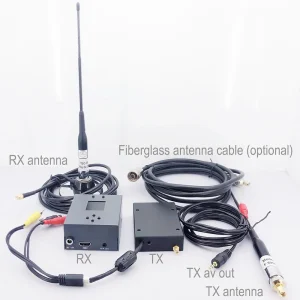

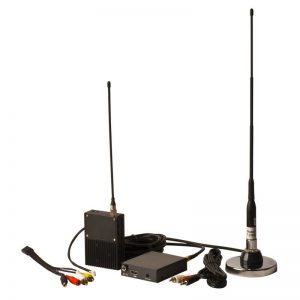
Video Transmitter
3. Frequency Selection – A Key Engineering Decision
Frequency selection determines whether 300 meters is feasible.
| Frequency Band | Penetration Performance | Recommendation |
|---|---|---|
| 2.4 GHz | Poor underground | Not recommended |
| 1.2 GHz | Moderate | Limited use |
| 900 MHz | Good | Recommended |
| 400–600 MHz | Best penetration | Ideal for mining |
Lower frequencies provide better penetration in rock and tunnel environments.
For underground mining applications, systems below 900 MHz are strongly recommended.
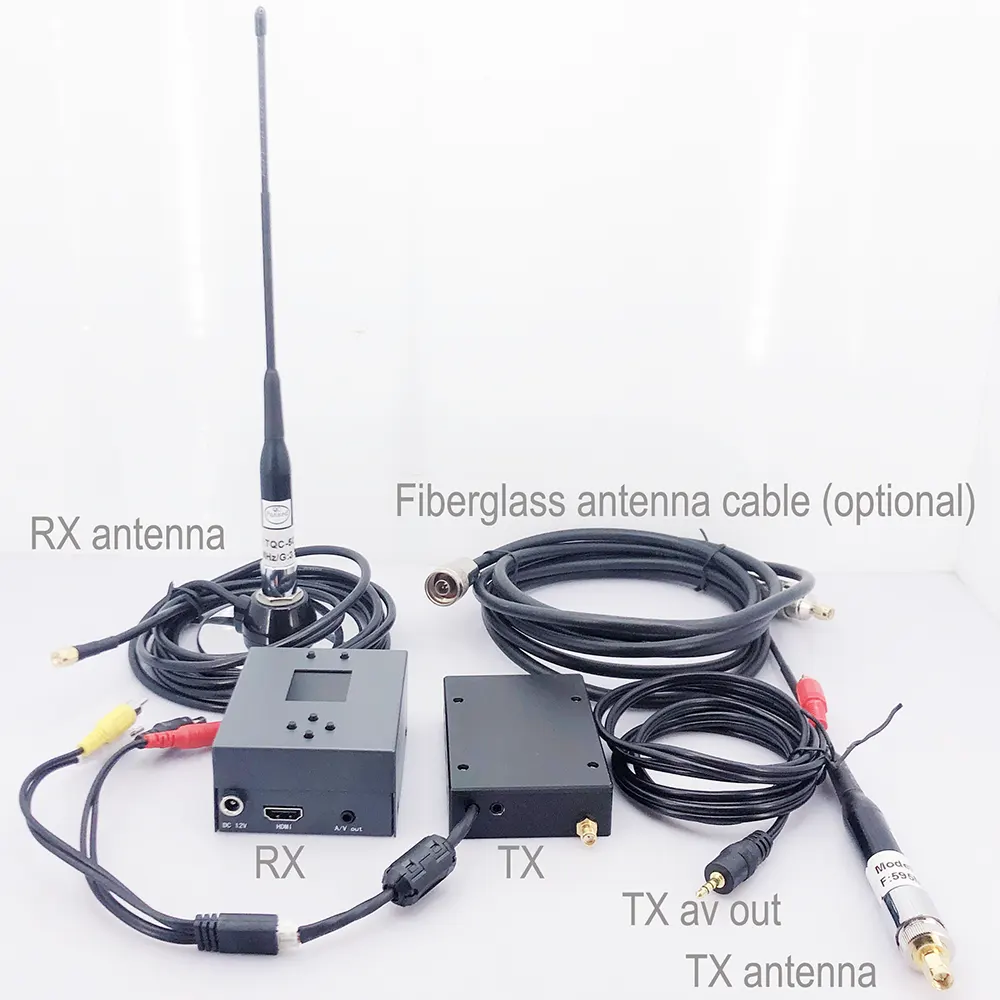
4. Complete System Architecture
A proper underground wireless video system should include:
1) Explosion-Proof Camera
- Mining-rated camera
- HDMI or CVBS output
- Flameproof housing
2) COFDM Transmitter
- Adjustable frequency
- 1W or higher output power
- H.264 or H.265 encoding
- Optional AES encryption
- Installed inside FLP enclosure
3) Antenna System
- Omnidirectional antenna for tunnel coverage
- Or directional antenna for straight tunnels
- Proper impedance matching
4) Power System
- Stable DC 12V / 24V
- Explosion-proof power supply
5) COFDM Receiver
- Diversity reception (dual antenna preferred)
- HDMI output to monitor or DVR
- Installed in safe zone or control room
6) Optional Repeaters
If the tunnel has bends or long distance:
- RF repeaters may be required
- Or distributed antenna systems
5. Technical Risks to Consider
Even with COFDM, potential risks include:
- Severe attenuation in dense rock
- Dead zones behind tunnel bends
- Moisture-related signal degradation
- Regulatory RF limitations
- Electromagnetic interference
For mission-critical monitoring systems, on-site RF testing is essential.
6. Alternative Mining Communication Solutions
In many mining projects, companies prefer:
- Leaky feeder systems
- Fiber optic backbone + explosion-proof wireless AP
- Dedicated underground communication networks
These systems offer:
- Higher reliability
- Wider coverage
- Easier compliance with safety standards
For large-scale or permanent installations, fiber-based solutions may be more stable than standalone wireless links.
7. Market Availability
Standard COFDM wireless video transmitters are widely available in the market for:
- UAV applications
- Robotics
- Law enforcement
- Industrial monitoring
However:
FLP-certified COFDM systems are rare.
Most require customization and certification processes.
Certification timelines can range from 6–12 months.
Cost is significantly higher than standard industrial models.
8. Final Recommendation
If you are planning a wireless video system for underground mining:
- Confirm whether FLP or intrinsic safety certification is mandatory.
- Choose frequencies below 900 MHz.
- Ensure output power is sufficient (≥1W recommended).
- Use diversity receivers and proper antenna design.
- Conduct on-site RF testing before mass deployment.
- Consider repeaters if tunnels are curved.
- Evaluate fiber-based alternatives for long-term infrastructure.
Conclusion
COFDM wireless video transmission can work in underground mining environments — but only with proper frequency selection, adequate power, professional antenna planning, and strict compliance with explosion-proof certification requirements.
Underground mining communication is not a typical wireless deployment scenario. It requires engineering-level planning rather than off-the-shelf installation.
If you are facing similar requirements, it is highly recommended to consult with a supplier experienced in mining communication systems to ensure safety, reliability, and regulatory compliance.
Video Transmitter
1. Description of the Underground Tunnel Environment
Underground mining and subsurface tunnel environments are significantly different from typical industrial or outdoor wireless deployment scenarios.
Depending on the region and industry terminology, this environment may be described as:
- Underground mine tunnel
- Mining gallery
- Drift or decline
- Shaft access tunnel
- Subsurface corridor
- Underground workings
- Confined underground space
- Hazardous classified area
- Gassy mine environment (coal mining)
Although terminology varies across countries, the physical conditions are similar.
Typical Environmental Characteristics
- Confined and Enclosed Space
Mining tunnels are narrow, elongated corridors with limited cross-section. The geometry strongly influences radio wave propagation. - High Humidity and Water Presence
Many mines have groundwater seepage, wet walls, and high humidity levels, which increase RF attenuation. - Irregular Rock Surfaces
Tunnel walls are rarely smooth. Rough rock surfaces cause severe multipath reflections and scattering. - Metallic Infrastructure
Rail tracks, conveyors, ventilation ducts, steel mesh, pipes, drilling equipment, and vehicles create additional signal reflections and shadowing. - Explosive Gas or Dust Risk
In coal mines and certain metal mines, methane (CH4), coal dust, or other flammable gases may be present. These environments are often classified as:- Hazardous location
- Flameproof required area
- Explosion-proof zone
- Intrinsically safe zone
- Long Linear Geometry
Tunnels often extend hundreds or thousands of meters in a linear direction with bends, intersections, and branch galleries.
2. Wireless Video Transmission Challenges in Underground Tunnels
Wireless communication in underground mining environments presents unique engineering challenges.
1) Severe Signal Attenuation
Rock, soil, and mineral composition absorb radio frequency energy.
Higher frequencies (e.g., 2.4 GHz or 5.8 GHz) experience significant attenuation underground.
Signal strength may drop rapidly, especially if:
- The tunnel is not straight
- The transmitter and receiver are separated by rock mass
- There are multiple corners or junctions
2) Non-Line-of-Sight (NLOS) Propagation
In most underground cases, the transmitter and receiver do not have clear line-of-sight.
Signal transmission relies on:
- Reflection
- Diffraction
- Waveguide effects inside tunnels
This makes the environment highly unpredictable without field testing.
3) Severe Multipath Interference
Tunnel walls, ceiling, floor, and metal objects reflect RF signals.
This causes:
- Fading
- Phase distortion
- Inter-symbol interference
- Signal fluctuation
Although COFDM modulation handles multipath better than analog systems, extreme underground reflections can still reduce reliability.
4) Dead Zones and Blind Spots
Tunnel bends, intersections, and elevation changes create:
- Shadow areas
- RF null points
- Signal blockage zones
In such cases, repeaters or distributed antenna systems may be required.
5) Regulatory and Safety Constraints
Underground mines are typically regulated under strict safety standards:
- ATEX (Europe)
- IECEx (International)
- MSHA (USA)
- FLP (Flameproof)
- Intrinsically Safe (IS) requirements
Wireless equipment must not create ignition risks in explosive atmospheres.
This limits:
- Transmission power
- Device design
- Enclosure type
- Heat dissipation options
6) Electromagnetic Interference (EMI)
Mining equipment such as:
- Drilling machines
- Electric motors
- Conveyor systems
- Ventilation fans
- Power distribution lines
Can generate electromagnetic noise that affects wireless video stability.
7) Power and Infrastructure Limitations
In remote underground sections:
- Power availability may be limited
- Network backbone may not exist
- Fiber deployment may be expensive
- Maintenance access may be difficult
This increases system design complexity.
3. Why Standard Wireless Video Systems Often Fail Underground
Many commercial wireless video transmitters are designed for:
- UAV applications
- Open-field surveillance
- Urban line-of-sight monitoring
- Robotics in industrial plants
These systems assume:
- Open-air propagation
- Minimal absorption
- Moderate multipath
- No explosive gas restrictions
Underground mining does not meet these assumptions.
As a result:
- Range is dramatically reduced
- Stability becomes unpredictable
- Certification compliance becomes mandatory
4. Engineering Considerations for Underground Wireless Video
To improve performance in mining tunnels, system design should consider:
- Lower Frequency Bands (typically below 900 MHz)
- Adequate Transmission Power (within regulatory limits)
- Diversity Reception
- Optimized Antenna Placement
- Tunnel Geometry Analysis
- On-site RF Testing
- Explosion-Proof Certification Compliance
- Possible Use of Repeaters or Distributed Systems
5. Global Demand for Underground Wireless Monitoring
Although terminology differs by country, the demand is global:
- Coal mining operations
- Metal ore mining
- Underground transportation tunnels
- Hydropower tunnels
- Subway construction
- Utility inspection tunnels
- Military underground facilities
All share similar RF challenges.
Customers may describe their needs using different expressions, but the technical core remains the same:
Reliable, low-latency, explosion-safe wireless video transmission in confined underground environments.
Ask A Question
Thank you for your response. ✨