




COFDM RF Modulator and demodulator module demand:
- Modulation module supporting h.264 and h.265 encoding,
- Demodulator module supporting h.264 and h.265 decoding,
- Tx+RX firmware option: Proprietary H.264 video compression uses only p-frames for the lowest latency
- Tх+Rx firmware option: HDMI+AV interface video input, two-way video compression transmission
- AES-256 encryption/decryption for HDMI and CVBS input
- Full control over COFDM parameters, bandwidth configurable from 1MHz to 8MHz in 1KHz steps; FEC 1/2, 2/3, 3/4, 5/6, 7/8; Guard interval 1/32, 1/16, 1/8, 1/4; constellation QPSK, 16QAM, 64QAM; bit rate 0.5Mbps to 31.67Mbps
- RTCP and UDP protocols for Rx video output
COFDM RF Modulator and Demodulator firmware compare
Table of Contents
Hardware modulator
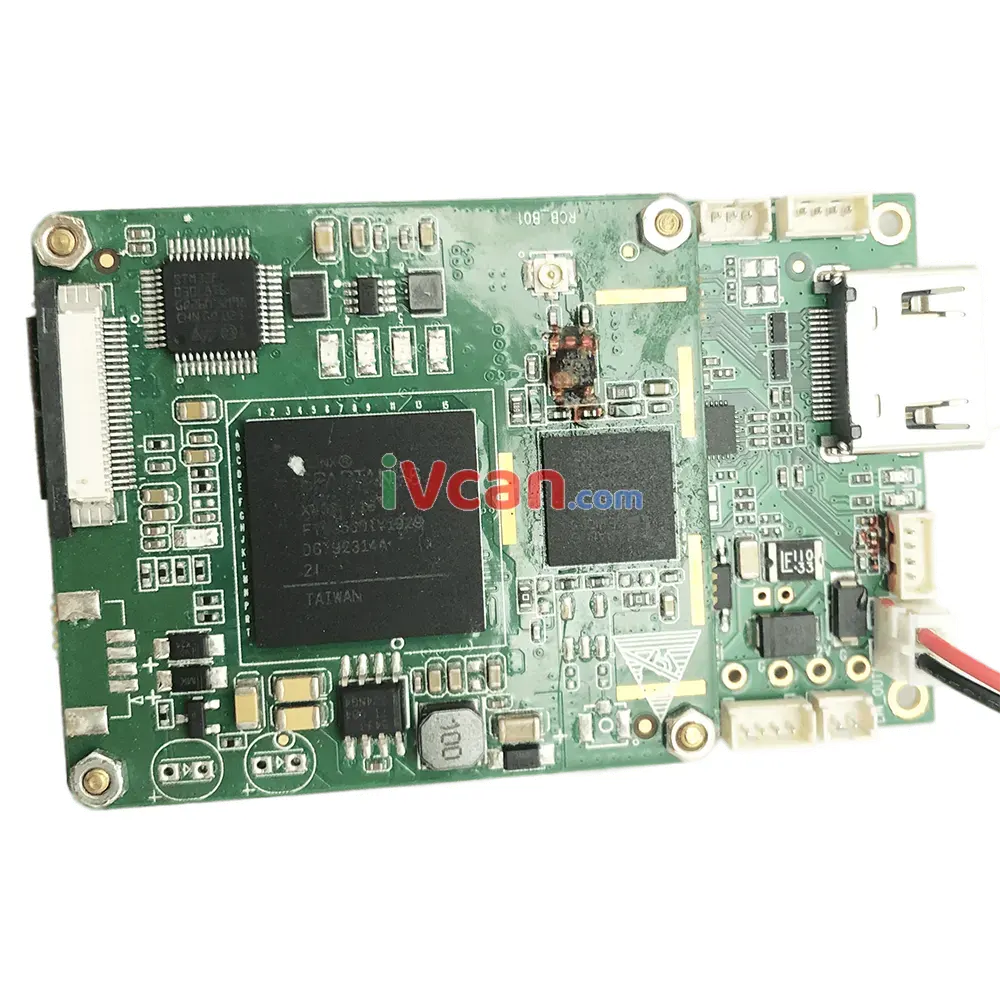
COFDM Modulator Encoder Transmitter Module:
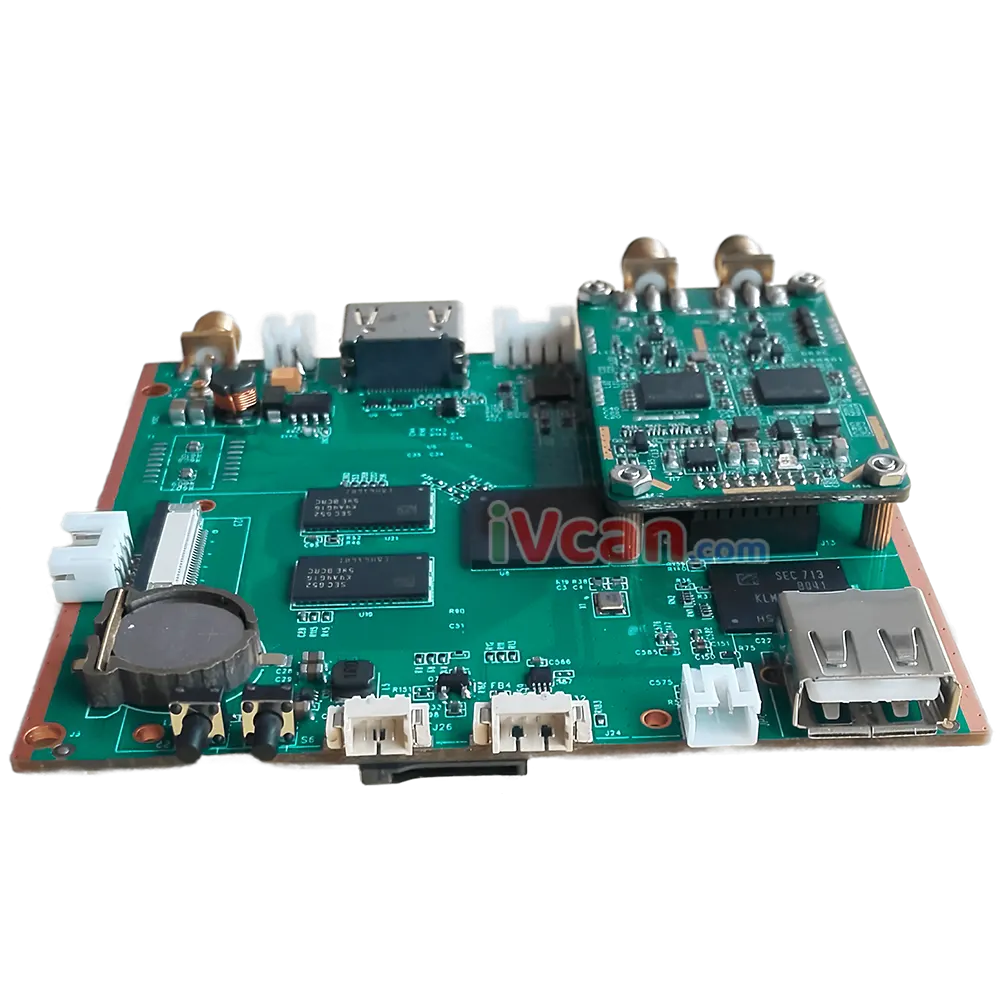
COFDM Demodulator Decoder Receiver Module:
H264

H265
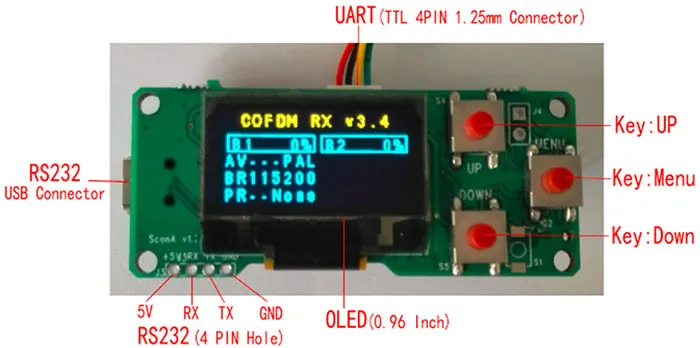
Parameter Configuration Board:
UART firmware command
Encoder Modulator Decoder Demodulator Module Parameter Configuration Instructions
Hardware and Firmware Compare
1. COFDM modulator encoder Transmitter Tx Module:
| Hardware | Vcan1776TX |
| Normal setting | Wireless parameter\bitrates\password\…\ setting via SconC or AT command |
| AES | AES256 |
| About bitrates | COFDM wireless link itself supports 0.5Mbps to 31.67Mbps But to ensure good video quality and the wireless transmitting distance, the video encoding bitrates are limited to less than 15Mbps. |
| Firmware | F1 (USB disk to do: F2 update to F1) | F2 (USB disk to do: F1 update to F2) |
| Function | Only support HDMI or AV input(one video) A. Proprietary H.264 video compression only used p-frames for lowest latency B. Normal H.264 video compression C. Normal H.265 video compression AT command to switch between A/B/C | support HDMI + AV input (two videos) Normal H.265 video compression for two video |
2. COFDM demodulator decoder Rceiver Rx Module:
| Hardware | Vcan1776RX-H264 |
| Function | support HDMI + AV output Built-in RTSP server enables video streaming out over Ethernet A. Proprietary H.264 video decompression only used p-frames for lowest latency. B. Normal H.264 video decompression AT command to switch between A/B |
| Normal setting | Wireless parameter\password\…\ setting via SconC or AT command |
| AES | AES256 |
| Hardware | Vcan1776RX-H265 |
| Function | support HDMI + AV output |
| Normal setting | Wireless parameter\bitrates\password\…\ setting via SconC or AT command |
| AES | AES256 |
| Firmware | F1 (TF card to do: F2 update to F1) | F2 (TF card to do: F1 update to F2) |
| Function | Built-in RTSP server enables video streaming out over Ethernet; A. Normal H.264 video decompression B. Normal H.265 video decompression AT command to switch between A/B | Normal H.265 video decompression for two videos Do not support built-in RTSP server |
COFDM Tx and Rx paired table:
| Firmware and function | Vcan1776TX | Vcan1776RX-H264 | Vcan1776RX-H265 |
| H.264 low latency | F1 -A | A | × |
| Normal H.264 | F1 -B | B | F1-A |
| Normal H.265 | F1-C | × | F1-B |
| Two videos H.265 | F2 | × | F2 |
Price Compare
| Module Model | Unit Price | Quantity | Total |
| Vcan1776TX | $680 | 21 | $1360 |
| Vcan1776RX-H264 | $350 | 1 | $350 |
| Vcan1776RX-H265 | $350 | 1 | $350 |
| Parameter Configuration Board | $40 | 2 | $80 |
For the modulator encoder transmitter TX module, Please consider buying 2 sets of Vcan1776TX, one for F1 firmware and one for F2 firmware, for easy test comparison.
For the demodulator decoder Receiver RX module, please consider buying one H264 and one H265 to compare.
COFDM RF Modulator and Demodulator firmware compare
COFDM demodulator datasheet
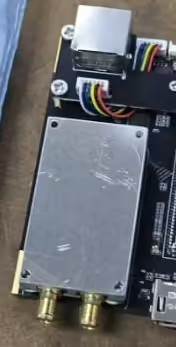
Question: Do you have the dimensions of the shielding cover for the RF module?
Answer:
FAQ
Q1: Please provide the following technical information:
I’m currently evaluating the parameters of your COFDM modulator. For a better understanding of your device, please provide the following technical information:
- FFT size
- Number of active subcarriers used for data transmission
- Occupied bandwidth or actual spectral bandwidth at 90% OBW
- PAPR (peak-to-average power ratio)
A1: Please check the reply from our engineer.
- FFT size: 2047
- Number of active subcarriers used for data transmission: 1705 active subcarrier(inclue pilot)
- Occupied bandwidth or actual spectral bandwidth at 90% OBW: 7.6Mhz in 8Mhz Channel.
- PAPR (peak-to-average power ratio): ~10.7db
Q: Does your COFDM video transmitter support dual video input simultaneous encoding and transmission?
Yes. Our COFDM transmitter supports simultaneous encoding and transmission of two video inputs at the same time.
The supported dual-input combinations are:
- HDMI + CVBS
- SDI + CVBS
Both video channels can be encoded and transmitted simultaneously through one transmitter system.
Q: What receiver options are available for dual video transmission?
We currently offer two receiver options for dual-channel video applications:
Receiver Option 1 – Dual Video Picture-in-Picture (PIP) Display
Features:
- Supports simultaneous decoding and display of two video channels
- Supports Picture-in-Picture (PIP) viewing mode
- Video outputs:
- HDMI output
- CVBS output
- Designed for connection to standard monitors/displays
Limitations:
- Does not support network video streaming output
- No RTSP or UDP streaming via Ethernet
- Cannot output video streams directly to a computer over LAN
Recommended for:
Users who need to monitor two video channels simultaneously on a display screen.
Receiver Option 2 – Network Streaming Receiver
Features:
- Supports Ethernet video streaming output
- Supports:
- RTSP streaming
- UDP streaming
- Can output video streams directly to a computer via network cable
- Includes a physical button to switch between Channel 1 and Channel 2 video streams
Limitations:
- Does not support simultaneous dual-channel PIP display
- Only one video channel can be viewed/output at a time
Recommended for:
Users who require IP streaming, computer integration, or software decoding/recording.
Q: Which receiver should I choose?
- If you need to view both video channels simultaneously on a monitor, we recommend Receiver Option 1 (PIP Receiver).
- If you need RTSP/UDP network streaming to a PC or software platform, we recommend Receiver Option 2 (Network Streaming Receiver).
Please let us know which receiver solution you prefer, and we will recommend the most suitable configuration for your project.
Ask A Question
Thank you for your response. ✨