






How to Use COFDM FDD Transceiver for Vehicle or Robot UAV Drone (Complete FAQ Guide)
Wireless communication is critical for unmanned ground vehicles (UGV), robots, UAV drones, and remote monitoring systems. A reliable solution for long-distance and low-latency communication is the COFDM FDD transceiver.
This guide answers common questions about how to use COFDM FDD transceiver for vehicle or robot UAV drone, including compatibility, frequency configuration, communication distance, data rate, video transmission, interfaces, and system security.
If you are designing a robot control system, unmanned vehicle network, or UAV drone communication link, this FAQ will help you understand how to deploy a COFDM wireless Ethernet transmission system effectively.
FAQ: How to Use COFDM FDD Transceiver for Vehicle or Robot UAV Drone
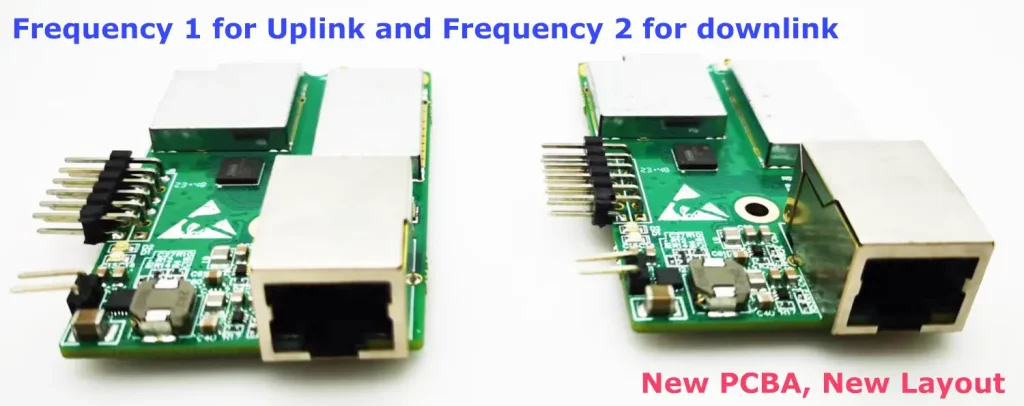
Table of Contents
What is a COFDM FDD transceiver and why is it used for robots or UAV drones?
A COFDM FDD transceiver is a wireless communication system designed for long-range digital transmission of data, video, and control signals.
COFDM technology provides several advantages:
- Strong resistance to interference
- Reliable transmission in complex environments
- Stable long-distance communication
- Low transmission latency
- High spectral efficiency
- Wideband FDD Operation with Independent Uplink/Downlink Frequencies
- The FDD transceiver supports independent configuration of uplink and downlink frequencies, enabling stable full-duplex communication.
- With a wide operating range from 175 MHz to 6000 MHz, the system offers exceptional flexibility for deployment in various frequency bands worldwide.
FDD (Frequency Division Duplex) allows simultaneous two-way communication, meaning a robot or drone can send video while receiving control commands at the same time.
This makes COFDM systems ideal for:
- Unmanned ground vehicles (UGV)
- Robotics platforms
- UAV drones
- Remote surveillance systems
- Long-range video transmission
How to use COFDM FDD transceiver for vehicle or robot UAV drone?
A typical COFDM wireless communication system includes two sides:
Vehicle or robot side (transmitter)
and
Operator control station (receiver).
Vehicle / robot side
Typical setup:
Camera → Video encoder (HDMI or CVBS camera need it, IP camera no need) → COFDM transmitter (including COFDM FDD transceiver module, power amplifier, bandpass filter, metal box) → Antenna
Control data from sensors or flight controller can also be sent through the RS232 data interface of the COFDM transmitter.
Ground control station
Typical setup:
COFDM receiver → Video decoder → Monitor or control computer
The operator receives:
- Live video
- Telemetry data
- Robot or drone status
At the same time, control commands can be sent back through the FDD return channel.

Can an analog FPV camera be connected to a COFDM FDD transceiver?
Analog FPV cameras cannot connect directly to a COFDM Ethernet module.
To transmit analog video, the system requires a video encoder.
Typical connection:
Analog FPV camera → AV / HDMI video encoder → Ethernet output → COFDM transmitter
At the receiver side:
COFDM receiver → Video decoder → HDMI / AV monitor
or
COFDM receiver → GCS or Computer, VLC player RTSP / UDP stream.
This allows the COFDM system to transmit digital IP video streams.
Can a Radiomaster TX12 controller work with a COFDM FDD transceiver?
A Radiomaster TX12 remote controller normally uses its own RF protocol.
Because of this, it cannot connect directly to a COFDM wireless Ethernet module.
However, there are possible integration methods:
- Using a flight controller or control computer that outputs telemetry or control signals via UART or Ethernet
- Sending control data through the COFDM FDD transceiver RS232, add RS232 – Sbus data converter board, If your Radiomaster TX12 controller has Sbus port.
Many robotics systems instead use:
- Ethernet control protocol
- Serial telemetry
- IP command systems
These work naturally with COFDM Ethernet links.
Do we need a computer on both sides of the system?
Not necessarily.
There are two common system architectures.
Embedded hardware solution
Vehicle side:
Camera
→ Encoder
→ COFDM transmitter
Ground station:
COFDM receiver
→ Decoder
→ Monitor
No computer required.
PC-based solution
Vehicle side:
Camera
→ Computer
→ COFDM transmitter
Ground station:
COFDM receiver
→ Computer
→ Video software
This approach is common for robot control platforms.
What frequencies are supported by a COFDM FDD transceiver?
Typical frequency ranges include:
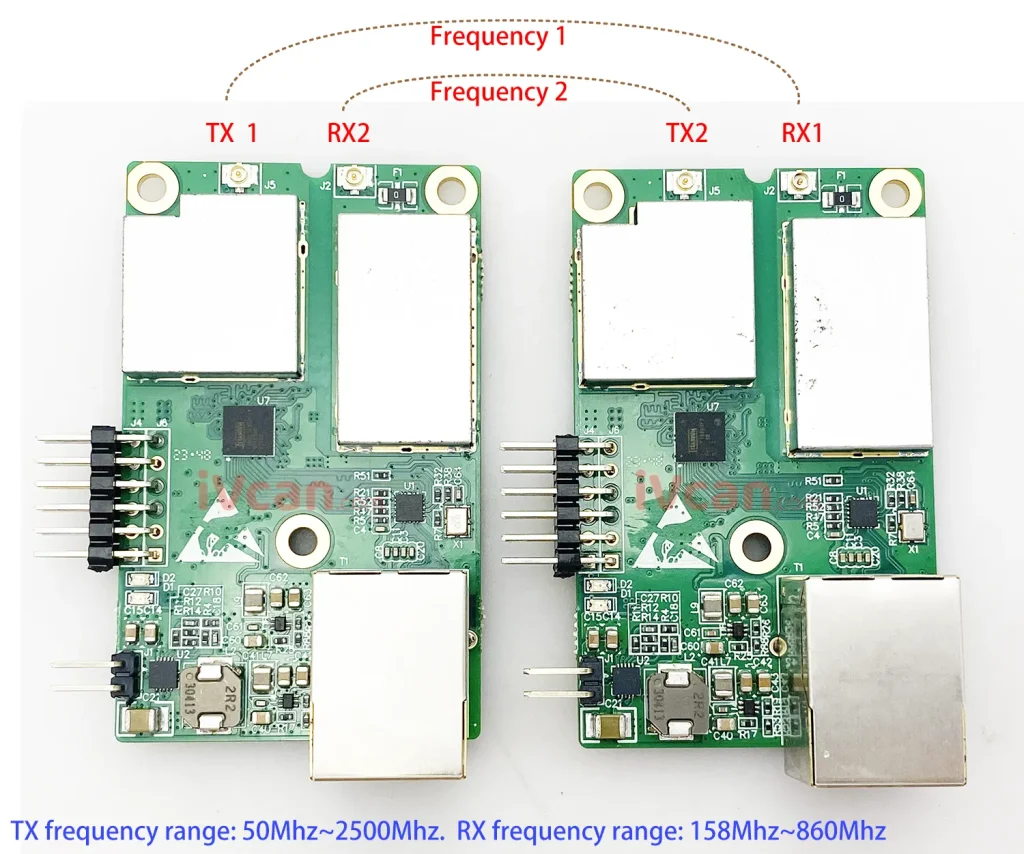
Transmitter frequency
50 MHz – 2.5 GHz
Receiver frequency
170 MHz – 860 MHz
To enable reception across the full transmitter frequency range, a BDC (Block Down Converter) is required to downconvert signals outside the receiver’s native band.
The frequency is user configurable through the device configuration interface.
Can the system operate at 470–790 MHz?
Yes.
The 470–790 MHz band is commonly used for long-distance COFDM communication.
Advantages include:
- Good propagation characteristics
- Moderate antenna size
- Strong obstacle penetration
- Long communication range
This band is widely used in:
- UAV data links
- robotic communication
- broadcast COFDM systems
Can the system operate at 156–162 MHz?
While the transmitter is capable of operating down to 50 MHz, the receiver chipset has a minimum supported frequency of 175 MHz. As a result, operation in the 156–162 MHz band is generally not recommended.
We suggest using frequencies in the 175–200 MHz range as the lowest operating band for reliable system performance.
Additionally, lower frequency operation may increase the risk of interference with other radio services or nearby equipment, depending on the environment.
Operation in the 156–162 MHz band may require custom RF configuration.
Lower frequencies offer:
- Better propagation
- Longer communication distance
- Improved performance in forests or mountains
However, antenna size becomes larger at lower frequencies.
How many wireless channels does the system support?
COFDM systems do not use fixed channel numbers like analog radios.
Instead, channels are defined by:
- Frequency selection
- Bandwidth configuration
- Frequency step size
Typical frequency step:
100 kHz
This allows many different channel configurations.
Multiple systems can operate simultaneously by selecting different frequencies.
What is the data transmission rate of a COFDM FDD transceiver?
The data rate depends on:
- Channel bandwidth
- Modulation scheme
- Signal quality
Typical values:
| Bandwidth | Data Rate |
|---|---|
| 2 MHz | 2 – 8 Mbps |
| 4 MHz | 5 – 15 Mbps |
| 8 MHz | up to 30 Mbps |
Maximum Ethernet throughput is approximately 30 Mbps.
What is the transmission latency?
COFDM wireless link latency is typically very low.
Typical wireless transmission delay:
7 – 30 milliseconds
Total system delay depends on:
- video encoding
- decoding
- network buffering
Typical total latency for video systems:
50 – 150 milliseconds
Does the system support 2K video transmission?
Yes.
Because the COFDM module transmits IP data, it can transmit any encoded video stream within the available bandwidth.
Common video formats include:
- H.264
- H.265
- RTSP streams
- UDP video streams
Typical bitrate for 2K video:
5 – 15 Mbps
This fits comfortably within the 30 Mbps capacity of the system.
What is the communication distance?
Communication distance depends on several factors:
- operating frequency
- transmit power
- antenna gain
- terrain conditions
Typical line-of-sight ranges are shown below.
470–790 MHz band
1 W power:
3 – 5 km
5 W power:
5 – 10 km
10 W power:
10 – 20 km
156–162 MHz band
Lower frequencies travel farther.
Typical ranges:
1 W power:
5 – 8 km
5 W power:
10 – 20 km
High-gain antennas can extend the range further.
What interfaces does the COFDM FDD transceiver support?
Typical interfaces include:
Ethernet
RJ45 10/100 Mbps
UART / Serial
RS232 communication interface
Optional interfaces may include:
- TTL serial
- USB integration
- IP network control
Ethernet is the primary interface for video and high-speed data transmission.
What are the power requirements and device size?
Typical operating parameters include:
Operating voltage:
12 V DC
Supported voltage range:
7 – 18 V
Power consumption:
5 – 8 watts
Typical module size:
Approximately
74 mm × 60 mm × 19 mm
This compact design allows installation in:
- robots
- vehicles
- drones
- surveillance systems
What communication protocols are supported?
The system supports standard network protocols such as:
- TCP
- UDP
- Transparent Ethernet bridge
This allows transmission of:
- video streams
- telemetry data
- sensor data
- control commands
Does the system support encryption and security?
Yes.
The system supports 128-bit encryption to protect transmitted data.
Security features include:
- encrypted wireless link
- configurable parameters
- frequency flexibility
These measures reduce the risk of signal interception.
Can the system operate at 27 MHz?
Operation at 27 MHz is technically possible but requires custom RF design and large antennas.
Because the wavelength is very long:
27 MHz wavelength ≈ 11 meters
Typical antenna sizes become large.
What data rate can be achieved at 27 MHz?
With typical bandwidth settings:
2 MHz bandwidth
Estimated data rate:
2 – 8 Mbps
Actual speed depends on:
- modulation mode
- signal quality
- interference conditions
What communication distance is possible at 27 MHz?
Lower frequencies travel farther.
Typical ranges:
1 W transmit power:
5 – 10 km
10 W transmit power:
10 – 30 km
High-power systems can reach even longer distances.
What parameters can users configure in the system?
The COFDM FDD transceiver supports many user-configurable parameters.
Configurable settings include:
RF parameters
Operating frequency
Transmit power
Channel bandwidth
OFDM parameters
Modulation type
FEC error correction
Guard interval
Network parameters
IP address
TCP / UDP mode
Security parameters
Encryption settings
These settings allow engineers to optimize the system for range, speed, or reliability.
Is there a ready-to-use system for vehicles or robots?
Yes.
Complete solutions can include:
Vehicle side
- camera
- video encoder
- COFDM transmitter
- antenna
Ground control station
- COFDM receiver
- video decoder
- monitor
Optional components include:
- control interface
- high-gain antennas
- power amplifiers
This allows rapid deployment of robot or UAV communication systems.
COFDM FDD Transceiver – Potential Limitations
While the COFDM FDD transceiver offers excellent long-range, low-latency, and full-duplex wireless communication, there are some limitations compared to other transceiver technologies, particularly TDD transceivers with FHSS (Frequency Hopping Spread Spectrum).
1️⃣ Fixed Frequency Operation
- The FDD transceiver requires independent uplink and downlink frequencies, which are usually set as fixed channels.
- Unlike FHSS-based TDD systems, it cannot dynamically hop frequencies, so it is more susceptible to narrowband interference if the selected frequency is congested.
2️⃣ Limited Frequency Flexibility Due to Hardware
- While the device can be configured from 175 MHz to 6000 MHz, the PA (power amplifier) and antenna performance drops significantly outside optimal frequency ranges.
- This means the system works best within a specific frequency band, and ultra-wideband operation can reduce transmission efficiency and range.
3️⃣ Lower Resilience to Interference in Crowded Spectrum
- FHSS TDD transceivers automatically hop across multiple frequencies, making them more resilient to interference.
- FDD COFDM is optimized for stable, high-data-rate channels, but cannot avoid interference dynamically, so frequency planning is essential in crowded bands.
4️⃣ Antenna and RF Matching Requirements
- Because uplink and downlink frequencies are fixed and independent, antenna design must be carefully matched to each frequency.
- Using a wideband antenna to cover both ends of the FDD spectrum may result in reduced efficiency and shorter range.
COFDM FDD transceivers excel in stable, low-latency, full-duplex transmission, but unlike FHSS TDD systems, they:
- Do not support frequency hopping
- Require careful frequency planning
- Have hardware-dependent optimal frequency ranges
- Are sensitive to antenna and PA design for best performance
For applications where frequency agility or interference avoidance is critical, FHSS or TDD transceivers may be more suitable.
Conclusion
Understanding how to use COFDM FDD transceiver for vehicle or robot UAV drone helps engineers build reliable wireless communication systems for modern unmanned platforms.
COFDM FDD technology offers:
- long-range wireless communication
- stable video transmission
- low latency
- flexible frequency configuration
- strong anti-interference performance
Because of these advantages, COFDM systems are widely used in robotics, unmanned vehicles, UAV drones, and industrial wireless networks.
When properly configured, a COFDM FDD system provides a robust wireless data link capable of transmitting video, telemetry, and control signals over long distances.
[products ids=”125593,155735,206479″
Ask A Question
Thank you for your response. ✨