




Here is a FAQ on frequency and power amplifier customization for COFDM transmitters and receivers.
Below are answers to some of the most common technical and logistical questions we receive from customers regarding our COFDM wireless video transmission systems. If you have additional questions, please feel free to contact our technical support team.
Table of Contents
1. What is the output power of the original cofdm transmitter board system itself (without an external power amplifier)?
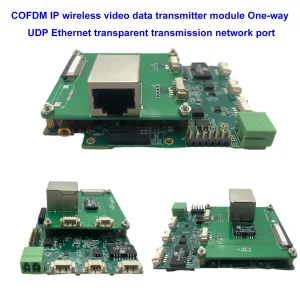
Our transmitter (TX) board is designed as a highly flexible and configurable RF module. By default, the TX board does not include a built-in high-power amplifier. Instead, it provides an adjustable RF output range that allows customers to fine-tune the performance according to their specific application.
- The typical RF output power of the system is configurable between –94 dBm and –5 dBm.
- Please note that the maximum achievable transmit power may vary slightly depending on the selected operating frequency point, as different frequency bands can have different efficiency and gain characteristics.
- Since the board does not integrate a large PA (Power Amplifier), this design helps reduce overall power consumption, size, and weight, making it especially suitable for UAVs, robotics, and other platforms where low-SWaP (Size, Weight, and Power) is critical.
For customers requiring extended transmission distance, higher link margin, or more robust penetration in complex environments, we recommend adding an external RF power amplifier, which we can also supply.
2. Can the ground receiver provide HDMI video output?
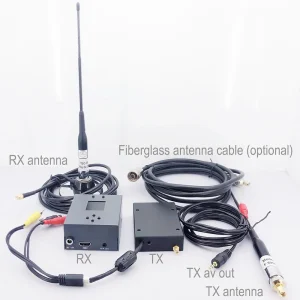
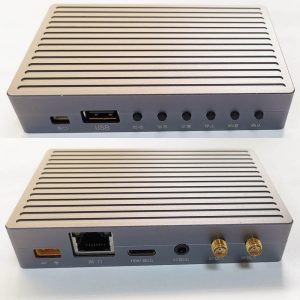
Yes. Our ground cofdm wireless video receiver unit is designed with multiple video output interfaces to support a wide range of applications and display equipment. The available output options include:
- HDMI – Provides high-definition digital video output for direct connection to modern displays, monitors, or recording equipment. This is the most commonly requested interface, offering excellent image quality and ease of use.
- CVBS (Composite Video Baseband Signal) – Offers an analog video output option, which is particularly useful for older monitors, goggles, or systems that still rely on analog video standards.
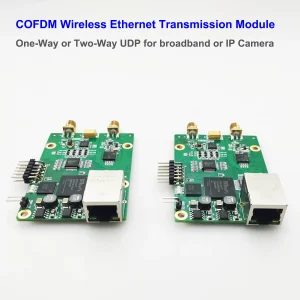
- Ethernet/IP Output – Allows direct integration into IP networks, video servers, or streaming platforms. This is especially valuable when remote monitoring or digital video distribution is required.
In short, customers can easily connect the ground station to almost any display or recording device, whether modern digital or legacy analog.
3. Is it possible to measure the output power of the amplifier?
Yes. We understand that accurate performance verification is very important to many of our customers. To support this, we can provide measurement and validation of the amplifier’s output power before shipping.
- Our team can perform real-time power measurements using calibrated RF test instruments to verify that the amplifier meets the specified performance level.
- If requested, we can record a short test video during the measurement process. This video will clearly show the setup, instruments used, and the measured results.
- The test documentation or video will be shared with you prior to delivery, ensuring full transparency and confidence in the product’s performance.
This approach allows you to receive your equipment with peace of mind, knowing the amplifier has been fully tested and verified.
4. Does the amplifier come with a built-in cooling system, or must we install one ourselves?
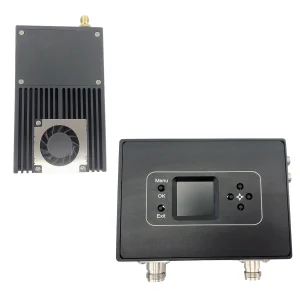
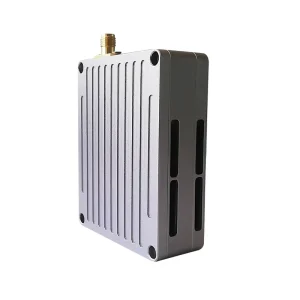
Our external amplifier modules are designed for maximum flexibility and integration into various platforms. For this reason, the amplifier does not include a built-in cooling fan by default.
- The amplifier module itself is compact and requires proper heat dissipation during operation, especially under continuous high-power conditions.
- We recommend that customers integrate their own cooling solution, tailored to the specific housing or enclosure in which the amplifier will be installed.
- Depending on your environment and usage scenario, this could mean using passive cooling (heatsinks, thermal pads) or active cooling (fans, forced air circulation).
This approach ensures that the amplifier can be adapted to a wide range of applications, from lightweight drone payloads to ground vehicle installations, while giving you full control over how thermal management is implemented.
5. Do you have experience shipping to EU countries without encountering customs restrictions?
Yes. We have extensive experience shipping our products to customers in the European Union and other international destinations. Over the years, we have successfully handled customs clearance for many EU clients.
We are also aware that certain terms, such as “amplifier,” can occasionally trigger additional customs scrutiny or restrictions. To minimize the chance of unnecessary delays:
- We can avoid using sensitive terminology such as “amplifier” on the outer packaging or shipping documentation, unless specifically required.
- Instead, we describe the products in a more general and compliant manner, which greatly reduces the risk of customs issues.
- Our logistics team can also provide guidance on the best shipping method, documentation, and labeling practices to ensure smooth delivery.
Our priority is to ensure that your order arrives safely, quickly, and without unnecessary complications.
6. What frequency range do your transmitter (TX) and receiver (RX) support?
Our systems are designed to be flexible across a wide range of frequency bands, depending on your application needs:
- The transmitter (TX) supports a frequency range of 170 MHz to 3500 MHz (3.5 GHz).
- The receiver (RX) natively supports 170 MHz to 860 MHz.
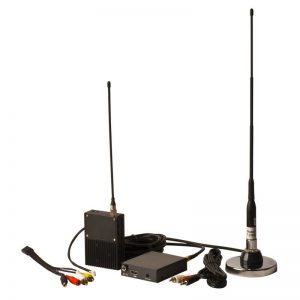
- For TX frequencies above 860 MHz (for example, 1.2 GHz, 2.4 GHz, or up to 3.5 GHz), the RX requires an additional frequency down converter. This converter shifts the incoming high-frequency signal into the RX’s supported band, enabling reliable demodulation and decoding of the video/data stream.
This architecture gives our customers both wideband frequency flexibility and cost-effective system design, ensuring that the RX remains optimized for low-noise, high-sensitivity performance while still supporting higher-frequency TX modules with the help of a down converter.
7. Additional Notes and Support
We are committed to providing not just reliable hardware, but also complete support for our customers. Beyond the above questions, we can assist with:
- Frequency customization – For example, you mentioned testing at 595 MHz. We can provide solutions around 600–620 MHz or other specific ranges upon request.
- System integration advice – Guidance on how to integrate our modules into your UAV, robotics, or fixed ground systems.
- Thermal design support – Suggestions on cooling solutions for different operating environments.
- Long-distance performance optimization – Recommendations for antenna selection, placement, and system configuration to maximize range and stability.
Conclusion
In summary, our TX board offers configurable RF power output without a built-in amplifier, making it ideal for compact, power-efficient applications. The ground receiver provides HDMI, CVBS, and Ethernet outputs, ensuring compatibility with modern and legacy equipment. We can measure and verify amplifier power before shipment, provide video documentation if required, and we advise customers to implement their own cooling solutions for amplifiers. Finally, with our experience in international logistics, including the European Union, we take steps to avoid customs complications and ensure smooth delivery.
Our team is always ready to support your project and provide tailored solutions to meet your specific requirements. Please feel free to reach out with any further questions.



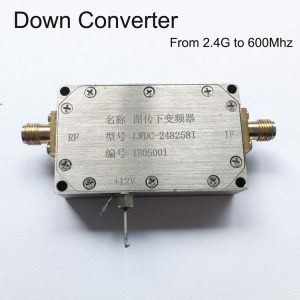
BDC Block Down Converter
Video Transmitter
COFDM Wireless Video Receiver HDMI cvbs output mini modulator module RX long distance fpv uav
Video Transmitter
Ask A Question
Thank you for your response. ✨