






In COFDM (Coded Orthogonal Frequency Division Multiplexing) systems, the Power Amplifier (PA) is a critical component that boosts the transmitter’s RF output to the levels needed for real-world coverage. But what happens when the PA fails — either partially or completely? Surprisingly, a burned or damaged PA doesn’t simply “stop working.” In fact, it can behave like a strong attenuator and may interfere with the normal operation of the transmitter.
In this article, we’ll explain why a damaged PA can cause problems and provide a safe method to test the COFDM transmitter and receiver without a PA, including checking whether video signals can still be received.
Can a Burned PA Act Like an Attenuator?
The answer is yes, and it’s a common scenario in RF systems. Depending on the failure mode, a burned PA may:
- Severely reduce gain — the transmitter output is very low
- Distort signals — linearity is degraded, causing COFDM subcarrier interference
- Reflect power back to the front-end — potentially stressing upstream circuitry
Table of Contents
How This Happens
When the PA is partially damaged:
- Some internal transistor junctions or bond wires may fail.
- Parasitic capacitances or damaged matching networks can still allow weak signal leakage from input to output.
- The result is a very low, distorted RF output, almost like inserting a 20–40 dB attenuator into the signal path.
For COFDM, which has a high peak-to-average power ratio (PAPR) and strict linearity requirements, even partial PA failure can seriously degrade modulation quality. Subcarriers may interfere, EVM (Error Vector Magnitude) worsens, MER (Modulation Error Ratio) drops, and the transmitted signal may violate spectral masks — all while it still appears that the transmitter is “working.”
Why a Damaged PA Can Interfere With Normal Operation
A burned PA is not just “quiet.” It can actively disrupt the transmitter:
- Cause the driver stage to overload
- Trigger automatic level control (ALC) loops
- Increase reflected power, potentially destabilizing PLLs
- Cause abnormal current draw or activate protection circuits
In short, a faulty PA can make the entire transmitter behave unpredictably, making it difficult to isolate the root cause of a problem.
How to Test the COFDM Transmitter Without the PA
If you suspect the PA is damaged, you can bypass it for short-range diagnostic testing to verify whether the modulator and digital front-end are still working. Here’s how:
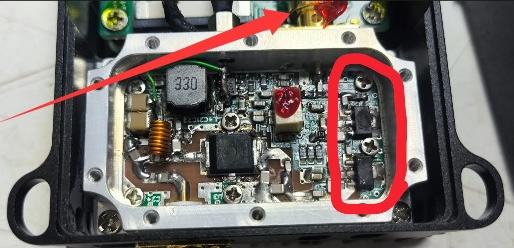
Step 1: Direct RF Output to the Antenna
- Disconnect or bypass the PA.
- Connect the transmitter module’s RF output directly to a suitable antenna.
- Connect the transmitting antenna directly to the location indicated by the red arrow; that’s the TX RF transmitter.
Step 2: Place Transmitter and Receiver Very Close
- Keep the transmitter and receiver antennas within 10 cm of each other.
- At this very short distance, even the low-power RF output from the module is usually enough for the receiver to detect the signal.
Step 3: Observe Receiver Performance
- Power on the system and check if the receiver can detect and decode the COFDM signal.
- For video applications, see whether the receiver can successfully display video output.
Important Considerations
- Impedance Matching:
- Without the PA, the transmitter’s output may not be perfectly matched to the antenna.
- Mismatch can reflect power back and potentially stress the module.
- Short Duration:
- This test is for diagnostic purposes only. Do not transmit continuously, as the driver stage is not designed for long-term operation without a PA.
- Close Range Only:
- Keep the antennas very close (~10 cm). At greater distances, the signal may be too weak for proper reception.
- Signal Monitoring:
- Check EVM, MER, and spectral quality if possible, to confirm the digital modulator is still functioning correctly.
What You Can Learn From This Test
- Determine whether the modulator and digital front-end are working properly
- Identify whether the PA or upstream stages are causing problems
- Verify whether video signals can still be transmitted and received over a very short distance
Conclusion
A burned or partially damaged PA can act like a strong attenuator and may interfere with the normal operation of a COFDM transmitter, even if some output is still visible. By carefully bypassing the PA for short-range testing, engineers and technicians can verify the functionality of the digital modulator and receiver, identify the root cause of issues, and avoid unnecessary component replacement.
This simple diagnostic approach — connecting the RF output directly to the antenna and keeping the transmitter and receiver antennas very close — is a safe, effective way to check whether your COFDM system is still operational at the digital level, including video transmission.



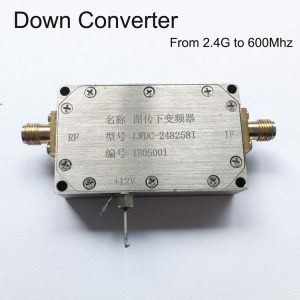
BDC Block Down Converter
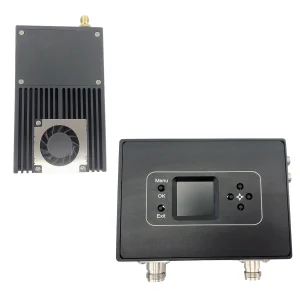
Video Transmitter
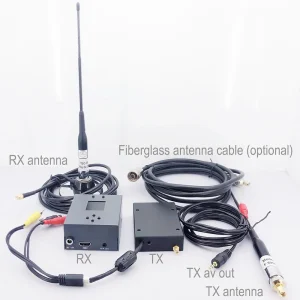
COFDM Wireless Video Receiver HDMI cvbs output mini modulator module RX long distance fpv uav
Video Transmitter
Ask A Question
Thank you for your response. ✨