






Understanding Film & TV Needs for SDI Wireless Links
When professionals from the film and television industry ask about new wireless video transmission solutions, their priorities are often very different from those in drones, security, or industrial applications. Recently, a filmmaker reached out with a simple but revealing question:
“Hey! I’m in the film and TV industry. Looking for new solutions to video and camera control. Are any of your SDI products 4:2:2 or 10-bit?”
Although the question is short, it tells us a lot about what this type of customer truly cares about. Let’s break down the real needs behind it.
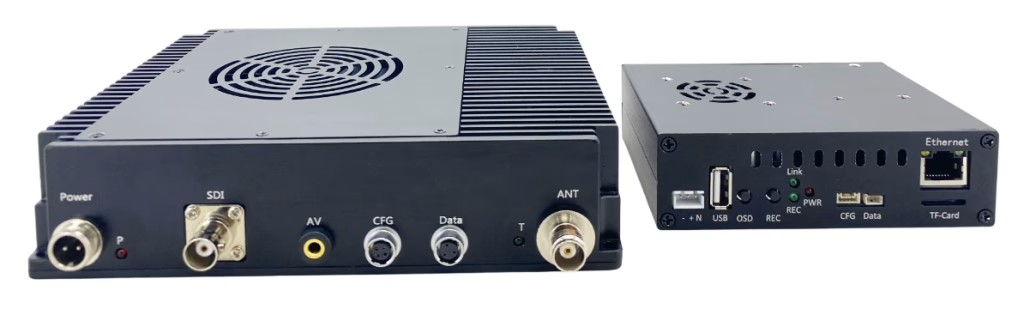
Table of Contents
1. Broadcast-Level Color Quality
Film and TV workflows rely heavily on accurate color reproduction. This is why customers often ask whether the SDI video input supports:
- 4:2:2 chroma subsampling – a requirement for most professional monitoring and post-production pipelines, offering better color fidelity than 4:2:0.
- 10-bit color depth – providing smoother gradients and more latitude for color grading, significantly reducing banding compared to 8-bit.
If a wireless system only supports 4:2:0 / 8-bit, filmmakers typically see it as suitable for basic monitoring, live streaming, or security use — but not for professional cinematography.
2. Compatibility With Professional Cameras
SDI cameras used in production—ARRI, RED, Sony, Blackmagic—output high-quality 10-bit or 12-bit signals. A filmmaker asking this question wants to know whether the wireless system preserves as much of that original image quality as possible when transmitting.
3. On-Set Monitoring Expectations
In modern film sets, “video village” setups often require:
- Clean, accurate monitoring
- Minimal color shift
- Reliable wireless links for directors, DPs, focus pullers, and clients
A system that restricts color sampling or bit depth may introduce visible artifacts, making it less suitable for critical monitoring.
4. Camera Control Requirements
The customer also mentioned “camera control,” which usually refers to features like:
- Start/stop trigger
- Menu control (via serial or IP)
- Lens control integration
- Bidirectional data transmission
This implies they are not just looking for a one-way video link, but a more integrated wireless workflow.
5. The Real Purpose Behind the Question
In summary, the filmmaker is evaluating whether the product can fit into a professional cinema environment. By asking about 4:2:2 and 10-bit support, they are really asking:
- Can your wireless system be used on professional film sets?
- Will the image quality meet industry monitoring standards?
- Is your solution comparable to existing cinema-grade products like Teradek?
Understanding this helps us deliver better technical explanations and position the right product for this market.
If your SDI transmitter supports 4:2:2 or 10-bit, it becomes much more competitive in the film and TV industry. If it does not, clear communication and proper expectation setting will help keep the discussion open for other use cases.

6. Reply about Our SDI wireless link
Thank you for your interest in our SDI wireless video products. Regarding your question about 4:2:2 and 10-bit support, here’s a detailed explanation of our system:
- SDI Interface Chip: We use the GS2971A SDI interface chip, which inherently supports 4:2:2 and 10-bit color spaces. It also provides optional conversion from SMPTE 425M Level B to Level A for 1080p 50/60 4:2:2 10-bit signals.
- Encoding Chip: However, our current video encoding chip processes video in YUV 4:2:0 format.
- Difference Between 4:2:2 and 4:2:0:
In 4:2:0, both horizontal and vertical chroma information is subsampled by 2, meaning every 2×2 pixel block shares the same color data. This reduces color detail compared to 4:2:2. While 4:2:2 preserves full vertical resolution for chroma, 4:2:0 sacrifices some color fidelity to save bandwidth. - Color Depth: Although the SDI chip supports 10-bit, the encoder outputs 8-bit (standard for most security-oriented boards like HiSilicon), so the final transmitted video does not retain full 10-bit color precision.
Summary:
Our SDI input can handle professional 4:2:2 10-bit signals at the interface level, but due to the current encoding, the transmitted video is limited to 4:2:0 8-bit. This is typical for security-focused video transmission hardware and is not uncommon in low-latency COFDM/H.265 modules.
If your workflow absolutely requires 4:2:2 or 10-bit video for high-end color grading, we can discuss potential upgrades or future modules designed specifically for film and broadcast applications.
Ask A Question
Thank you for your response. ✨