






COFDM HDMI wireless video transmitter and receiver module AES128
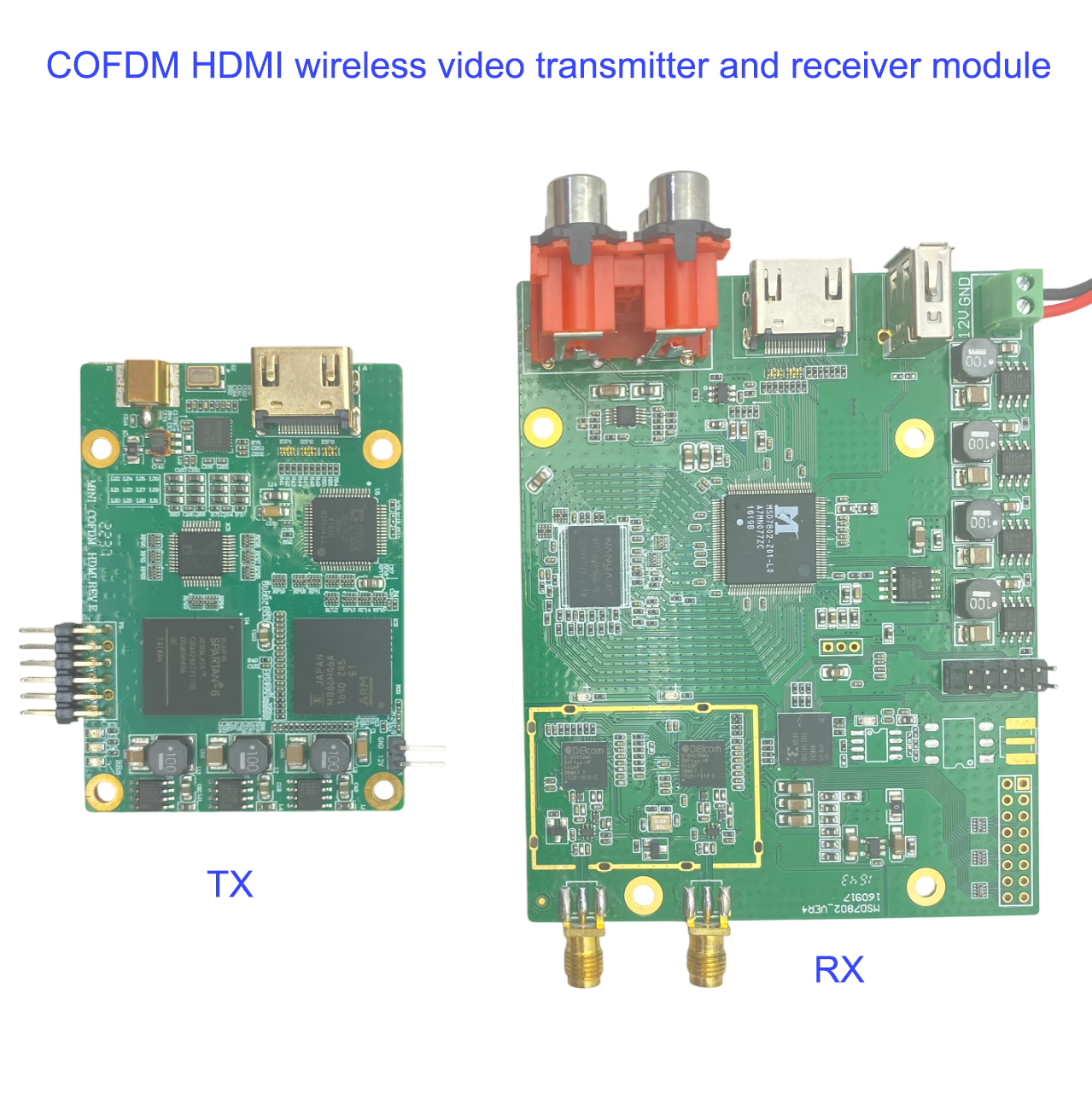
Table of Contents
introduction
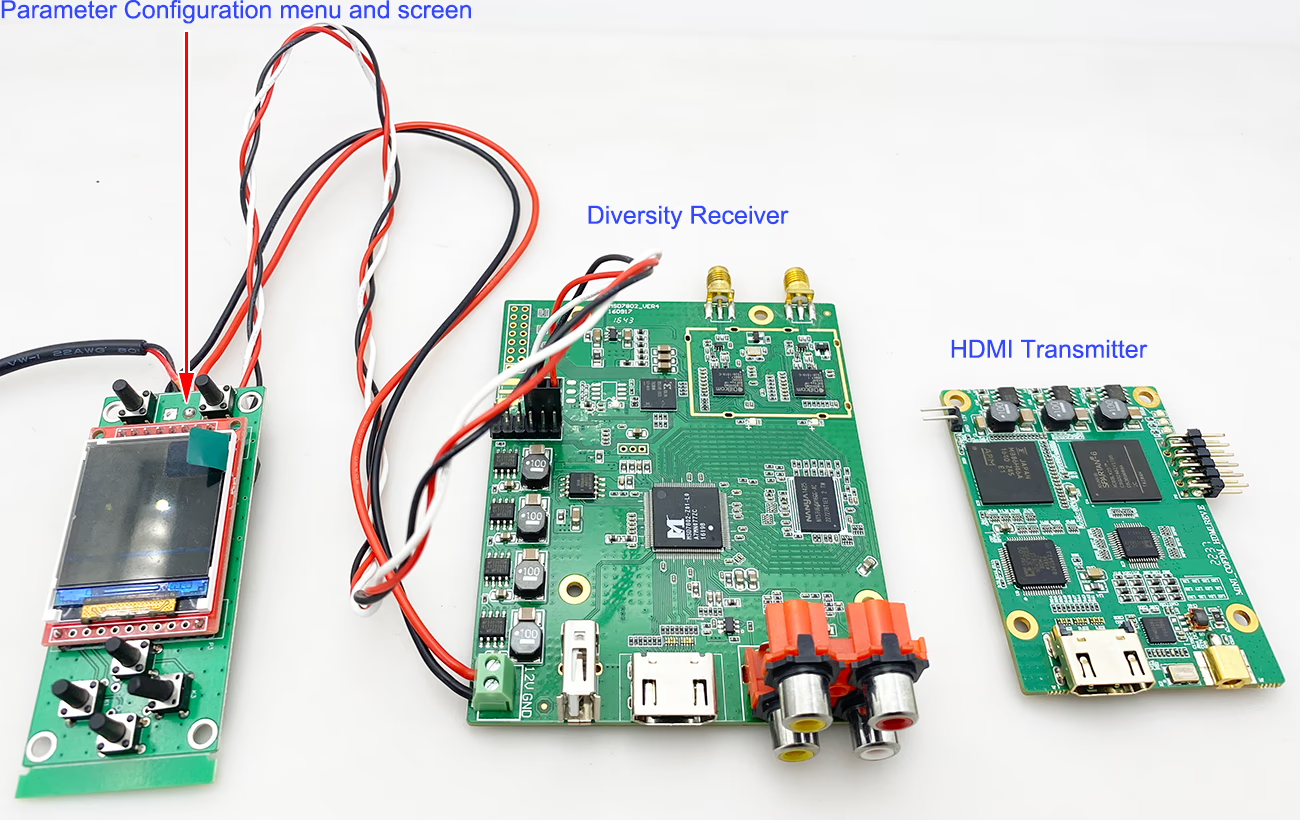
The COFDM Wireless Video Transmitter Modulator and Receiver Demodulator Module is a professional-grade COFDM wireless video transmitter and receiver solution designed for high-performance applications. The transmitter supports HDMI video input, and the receiver provides HDMI and AV video output, ensuring versatile connectivity for diverse systems. Users can configure the system via AT commands or use an extra parameter configuration board to control and read parameters efficiently. Operating across a wide frequency range of 170–3500 MHz, the module allows flexible selection of the working frequency and supports adding an extra power amplifier to meet custom client project requirements. (Receiver’s default frequency range is 170-860 MHz, Beyond this range, additional frequency-Downconverter is required)
The wireless video transmission system supports a diversity tuner on the receiver, two antennas, and dual-demodulator receivers to maximize signal stability and reliability. With H.264 lower latency and low-latency firmware, it delivers smooth real-time video transmission. Additional features include USB recorder function (USB can be recorded in real time), adjustable bandwidths of 2 Mb, 4 Mb, 6 Mb, or 8 Mb, encryption with custom passwords(AES128), and built-in an attenuator on the transmitter to reduce the power output.
We provide flexible solutions, from PCBA to fully customized hardware and software solutions, tailored to client needs. Professional technical support is available for both software and hardware, ensuring seamless integration and optimal performance in demanding environments.
Customizable Options
1. Frequency & Transmission
-
Operating Frequency Band: Customizable (e.g., 2.4GHz, 5.8GHz, 1.2GHz) according to local regulations.
-
Transmission Power: Adjustable (e.g., 10mW, 100mW, 500mW, 1W) for different ranges.
-
Modulation Settings: COFDM parameters can be customized (2K/8K FFT, QPSK/16QAM/64QAM) to optimize stability or bandwidth.
-
Transmission Distance: Adjustable based on power and antenna design, from short-range 100m to long-range 10km+.
2. Video & Audio Interfaces
-
Input Interfaces: HDMI, CVBS, SDI; supports single or multiple channels.
-
Output Interfaces: HDMI, CVBS, SDI, network streaming (RTSP/UDP/RTMP).
-
Audio Support: Analog or digital audio transmission, embedded in HDMI/SDI if required.
3. Networking & Protocols
-
IP/Network Streaming: Supports Ethernet/RJ45 or Wi-Fi transmission, outputs RTSP, UDP, or HTTP streams.
-
Protocol Compatibility: Can be customized for UAV or monitoring system protocols (e.g., Mission Planner, QGC).
4. Hardware & Enclosure
-
Enclosure Material & Design: Aluminum, plastic; customizable colors and dimensions.
-
Cooling Solution: Fan-assisted or passive heat dissipation based on power requirements.
-
Protection Level: IP43/IP65 for outdoor environments.
-
Mounting Options: Fixed bracket, magnetic, or UAV/mounted installation solutions.
5. Antenna & Signal Enhancement
-
Antenna Types: Omni-directional, directional, panel antennas according to coverage needs.
-
Diversity / MIMO: Dual-antenna design to improve signal stability.
6. Control & Extra Features
-
Remote Control: APP or PC control for power, channel, and settings.
-
Audio/Video Switching: Options for audio-only or video-off modes.
-
Encrypted Transmission: AES 128/256 encryption for secure data.
-
Firmware Upgrade: Local or remote upgrade support.
7. Power & Accessories
-
Power Supply: DC 7–36V, Li-ion battery, or PoE options.
-
Kit Options: Single transmitter, single receiver, or multi-channel combinations.
Summary:
Customizations mainly focus on transmission parameters (frequency, power, distance), interface types (HDMI/CVBS/SDI/network), enclosure & installation, antennas, remote control & encryption, and power options, allowing clients to tailor solutions for UAVs, mobile monitoring, broadcasting, or industrial applications.
FAQ
1. What is the COFDM Wireless Video Transmitter Modulator and Receiver Demodulator Module?
The COFDM Wireless Video Transmitter Modulator and Receiver Demodulator Module is a professional solution for high-quality video transmission with HDMI input, HDMI and AV output, and dual demodulator receivers.
2. What video inputs does the transmitter support?
It supports HDMI video input, allowing connection to cameras, video encoders, or other HDMI sources.
3. What outputs are available on the receiver?
The receiver provides HDMI and AV video output, offering flexibility for different display or recording devices.
4. Can I configure the module remotely?
Yes, the module supports configuration through AT commands or an extra parameter configuration board to control and read parameters.
5. What frequency range does the module operate on?
It works across 170–3500 MHz, providing flexible deployment options for various environments.
6. Can an extra power amplifier be added?
Yes, clients can add an extra power amplifier to customize transmission strength for specific projects.
7. Does the receiver support a diversity tuner?
Yes, the receiver features a diversity tuner and supports diversity antennas to improve signal reliability.
8. What video encoding does the module use?
The system uses H.264 lower latency encoding combined with low-latency firmware for smooth real-time transmission.
9. Is USB recording supported?
Yes, the USB recorder function allows the receiver to save received video locally for review or backup.
10. Can the module be customized for client projects?
Yes, we provide PCBA or fully customized solutions, including additional parameter boards, encryption, and software/hardware support.
11. What is the maximum bandwidth supported?
The module supports adjustable bandwidths of 2, 4, 6, and 8 Mb to match different transmission requirements.
12. Can I add an attenuator to the transmitter?
Yes, the transmitter can be fitted with an attenuator to adjust signal power for specific scenarios.
13. Is encryption supported?
Yes, clients can set encryption passwords to secure video transmission.
14. How does the dual demodulator receiver benefit video reception?
Two demodulator receivers improve signal stability and reduce interference, especially in challenging environments.
15. Does the module support analog video inputs?
Yes, the receiver supports AV video output, allowing compatibility with analog monitors.
16. Can the module handle long-range transmission?
Yes, combined with optional power amplifiers and diversity antennas, the system supports stable long-range wireless video.
17. Can I control the module using a PC?
Yes, using the extra parameter configuration board, users can monitor and adjust parameters via a PC interface.
18. Is the module suitable for professional broadcasting?
Yes, the professional-grade COFDM wireless video receiver is designed for demanding video transmission applications.
19. Can it be used in drones or UAVs?
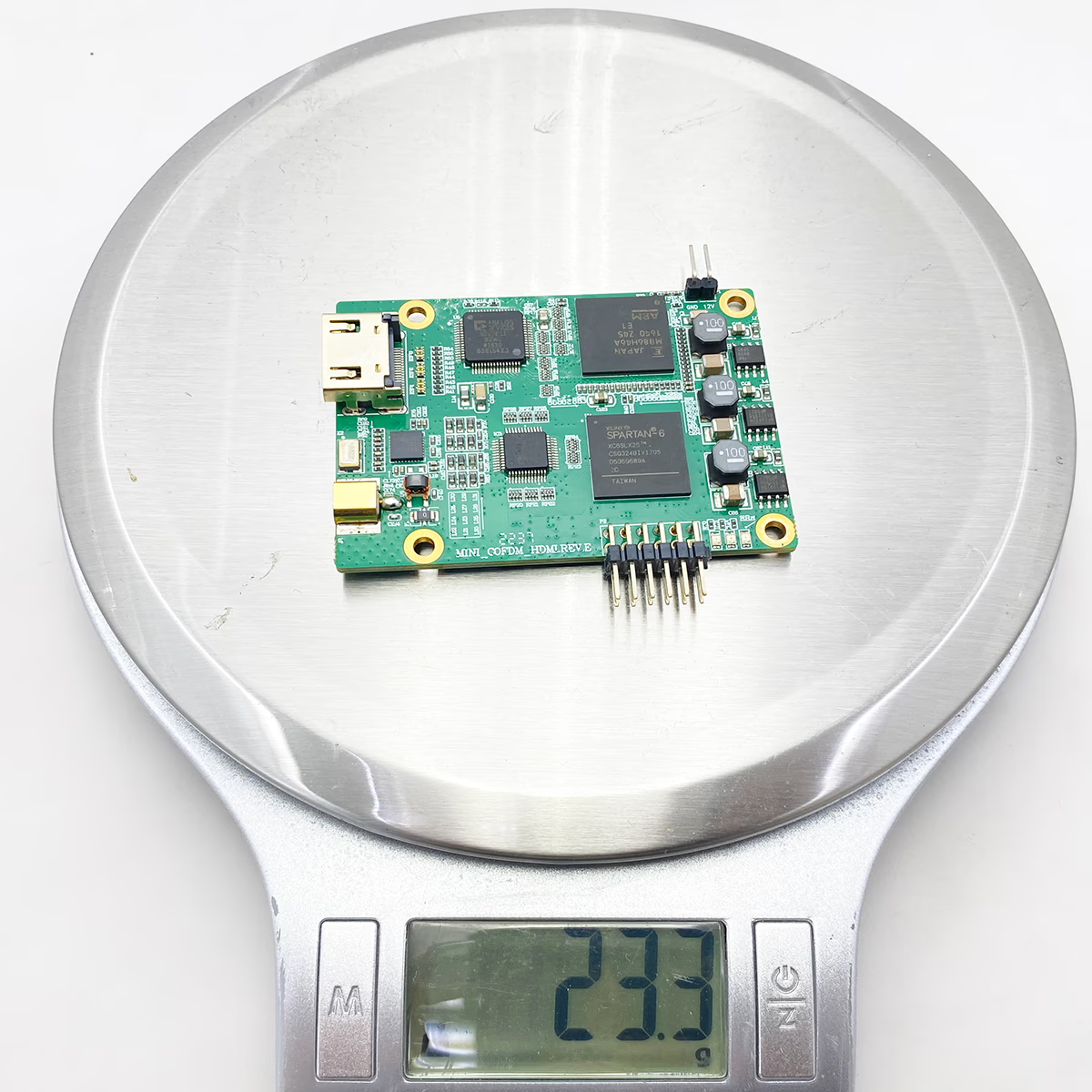
Yes, the lightweight design and low-latency H.264 encoding make it ideal for UAV or drone video systems.
20. Can multiple receivers work with one transmitter?
Yes, multiple receivers can be paired with a single transmitter for multi-display monitoring.
21. How do AT commands help configure the module?
AT commands allow remote control of system parameters, including frequency, power, bandwidth, and video settings.
22. Can the working frequency be changed quickly?
Yes, the frequency can be set anywhere within 170–3500 MHz, making it adaptable to different regions and conditions.
23. Does the module support real-time video streaming?
Yes, thanks to low-latency firmware and H.264 encoding, it delivers smooth real-time video.
24. Can the transmitter work with external antennas?
Yes, the transmitter can use diversity antennas for enhanced signal transmission and reception.
25. Is the module compatible with standard HDMI monitors?
Yes, it supports standard HDMI video output, ensuring compatibility with most modern monitors and TVs.
26. Can the system be integrated into a custom project?
Yes, the module is fully customizable, supporting PCBA solutions, extra boards, and hardware modifications.
27. Is technical support available?
Yes, we provide professional software and hardware technical support for installation and integration.
28. How stable is the video transmission?
With diversity tuning, dual demodulators, and optional power amplifiers, the module ensures highly stable video transmission.
29. Can I set different bandwidths for different applications?
Yes, bandwidth can be adjusted to 2, 4, 6, or 8 Mb depending on network conditions and video quality needs.
30. Does it support analog AV recording?
Yes, the receiver’s AV output can be recorded via the USB recorder function.
31. Can the transmitter be powered externally?
Yes, it supports standard 12V power input, with options for higher power via extra amplifiers.
32. Is the module weather-resistant?
While designed for professional use, environmental protection depends on custom enclosure options provided during customization.
33. Can it be used for live events?
Absolutely. Its low-latency video transmission and dual demodulators make it suitable for live broadcasting.
34. Can multiple transmitters operate without interference?
Yes, the flexible frequency range (170–3500 MHz) allows multiple systems to operate simultaneously.
35. Is firmware upgradable?
Yes, low-latency firmware can be updated to improve performance or add new features.
36. Can encryption be customized per client?
Yes, we provide customizable encryption, allowing clients to set secure transmission passwords.
37. Does it support video over IP?
Please refer to other Vcan1776 models, which support IP Ethernet video stream output.
38. Can the receiver display multiple video sources?
Yes, with dual demodulators, the receiver can manage multiple signals for redundancy or diversity.
39. How compact is the module?
It is compact enough for integration into UAVs, vehicles, or professional camera systems while still supporting dual demodulators.
40. Can the system handle interference in urban environments?
Yes, diversity antennas and frequency agility minimize interference for urban or dense deployment.
41. Can I integrate an extra parameter board after purchase?
Yes, the system supports additional parameter boards for remote configuration and monitoring.
42. How fast can the system recover from signal loss?
The combination of dual demodulators and low-latency firmware ensures rapid recovery from temporary signal loss.
43. Can it be used for military or secure applications?
Yes, with custom encryption and professional-grade hardware, it is suitable for secure applications.
44. What kind of clients benefit from this module?
Clients in broadcasting, drones, UAVs, surveillance, and live events benefit from this COFDM wireless video solution.
45. Is it easy to install?
Yes, the module is designed for professional installation and can be integrated into custom projects with technical support.
46. Can the module be customized for extreme distances?
Yes, adding extra power amplifiers and using diversity antennas allows operation over long distances.
47. Are there software tools for monitoring?
Yes, the parameter configuration board allows real-time monitoring and adjustments via PC software.
48. Can I use it for HD video transmission?
Yes, HDMI input and output support full HD video with H.264 low-latency encoding.
49. Is the module compatible with third-party cameras?
Yes, it works with any device providing standard HDMI video output.
50. What makes this module unique?
The COFDM Wireless Video Transmitter Modulator and Receiver Demodulator Module combines professional-grade dual demodulators, low-latency firmware, customization options, diversity antennas, and full technical support, making it ideal for demanding wireless video applications.



iVcan.com –
I have been using the COFDM Wireless Video Transmitter Modulator and Receiver Demodulator Module for several weeks, and it has exceeded my expectations. The HDMI input and HDMI/AV output deliver crystal-clear video, while the dual demodulators and diversity antennas ensure stable, reliable reception even in challenging environments. The low-latency H.264 firmware makes live streaming smooth and responsive, and the USB recorder function is incredibly convenient for capturing footage. Additionally, the system’s flexibility, including customizable frequency, optional power amplifier, and encryption features, allows me to tailor it perfectly for my projects. Overall, it is a professional-grade solution that combines performance, reliability, and adaptability.