








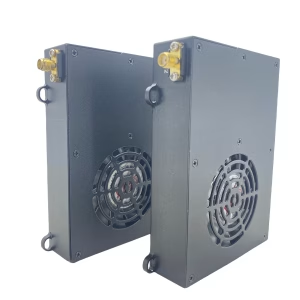
Wireless Video Transmission
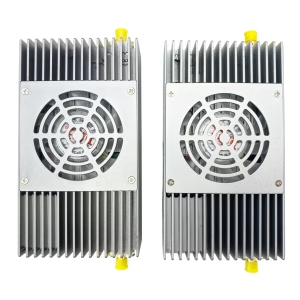
Wireless Video Transmission
10WPA 55KM drone UAV two-way broadband wireless link 1420-1530MHz

Wireless Video Transmission
Mesh 2X 10 watts Power Amplifier 250km drone video data link long Range UAV Transmitter and Receiver

Wireless Video Transmission
UAV wireless video telemetry downlink Flight Control commands uplink
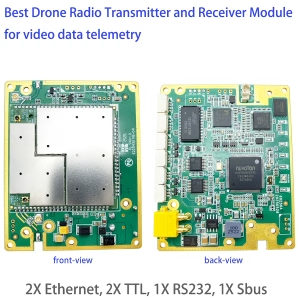
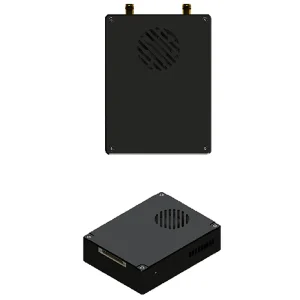
Bidirectional Two-Ways
50-100km Drone Wireless Video Data Control Transmitter and Receiver 2W-5WPA 1.4G-2.4G Vcan1805


CVBS HDMI to IP Encoder
Drone Video Encoder HDMI SDI AV input, IP RJ45 Ethernet output RTSP UDP, H265 H264


Wireless Video Transmission
300-500Mhz COFDM IP RJ45 transceiver with 10W PA filter antenna

Wireless Video Transmission
FPV 175Mhz COFDM Digital VTX VRX wireless video transmitter and receiver

Wireless Video Transmission
2x20W PA IP mesh drone video data transmitter and receiver 260km

Wireless Video Transmission
1.4G drone video data transmitter-relay-receiver 2T2R 2WPA 60km
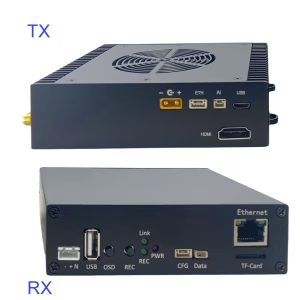
Wireless links are critical in UAVs, unmanned ground vehicles (UGVs), marine drones, and field broadcast operations. They support real-time video, telemetry, and control data transmission. These systems can be classified based on network topology, transmission direction, frequency, video input, transmission distance, power, application scenario, data interfaces, and customizable features.
1. Network Topology (Networking Mode)
-
Point-to-Point (P2P)
-
Direct link between a single transmitter and a receiver.
-
Advantage: Low latency, simple setup, high reliability.
-
Example: UAV video downlink to a single ground station.
-
-
Point-to-Multipoint (P2MP)
-
One transmitter communicates with multiple receivers simultaneously.
-
Advantage: Efficient broadcasting for multiple monitoring or control points.
-
-
Relay Transmission
-
Data is forwarded through intermediate nodes to extend coverage or bypass obstacles.
-
Advantage: Overcomes line-of-sight (LOS) limitations for urban, mountainous, or maritime environments.
-
-
IP Mesh (Self-Organizing, Node-Centric Network)
-
Nodes automatically route data without a central server.
-
Advantage: Resilient, scalable for multi-UAV or robotic network deployments.
-
2. Transmission Direction
-
Unidirectional Video Transmission
-
Video downlink only; suitable for surveillance, live broadcast, or FPV video.
-
-
Bidirectional Transmission
-
Video downlink combined with telemetry or control uplink.
-
Example: UAV sending HD video while receiving flight control or sensor data.
-
3. Operating Frequency
-
Common Frequencies: 600 MHz, 800 MHz, 1.4 GHz, 1.7 GHz, 2.4 GHz, 5.8 GHz
-
Advanced Configuration: Different uplink and downlink frequencies for interference avoidance or regulatory compliance.
-
Frequency selection impacts range, penetration, bandwidth, and anti-interference performance.
4. Video Input Format
-
Network IP Cameras – flexible, compatible with IP-based UAV payloads.
-
HDMI Cameras – standard HD or 4K cameras.
-
CVBS Cameras – legacy analog support.
-
SDI Cameras – professional broadcast quality, suitable for film/TV UAVs.
-
AHD Cameras – Analog HD cameras for security or industrial UAVs.
5. Transmission Distance
-
Short to Medium Range: 10 km, 30 km
-
Long Range: 50 km, 100 km, 150 km
-
Ultra Long Range: 200 km, 300 km
-
Distance depends on line-of-sight, antenna gain, power amplifier (PA), and environmental conditions.
6. Transmission Power (PA Integration)
-
Selectable Output Wattage: 1 W, 2 W, 5 W, 10 W, 20 W
-
Higher wattage allows longer distance and more stable links, essential for UAVs, marine drones, or ground robots operating in remote locations.
7. Application Scenarios
-
UAV Wireless Video/Data Transmission – aerial surveillance, mapping, or inspection.
-
UGV / Robotic Dog Data Transmission – terrestrial autonomous or semi-autonomous vehicles.
-
Marine UAV/Unmanned Boat Transmission – sea-to-sea or sea-to-shore links.
-
Handheld Communication Devices – portable monitoring or command systems.
-
Live Broadcast – aerial coverage for TV or events.
8. Data Interface
-
TTL – connects to UAV flight controllers for telemetry.
-
RS232 / RS422 – industrial or long-distance serial communication.
-
S.Bus – for UAV remote controller integration.
9. Customizable Features
-
FHSS (Frequency Hopping Spread Spectrum) – automatic frequency adjustment to reduce interference.
-
Ultra-Low Latency Option – optimized for live video monitoring or high-speed UAV operations.
-
AAT, Automatic Tracker with Directional Antenna – for ground receivers with high-gain directional antennas, it will automatically control the antenna facing the UAVs or robots.
-
Integrated Ground Receiver + Directional Antenna – simplifies setup, reduces cabling.
-
Waterproof / Weatherproof Transmitters – for marine, outdoor, or harsh environment deployments.
Summary
Wireless video, data, and telemetry links in UAVs and unmanned systems can be classified along multiple dimensions:
-
Network Topology: Point-to-Point, Point-to-Multipoint, Relay, IP Mesh
-
Transmission Direction: Unidirectional Video, Bidirectional (Video + Data)
-
Operating Frequency: 600 MHz, 800 MHz, 1.4 GHz, 1.7 GHz, 2.4 GHz, 5.8 GHz, uplink/downlink separated
-
Video Input Format: Network IP, HDMI, CVBS, SDI, AHD
-
Transmission Distance: 10 km, 30 km, 50 km, 100 km, 150 km, 200 km, 300 km
-
Transmission Power: 1 W, 2 W, 5 W, 10 W, 20 W
-
Application Scenarios: UAV, UGV/robot, marine drones, handheld, live broadcast
-
Data Interface: TTL, RS232, RS422, S.Bus
-
Custom Features: FHSS, ultra-low latency, Automatic Antenna Tracker, integrated ground station, waterproof transmitter
This classification helps UAV integrators, marine operators, broadcast teams, and industrial clients select or design wireless video/data/telemetry systems tailored to operational range, environmental conditions, latency requirements, and application-specific interfaces.