






FAQ: Behavior of Analog Video Scramblers Under Interference and Jamming
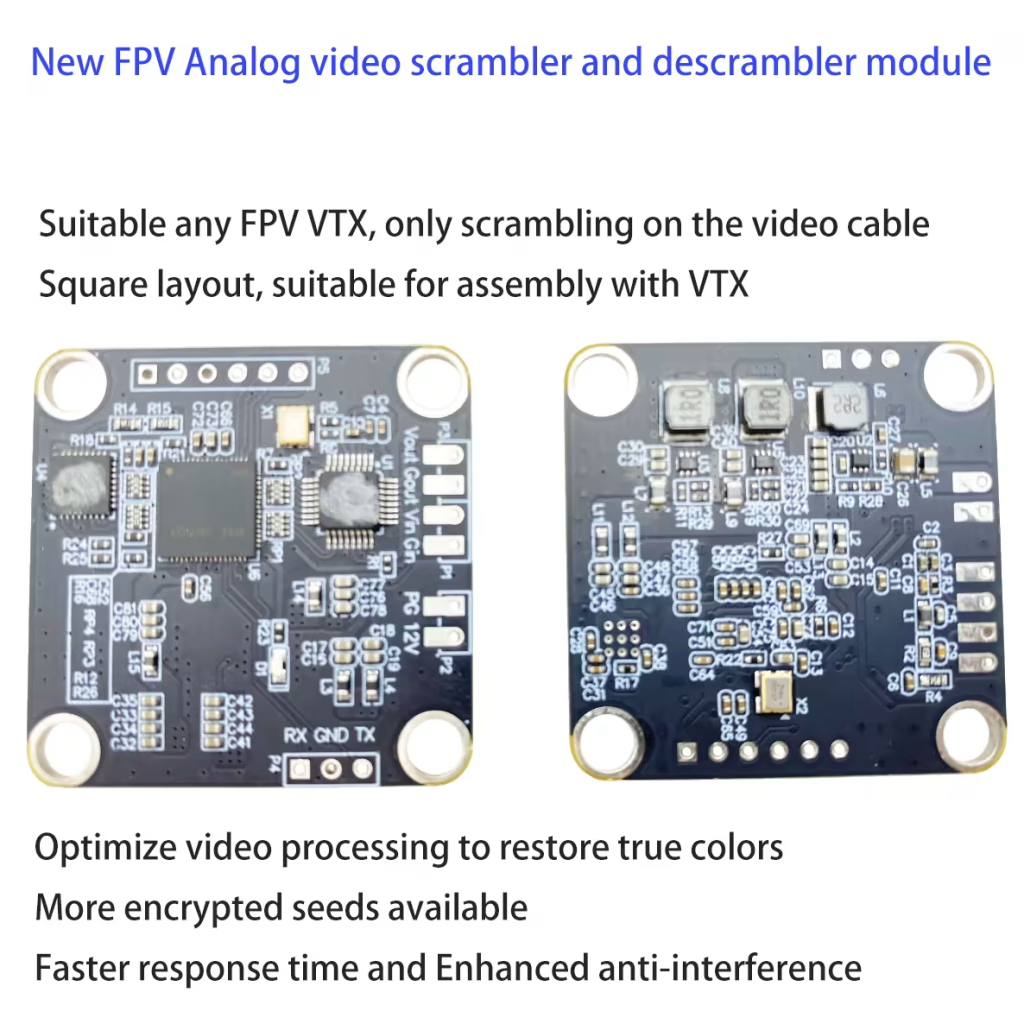
Table of Contents
Q1: Will the image disappear if an analog video signal is jammed?
No — not immediately.
Analog video systems degrade gradually as interference increases. When the signal-to-noise ratio (SNR) is reduced due to jamming or interference, the video quality typically worsens progressively rather than disappearing abruptly.
Common effects include:
- Increased noise (“snow”)
- Distortion and rolling
- Loss of color or contrast
- Partial synchronization instability
A complete loss of image usually occurs only when interference is strong enough that the receiver can no longer maintain synchronization, regardless of whether scrambling is used.
Q2: Does using an analog video scrambler make the image more likely to disappear under interference?
No.
An analog video scrambler does not change the fundamental behavior of the analog transmission channel.
With or without scrambling:
- Interference reduces video quality progressively
- The receiver continues to output a video signal as long as synchronization can be maintained
Scrambling does not introduce a “black screen” or abrupt cutoff effect by itself.
Q3: What will the image look like when a scrambled signal is interfered with?
If a scrambled analog video signal is subjected to interference:
- The video signal will still be present at the receiver
- The image may contain a combination of:
- Noise and distortion caused by interference
- Visual artifacts caused by scrambling
- The resulting image may be unintelligible, but it is not typically a blank screen
In other words, the signal energy remains present, but the image cannot be properly interpreted without correct descrambling and sufficient signal quality.
Q4: Why does digital video sometimes turn completely black under interference, while analog does not?
This is due to the threshold (cliff) effect of digital systems.
- Digital video relies on error-free data decoding
- Once interference exceeds a certain threshold, decoding fails
- This results in a sudden loss of video (“freeze” or black screen)
Analog video does not exhibit this behavior and instead degrades smoothly as interference increases.
Q5: Does the analog video scrambler include anti-jamming or noise-resistant coding?
No.
The purpose of an analog video scrambler is signal protection and access control, not interference mitigation.
Typical analog scrambling techniques include:
- Line or field reordering
- Sync modification
- Spectrum inversion
- Phase manipulation
These techniques:
- Prevent unauthorized viewing
- Do not include forward error correction (FEC)
- Do not provide spread-spectrum or frequency-hopping capabilities
System-level anti-jamming performance is primarily determined by:
- Transmit power
- Modulation scheme
- Channel bandwidth
- Receiver sensitivity
- Antenna design
Q6: In an interference environment, is scrambled video less usable than unscrambled video?
Under identical RF conditions:
- Scrambled and unscrambled analog video have equivalent robustness
- Scrambling does not make the signal inherently more fragile
- Properly authorized receivers will recover the video as long as the link budget supports it
The key difference is that unauthorized receivers cannot interpret the image, even if the signal itself is still present.
Summary
- Analog video degrades gradually under interference
- Scrambling does not cause sudden image loss
- Interference affects scrambled and unscrambled signals similarly
- Scrambling protects content, not the RF link itself
- Anti-jamming performance depends on RF system design, not scrambling

FPV camera
FPV Analog video scrambler and descrambler module for video encryption and decryption board
Ask A Question
Thank you for your response. ✨