






Can a 100 mW 2.4 GHz COFDM Transmitter Deliver a 5 km Video Link Between Ships?
Recently, we received an interesting technical inquiry from a customer who wanted to establish a wireless video link between ships. Their requirement provides a good case study for understanding the practical limits of COFDM-based video transmission over sea.
Table of Contents
Customer Requirement
*“We are looking for a COFDM video link that can carry two video streams simultaneously between ships within visual range, at least 5 km apart. Ideally, the link should support Ethernet so we can stream video of our choice.
We noticed that 1.4 GHz might require licensing under ICASA, while 2.4 GHz is unlicensed but limited to 100 mW EIRP. Can the transmit power be adjusted, and can channels be selected in the 2.4 GHz range?”*
Technical Analysis
The customer is correct that ICASA (in South Africa) limits unlicensed 2.4 GHz operation to 100 mW EIRP. However, this low power output presents serious limitations for long-range marine applications.
Let’s break it down:
- Frequency: 2.4 GHz (ISM band, 100 mW EIRP limit)
- Distance: 5 km over open sea (line of sight)
- Environment: Moving vessels, multipath reflection, salt spray, and vibration
- Requirement: Dual video streams over Ethernet (COFDM modulation)
Using standard link-budget calculations, the free-space path loss (FSPL) over 5 km at 2.4 GHz is approximately 114 dB. With only 20 dBm (100 mW) transmit power and small antennas, the received power would fall around −94 dBm, which is below the minimum sensitivity of most COFDM receivers for stable video streaming.
Even if a 12 dBi directional antenna is used at the receiver, the resulting −82 dBm signal level remains marginal—especially when real-world fading and ship motion are considered. In practical conditions, the reliable range of a 100 mW COFDM transmitter with omni antennas is typically a few hundred meters, not kilometers.
Why COFDM Still Matters
COFDM (Coded Orthogonal Frequency Division Multiplexing) remains the preferred modulation for wireless video transmission because of its excellent resistance to multipath interference and non-line-of-sight conditions. However, like all RF systems, its performance depends on link budget, antenna gain, and regulatory power limits.
At low transmit powers (like 100 mW), COFDM’s strong error correction helps maintain video stability at short ranges—but it cannot compensate for insufficient signal strength over long distances.
Recommended Solutions
To meet a 5 km or greater range with stable Ethernet video streaming, we recommend the following options:
- Licensed Frequency Operation (e.g. 1.4 GHz or 1.2 GHz bands)
Applying for a licensed frequency allows higher EIRP and more stable performance. Our high-power COFDM transmitters support output levels up to several watts for professional, licensed users. - High-Gain Directional Antennas
If both vessels can maintain a fixed line of sight and stable heading, using directional antennas (12–18 dBi) can significantly increase range. This approach works best for stationary or slow-moving platforms. - Lower Bitrate or Single Video Stream Mode
Reducing the bitrate or transmitting one stream instead of two lowers the required SNR, improving link reliability at longer distances. - Relay or Repeater Station
For fleet or formation operations, a middle vessel or buoy can serve as a repeater, effectively doubling the coverage area. - Professional Microwave or COFDM FDD Transceivers
Our FDD COFDM transceiver modules can handle bidirectional Ethernet and video data with ultra-low latency (as low as 30 ms), suitable for point-to-point marine communication when operated in licensed spectrum.
Practical Conclusion
While a 2.4 GHz COFDM transmitter limited to 100 mW can provide robust short-range wireless video links, it cannot deliver reliable 5 km coverage between moving ships in open water.
For professional applications such as maritime surveillance, offshore operations, or ship-to-ship video exchange, a licensed higher-power COFDM system or directional antenna solution is strongly recommended.
Related Products
- COFDM HDMI Transmitter & Receiver Modules
- FDD COFDM Transceiver for Bidirectional Ethernet Video
- Ultra-Low Latency H.265 COFDM Wireless Video Link

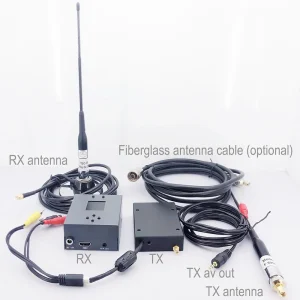
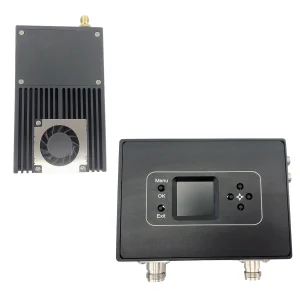


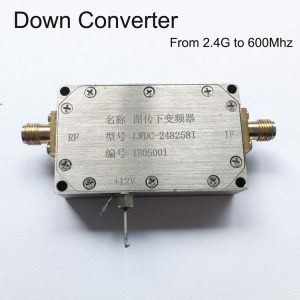
BDC Block Down Converter
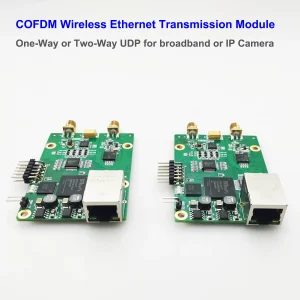
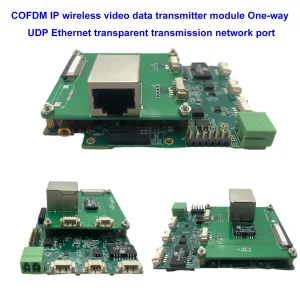
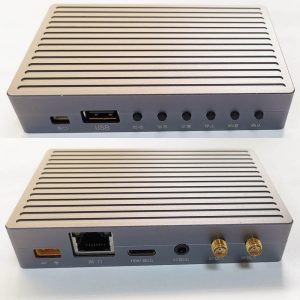
Video Transmitter
COFDM Wireless Video Receiver HDMI cvbs output mini modulator module RX long distance fpv uav
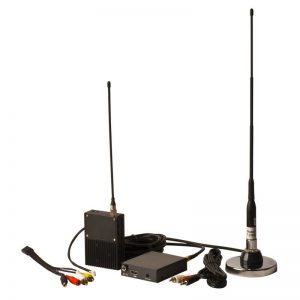
Video Transmitter
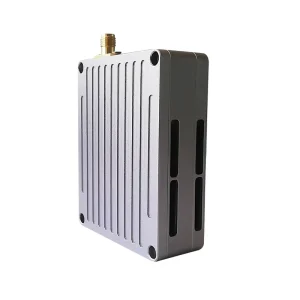
What is a COFDM Transmitter?
A COFDM transmitter is a wireless video transmission device that uses Coded Orthogonal Frequency Division Multiplexing (COFDM) modulation.
Unlike traditional analog or simple digital links, COFDM splits the data into multiple narrowband carriers that are transmitted simultaneously.
This makes it extremely resistant to multipath interference, signal fading, and reflections — especially important in environments like cities, tunnels, and over water.
COFDM transmitters are widely used in:
Drones and UAVs for long-range HD video downlink
Public security and emergency response video systems
Broadcast and film production wireless camera systems
Maritime and vehicle communication links where line-of-sight may fluctuate
Because of this robust performance, COFDM wireless video transmitters are considered the most reliable solution for real-time HD video transmission in dynamic or mobile conditions.
How to Choose a COFDM Transmitter?
When choosing a COFDM transmitter, consider the following key factors:
Transmission Distance & Power
Determine your required range and confirm whether local regulations allow the necessary transmit power (e.g., 100 mW unlicensed vs. 1–2 W licensed).
The longer the range, the higher the output power or antenna gain required.
Frequency Band
Common options include 1.2 GHz, 1.4 GHz, 2.4 GHz, and 5.8 GHz.
Lower frequencies generally provide better penetration and longer range, while higher frequencies support smaller antennas but shorter distances.
Video Input Type
Choose according to your camera system: HDMI, SDI, or Ethernet (IP) input.
For multi-camera or IP-based systems, Ethernet COFDM modules are ideal.
Latency and Compression
For real-time control or live streaming, look for H.265 ultra-low latency COFDM transmitters — our latest modules can achieve end-to-end delay as low as 30 ms.
Environment and Application
For drones, focus on lightweight and low-latency modules.
For marine or vehicle applications, use sealed housings and stable FDD bidirectional links.
For broadcast use, select systems with professional camera mounts and adjustable frequencies.
Why Choose Our COFDM Video Transmitter?
Choosing the right COFDM video transmitter can make all the difference between an unstable link and a professional-grade wireless system.
Here’s why hundreds of system integrators, drone manufacturers, and broadcast teams choose our COFDM transmitters:
Ultra-Low Latency – As Low as 30 ms
Our latest H.265 COFDM transceiver modules use advanced video compression and optimized RF algorithms to achieve end-to-end delays as low as 30 milliseconds, ensuring real-time control and smooth HD video transmission.
High Stability in Dynamic Environments
Designed for mobile and non-line-of-sight (NLOS) applications, our COFDM systems maintain a stable link even in complex environments such as cities, tunnels, forests, or over water.
Flexible Input Options – HDMI, SDI, and Ethernet
Whether your system outputs HDMI, SDI, or IP video, we provide corresponding modules to fit seamlessly into your setup.
For network-based video, our COFDM Ethernet video transmitters support bidirectional data transmission and real-time IP streaming.
Compact and Modular Design
Our transmitters are designed for easy integration into UAVs, robots, vehicles, or marine systems.
Lightweight aluminum housings and modular interfaces allow quick deployment and customization.
Industrial-Grade Reliability
With over ten years of experience in COFDM wireless image transmission, our engineering team ensures each product is optimized for long-term operation in demanding conditions — from high humidity to vibration and temperature extremes.
Full Technical Support and Customization
We don’t just sell hardware — we help our partners build complete solutions.
Our team provides custom firmware, frequency tuning, and integration support for specialized applications such as public security, UAV mapping, fire and rescue, or marine operations.
Ask A Question
Thank you for your response. ✨