






FPV transmitter long-range model is FPV1887. FPV camera transmitter has two types, analog video and digital COFDM digital video encoder and transmission. FPV1887 is the second type.
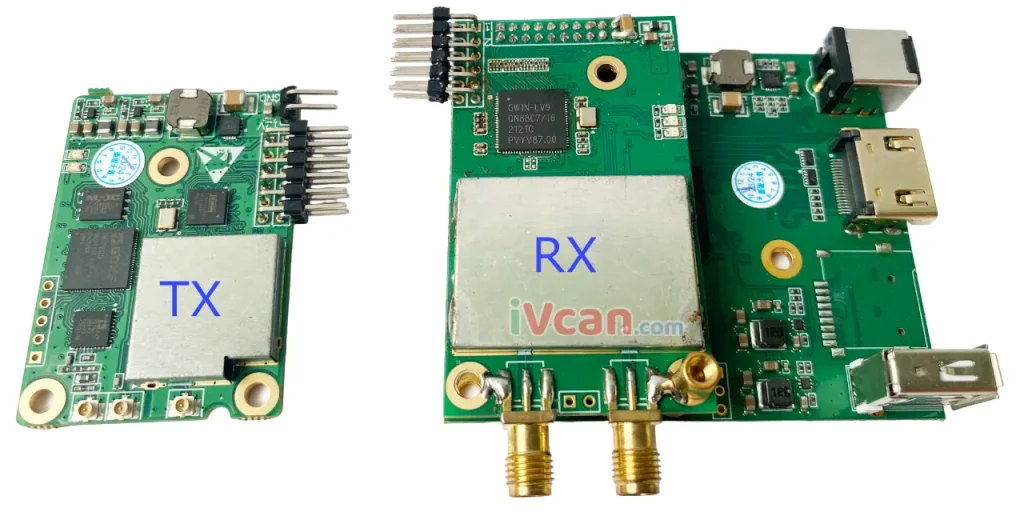
Table of Contents
FPV digital video transmitter VS FPV analog video transmitter
| FPV1887 (Digital, COFDM) | VCAN1997 (Analog) | |
| Two Antenna Diversity Receiver | 2-80cm omnidirectional Fiberglass Antenna | No |
| Video Encryption (protect privacy) | AES 128 bits password | No Anyone can see the video at the same frequency |
| Frequency Bandwidth | 2Mhz, 6Mhz, 7Mhz, 8Mhz | No |
| Transmission Distance | 3-watt PA 50km 2-watt PA 30km 1-watt PA 10km | Without power amplifier Less than 100-meter With 10-watt PA is coming soon |
| Cooling metal shell | With CNC customized metal box | No metal box, only a PCBA module |
| Radio Telemetry Download | One-way data radio | No |
| TX Parameter Configuration Tool | Yes, (USD45) | No |
| TX Frequency Change | support modifying the frequency from the serial port (need extra data transmission) | Radio Telemetry Download |
| Frequency Range | 170-860Mhz | 663.25~775.25Mhz |
| Unit Price | USD790 | USD25 |
FPV COFDM Digital Video Transmission V.S. FPV FM Video Transmission comparison
| Function | FPV COFDM low-latency Digital Video Transmission | FPV Regular FM Video Transmission |
| Latency Time Delay | 130ms | 20ms |
| Output TX Power | 1-watt / 2-watt / 3-watt Digital Power Adjustable | 1.5-watt /2.5-watt Fixed power |
| Transmission frequency | 170-860MHz Single Device Center Frequency ±40MHz | 1040-1360MHz Nine Channels 5.8GHz |
| RF bandwidth | 2 / 3 / 4 / 5 / 6 / 7 / 8MHz adjustable | Single frequency point modulation bandwidth 40MHz |
| Transmission Range | 1-watt@20Km / 2-watt@30Km / 3-watt@50Km | the longest range is 5Km |
| NLOS Transmission Capability | have | none |
| Ultra-low altitude transmission capability | The height of the transmitter and receiver is 3 meters. The transmission range is longer than 3km. | The height of the transmitter and receiver is 3 meters. The transmission range is 500m-1km. |
| Video Encryption | AES128-bit encryption and decryption | No encryption (We can customize CVBS video encryption and decryption modules in future.) |
| Data Transmission | One-way serial port ( From air transmitter to the ground receiver) | no |
| Parameter Configuration | Serial port parameter Parameter Configuration Tool | Toggle switch or button Adjust frequency |
| safety | After encryption, other receivers cannot decode the video without the secret key, and there is no need to worry about all parameters of the video overlay being known to the outside world. | Everyone can watch the video at the same frequency. |
| Receiver Information Display | Real-time display monitors received signal strength and quality | none |
Weight shell All-aluminum heat dissipation tooth structure Profile housing | Less than 90g | Less than 100g |
| Shell | CNC produced All-aluminum Heat Dissipation Tooth Structure | Profile Housing |
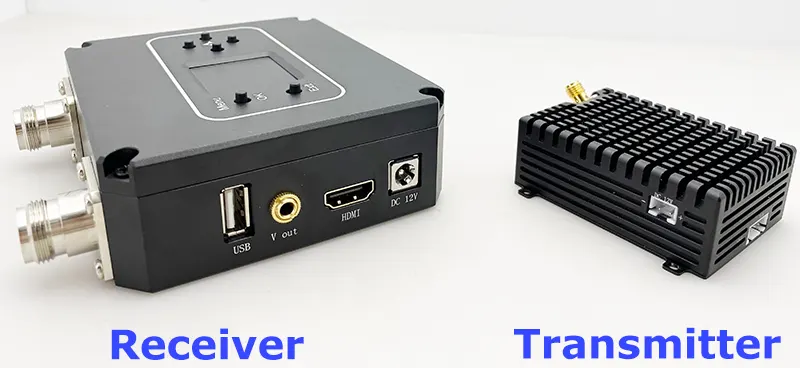
What setting can I configure via the transmitter parameter configuration board tool?
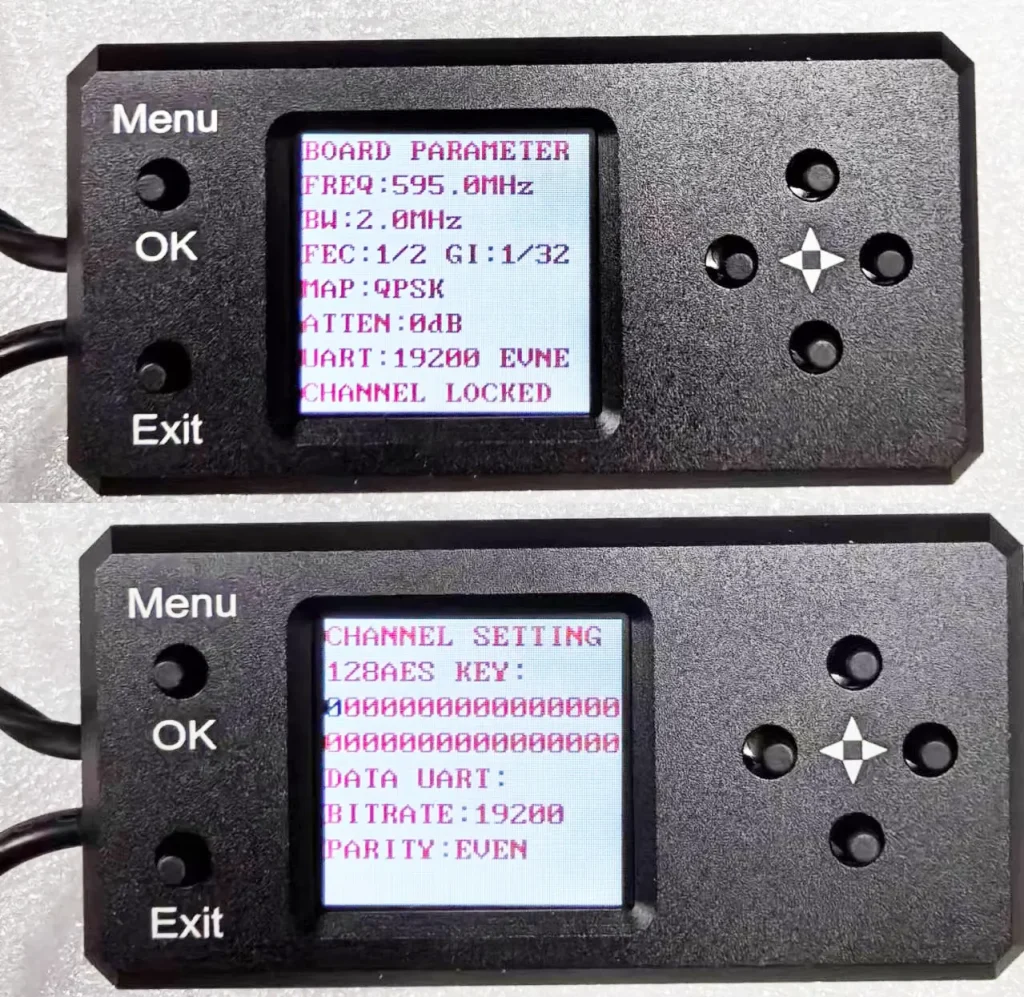
3 sets of FPV camera transmitters with one extra transmitter parameter configuration board tool
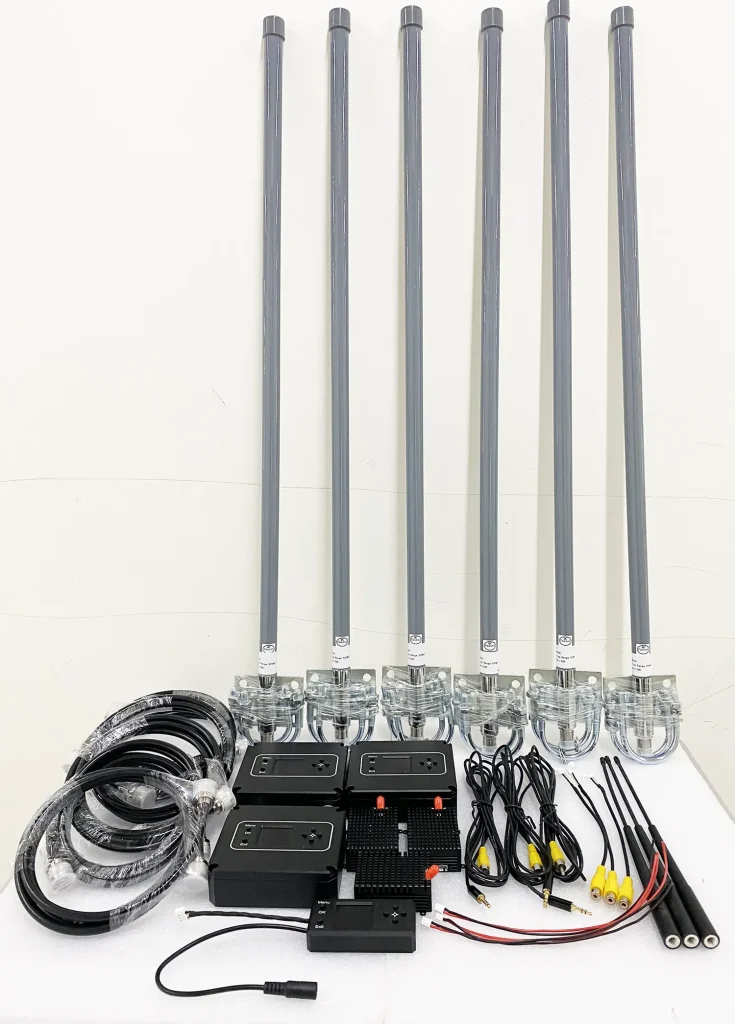
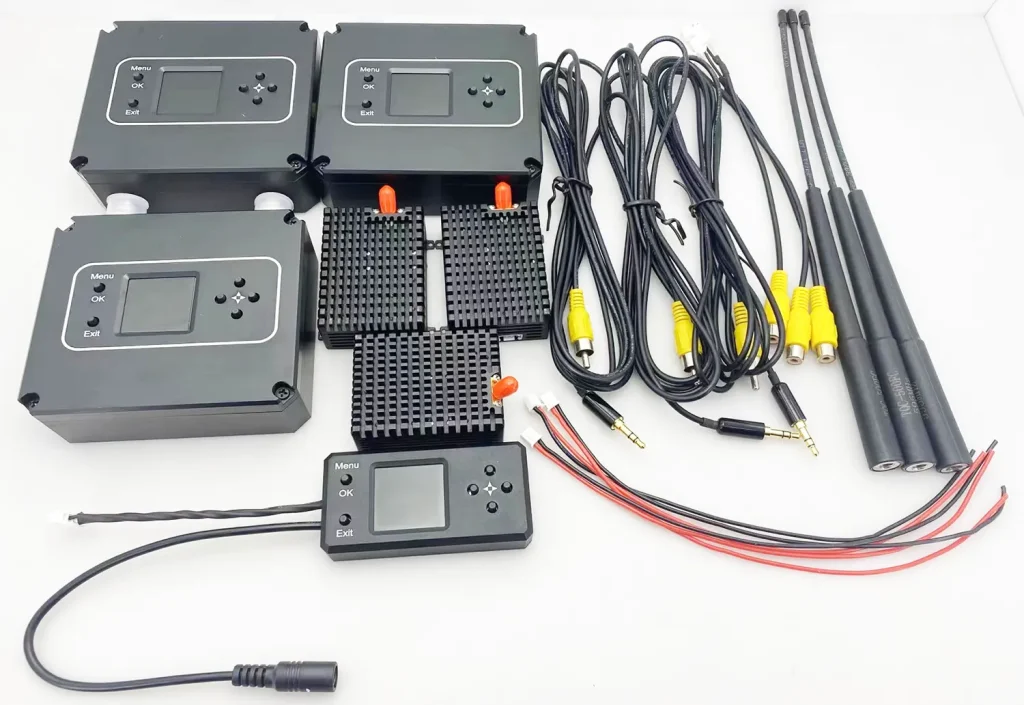
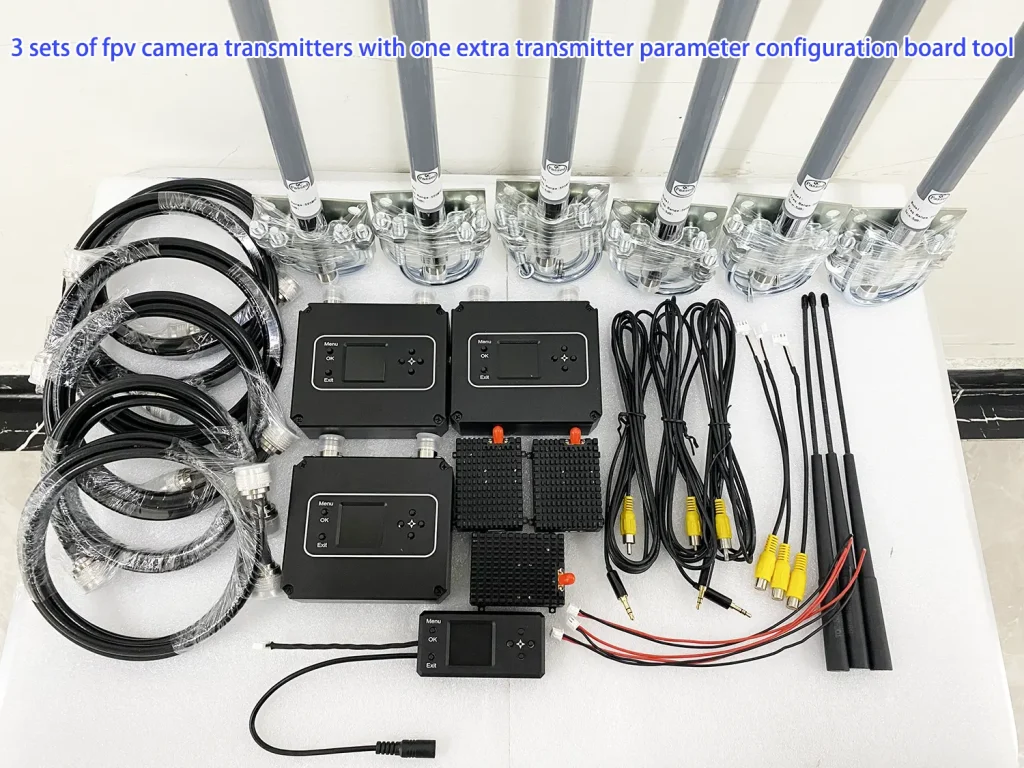
3 full set of the FPV wireless video transmitter and receiver with one TX antenna and two RX antenna.
There are two cartons, 40x30x21cm 4kgs and 96x60x12cm 5kgs. Because the volume of the two cartons of goods is relatively large, the transportation company usually charges 12 kilograms.
One set of FPV transmitters and receivers, with an 80cm receiver antenna and one parameter tool for the transmitter.
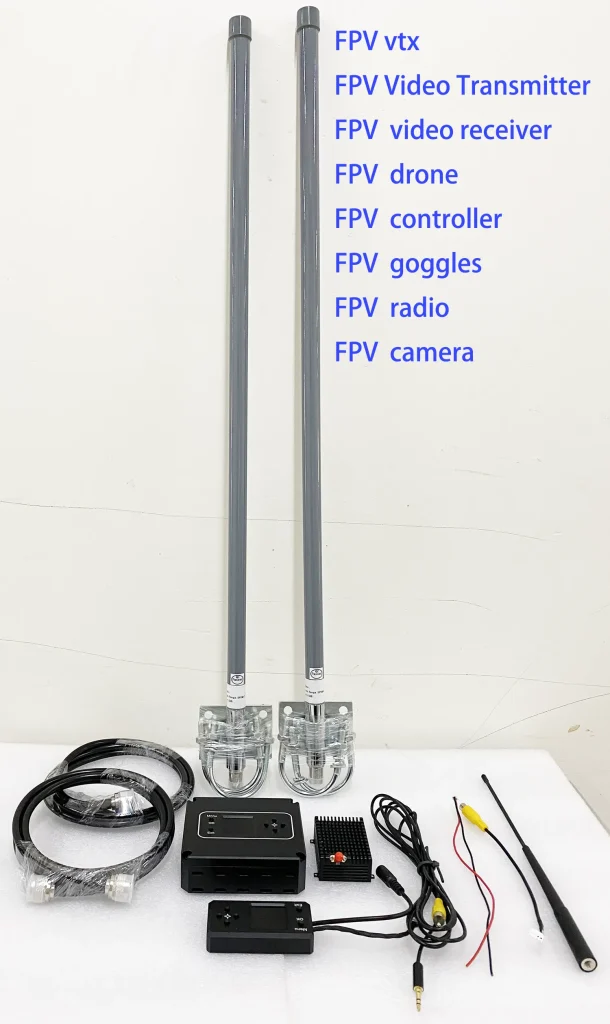
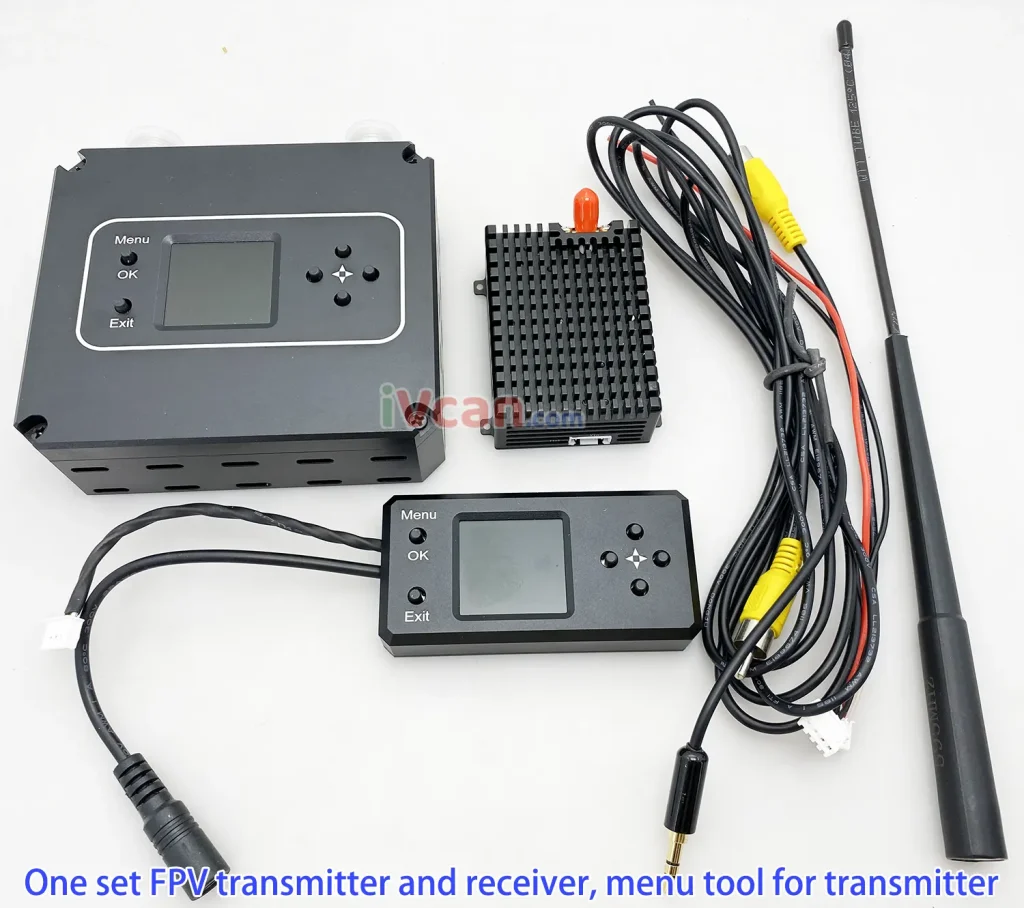
Wireless Video Transmission is one of the important components of FPV. FPV means first-person vision. To realize the first-person view of the aircraft, it is necessary to use the Wireless Video transmission system to transmit the living video from the FPV camera back to the pilot’s glasses/screen.
From the perspective of transmission mode, wireless video transmission is mainly divided into two types, one is analog video transmission, and the other is digital video transmission.
Analog video transmission has been developed for a long time and has great advantages in terms of delay. The delay is low, so it is widely used in racing and pattern flying.
Digital Video transmission is a new technology, with low latency, longer transmission distance, and clearer images with HD resolution.
The wireless video transmission system is mainly divided into two parts: the receiving end and the transmitting end.
The transmitting end is a camera and video transmitter installed on the aircraft. The camera converts the captured picture into an analog or digital signal and transmits it to the wireless video transmitter, and the transmitter transmits the camera signal through radio.
The receiving end is responsible for receiving and displaying the signal on the screen.
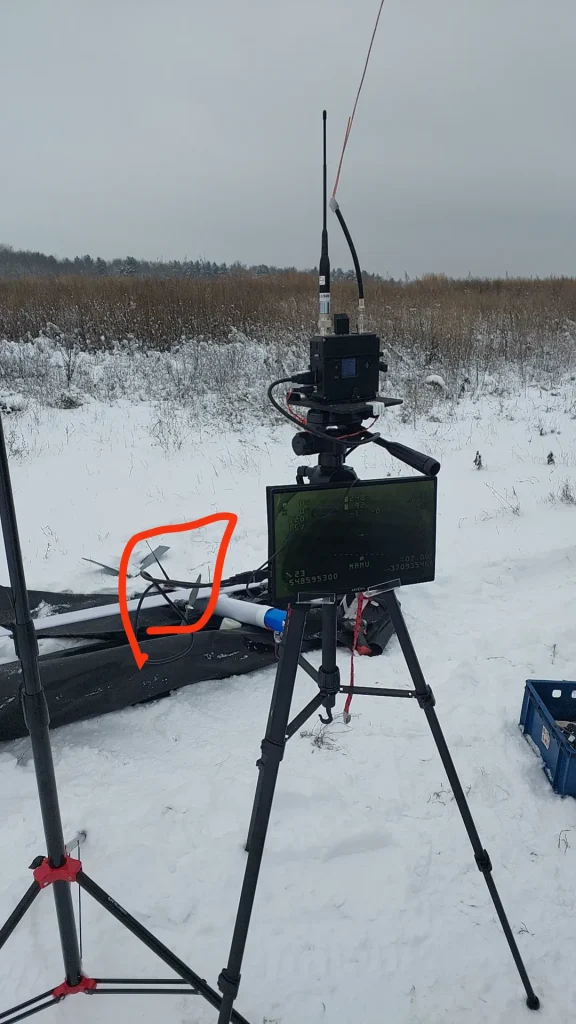
We had a distance of 3 at first, and then after the settings, we were able to improve the video to 10 km, but then the picture disappeared again. We put the antenna vertically up and placed it in the tail of the plane, the picture improved, but we haven’t flown further than 20 km yet. And our goal is 40 km or more.
Do you have any pictures of the parameters on the receiver during flight and the installation pictures of the UAV video transmission?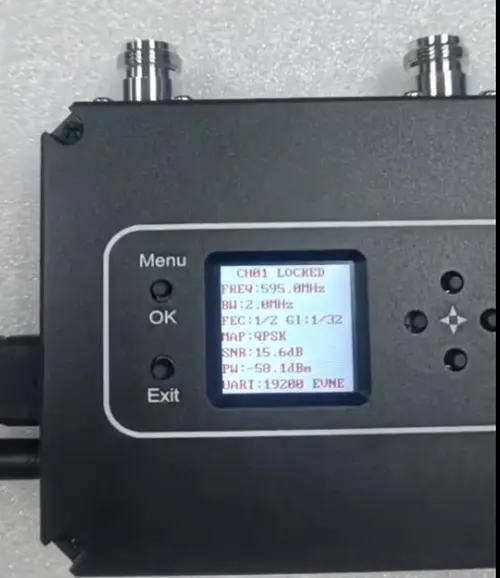
I need to know the height of the antenna and the flying height of the drone to determine what means to use to increase the flying distance.
I am interested in video transmission for an fpv drone, CVBS at 30+ km, I also need radio telemetry at the same distance. Is it possible to connect the receiver to the Skyzone glasses?
We have fpv transmitter and receiver, the receiver has HDMI and CVBS output to the monitor. You can connect with a glasses monitor if you need it.
Fpv1887 supports 3W 55km, so 30km is no problem
We also have radio telemetry, vcan1878 is recommended.
Why my transmitter programmer is frozen on the power-on screen?
Because the transmitter and transmitter programmer (transmitter parameter configuration board tool) both need to power it on.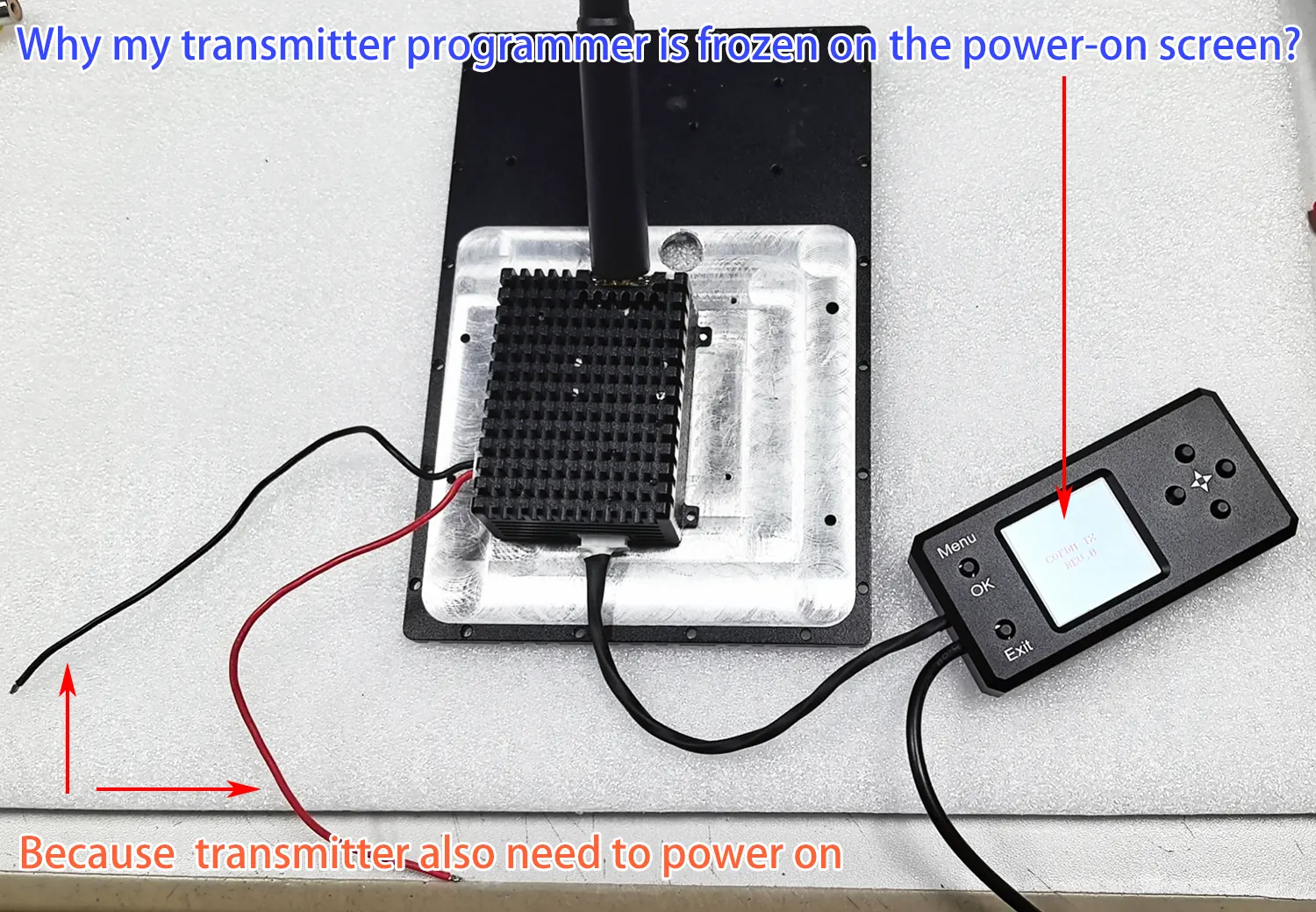
What is the power supply of your FPV VTX?
The Quadcopters do not have 12 volts. They use lithium polymer batteries and the on-board voltage is 5 or 9 volts 2A.
Answer: The FPV Video transmitter power needs 12-16.8V3A. 4 pieces is 3.7×4=14.8V power supply.
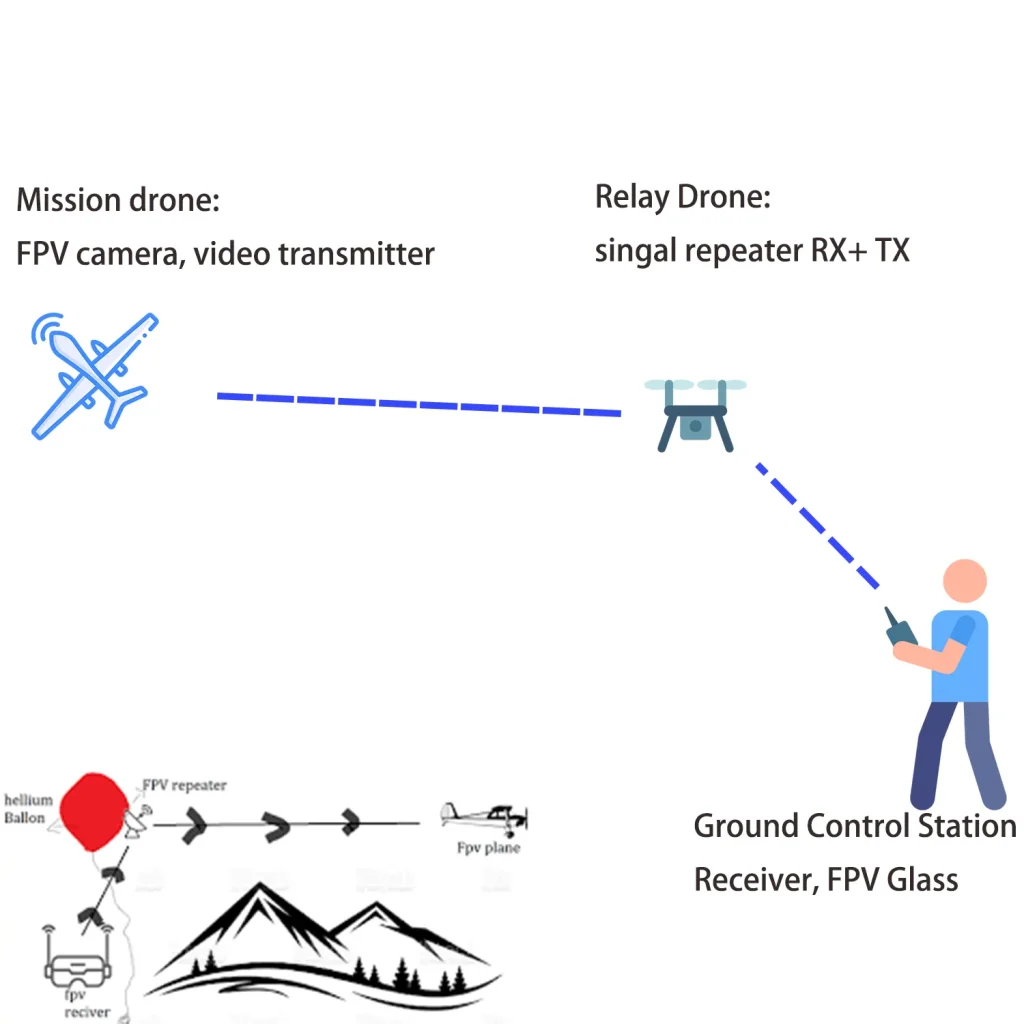
If I need to add a relay between the transmitter and receiver, there are two frequencies from the transmitter and receiver. One frequency is 860Mhz. Which frequency can I choose for the other one?
I recommend choosing a frequency between 200Mhz-700Mhz to avoid interference.
I suggest adding the filter to the repeaters, transmitters, and receivers to reduce frequency harmonics and interference between frequencies.
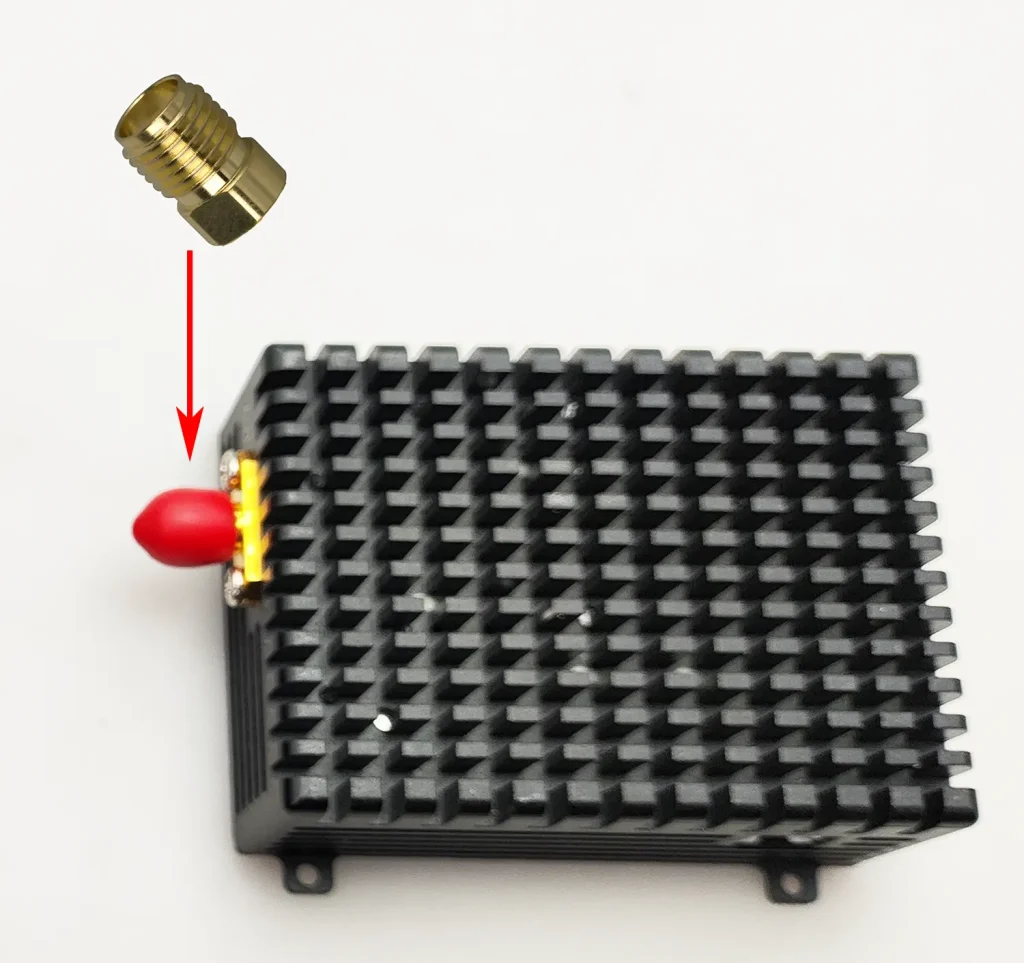
Could you please change the position of the transmitter RF antenna from a 45-degree oblique angle to a flat angle?
Yes, we can customize it for you. Please tell us when placing your order.
some people use the below keywords to find us:
передача видео сигнала на 20 км фпв sfgt ampf 1200 видеопередатчик для fpv
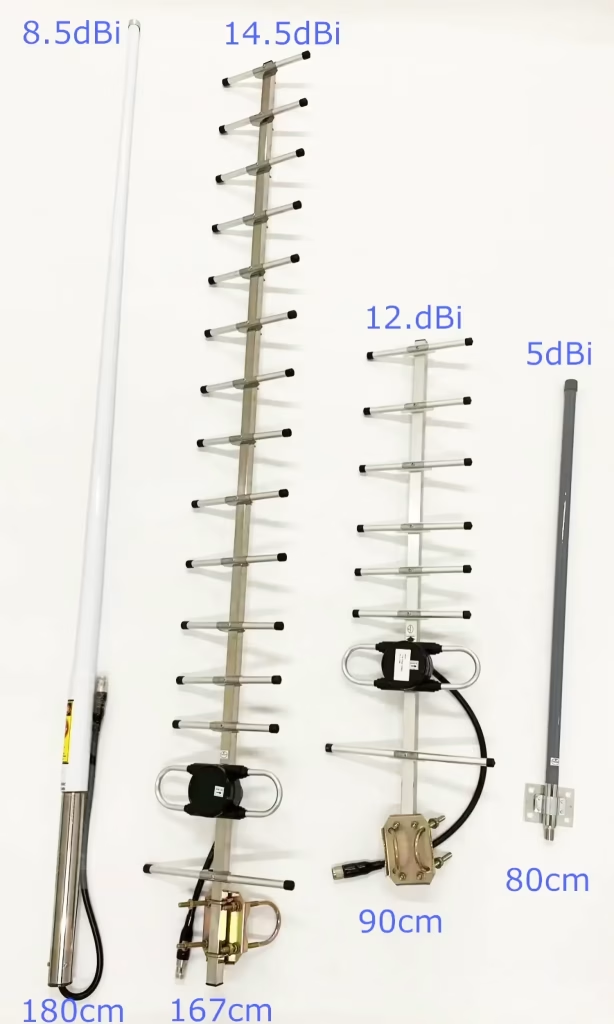
Q: Do you have a suggestion for a good directional antenna that will work with this VTX video transmitter at the 595mhz band?
A: We recommend using the Yagi directional antenna if your application agrees.
- Q: What is the maximum transmission distance of the FPV1887 video transmitter?
A: It supports up to 50km in Line-of-Sight (LOS) conditions with the default 3W power amplifier (PA) 13. - Q: What is the end-to-end latency of this module?
A: The wireless transmission itself has 75ms latency, with total end-to-end delay under 120ms—ideal for real-time FPV control. - Q: Does it support encryption for secure video feeds?
A: Yes, it uses AES128-bit digital encryption, preventing unauthorized access unlike analog transmitters - Q: What video encoding format is used?
A: H.265 compression ensures high efficiency and clear SD video (720×480) at low bandwidths. - Q: What frequency bands are supported?
A: Customizable between 170–860MHz (default 595MHz), allowing region-specific compliance. Other frequencies can also be customized according to your project requirements.
- Q: How does the narrow 2MHz bandwidth improve performance?
A: By reducing RF bandwidth to 2MHz/QPSK, receiving sensitivity reaches -98dBm—7dB higher than standard models, doubling transmission distance and enhancing anti-interference. - Q: Is it suitable for non-line-of-sight (NLOS) environments?
A: Yes, COFDM modulation provides strong diffraction capabilities, maintaining stable video in urban/obstructed areas. - Q: Why choose this over analog transmitters?
A: Digital COFDM offers superior penetration, encryption, and stability vs. analog’s vulnerability to interference and eavesdropping. - Q: Can it handle high-speed UAVs?
A: Optimized for vehicles under 120km/h. For faster drones (>120km/h), latency may affect control responsiveness. - Q: What is the operating temperature range?
A: Tested from -40°C to 85°C, with an aluminum heatsink shell for thermal management. If the temperature is too high, the receiver video will freeze and the transmitter will automatically enter protection mode.
- Q: What is the size and weight for UAV integration?
A: The entire unit weighs <100g (motherboard: 50×35×10mm; full assembly: 67×48×23mm), critical for weight-sensitive drones. - Q: What power supply is required?
A: 12–16.8V, 3A input (e.g., 4S LiPo battery). For lower-power needs, PA can be downgraded to 1W/2W. - Q: How to dissipate heat without airflow?
A: Mount the transmitter on metal surfaces with thermal paste. The sealed aluminum shell acts as a heatsink. - Q: Can I use it with HDMI cameras?
A: No. It supports CVBS analog cameras only (720p) to minimize latency. For HDMI, use models like COFDM-908T. - Q: Does it include antennas?
A: Yes, with 45°-angled antennas optimized for FPV flight dynamics. Custom lengths/configurations are available.
- Q: Can I adjust the PA output power?
A: Yes, choose 1W, 2W, 3W, or 4W PAs. Default 3W supports 50km; lower PAs extend battery life. - Q: How to modify RF bandwidth or encryption settings?
A: Use a configuration tool board (sold separately) to set bandwidth (2M/4M/6M/8M), AES128 keys, or PA attenuation. - Q: Is antenna polarization customizable?
A: Yes, pair with LHCP/RHCP antennas (e.g., TrueRC Matchstick Carbon) for signal consistency. - Q: Can I request non-standard frequencies?
A: Yes, 170–860MHz bands can be factory-customized for specialized applications. - Q: Does it support relay systems for extended range?
A: Yes, build repeaters using dual transceivers. Use 800MHz for TX→Relay and 300MHz for Relay→RX to avoid interference.
- Q: Is this suitable for long-range industrial drones?
A: Absolutely. The 50km range, COFDM reliability, and IP-rated shell make it ideal for surveying/inspection. - Q: Can it be used on racing drones?
A: Limited by weight and latency. For racing drone long range and video quality demand, it is suitable. - Q: How does it perform in crowded RF environments?
A: Narrow bandwidth 2MB reduce interference. Add optional band-pass filters for noisy areas. - Q: Is it compatible with BetaFlight OSD?
A: Yes, integrates with BetaFlight for real-time telemetry overlay.
- Q: How does FPV1887 outperform COFDM-912T?
A: Lower latency (120ms vs. 400ms), smaller size (80g vs. heavier), and 2MHz bandwidth (vs. 6MHz) enable longer range and lower resource use. - Q: Why is it lighter than similar long-range TX modules?
A: Advanced COFDM modulation reduces PCB complexity, and the aluminum shell minimizes weight while shielding. - Q: Compared to DJI HD systems, what are the trade-offs?
A: FPV1887 offers FPV longer range and lower cost but only SD video. DJI provides HD video quality at shorter distances. DJI also support 4K TF card for video recording.
- Q: What if the transmitter overheats?
A: It auto-throttles at >100°C to protect components. Add cooling fins or airflow holes if waterproofing isn’t needed. - Q: How to update firmware or configure settings?
A: Use the parameter configuration tool (optional) via MicroUSB or serial interface. - Q: Are receiver modules included?
A: Included the receiver, it supports dual-diversity antennas (70×80×15mm) for optimal signal pickup.
- Q: How to minimize interference in urban environments with dense RF noise?
A: Use narrow 2MHz bandwidth combined with LHCP/RHCP polarized antennas to reduce multipath distortion. Add optional band-pass filters for 170-860MHz sub-bands. - Q: Does it support frequency hopping for anti-jamming?
A: No. - Q: Can it coexist with 5.8GHz analog VTXs on the same drone?
A: Not recommended.
- Q: What is the operational altitude limit for this transmitter?
A: Tested up to 5,000 meters ASL. Reduced air density minimally affects COFDM performance, but signal diffraction weakens above 3,000m. - Q: How to prevent condensation damage in high-humidity environments?
A: The aluminum shell acts as a heatsink and moisture barrier. For tropical use, apply conformal coating to PCB joints and SMA connectors. - Q: Can it withstand vibrations from gasoline-powered UAVs?
A: Yes, shock-proof design and soldered components pass MIL-STD-810G vibration tests. Mount with silicone grommets for engines >15,000 RPM.
- Q: Compared to Walksnail Avatar V3, which is better for 50km+ flights?
A: FPV1887 excels in range (50km vs. 4km) and power efficiency (3W vs. 500mW), but Walksnail offers HD video at 27ms latency for short-range racing. - Q: Why choose this over DJI O3 Air Unit for industrial inspections?
A: FPV1887 provides longer range (50km vs. 4km), lower cost, and customizable frequencies for non-line-of-sight sites, while DJI offers 1080p video with higher latency. - Q: How does its anti-jamming capability compare to OQPSK satellite links?
A: COFDM’s 2D spreading resilience outperforms OQPSK in terrestrial multipath environments, but OQPSK is superior for satellite-UAV communication with Doppler compensation.
- Q: Can it record video locally like DJI Air Unit?
A: No. For recording, pair with an external HD action camera via analog CVBS output. Onboard recording would increase latency. - Q: How to integrate telemetry data (GPS, battery voltage) into the video feed?
A: Connect to flight controllers (BetaFlight/iNAV) via UART. Use MFD TeleFlyPro encoder for OSD overlay on both video/audio channels.
- Q: What is the minimum battery capacity for a 50km round-trip mission?
A: For a 2kg UAV, 4S 10,000mAh LiPo. VTX consumes ~15W (3W PA + 2W COFDM). Use 80% battery margin for safety. - Q: Can solar panels power this transmitter during long-endurance flights?
A: Yes, if paired with a 12V DC-DC regulator. Solar input must sustain ≥13V under load; recommend 50W panels for mid-sized UAVs.
- Q: Is FCC/CE certification included for custom frequencies?
A: Factory provides FCC ID/CE DOC for default 595MHz. For other bands (e.g., 433MHz), users must apply for local radio licensing. - Q: Does AES128 encryption comply with military data standards?
A: Yes, but for Classified communications, add an external AES256 module via the UART expansion port.
- Q: Video freezes at 20km despite LOS conditions. How to diagnose?
A: Check:- Antenna SWR (should be ≤1.5)
- PA temperature (>80°C throttles power)
- Receiver diversity (use two antennas at 90° angles)
- Q: Why does the OSD disappear intermittently?
A: Caused by voltage, voltage spikes >16.8V. Add a 12V linear regulator or capacitor buffer to stabilize BetaFlight OSD signals.
- Q: Can it be used for drone swarms?
A: No, only support point to point model. (one transmitter and one receiver). - Q: Is it suitable for counter-UAV systems like FPV Killer?
A: Yes. Its AES128 encryption resists hijacking, and narrow bandwidth complicates jamming. - Q: How to adapt this for submarine FPV?
A: Replace antennas with 30cm waterproof whips. Range drops to 1-2km in seawater; use 170MHz band for better penetration.
Ask A Question
Thank you for your response. ✨