






Wearable Camera Long-Range Mesh Video Solution – Discover how the Vcan1962 Handheld IP Mesh Ad Hoc Transceiver solves wireless streaming limits up to 1KM NLOS.
Table of Contents
Customer Inquiry
“We develop wearable devices with dual USB nano cameras. At the moment we use Wi-Fi network for wireless streaming with constraint of limited range. Wondering if you have some video transmitter/receiver that could operate in a 1KM range with no line of sight and minimal latency.”
Understanding the Customer’s Need
This customer is developing wearable video devices with dual USB nano cameras that currently rely on Wi-Fi for video transmission. The main challenges are:
- Limited range (typically <100m for standard Wi-Fi)
- Need for 1KM range operation
- Non-line-of-sight (NLOS) environment
- Minimal latency for real-time monitoring
To address this, a robust, mobile, and self-healing network is required—one that maintains high-quality video streaming even in complex or obstructed environments.
Recommended Solution: Vcan1962 Handheld IP Mesh Ad Hoc Network Transceiver
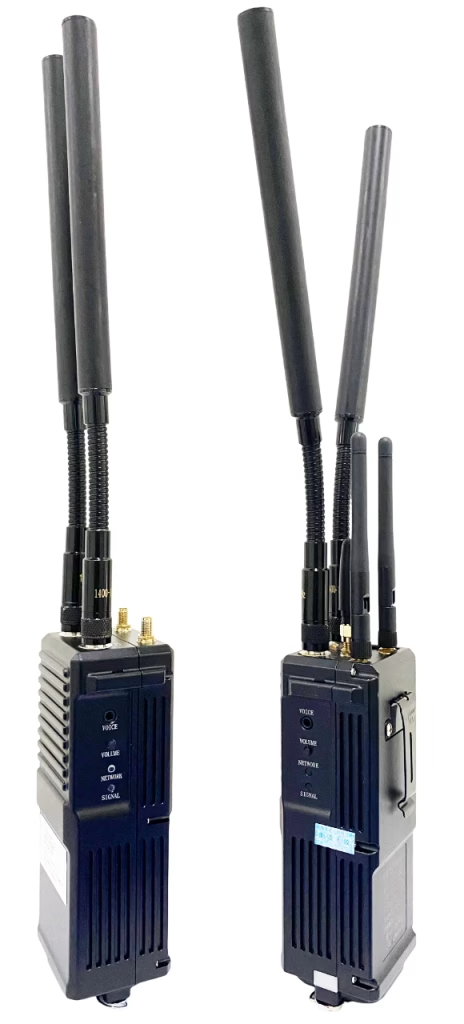
The Vcan1962 is a handheld IP Mesh Ad Hoc transceiver designed for portable video, data, and voice communication. It supports Wi-Fi and RJ45 video input, ideal for integrating with wearable cameras or mobile video systems.
Overview
The Vcan1962 creates a broadband wireless mesh network (MANET) that operates without existing network infrastructure. Each unit acts as a node that can automatically connect, relay, and transmit real-time video, voice, and data signals—even in non-line-of-sight conditions.
Unlike traditional Wi-Fi, the mesh network forms a centerless, distributed, multi-hop system—allowing your wearable devices to communicate over longer distances and adapt dynamically to changes in the environment.
Key Features
- Self-Organizing Mesh Network: No base station needed. Nodes connect automatically within seconds.
- Multi-hop Relay: Extend range beyond 1KM easily through node relays.
- Low Latency: Only about 2ms delay per hop, ensuring real-time video.
- Strong NLOS Performance: Excellent diffraction and anti-fading capability.
- Secure Transmission: AES 128-bit encryption for data protection.
- High Data Rate: Peak bandwidth up to 90Mbps for HD video.
- Rugged Design: IP65 protection, -40°C~+70°C operating range.
- Portable and Battery-Powered: 12V/2A, 4000mAh internal battery for field use.
Technical Highlights
| Parameter | Specification |
|---|---|
| Frequency | 1415–1455MHz |
| Power Output | 2×1W adjustable |
| Bandwidth | 5 / 10 / 20MHz |
| Modulation | BPSK/QPSK/16QAM/64QAM |
| Sensitivity | -98dBm |
| Data Rate | Up to 90Mbps |
| Range | 1–8km (multi-hop supported) |
| Delay | ~2ms per hop |
| Network Scale | ≥32 nodes |
| Interface | RJ45 ×2, RS232 ×2, Wi-Fi |
| Power | 12V DC, 6–12W consumption |
Applications
- Wearable camera systems (body-worn video)
- Robotics and unmanned systems
- Law enforcement and tactical teams
- Emergency communication and disaster response
- Industrial inspection and rescue operations
FAQ
Q1: Can it work without line of sight?
Yes. The Vcan1962 supports strong diffraction and multipath resistance, ideal for urban, indoor, or forested environments.
Q2: What is the real transmission delay?
The latency is around 2ms per hop, allowing real-time HD video with minimal lag.
Q3: How far can it transmit?
Single-hop ground-to-ground range can reach 1–8km, and multi-hop relay can extend it further.
Q4: Does it need an internet connection?
No. It’s a standalone ad hoc network, working independently from cellular or Wi-Fi infrastructure.
Q5: How many devices can be connected?
Up to 32 nodes can be networked together simultaneously.
For wearable camera developers facing Wi-Fi range limits, the Vcan1962 Handheld IP Mesh Ad Hoc Network Transceiver provides a powerful and flexible alternative. It delivers stable, encrypted, long-range NLOS video and data transmission—perfect for mobile, wearable, or field-based applications where reliability and low latency are essential.
👉 Recommended Product:
Handheld IP Mesh Ad hoc Network Transceiver – Vcan1962
Ask A Question
Thank you for your response. ✨