UAV Broadband Relay Guide: How to Build a Drone Wireless Video Radio Link Relay for Mountain-Blocked Long-Range Flights
In long-range UAV operations, mountainous terrain is one of the most common causes of video and control signal degradation. Even with high-power links, non-line-of-sight (NLOS) conditions can dramatically reduce usable range, leading to pixelated video, unstable control, or complete signal loss.
This article explains how to build a simple and effective UAV broadband wireless link relay system using existing Vcan1933 equipment, based on a real deployment scenario. For more product details, see Vcan1933 Drone Link for Long-Range Video & Data.
Table of Contents
1. Problem Description
Total flight distance required: 35–40 km
Mountain obstruction: ~11 km from the take-off point
Current performance:
Video available up to ~25 km (highly pixelated, minimal control)
No signal beyond 25 km
Available equipment:
Vcan1933 8W unit (previous system)
Vcan1933 2W unit (recently purchased)
Additional advantage:
A suitable relay installation location has already been identified
The goal is to reuse existing hardware to overcome the mountain blockage and extend the effective range.
2. Is the 2W Vcan1933 Suitable for a Relay?
Yes — absolutely.
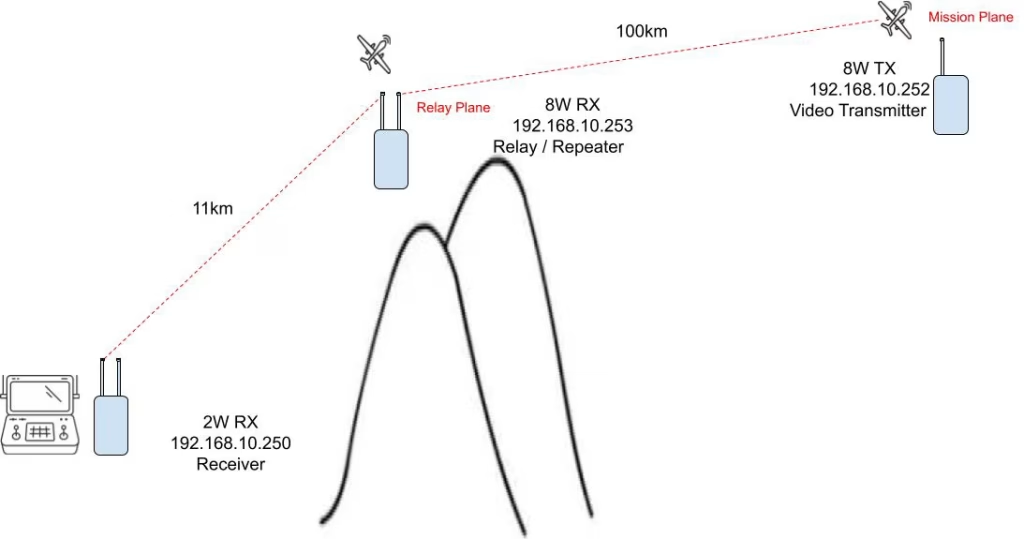
Because the relay site is only about 11 km from the ground station, a 2W unit is more than sufficient for the ground-side link. The key is to reassign the roles of the existing devices correctly.
UAV Broadband Relay Guide-How to Build a Drone Wireless Video Radio Link Relay
3. Recommended Relay Architecture
Device Role Assignment
Location
Device
IP Address
Role
Mission UAV
8W Vcan1933 TX
192.168.10.252
Slave / Air Unit
Relay site (mountain / hill)
8W Vcan1933 RX
192.168.10.250 (before) 192.168.10.253 (after)
Repeater
Ground station
2W Vcan1933 RX
192.168.10.250
Slave / Ground Unit
This setup ensures:
Maximum uplink reliability from the mission UAV
Strong mid-point signal regeneration at the relay
Stable short-distance link to the ground station
4. Step-by-Step Configuration Guide
Step 1: Unify the Network ID (Very Important)
Originally, the two Vcan1933 systems operate independently, each with its own Network ID.
For a relay system to work:
All three devices must use the same Network ID
Mission UAV (8W TX)
Relay unit (8W RX → Repeater)
Ground station unit (2W RX)
This allows all units to operate within the same network and forward data correctly.
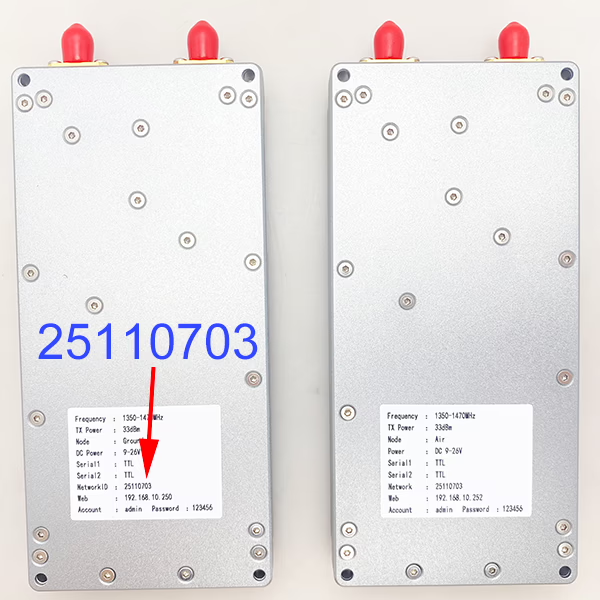
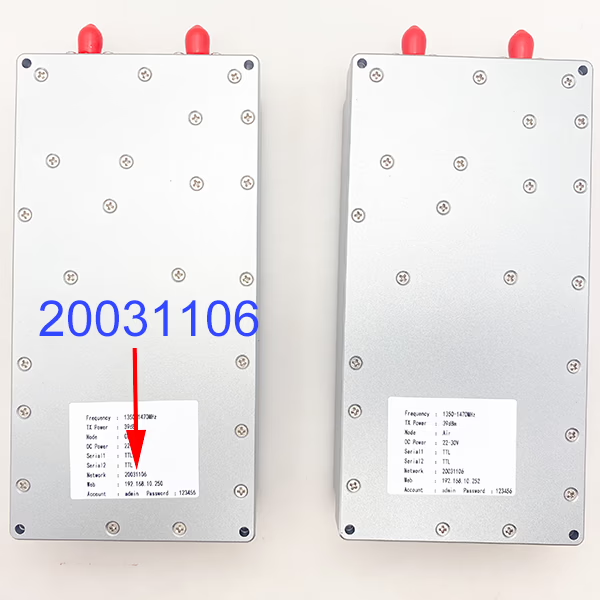
Operation: Change 2W Master Ground Unit ID 25110703 to 20031106 (default ID of 8W set network).
25110703 ID of 2W Vcan1933
20031106 ID of 8W Vcan1933
Step 2: Modify the IP Address to Avoid Conflicts
By default:
Vcan1933 Master (Ground Unit) IP address: 192.168.10.250
If both the 8W Master Ground Unit and the 2W Master Ground Unit keep this default value, an IP conflict will occur.
Action required:
Change the IP address of the 8W Master (Ground Unit) to a different unused IP, for example:
192.168.10.253
Make sure the new IP remains in the same subnet and does not conflict with any other device.
Step 3: Set the Relay Device to Repeater Mode
Power on the 8W receiver that will be installed at the relay location
Access its management interface:
Default IP: 192.168.8.250
Log in to the web configuration page
Change the device role and IP address:
From Master → Repeater
From 192.168.10.250 → R192.168.10.253
Save the configuration and reboot if required
Once configured, this unit will:
Receive the video and control signals from the mission UAV
Regenerate and forward them toward the ground station
how to modify the IP address of UAV Broadband radio linkhow to modify the operating model and network address ID of UAV Broadband radio link
5. Deployment Tips for Best Performance
Ensure clear line-of-sight:
UAV ↔ Relay
Relay ↔ Ground station
Install the relay antenna at a higher elevation whenever possible
Use longer omnidirectional antennas at the relay site to maximize link quality
Secure stable power for the relay (battery or fixed power source)
Test the full system on the ground before flight.
Check the repeater wireless noise from ground unit 192.168.10.250Check the wireless noise of salve air unit on mission plane from repeater 192.168.10.253Check the slave wireless noise from slave unit 192.168.10.252
6. Expected Result
With the relay properly configured:
The mountain no longer blocks the primary link
Video quality remains stable beyond 25 km
Control reliability improves significantly
Total flight distance of 35–40 km becomes achievable under proper RF conditions
7. Conclusion
By reusing an existing 8W Vcan1933 unit as a repeater and deploying a 2W Vcan1933 at the ground station, you can build a cost-effective and reliable UAV broadband wireless link relay system. This approach is ideal for long-range UAV missions in mountainous or obstructed environments, without requiring additional custom hardware.









Ask A Question
Thank you for your response. ✨