






RS422 vs RS485: Key Differences and Applications
RS422 and RS485 are widely used differential serial communication standards, offering reliable long-distance data transmission and strong interference resistance. Although similar, they serve different purposes in industrial, UAV, and surveillance applications. Understanding their differences helps you choose the right solution for your system.
Table of Contents
What is RS422?
RS422 (Recommended Standard 422) is designed for high-speed, long-distance one-way communication.
- Type: Point-to-multipoint, one-way (half-duplex)
- Nodes: 1 transmitter + up to 10 receivers
- Distance: Up to 1200 meters
- Speed: Up to 10 Mbps
- Applications: Instrumentation, telemetry, and remote monitoring
RS422 ensures stable signals and strong noise immunity but only supports a single master device.
What is RS485?
RS485 (Recommended Standard 485) is ideal for multi-device networks with two-way communication.
- Type: Multi-point, two-way (half-duplex or full-duplex)
- Nodes: Up to 32 devices, each can send/receive data
- Distance: Up to 1200 meters
- Speed: Up to 10 Mbps
- Applications: Industrial automation, PLC networks, building control, PTZ camera control
RS485 allows multiple master devices on the same bus, making it highly flexible for industrial environments.
RS422 vs RS485: Key Differences
| Feature | RS422 | RS485 |
|---|---|---|
| Communication Direction | One-way | Two-way (half-duplex by default) |
| Max Nodes | 1 transmitter + 10 receivers | Up to 32 nodes (multi-master supported) |
| Bus Structure | Point-to-multipoint | Multi-point bus |
| Transmission Distance | Up to 1200 m | Up to 1200 m |
| Maximum Speed | Up to 10 Mbps | Up to 10 Mbps |
| Typical Applications | Instrumentation, telemetry | Industrial automation, PTZ cameras |
| Multi-Master Support | No | Yes |
When to Use RS422 vs RS485
- RS422: Best for one-way communication from a single master to multiple receivers.
Example: Sensor data transmission from a remote station to a control center. - RS485: Ideal for multi-node networks requiring two-way communication or multiple master devices.
Example: PTZ camera control in surveillance systems or PLC communication in factories.
Enhancing System Flexibility
You can further optimize your system with conversion options:
- Convert a TTL port to RS422 to extend communication distance and stability.
- Add an RS232-to-RS485 converter board to support RS485, commonly used for camera PTZ control or multi-device industrial networks.
Conclusion
RS422 and RS485 are both reliable communication protocols. RS422 excels in one-way, point-to-multipoint setups, while RS485 is perfect for multi-node, two-way networks. Choosing the right standard ensures robust and efficient communication for industrial, UAV, and surveillance applications.
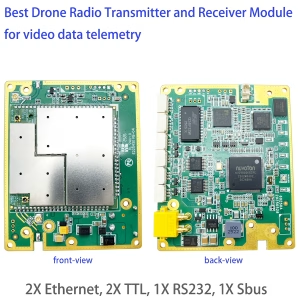
For best wireless video data transceiver module Vcan2122, We can also convert one TTL port to RS422, and additionally, we can add an RS232-to-RS485 converter board to support RS485, which is commonly used for camera PTZ control.
Ask A Question
Thank you for your response. ✨