





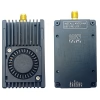
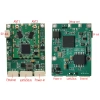
Ultra-Wideband FPV Video Receiver (200MHz–7.5GHz) with UART Programmable Frequency Scanning
Table of Contents
Description
Ultra-wideband FPV receiver supporting 200MHz–7.5GHz frequency range with UART programmable control, -96dBm sensitivity, PAL/NTSC output, and 7–36V input. Compact, lightweight, and ideal for custom RF video applications, drone FPV systems, and advanced signal monitoring.
Overview
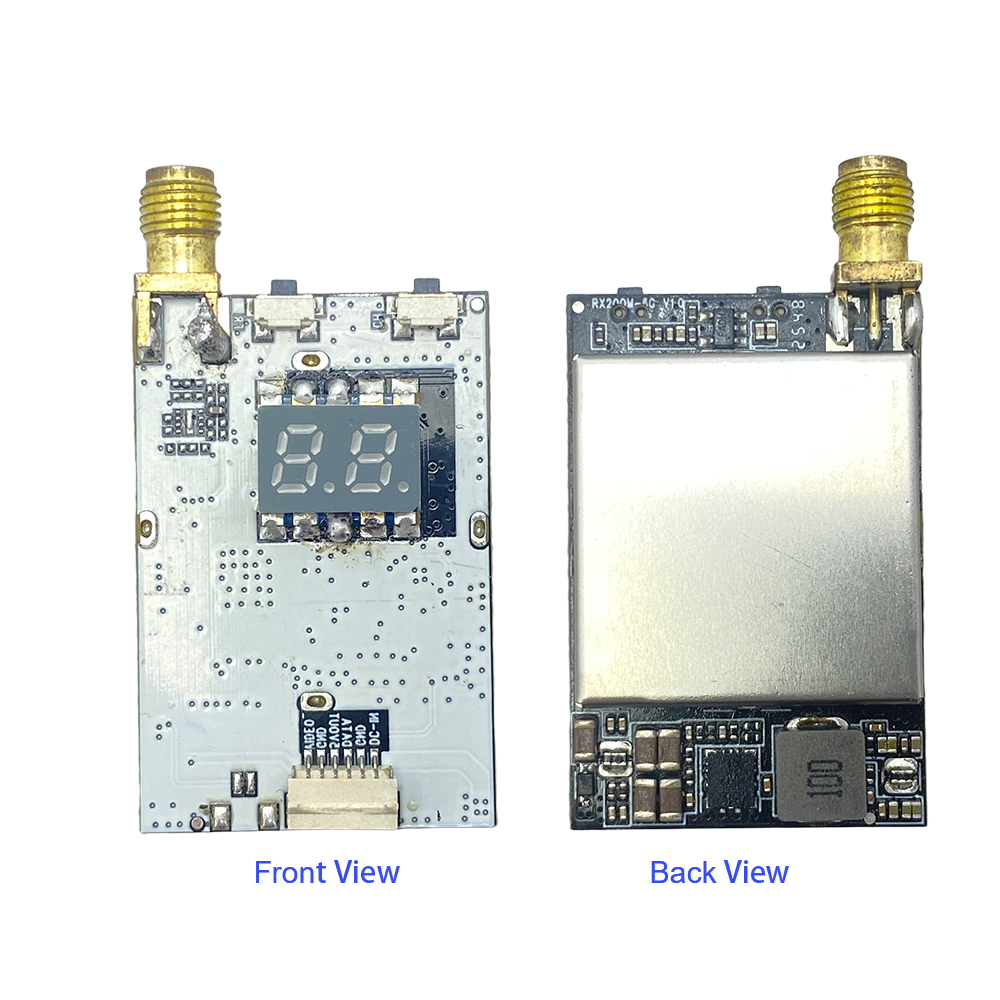
The Ultra-Wideband FPV Video Receiver is a high-performance analog video reception module designed for advanced FPV (First Person View) systems and custom RF applications. Covering an exceptionally wide frequency range from 200MHz to 7.5GHz, this receiver provides unmatched flexibility compared to traditional fixed-band FPV receivers.
Engineered for professionals, developers, and enthusiasts, the device supports UART (serial) programmable frequency control, allowing users to define custom frequency points and scanning ranges. This makes it ideal not only for FPV drone systems but also for RF experimentation, signal monitoring, and multi-band video reception.
With a high sensitivity of -96dBm, the receiver ensures stable video performance even in challenging environments. It supports both PAL and NTSC analog video formats, ensuring compatibility with a wide range of cameras, displays, and flight control systems.
The compact and lightweight design (only 9.9g) makes it easy to integrate into UAV systems, ground stations, or portable monitoring setups. A wide input voltage range of 7–36V (2S–6S battery support) allows flexible power options for different use cases.
Whether you are building a custom FPV system, conducting RF testing, or developing next-generation wireless video solutions, this ultra-wideband receiver delivers precision, flexibility, and reliability.
Features
1. Ultra-Wideband Frequency Coverage
Supports an extensive frequency range from 200MHz to 7.5GHz, enabling compatibility with multiple RF bands and non-standard video transmission systems. This wide coverage eliminates the limitations of traditional FPV receivers restricted to narrow frequency bands.
2. UART Programmable Frequency Control
Equipped with a serial (UART) interface that allows users to:
- Customize starting frequency
- Define frequency steps
- Perform manual frequency scanning. (automated frequency scanning does not support now)
- Integrate with flight controllers or external systems
This feature provides unmatched flexibility for developers and advanced users.
3. High Sensitivity (-96dBm)
The receiver is optimized for long-range and low-signal environments. Its high sensitivity ensures:
- Stable video reception
- Reduced signal dropouts
- Improved performance in interference-heavy environments
4. Wide Voltage Input (7–36V DC)
Compatible with 2S to 6S LiPo batteries, the built-in high-efficiency DC/DC power system ensures stable operation across a wide voltage range.
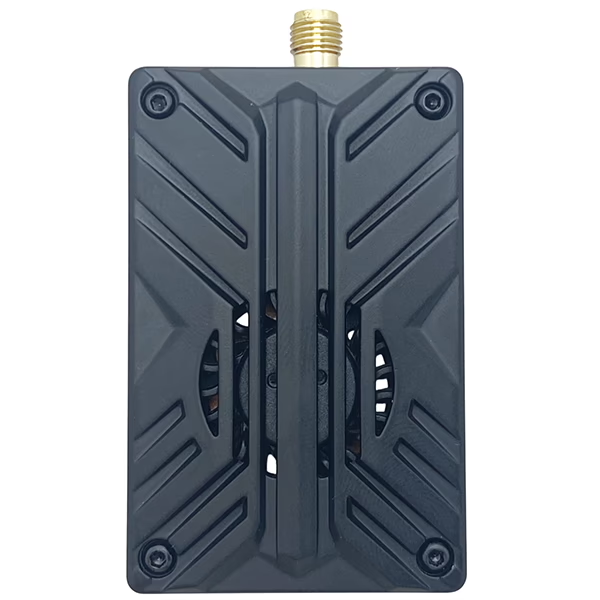
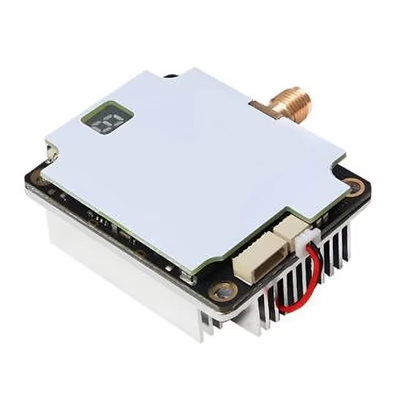
5. Compact and Lightweight Design
- Weight: 9.9g (without antenna)
- Size: 40.4 × 26.8 × 5.0 mm
Ideal for integration into drones, portable receivers, or embedded systems.
6. PAL/NTSC Video Output Compatibility
Supports both major analog video standards:
- PAL
- NTSC
Ensures compatibility with global FPV cameras and display systems.
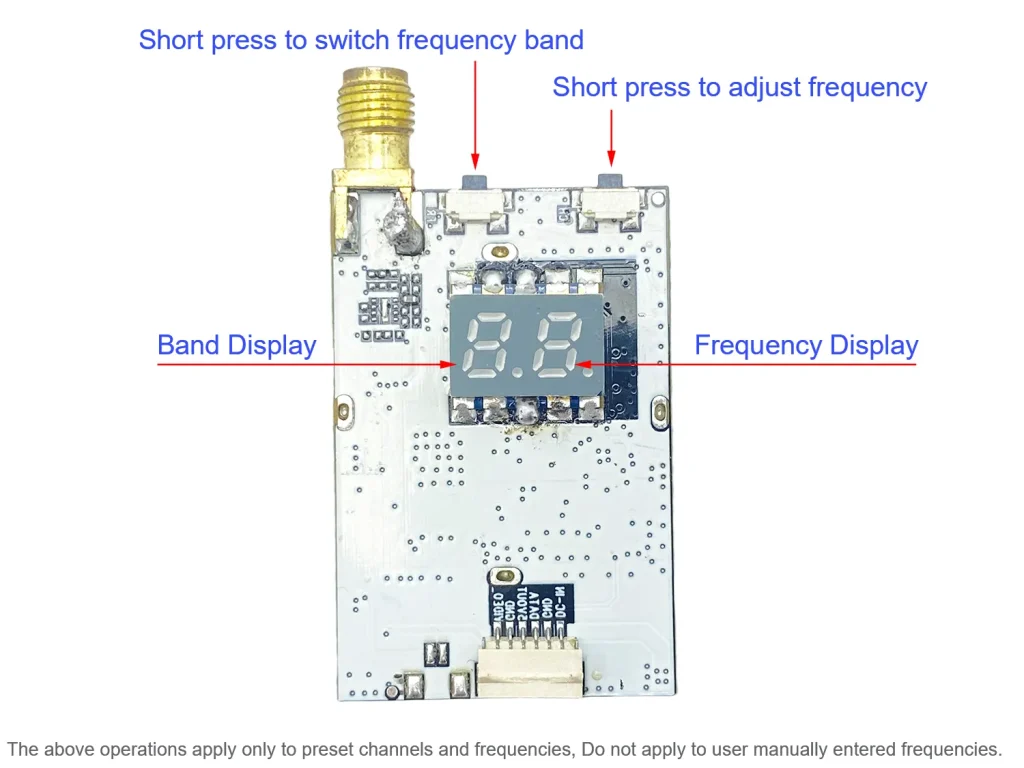
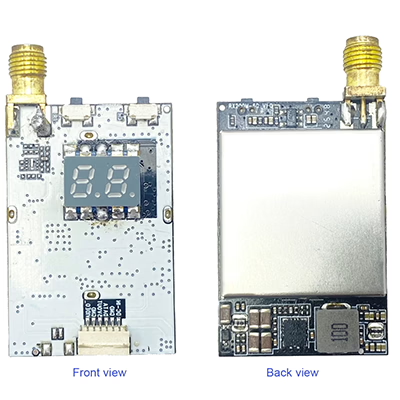
7. Dual Button Control Interface
- Short press: Switch frequency channel
- Long press (3 seconds): Switch frequency band
Simple and intuitive manual operation without requiring external tools.
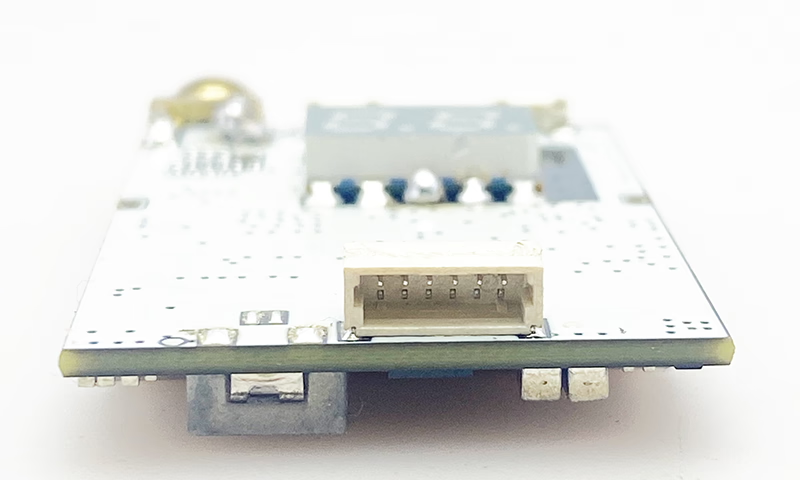
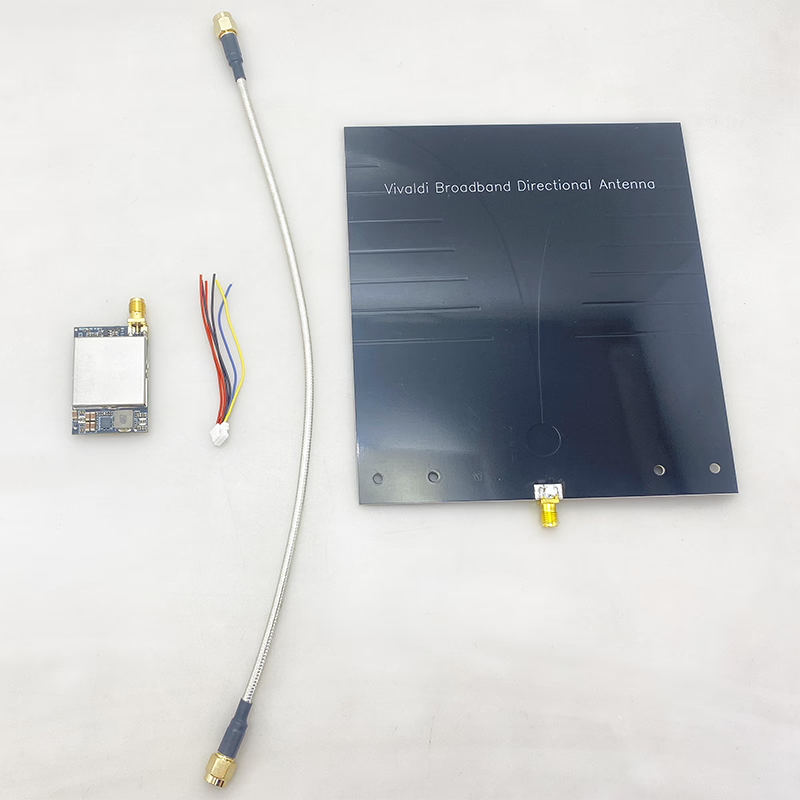
8. SMA Antenna Interface
Standard SMA connector allows easy integration with a wide range of antennas for different frequency bands and applications.

Specifications
| Parameter | Description |
|---|---|
| Frequency Range | 200MHz – 7.5GHz |
| Input Voltage | 7–36V DC (2S–6S LiPo) |
| Power System | High-efficiency DC/DC |
| Sensitivity | -96 dBm |
| Video Format | PAL / NTSC |
| Dimensions | 40.4 × 26.8 × 5.0 mm |
| Weight | 9.9g (without antenna) |
| Antenna Connector | SMA (male) |
| Control Interface | UART (Serial) |
| Button Control | Band & Channel Selection |
| Video Interface | Analog video output |
| Operating Mode | Manual / UART programmable |

Connection Cable Description
SH1.0-6P Connector (Main Connection Cable)
| PIN | Interface | Wire Color | Definition | Description |
|---|---|---|---|---|
| 1 | VCC | Red | 7-36V Power Input | Connect to the positive terminal of the battery. Supports 2S-8S batteries. |
| 2 | GND | Black | Power Ground | Connect to the negative terminal of the battery. |
| 3 | DATA | Blue | RX Control Signal | Connect to the TX pin of the serial port module. |
| 4 | VCC | Red | 5V Power Output | Connect to the camera VCC to supply power to the camera. |
| 5 | GND | Black | Power Ground | Connect to the camera GND. |
| 6 | VIDEO | Yellow | Video Output | Video output. Connect to a display or video goggles for image output. |

Applications
1. FPV Drone Systems
Perfect for long-range and multi-band FPV drone setups where flexibility in frequency selection is critical.
2. RF Signal Monitoring
Useful for engineers and technicians who need to monitor analog video signals across a wide spectrum.
3. Custom Wireless Video Systems
Ideal for developing proprietary or experimental wireless video transmission systems.
4. Ground Stations
Can be integrated into portable or fixed ground stations for UAV operations.
5. Research and Development
Supports academic and industrial R&D projects involving RF communication and video transmission.
6. Multi-Band Surveillance Systems
Suitable for applications requiring reception of signals across different frequency bands.
Customization Options
We support flexible customization to meet different project and OEM requirements:
1. Frequency Range Customization
- Adjust default frequency bands
- Pre-configure specific frequency ranges
2. Firmware Customization
- Custom UART command sets
- Proprietary communication protocols
- Frequency scanning algorithms
3. Interface Customization
- Connector type changes
- Cable length and pinout adjustments
4. Branding and Packaging
- OEM/ODM logo printing
- Custom packaging design
5. Hardware Modifications
- Enclosure changes
- Heat dissipation optimization
- Integration into larger systems
FAQ (Frequently Asked Questions)
Q: Is there an ultra-wideband video receiver (VRX) that supports frequencies up to 12 GHz? Are there any plans for such a product?
A: At present, our video receivers support frequencies up to 7.5 GHz. Support for the 12 GHz band is not available in our current lineup. We are currently developing a new FPV VRX with an extended frequency range of up to 10 GHz. Expanding into higher frequency bands involves significant engineering challenges and requires thorough development and testing, so we are not able to provide a confirmed release timeline at this stage.
Q1: What frequency range does this receiver support?
A: The receiver supports an ultra-wide frequency range from 200MHz to 7.5GHz, allowing operation across multiple RF bands. The default antenna frequency range is 860-8000MHz. If you modify the operation frequency is from 200-860MHz, you have to use this range antenna.
Q2: Can I customize the frequency manually?
A: Yes. You can adjust frequencies using UART serial commands for precise control. You can set the frequency by sending a command. For example:bp:5765\r\n
This command sets the FPV VRX frequency to 5765 MHz.
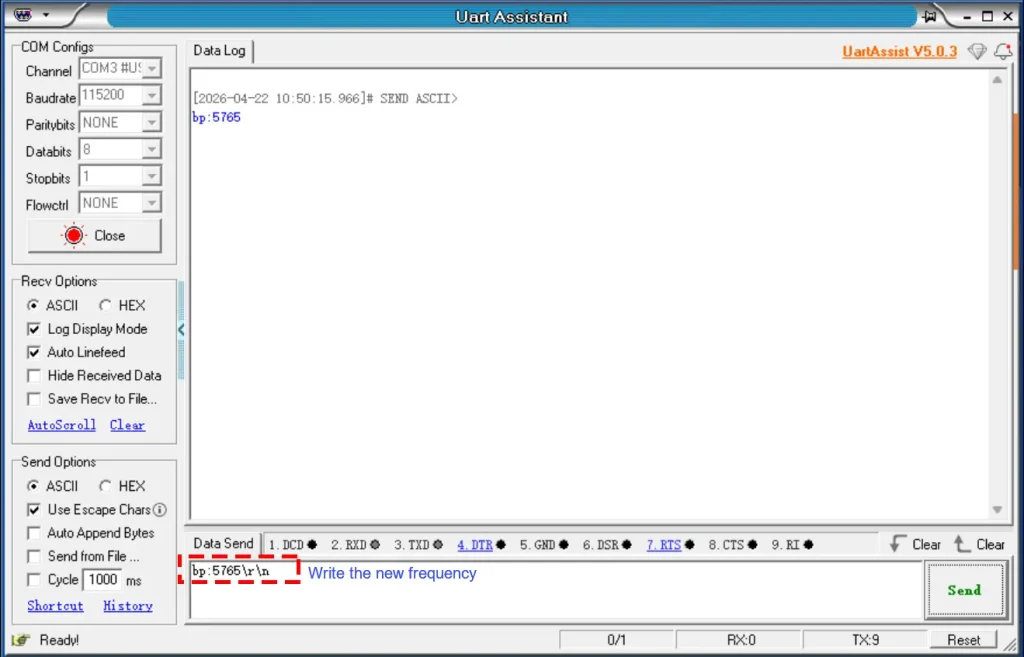
Q3: How do I change the starting frequency via UART?
A: Connect the receiver to a serial tool, configure the correct COM port and baud rate, enable ASCII mode, send the desired frequency command, and restart the device.
Q: What frequency range is supported?
A: The system supports frequency input from 200 MHz to 7500 MHz. Any user define frequency, For example: 980 MHz, 3765 MHz, 4988 MHz, etc.
Q: Can I set multiple custom frequencies or scan frequencies automatically?
A: Currently, only one custom frequency can be set at a time. Automatic frequency scanning (full-band scan) is not available in the current version.
Q: Does the device include preset frequencies?
A: Yes, several commonly used frequencies are preset for convenience.
A: Yes. In addition to the two hardware buttons, the receiver also provides a UART serial interface. You can send commands through this UART port to control the FPV VRX, such as changing frequency and potentially other functions.
A: It depends on the frequency range you switch to. The default antenna supports a very wide frequency range (approximately 800 MHz to 8 GHz). If your new operating frequency falls within this range, you generally do not need to replace the antenna. However, if you change to a lower frequency band such as 200–800 MHz, the default antenna may no longer perform efficiently, and replacing it with a compatible antenna designed for that range is recommended.
Additionally, while wideband antennas offer convenience, you may achieve better performance by using an antenna tuned for a narrower frequency band. Narrowband antennas typically provide higher gain and improved signal quality within their specified range.
Q: Do you have any documentation describing the UART communication protocol?
A: At the moment, there is no formal UART communication documentation available.The UART interface currently supports a single basic command for changing the frequency: bp:5765\r\n This command sets the receiver frequency (in MHz). Aside from this frequency-setting command, no additional UART commands are supported at this time.
Q: If I send a UART command like bp:5765\r\n, will the receiver switch to 5765 MHz immediately? Do I need to reboot or confirm using buttons?
A: Yes, the receiver will switch to the specified frequency immediately after the command is received. No reboot or manual confirmation via hardware buttons is required. The change takes effect in real time as soon as the UART command is processed.
Q: Can I send multiple UART commands in sequence with different frequencies (e.g., bp:5765\r\n, then another frequency, etc.)?
A: Yes, you can send multiple commands in sequence. The receiver will automatically switch to the new frequency each time a valid command is received. Commands are processed one by one in the order they are sent. However, the FPV VRX can only operate on one user-defined frequency at a time. While each command is executed sequentially, only the most recently set frequency is retained. Any new command will overwrite the previously configured frequency.
Q: What is the approximate switching time from sending a UART command to getting a stable video signal?
A: After sending a UART command, the receiver typically switches to the new frequency within a few seconds. The time required for a stable video signal to appear depends on signal strength and quality. Under strong signal conditions, the video will appear quickly. In weaker signal conditions, it may take longer for the image to stabilize.
Q: Did I understand the UART settings correctly — 115200 baud, 8 data bits, no parity, 1 stop bit, ASCII commands?
A: Yes, your understanding is correct. The UART interface uses the following configuration: Baud rate: 115200; Data bits: 8; Parity: None; Stop bits: 1; Command format: ASCII. This configuration (commonly referred to as 115200 8N1) is correct for communicating with the device.
Q: What UART voltage level is used on the board: 3.3V TTL, 5V TTL, or RS232?
A: The board uses 3.3V TTL UART logic levels. Only a shared ground (GND) connection is required between devices for communication. Please note that the interface is not RS232 compatible, and RS232 signals must not be connected directly to the UART pins, as this may damage the device.
Q: Can you make your wideband FPV VRX support frequency control via SPI?
A: The standard version supports frequency tuning through the UART (DATA) port using simple serial commands. SPI control is not supported by default, but we can customize SPI frequency control for OEM/ODM projects based on your requirements.
Q: Does the “Wideband FPV Receiver (0.2–7.5GHz) with UART Control” support RSSI (Received Signal Strength Indicator) functionality?
A: The current version (200-7500MHz) does not support RSSI functionality. However, this feature is already in our development pipeline. RSSI will be fully supported in the next product iteration, which is scheduled for release next month.
Q4: Does it support digital video?
A: No. This is an analog video receiver supporting PAL and NTSC formats only.
Q5: What power supply is required?
A: The device supports a wide input range of 7–36V DC, compatible with 2S–6S LiPo batteries.
Q6: Is it compatible with standard FPV cameras?
A: Yes, as long as the camera outputs analog PAL or NTSC video signals.
Q7: Do I need to install an antenna before use?
A: Yes. Always connect the antenna before powering on the device to avoid damage.
Q8: Can it be used without the enclosure?
A: Yes, but removing the enclosure may affect heat dissipation and slightly reduce performance under high load.
Q9: What type of antenna connector does it use?
A: It uses a standard SMA male connector.
Q10: Is this suitable for long-range applications?
A: Yes. With -96dBm sensitivity and proper antenna selection, it performs well in long-range scenarios.
Conclusion
The Ultra-Wideband FPV Video Receiver is a powerful, flexible, and highly customizable solution for modern FPV and RF applications. With its unmatched frequency range, UART programmability, and compact design, it stands out as a versatile tool for both professionals and enthusiasts.
Whether you are building drones, testing RF systems, or developing new wireless video technologies, this receiver provides the performance and adaptability you need.
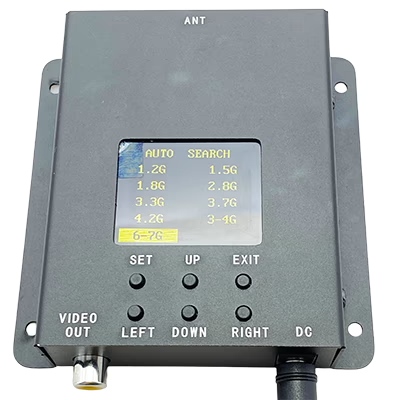
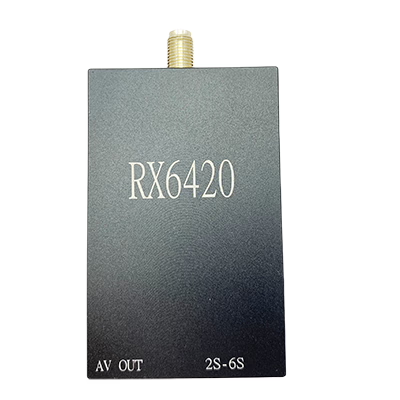
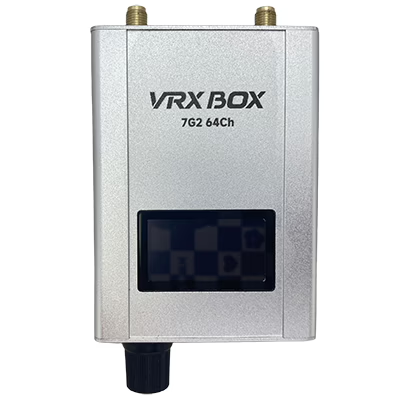
7GHz FPV VRX receiver
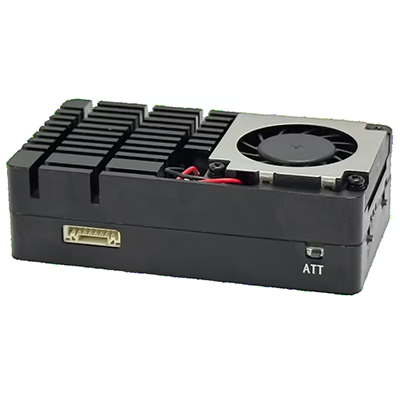
7GHz FPV VTX transmitter

Chinese User Manual
Chinese instruction manual for ultra-wideband FPV image transmission receiver





Reviews
There are no reviews yet.