






2.4GHz Drone Transmitter and Receiver Module – High-Speed UAV Video & Telemetry Transmission
Table of Contents
Overview
Introducing our next-generation 2.4GHz Drone Transmitter and Receiver Module, designed for professional UAV applications, long-range video transmission, and telemetry data communication. This advanced wireless module supports multiple working frequency bands: 1427.9–1467.9 MHz (1.4G), 806–826 MHz (800Mhz), or optional 2401.5–2481.5 MHz (2.4G), providing versatile compatibility for diverse drone applications.
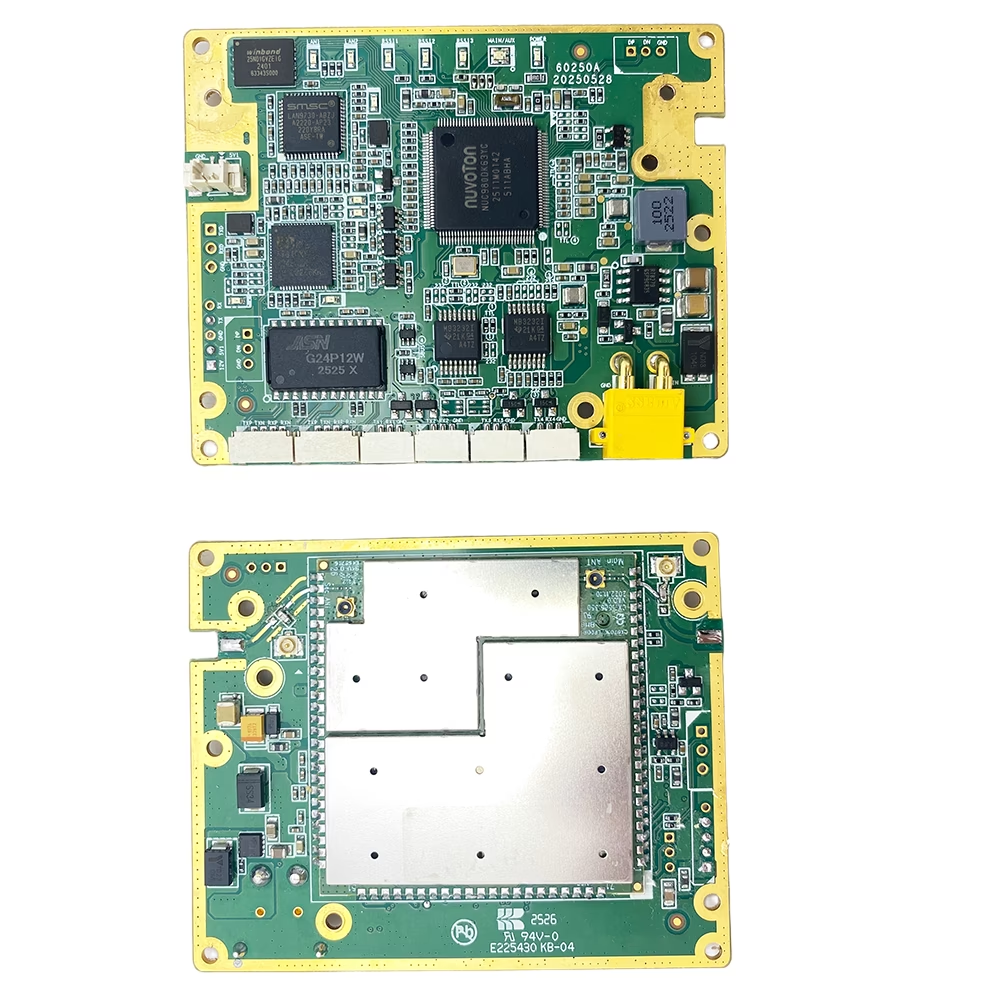
Engineered from our UAV communication factory, this module ensures high-speed, low-latency, and reliable video and data transmission for drones, UAV research projects, and industrial aerial operations. With dual Ethernet ports and multiple serial interfaces, it integrates seamlessly with IP cameras, flight controllers, and remote controllers, making it the ideal solution for drone enthusiasts, engineers, and manufacturers.
Features
-
Wireless Working Frequency Bands: 1427.9–1467.9 MHz (1.4G), 806–826 MHz (800Mhz), optional 2401.5–2481.5 MHz (2.4G)
-
Dual Ethernet Ports: Connect directly to IP cameras, ground station computers, or NVR systems
-
Four Configurable Serial Ports: Two TTL ports for flight controllers, one SBus port for remote controllers, and one RS232 port (reconfigurable as TTL)
-
Built-in 300mW RF Amplifier: Stable transmission for medium-range operations
-
Support for External Amplifiers: Connect 2W, 5W, or 10W amplifiers for extended ranges (up to 150 km)
-
High-Bandwidth Transmission: Delivers data rates of up to 30 Mbps @ 20 MHz, ideal for UAV video, telemetry, and data links.
-
Automatic Frequency Selection: Automatically detects interference and dynamically selects the optimal operating frequency in real time.
-
Plug-and-Play Integration: Quick setup with minimal configuration
-
Lightweight & Compact: Optimized for UAV mounting without affecting drone flight dynamics
-
Star Network Topology Support: Supports point-to-multipoint networking with up to 16 nodes connected simultaneously.
- Multiple Interface Design: Equipped with RS232, TTL, CAN, SBUS, and RS485 interfaces for flexible system integration.
-
Multiple Bandwidth Modes: Supports 3 MHz, 5 MHz, 10 MHz, and 20 MHz channel bandwidths to balance range and throughput.
-
Multi-System Coexistence: Allows multiple systems to operate simultaneously on fixed frequencies without mutual interference.
Specification
General Parameters
Model
Vcan2122
Working Frequency Bands
-
1427.9–1467.9 MHz (1.4GHz)
-
806–826 MHz (800MHz)
-
2401.5–2481.5 MHz (2.4GHz)
RF Channel Configuration
1T2R (1 Transmit / 2 Receive)
Modulation Method
OFDM
Communication Encryption
AES-128
RF Performance
Transmit Power
300mW
Built-in RF Amplifier
300 mW
External Amplifier Support
2W / 5W / 10W
Transmission Distance (Line-of-Sight)
-
Air-to-Ground: 30 km
-
Extended range up to 150 km with external amplifier
Receiver Sensitivity
| No. | Channel Bandwidth (MHz) | Data Rate | Sensitivity (dBm) |
|---|---|---|---|
| 1 | 20 MHz | 10 Mbps | -94 dBm |
| 2 | 20 MHz | 5 Mbps | -97 dBm |
| 3 | 10 MHz | 10 Mbps | -91 dBm |
| 4 | 10 MHz | 5 Mbps | -96 dBm |
| 5 | 5 MHz | 10 Mbps | -84 dBm |
| 6 | 5 MHz | 5 Mbps | -93 dBm |
| 7 | 3 MHz | 5 Mbps | -87 dBm |
| 8 | 3 MHz | 2 Mbps | -98 dBm |
RF Interface
SMA × 2
Bandwidth & Data Rate
Channel Bandwidth Modes
3 MHz / 5 MHz / 10 MHz / 20 MHz
Maximum Data Rate
30 Mbps @ 20 MHz
System Bandwidth
Up to 20 Mbps
Transmission Latency
≤ 20 ms
Networking & Interfaces
Ethernet Ports
2 × 100Mb Ethernet (IP Camera / NVR / Ground Station)
Serial Interfaces
-
TTL / RS232 / RS485 × 1
-
TTL / RS232 / CAN / SBUS / RS485 × 1
Network Topology Support
Point-to-multipoint star networking, supporting up to 16 nodes
Automatic Frequency Selection
Real-time interference detection and optimal frequency switching
Multi-System Coexistence
Supports multiple systems operating simultaneously on fixed frequencies
Power & Consumption
Power Supply
-
DC 7–24V
-
DC 9–15V (Typical: +12V @ 2A)
Power Consumption
-
≤ 15W (Air Unit @ 4 Mbps)
-
≤ 8W (Ground Unit)
Physical Characteristics
Module Dimensions
73 × 59 × 10 mm
Module Weight
33.7 grams
Environmental Conditions
Operating Temperature
-20°C to +55°C
Application
-
Professional UAV video transmission and telemetry
-
Long-range drone operations and monitoring
-
Multi-drone research and swarm communication
-
Industrial inspection, mapping, and surveying drones
-
UAV development and production testing
-
Aerial live streaming for security and entertainment
Customize Option
-
Frequency band customization (1.4G / 800MHz / 2.4G) for specific project requirements
-
Optional external amplifiers for extended transmission range
-
Configurable serial port layout for integration with custom UAV systems
-
Firmware upgrade support via Ethernet or USB
Recommended Configuration
-
Drone Type: Multirotor or fixed-wing drones
-
Camera: IP camera or onboard UAV camera
-
Amplifier: Optional 2W / 5W / 10W external RF amplifier for distances >50 km
-
Antenna: High-gain directional antenna recommended for long-range operations
-
Ground Station: Laptop or NVR for monitoring and recording video streams
Packing Information
-
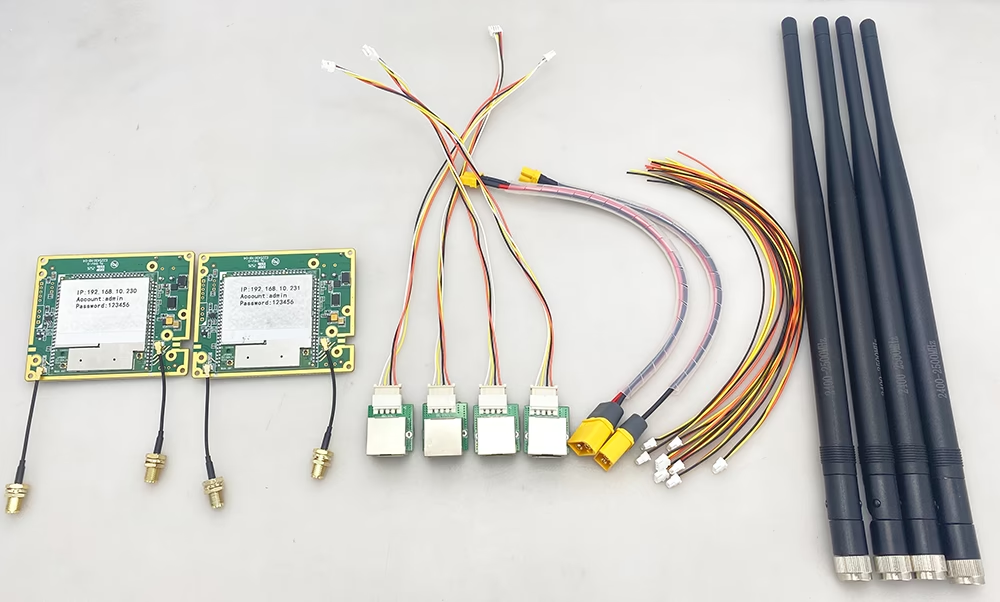
2 × Drone Transmitter and Receiver Module (MOQ 2units, one for Ground Unit, one for Air Unit)
- 2 × Power Cable (DC 7–24V)
-
4 x Ethernet Cable
- 8 × Data Cable
-
4 x Testing Antenna
- 4 × SMA to MCX converter RF cable
FAQ
Q1: Can this module operate at 2.4GHz?
A1: Yes, it supports optional 2401.5–2481.5 MHz (2.4G) frequency band.
Q2: What is the maximum transmission range?
A2: Standard built-in 300mW supports 0–30 km, Optional Up to 150 km with external amplifier;
Q3: Can I connect IP cameras or NVRs?
A3: Yes, dual Ethernet ports allow simultaneous connections to cameras and recording systems.
Q4: Is it compatible with standard UAV flight controllers?
A4: Yes, TTL and SBus ports support most drones’ flight control systems.
Q5: Can it handle multiple drones?
A5: Yes. Within the same network, the system supports a star network topology (point-to-multipoint) and can connect up to 16 nodes simultaneously.
In addition, the system supports multi-system coexistence, allowing multiple independent networks to operate concurrently on fixed frequencies without mutual interference. This makes it suitable for multi-drone operations, swarm testing, and complex UAV deployment scenarios.
Q6: Is it suitable for research and industrial projects?
A6: Absolutely, ideal for UAV engineers, enthusiasts, and factory-level drone testing.
Q6: What are the default IP addresses and login credentials for the web management interface?
A6: The default IP addresses are 192.168.10.230 for the Master (Ground Unit) and 192.168.10.231 for the Slave (Air Unit).
The default login credentials for both units are:
-
Username: admin
-
Password: 123456
Users can access the web management interface via a standard web browser to configure system parameters.
Q7: How should I choose between the different frequency range versions of this product?
A7: Our product is available in two main types: a three-band version and an ultra-wideband version, depending on your application needs.
-
Three-Band Version: You can select one of the three frequency ranges as your working frequency:
-
806–826 MHz
-
1427.9–1467.9 MHz
-
2401.5–2481.5 MHz
The antenna and power amplifier will be customized to match the selected frequency range. For example, if you choose the 1.4 GHz band, the working frequency range will be 1427.9–1467.9 MHz with an automatic frequency adjustment bandwidth of 40 MHz, ensuring stable performance within this band.
Tip: If you need to perform sample testing or ensure compliance with local frequency regulations, the three-band version is recommended. You can test using 1.4 GHz, or alternatively the 800 MHz band, depending on your local requirements and application.
-
-
Ultra-Wideband Version: This version supports a broader working frequency range of 1420–1530 MHz, with an automatic frequency adjustment bandwidth of 110 MHz. It is ideal for scenarios where interference avoidance is critical, as it allows the system to automatically select the best working frequency within the wide band.
Recommendation:
-
Choose the three-band version for fixed-frequency applications, sample testing, or to comply with local frequency regulations.
-
Choose the ultra-wideband version if your environment has potential interference or you need flexible frequency selection across a wider range.
Our Factory Advantages
-
Over 10 years of expertise in UAV wireless modules and COFDM transmission technology
-
Professional R&D and production team for drone data transmission solutions
-
OEM and customization services for frequency, ports, and amplifier options
-
Stringent quality control to ensure reliable long-distance video and telemetry links
-
Fast delivery and professional technical support for integration and testing
Why Choose iVcan.com
-
Industry-leading UAV wireless solutions, optimized for 2.4GHz and other bands
-
Reliable long-range transmission for drones, telemetry, and real-time video
-
Flexible configuration and easy integration with existing drone systems
-
Designed for enthusiasts, engineers, UAV manufacturers, and research institutions
-
Strong after-sales support and global shipping for drone developers




iVcan.com –
I recently tested the Ultra-Wideband Version (1420–1530 MHz), and it has exceeded my expectations. The wide frequency range makes it incredibly flexible, automatically adjusting to avoid interference, which is perfect for busy RF environments. Installation was simple thanks to the magnetic antenna base, and the signal has remained strong and stable even when moving around or in areas with other wireless devices. I also appreciate that it supports a broad working range, making testing and deployment much easier. Overall, it’s a reliable, high-quality module that delivers excellent performance for professional wireless applications.