







1600-2200 MHz frequency down converter to 200-800 MHz mixer

Table of Contents
Weight

Size


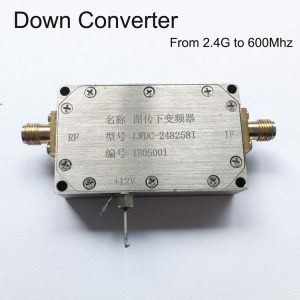
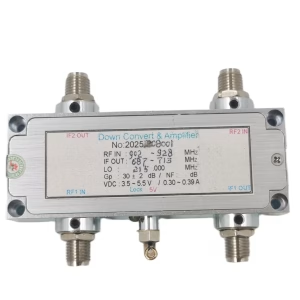
A 1600-2200 MHz frequency down converter to 200-800 MHz mixer is an RF (radio frequency) device that takes input signals in the 1600-2200 MHz frequency range and converts (or “down-converts”) them to a lower frequency range of 200-800 MHz.
How It Works:
-
This is typically achieved using a frequency mixer combined with a local oscillator (LO).
-
The mixer combines the input RF signal with the LO signal to produce sum and difference frequencies.
-
A band-pass filter is then used to select the desired lower frequency output (200-800 MHz) and reject the unwanted signals.
Purpose / Applications:
Our COFDM transmitter supports 50-6000MHz, but the wireless video receiver can only support 170-860MHz. At this time, you need to add this frequency downconverter to the receiver.
-
Satellite communications: Down-converting high-frequency satellite signals to a lower frequency for easier processing.
-
Surveillance and signal monitoring: Converting signals to a frequency range compatible with receivers or spectrum analyzers.
-
Wireless communication systems: When a receiver cannot directly handle high frequencies, down-conversion brings the signal to a usable range.
-
Radar and electronic warfare: For processing signals in different frequency bands.
Example:
If you input a 1800 MHz signal, the mixer could use an LO (for example at 1600 MHz), producing a difference of:
which falls within the 200-800 MHz output range.
Summary:
| Feature | Details |
|---|---|
| Input Frequency | 1600-2200 MHz |
| Output Frequency | 200-800 MHz |
| Function | Frequency down-conversion |
| Applications | Satellite, RF surveillance, comms, radar |
RF Frequency Downconverter, RF Up/Down Converter for COFDM video transmitter,

FAQ
-
What is a 1600-2200 MHz frequency down converter to 200-800 MHz mixer?
It converts RF signals from 1600-2200 MHz down to 200-800 MHz. -
What are common applications for this down converter mixer?
Used in wireless video data transmission communications, UAV video links, RF testing, and military systems. -
Can this frequency down converter be used for drone video transmission?
Yes, it is ideal for down-converting UAV video transmission signals. -
What is the input frequency range?
The input range is 1600 MHz to 2200 MHz. -
What output frequency does this mixer provide?
It outputs signals in the 200 MHz to 800 MHz range. -
What is the typical conversion loss of this mixer?
About 7-10 dB depending on design. -
Is this frequency mixer suitable for military communications?
Yes, it supports military-grade RF communication systems. -
What is the LO frequency required for the mixer?
Typically in the 1600 MHz range. -
Does this mixer support wideband RF signals?
Yes, it supports wideband applications. -
What are the power supply requirements?
Usually 12V DC power is needed. -
What output power can be expected?
Typically 0 dBm to +10 dBm. -
Is this mixer compatible with COFDM video signals?
Yes, it works with COFDM video transmitters and receivers. -
What is the noise figure of this RF down converter?
Around 3-5 dB for high-quality models. -
Can the mixer handle high dynamic range?
Yes, it supports wide dynamic range signals. -
What connectors are used?
SMA or N-type RF connectors. -
Is this product suitable for satellite communication?
Yes, for both uplink and downlink applications. -
What is the port-to-port isolation?
Typically more than 20 dB. -
Is this mixer useful for RF lab testing?
Yes, it’s widely used in RF testing and development. -
What are the typical physical dimensions?
Compact sizes are available, depending on the design. -
What is the operating temperature range?
Usually from -40°C to +85°C. -
Is customization available for this mixer?
Yes, frequency ranges and features can be customized. -
What is the gain of the down converter?
It can be passive or have a flat gain depending on configuration. -
What is the maximum input power?
Usually +10 dBm to +20 dBm. -
Can it be used in telemetry links?
Yes, it is suitable for telemetry data links. -
What is the IP3 (Third Order Intercept Point)?
Generally +20 dBm or higher. -
What is the image rejection performance?
Typically above 30 dB. -
Does it include built-in filters?
Some versions have integrated filters; others may need external filters. -
Is it suitable for UAV or airborne systems?
Yes, especially in drones and aviation RF links. -
What is the lead time for orders?
Usually 2-4 weeks depending on stock. -
Does the down converter have a built-in amplifier?
Some models include a low noise amplifier. -
Can this be used in ground station receivers?
Yes, for satellite or drone ground stations. -
What is the spurious output level?
Typically better than -60 dBc. -
What modulation types are supported after down conversion?
QPSK, COFDM, 16QAM, and more. -
Are waterproof or rugged models available?
Yes, ruggedized versions are offered. -
What certifications come with the product?
CE, RoHS, and other standard RF certifications. -
Is continuous 24/7 operation supported?
Yes, with proper cooling or heatsinks. -
What is the warranty period?
Typically 1 year, extendable by request. -
Is technical support provided?
Yes, support for integration is available. -
What is the LO leakage level?
Generally less than -40 dBm. -
Is OEM service available?
Yes, OEM and ODM services are provided. -
Can ham radio enthusiasts use this product?
Yes, for advanced amateur radio setups. -
What is the LO phase noise performance?
Low phase noise, typically below -90 dBc/Hz at 10kHz offset. -
Does it support duplex RF operation?
Usually simplex, but duplex options can be customized. -
Can it be used for 5G testing?
Yes, useful in RF and 5G signal testing labs. -
What shipping methods are available?
DHL, FedEx, UPS, and other international carriers. -
Is a datasheet available?
Yes, detailed datasheets are provided. -
What is the minimum order quantity?
MOQ is often just 1 unit. -
Can it integrate with FPGA systems?
Yes, it is compatible with FPGA platforms. -
Is there an evaluation board?
Yes, evaluation kits may be available. -
How to order this frequency down converter mixer?
Contact the supplier directly or request a quote online.


iVcan.com –
I have been using the 1600-2200 MHz frequency down converter to 200-800 MHz mixer BDC, and it has exceeded my expectations. The unit is very reliable and provides a stable, clean frequency conversion with minimal signal loss. Its performance is consistent, making it highly suitable for long-duration applications. The build quality feels solid and professional, and the installation was simple and straightforward. I noticed a significant improvement in signal processing efficiency when integrating it into my system. Overall, this down converter is a dependable and high-performance solution that adds great value to RF projects.