



Here is a client’s demand.
I have a ground rover which needs 2km non los communication. I need the whole system (excluding the camera). The range or the type of obstacle is not quite clear in the video. Let me clarify my requirements.
Obstacle type: Let’s say between my rover and base station there is a building with 2500 sq meters space in between. I don’t need fire proofing on my antenna(if there’s any). For my system, I need omni antennas able to send control data and receive both data and a video stream. The range should be at least 1.2km. 2km is recommended.From the customer’s needs, we can understand that he needs a two-way video data transmission system for the ground rover. Customers need to receive the video transmitted from the ground rover through the receiver, and also need to be able to send data through the remote control to control the ground rover 1 to 2 kilometers away.
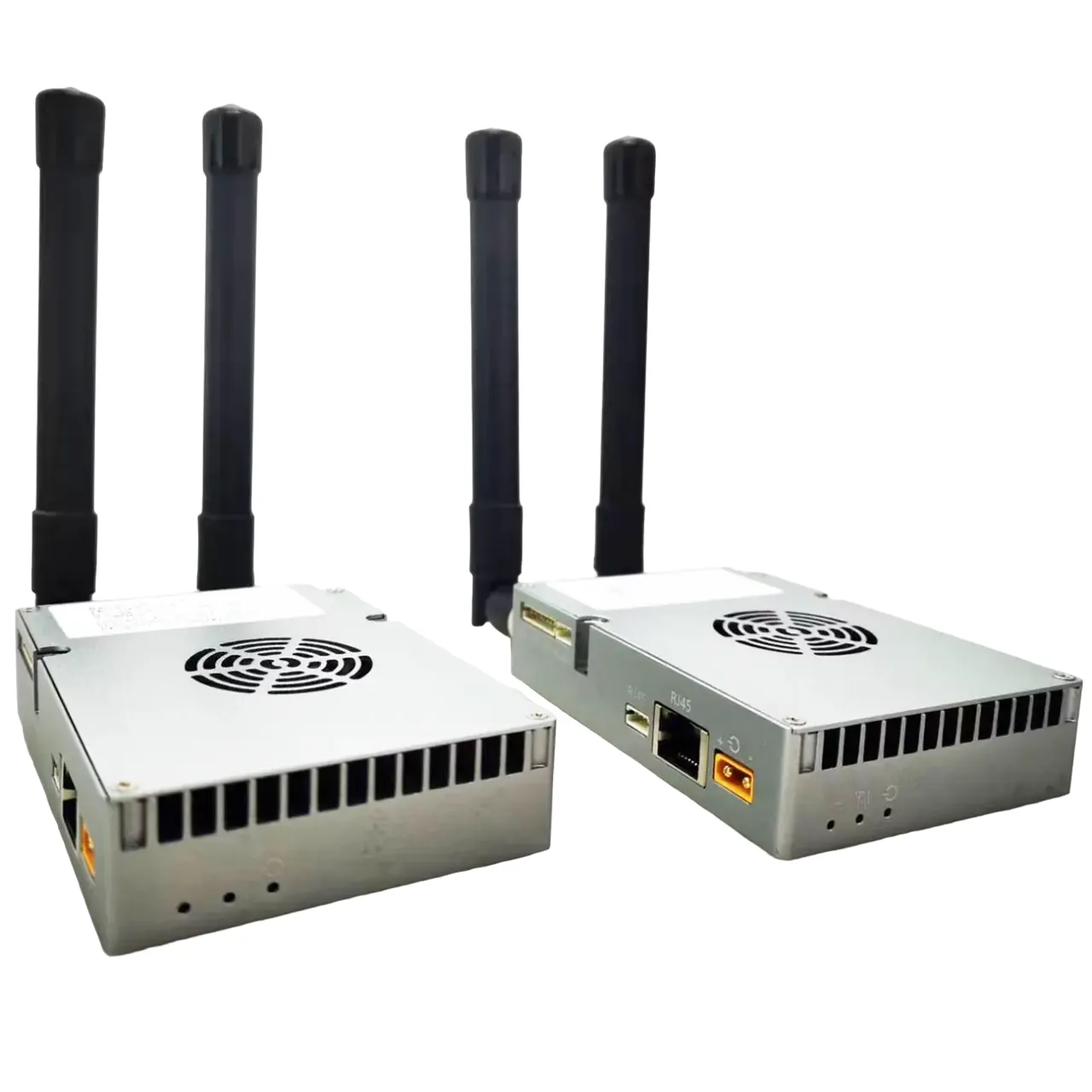
This is a typical solution that requires a ground two-way transmission system. Our Vcan1935 is used for ground fire prevention robots. Our TX900 two-way transmission system can be used for point-to-point or relay solutions, and there is also 1806 using IP mesh, which is suitable for solutions with more than 3~4 nodes.
The most difficult thing to achieve among the customer’s requirements is the obstacles in the middle, because the customer also mentioned that his obstacles are unknown, which may be buildings, factories, woods or hills.
To solve the problem of effective transmission of the two-way transmission system in the presence of obstacles, it is necessary to consider whether the transmission can be achieved through the reflection of the wireless signal. If not, it is necessary to consider adding a relay node at the highest point of the obstacle, or forwarding to a place where the transmitter and receiver can have line of sight.
Because the ground transmission distance is 1 to 2 kilometers, we also need to consider that the earth is round and there is a problem of the earth’s curvature blocking the signal. Therefore, it is also necessary to recommend that users put the antennas at both ends of the transmitter and receiver as high as possible.
If the customer’s transmitter and receiver are both dynamically moving, it will be difficult to set up a relay node on an obstacle. The recommended solution is to fly a drone in the air as a relay node, or consider adding a mobile node in a certain area in the middle, such as installing a node on a car, to relay the signal from the receiver to the transmitter.
If you have similar needs, please tell us your specific needs and we can provide a perfect solution based on your needs.
For a ground rover requiring Non-Line-of-Sight (NLOS) 2-way communication, you need a robust, low-latency, high-reliability wireless link that can handle obstacles such as buildings, terrain, and foliage.
Table of Contents
Key Requirements & Technologies:
- COFDM (Coded Orthogonal Frequency Division Multiplexing)
- Best for urban, forested, or indoor environments.
- Works well with reflections and multipath interference.
- Can penetrate obstacles better than traditional point-to-point links.
- MESH Networks (Mobile Ad-Hoc Networks – MANET)
- Self-healing, multi-node networking for moving rovers.
- Used in military and robotics applications.
- Companies like Persistent Systems, DTC (Domo Tactical), and Silvus Technologies offer robust solutions.
- Software-Defined Radio (SDR) with Frequency Hopping
- Customizable frequencies and encryption.
- Works in L-band (1-2 GHz), S-band (2-4 GHz), C-band (4-8 GHz), or UHF (300-900 MHz) for deep penetration.
- 4G/5G or Private LTE (If infrastructure is available)
- Provides low-latency, long-range connectivity.
- Works well in urban areas with LTE coverage.
- Satellite (SATCOM) Link (For Extreme NLOS & Long-Range Needs)
- Suitable for remote operations where ground-based RF isn’t reliable.
Recommended Communication Systems for a Ground Rover:
| Technology | Pros | Cons | Example Systems |
|---|---|---|---|
| COFDM Radio | Great for NLOS, low latency | Requires specific radio hardware | DTC, Vislink, Haivision |
| MESH Networks (MANET) | Works in dynamic environments, self-healing | Shorter range per node | Silvus StreamCaster, Persistent Systems MPU5 |
| SDR with FHSS | Custom frequencies, high security | Requires SDR expertise | Ettus USRP, DTC SDR |
| Private LTE/5G | High bandwidth, low latency | Needs LTE infrastructure | Nokia Private LTE, Cradlepoint |
| Satellite (SATCOM) | Works anywhere | High cost, high latency | Starlink, Inmarsat, Iridium |
Best Setup for Your Rover:
- Short to Medium Range (1-10 km, Urban/Rural):
- COFDM radio (DTC, Vislink) or MESH (Silvus, Persistent Systems).
- Long-Range (10-50 km, Remote Areas):
- MANET Mesh + High-Gain Antennas or Custom SDR with Frequency Hopping.
- Extreme NLOS (Beyond 50 km, No Ground Network):
- Hybrid SATCOM + COFDM Backup.
Ask A Question
Thank you for your response. ✨