






In most commercial IP Mesh networking radio link systems, the logic for selecting the “most favorable” signal — meaning the algorithm that decides which link or node to connect to — is built into the device firmware.
Here’s what that usually means in practice:
Table of Contents
How it works
- The system constantly measures link quality metrics such as RSSI (signal strength), SNR (signal-to-noise ratio), packet loss, and sometimes latency.
- It compares these values across all available links or nodes.
- Based on its internal algorithm, it switches to the link it considers “best” — often prioritizing highest RSSI or SNR.
Can you adjust it?
- Direct adjustment of the logic (e.g., changing the weighting of RSSI vs. SNR, or altering thresholds) is usually not possible unless the manufacturer provides:
- A configuration interface for these parameters, or
- Access to the firmware/SDK for custom development.
- What you can often adjust:
- Enable/disable auto-switching (sometimes called “roaming” or “auto frequency hopping”).
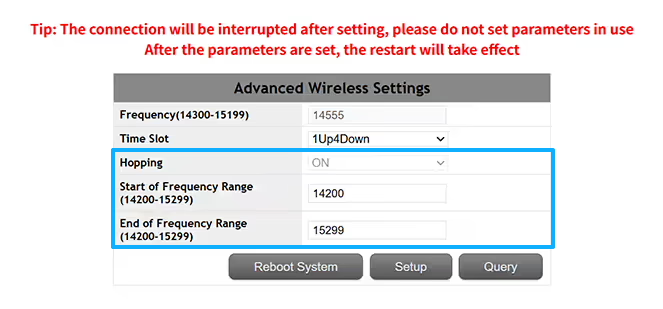
- Limit the candidate pool (e.g., restrict which channels or nodes are considered), which indirectly influences the choice. In the figure above, the start and end frequencies of the frequency range can be selected.
- Use an external controller to monitor link quality and send manual switch commands, bypassing the built-in decision logic.
- Enable/disable auto-switching (sometimes called “roaming” or “auto frequency hopping”).
Options if you need custom logic
- Firmware customization — Requires manufacturer cooperation or open-source firmware.
- Controller-based decision-making — Let a central node decide when to switch and push that to the mesh nodes.
- Parameter tuning — If the device exposes thresholds (e.g., minimum RSSI to maintain a link), adjusting these can change behavior without rewriting the algorithm.
Here’s an comparison table of common Mesh network “best signal” selection algorithms, summarizing their core logic, strengths, weaknesses, and typical use cases:
| Algorithm Type | Core Decision Metric(s) | Advantages | Disadvantages | Typical Use Cases |
|---|---|---|---|---|
| RSSI-Only Selection | Compares Received Signal Strength Indicator (RSSI) values and picks the highest | Simple to implement, fast switching | Ignores noise/interference; may choose a strong but noisy link | Static environments with low interference |
| SNR-Priority Selection | Prioritizes Signal-to-Noise Ratio (SNR), with RSSI as a secondary factor | Filters out high-interference links; more stable connections | Slightly higher computation cost; switching delay may increase | Urban or industrial areas with heavy RF noise |
| Multi-Metric Weighted | Weighted combination of RSSI, SNR, packet loss, latency, etc. | Balanced decision-making; adapts to different performance needs | Complex to tune; requires more processing power | Mission-critical links (UAVs, emergency comms) |
| Hysteresis Threshold | Adds upper/lower thresholds before switching | Prevents frequent “ping-pong” switching | May delay switching to a better link | Mobile nodes moving at moderate speed |
| Predictive Algorithm | Uses historical link quality data to forecast future performance | Can preemptively switch before degradation occurs | Needs large data history; algorithm complexity | High-speed mobility scenarios (vehicles, drones) |
Key takeaways:
- Most off-the-shelf Mesh systems use RSSI-only or RSSI + SNR logic baked into firmware.
- Adjusting the logic itself usually requires firmware customization or vendor support.
- You can often influence results indirectly by limiting candidate channels/nodes or using an external controller to override decisions.
Ask A Question
Thank you for your response. ✨