






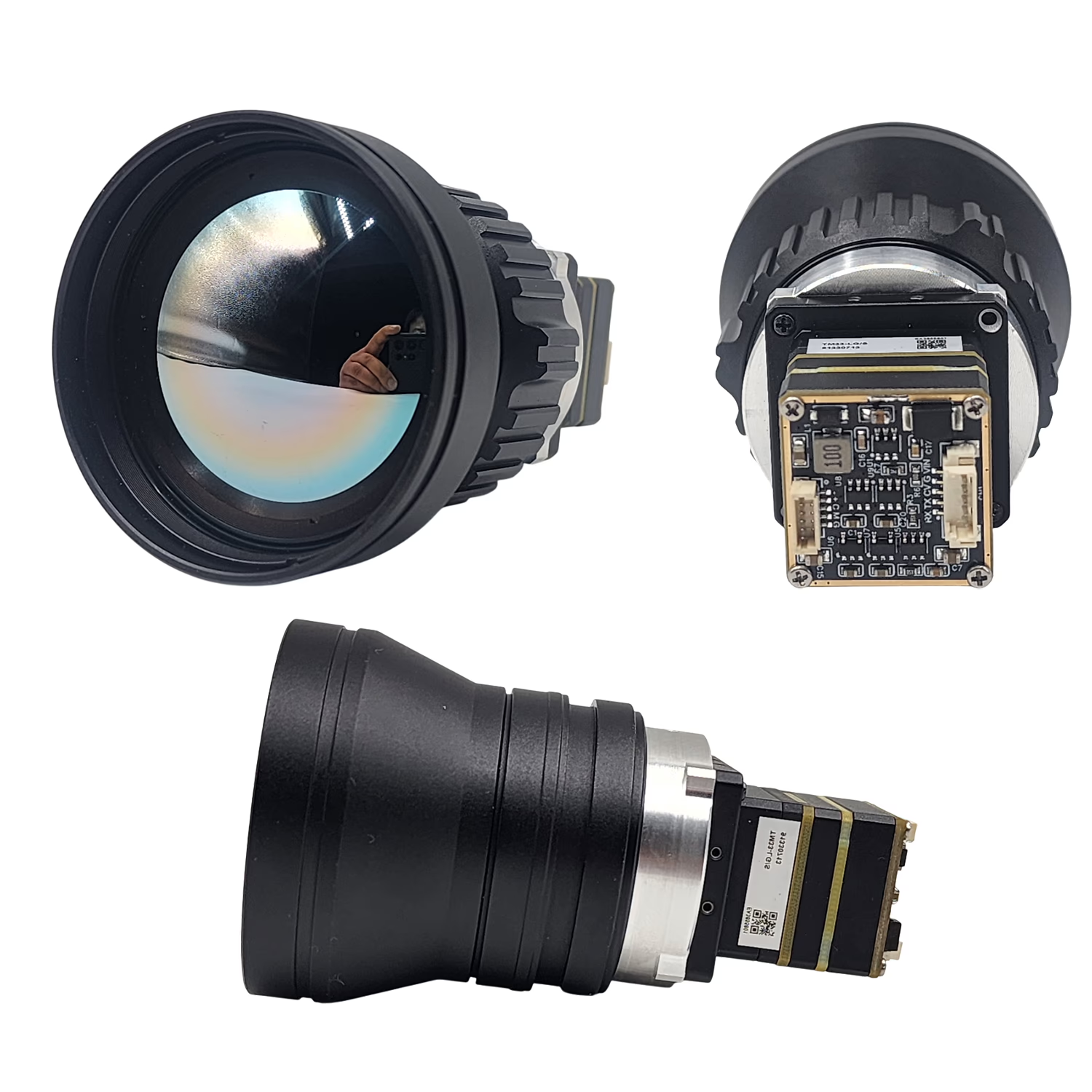
FPV Thermal Imaging Camera cvbs 50mm lens 384×288 resolution composite video AV output
FPV Thermal Imaging Camera — 384×288 CVBS, 50 mm Lens (Analog)
Overview
This FPV thermal imaging camera is a small, lightweight, analog (CVBS) thermal module specially designed for integration into drones, gimbals, pods, and other aerial platforms. It outputs standard composite video (NTSC/PAL) and supports a 50 mm thermal lens, providing a narrow field of view ideal for long-range detection. The internal sensor is an uncooled vanadium oxide (VOx) micro-bolometer operating in the long-wave infrared (8–14 µm) band. The 384×288 resolution and tailored signal processing deliver a robust thermal video feed compatible with existing FPV analog video systems.
Key design goals:
-
Compatibility with analog FPV systems (no need to replace entire video chain)
-
Compact form factor, low weight, low power consumption
-
Flexible configurations (lens, video polarity, imaging modes)
-
Rugged thermal performance across temperature extremes
-
Simple control via UART for color mode, flip, calibration, etc.
This is intended as a premium (but still relatively cost-sensitive) thermal module for professional or advanced hobby use (search-&-rescue, inspection, long-range observation, etc.).
Features
| Feature | Description / Benefit |
|---|---|
| Sensor / Detector | VOx (vanadium oxide) uncooled microbolometer |
| Resolution | 384 × 288 pixels |
| Spectral Band | 8–14 µm (longwave infrared) |
| Thermal Sensitivity (NETD) | ≤ 40 mK (typical) |
| Frame Rate / Speed | 50 Hz (real-time video) |
| Lens | 50 mm F1.0 (fixed or optional focus) |
| Field of View (FOV) | Narrow field (approx. ~4°–8°, depending on pixel size and lens) |
| Minimum Focus Distance | ~5 m (or manufacturer-defined) |
| Video Output | CVBS (composite analog, NTSC or PAL selectable) |
| Signal Polarity / Output Type | Standard CVBS; optionally UVC / digital version by customization |
| Control Interface | UART TTL-level (3.3 V) for settings, modes, flip, calibration |
| Color / Pseudocolor Modes | Supports ~15 display modes (white-hot, black-hot, rainbow, iron red, fusion modes, etc.) |
| Image Enhancements | Noise reduction, detail enhancement, nonuniformity correction (NUC) |
| Image Flip / Mirror | Vertical flip, horizontal mirror, or both — configurable via UART |
| Bad-pixel Correction | Automatic or manual dead-pixel mapping / correction |
| Power Input | DC 5 V to 17 V (wide input range) |
| Power Consumption | ≤ 1.0 W (typical) |
| Operating Temperature | –40 °C to +80 °C |
| Storage Temperature | –50 °C to +85 °C |
| Shock & Vibration | Vibration resistance (3-axis sinusoidal), shock rated (e.g. 15 g, 11 ms) |
| Humidity | ≤ 90% RH non-condensing |
| Dimensions (camera body) | ~ ≤ 30 × 30 × 35 mm (without lens, typical) |
| Weight (camera only) | ≤ 30 g (varies with lens) |
| Lens Mount / Format | Proprietary or standard (e.g. M30 × 0.5, C-mount adapter, or custom flange) |
| Options / Customization | UVC output, digital video overlay, internal temperature readout, alternative lenses, custom firmware |
Imaging / Display Options & Modes
-
Pseudocolor / Palette Modes
White heat (white-hot), Black heat (black-hot), Rainbow, Fusion 1, Fusion 2, Iron Red 1, Iron Red 2, “Ice & Fire”, Rain, Dark Blue, Red Heat, Green Heat, Dark Brown, etc. -
Digital Zoom / Electronic Gain
×1, ×2, ×4, ×8 (digital magnification) -
Automatic Gain Control (AGC)
Histogram-based AGC to balance contrast in scenes -
Detail Enhancement
Sharpening / edge enhancement to accent thermal boundaries -
Automatic & Manual Calibration (NUC)
Automatic shutter correction as well as manual calibration (background correction) -
Flip / Mirror
Vertical flip, horizontal mirror, central flip modes -
Overlay / On-Screen Display (OSD)
Temperature readouts (max, min, average), crosshair, center marker (if requested, with firmware)
Applications & Use Cases
This thermal imaging camera is well-suited for drone-based applications requiring thermal vision, especially in low-light or zero light conditions. Some candidate use cases include:
-
Search & Rescue / Night Search: detecting human heat signatures in forest, wilderness, disaster areas
-
Inspection / Infrastructure Survey: checking hotspots on power lines, industrial plants, pipelines
-
Wildlife Monitoring / Conservation: spotting animals at night
-
Security / Surveillance: perimeter monitoring, intrusion detection
-
Thermal Mapping / Thermal Anomaly Detection: coupling with GPS / telemetry for mapping
-
Emergency / Firefighting Support: detecting hotspots, fire fronts through obscurants
-
Cinematography / FPV Cinematic Shots: capturing dramatic thermal imagery for creative effects
Because this module outputs analog CVBS, it can readily plug into existing analog FPV video transmitters (VTX) / ground stations (VRX) without major overhauls. That makes it a drop-in upgrade for many FPV rigs (pending careful power and mechanical integration).
Specification (Proposed / Typical)
| Parameter | Specification |
|---|---|
| Sensor | VOx uncooled microbolometer |
| Resolution | 384 × 288 pixels |
| Pixel Pitch | 12 µm |
| Spectral Range | 8–14 µm |
| NETD | ≤ 40 mK (typical) |
| Frame Rate | 50 Hz (real-time video) |
| Lens | 50 mm F1.0 fixed-focus or optionally adjustable |
| Field of View (H × V) | ~4.8° × 3.6° (approximate estimate) |
| Minimum Focus Distance | ~5 m |
| Video Output | CVBS composite (NTSC / PAL) |
| Video Control | UART (3.3 V TTL) |
| Color Modes | ~15 preset pseudocolor palettes |
| Digital Zoom | ×1, ×2, ×4, ×8 |
| Gain / AGC | Histogram-based AGC |
| Calibration | Auto shutter NUC + manual calibration |
| Flip / Mirror | Vertical / Horizontal / Center modes |
| Power Supply | 5 V to 17 V DC |
| Power Consumption | ≤ 1.0 W (typical) |
| Operating Temp | –40 °C to +80 °C |
| Storage Temp | –50 °C to +85 °C |
| Shock / Vibration | Rated to survive expected UAV vibrations / shocks |
| Humidity | ≤ 90% RH (non-condensing) |
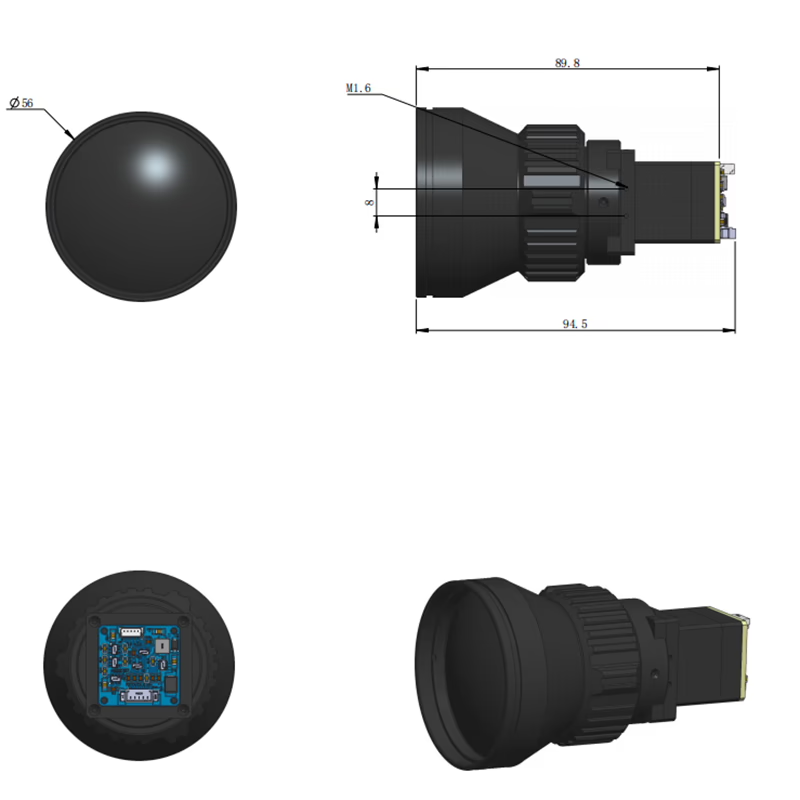
| Dimensions | ~30 × 30 × 35 mm (camera body, no lens) |
| Weight | ≤ 30 g (w/o lens) |
| Lens Mount | Customer-chosen (e.g. M30, custom flange) |
| Optional Features | UVC output, digital overlays, alternative lenses, custom firmware |
Options & Variants
When designing or ordering, you can consider a range of optional variants or modifications:
-
Alternate Resolutions
While our base spec is 384×288, you may wish to support 256×192 or 640×512 (higher cost, heavier) as alternative SKUs. Many similar products offer such resolution variants. -
Lens Variants
Although 50 mm is your target lens, you may also offer 35 mm, 25 mm, 19 mm, 15 mm, 9.7 mm, etc. Many existing modules support 9.7 mm or 6.8 mm lenses.
You could also provide optional focus adjustment or interchangeable lens mounts. -
Digital / USB Variant (UVC)
Provide a variant where instead of analog CVBS, the camera outputs UVC (USB Video Class) digital video—useful for PC / embedded systems. (This is often offered as a custom upgrade.) -
Video Temperature Overlay / OSD
Add firmware to overlay max/min/average temperature, crosshairs, center marks, etc. This overlay can be included in the video stream (if camera supports it). -
Preset Flips / Mirror Option
Before shipping, you can pre-configure flip (vertical / horizontal) orientation to match the intended mounting (e.g. upside-down mount). -
Customized Connector / Pin out
Standard interface: 5 pins (POWER, GND, CVBS, UART_TXD, UART_RXD). You can optionally reassign or combine pins, or include an on-board connector (e.g. JST, Molex) or cable harness. -
Casing / Housing
Offer optional protective CNC aluminum cases, lens covers, window windows (e.g. germanium window), mounting brackets, gimbal adapters. -
Firmware Customization
Support custom commands, alternate palettes, custom behaviors (e.g. auto zoom, dynamic exposure) as per client firmware requests. -
Calibration / Factory NUC Tuning
Perform factory calibration / mapping for improved image quality, bad pixel correction, drift compensation. -
Thermal Sensor Extras
Possibly include reference thermistor or ambient temperature reading to improve temperature stability or compensation.
Mechanical & Mounting Considerations
-
Lens protrusion & weight
The 50 mm lens will add length, weight, and moment load. Ensure the drone / gimbal mount can support the lens dynamically (vibration, inertia). -
Thermal window material
Lens windows often require IR-transparent materials (e.g. germanium, ZnSe). Ensure your design accommodates the proper protective window. -
Center of gravity & balance
Because the thermal module is likely offset or elongated by the lens, ensure you account for the moment arm on the drone/gimbal mount. -
Heat dissipation & airflow
Although the module is low-power, plan for adequate airflow and heat path, especially in housing or sealed pods. -
Vibration isolation
Use soft mounts or dampers if the drone vibrates heavily; the sensor may degrade with excessive vibration. -
Lens focus & adjustment
If the 50 mm lens is fixed-focus, specify target focus distance. If adjustable, provide a mechanism (set screw, knurled ring, etc.). -
Connector orientation / clearance
Ensure the 5-pin connector orientation is accessible in your drone frame or pod.
Integration & Interfacing
-
Power
Supply a stable DC voltage between 5 V and 17 V. Use clean regulation and bypass capacitors to avoid noise coupling into sensitive thermal electronics. -
Video chain compatibility
Because output is CVBS, the thermal camera can feed into standard FPV video transmitters (VTX) or video multiplexing setups, then to ground station analog video receivers (VRX). -
UART Control
Use a UART (3.3 V TTL) interface to send commands (e.g. change palette, flip mode, zoom, calibration). Communication protocol typically will include command IDs, parameter bytes, and possibly checksums. -
Signal Infrastructure
Shielded coax (e.g. RG174) or twisted pair + coax, depending on your layout. Use appropriate impedance matching and connectors (e.g. SMA, BNC, or mini coax). -
Calibration / NUC
At startup or on command, the module may require a shutter-based calibration (NUC). Ensure your integration allows the shutter action (if present) unobstructed field of view. -
Temperature overlay / OSD (optional)
If you enable OSD, the module may embed numeric temperature readouts in the analog video output. This may require additional firmware or digital overlay logic. -
Mount orientation / flip
Because it may be mounted inverted, support flip / mirror settings so video appears correct to the pilot. -
Latency & synchronization
Minimize latency in video path; ensure synchronization with video transmission chain.
Example Comparisons & Existing Products
To help ground this in reality, here are some analogous products currently on the market:
-
384×288 FPV Thermal Imaging Camera (Underwater Thruster) — CVBS output, longwave IR, mini size.
-
Axisflying High Resolution Thermal Camera Module — supports 256×192 / 384×288 / 640×512 resolution CVBS output.
-
Mini Series CVBS Thermal Imaging Camera Module — OEM mini series CVBS thermal imagers.
-
Thermal Imager for FPV Drones (eBay listing) — 384×288, 50 fps, CVBS.
-
CVBS Analog FPV Drone Thermal Imaging Camera — generic CVBS analog FPV thermal module.
-
CVBS Infrared Thermal Imaging Camera (JS) — another CVBS analog thermal camera.
One commercial thermal camera is the Foxeer FT384 V2, a compact analog CVBS 384×288 thermal module with 9.1 mm lens, 50 fps, <50 mK sensitivity, and weight ~38 g
These examples demonstrate that 384×288 / CVBS modules are feasible and available, which supports the viability of your specification.
FAQ (Based on Your Original Questions)
Q: Can you provide a 3D file?
A: Yes, a 3D (CAD) model (e.g. STEP, STL, IGES) of the camera housing + lens flange can be provided prior to production. This helps you verify mechanical clearance and mounting compatibility.
Q: Can you offer UVC (USB Video Class) instead of CVBS?
A: Yes. We can provide a variant that includes a UVC digital output module (USB interface) in place of (or in addition to) CVBS, though the additional electronics may increase cost, size, and power.
Q: Can the thermal imaging camera display temperature in the video?
A: Yes. We can embed temperature overlay (max, min, average) in the video feed. If digital (UVC), it’s easier; for analog (CVBS), we can insert OSD overlay circuits or firmware to overlay temperature data. However, this sometimes reduces the analog video dynamic range slightly.
Q: How do I interface settings (like flip or mirror)?
A: The camera supports UART (3.3 V TTL) commands to control settings: color mode, flip/mirror, calibration, zoom, etc. We can provide a command protocol (e.g. command bytes, checksums). Also, before shipping, we may preset a flip / mirror mode per your mounting orientation.
Q: Will the camera work with my existing FPV video system, or do I need a new system?
A: Because the output is CVBS analog, it is compatible with standard analog FPV transmitters (VTX) and receivers (VRX). You should not need to replace your entire video chain, just integrate this module in place of (or alongside) your visible-light FPV camera. The only caveat is power, mechanical mounting, and video path latency.
Q: Does this thermal camera work with my phone (for e.g. checking hidden cameras)?
A: If you choose the UVC variant (digital), you can connect via USB to a phone or computer and view video / temperature data. If you stick with CVBS, you’d need a CVBS-to-USB converter (capture card) or a monitor that accepts analog composite input.
Q: Does the FPV thermal camera support changing display color modes and digital zoom?
A: Yes — via UART commands or onboard firmware, the camera supports up to ~15 pseudo-color palettes and digital zoom (e.g. ×1, ×2, ×4, ×8).
Q: What lens sizes are available?
A: While your spec uses 50 mm, optional lens sizes include 35 mm, 25 mm, 19 mm, 15 mm, 9.7 mm, 6.8 mm, etc. Many suppliers offer these as customization options.





iVcan.com –
I’ve been using this FPV thermal imaging camera with a 50mm lens for my long-range quadcopter setup, and the performance really exceeded my expectations. The image clarity is impressive, even in total darkness, and the analog CVBS output integrates perfectly with my existing FPV system without any extra setup. The narrow field of view of the 50mm lens gives great detail at long distances. It’s compact, lightweight, and the temperature response is fast and accurate. Definitely a great upgrade for serious FPV night missions!