






A client mentioned his demand
I am interested in buying a COFDM video receiver unit with the capability of decoding H.265 video, and the specifications that I require it to meet for receiving and decoding are as follows:
The H.265 COFDM 1080/60p receiver operates on DVB-T with a 16QAM modulation scheme within the frequency range of 2 to 2.25 GHz and utilizes a 16QAM modulation with a 1/32 guard interval.
I will be utilizing the h.265 (HEVC) encoder format, which will also allow me to work with progressive frame rates. 1080 50/60p
A 2-3GHz COFDM DVB-T H.264/H.265 Decoder 1080p 60FPS Receiver is a specialized wireless video transmission device designed for high-definition video reception and decoding. It integrates multiple advanced technologies to enable reliable, low-latency, and high-quality video streaming in challenging environments.
The frequency range for demodulation in a standard DVB-T or DVB-T2 receiver typically spans from 170 Megahertz to 860 Megahertz, encompassing a broad spectrum of digital television signals. As a result of implemented technical optimizations, the system’s maximum supported frequency range has been increased to 930 MHz.
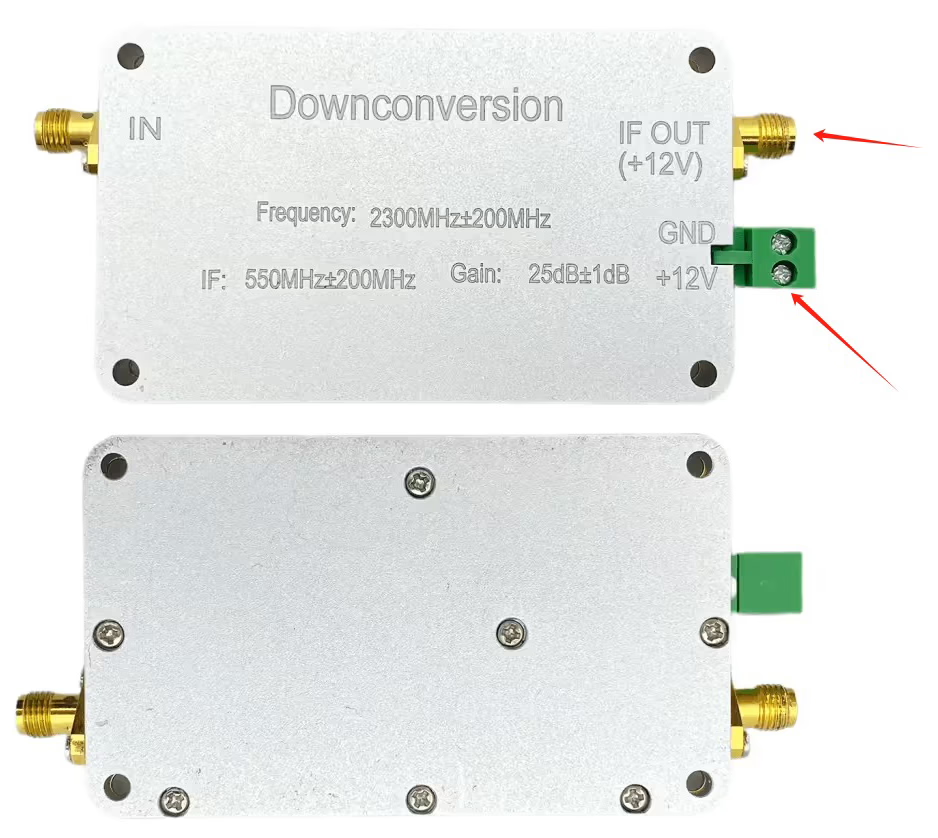
Because frequencies in the 2-3 GHz range necessitate the use of a frequency down converter, and because diversity DVB-T or DVB-T2 receivers always incorporate two RF inputs, two frequency down converters are typically required.
DVB-T’s coding support
MPEG-2 (H.262): This was the main coding standard when DVB-T was originally designed and was widely used in early digital TV broadcasting.
H.264/AVC (MPEG-4 Part 10): As technology develops, DVB-T supports H.264 through specification extensions to improve compression efficiency (support from equipment and service providers is required).
No support for H.265/HEVC: The DVB-T standard was developed before the launch of H.265, so it does not natively support this coding format.
H.265/HEVC supporter: DVB-T2
The upgraded standard DVB-T2 (released in 2008) supports more efficient coding, including H.265/HEVC, and is suitable for HD and UHD content transmission.
DVB-T2 is significantly better than DVB-T in spectrum efficiency, anti-interference ability and compression performance, and is suitable for scenarios where bandwidth needs to be saved.
Here is our models to meet the demand.
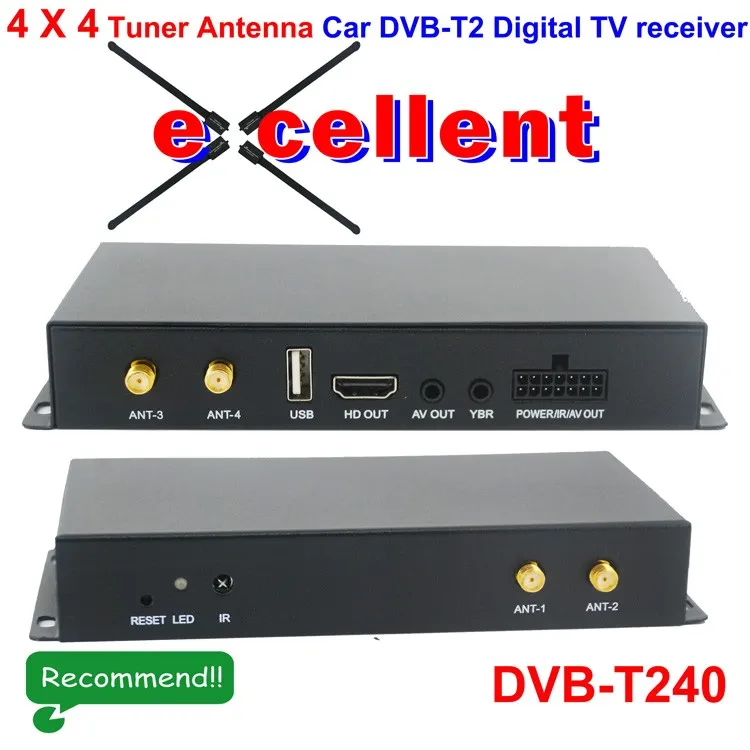
Four antenna RF demodulator DVB-T model DVB-T240
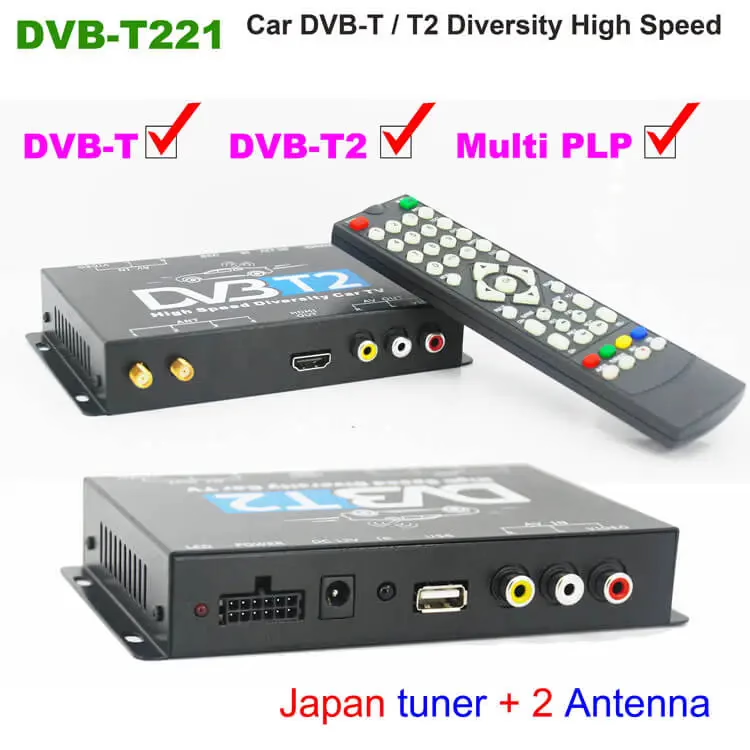
Two antenna RF demodulator DVB-T / DVB-T2 model DVB-T221
If the transmitter and receiver use products from different brands, the encoding and decoding between them may not be decoded by the receiver if the encoding board uses a special encoding method or private code, such as AES128 encryption. Or it may cause a large delay. We recommend that customers use our encoder (transmitter) and decoder (receiver).
Table of Contents
Q1: To replace the 2-2.25 GHz range, does the down converter’s frequency coverage extend to encompass the broader 2-2.5 GHz range?
A1: Frequency down converter range can support 2-2.5Ghz.
Q2: I would like to request a frequency down converter that operates within the 5.9 GHz to 6.4 GHz range, and I would appreciate receiving a cost estimate for such a unit.
A2: Sorry, our frequency down converter can not cover the frequency range 5.9Ghz to 6.4Ghz.
Q3: Does your DVB-T decoder RF antenna supports 12V output to power supply the frequency down converter?
A3: Our DVB-T decoder RF antenna has only 5V 60mA for some antenna with signal booster. Our frequency down converter has 12V extenal power supply. You don’t need the RF output 12V to power supply it.
Ask A Question
Thank you for your response. ✨