






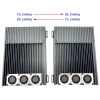
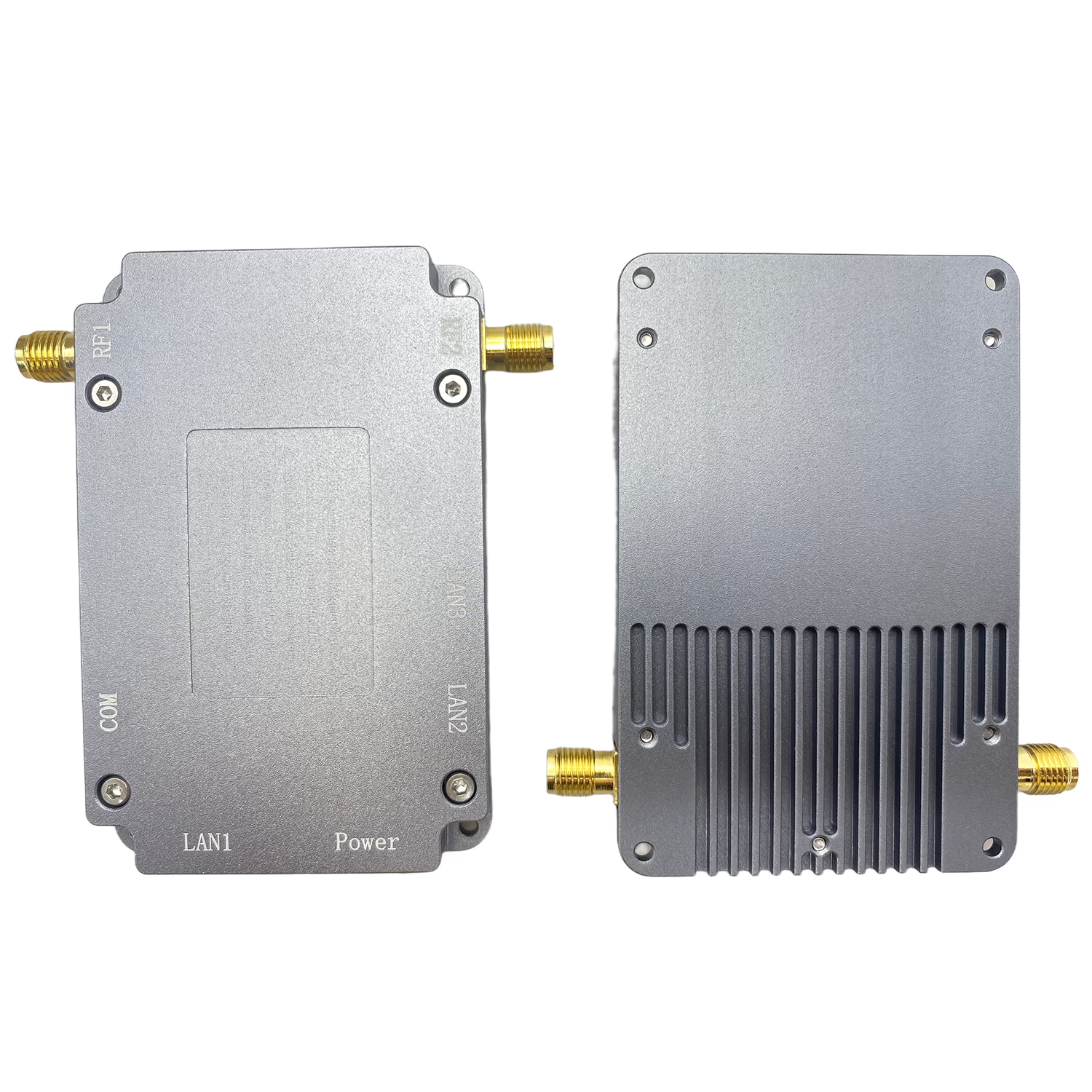
2x1W MANET Radio & IP Mesh for UAV UGV EOD Robotics
Table of Contents
Overview
The Vcan1401 2×1W MANET Radio & IP Mesh Module is a new-generation, highly integrated broadband wireless self-organizing network (MANET) transceiver designed for UAVs, UGVs, unmanned surface vehicles (USVs), and robotic platforms operating in complex and dynamic environments.
Based on an advanced SoC + ADI RF architecture, Vcan1401 delivers a compact size, low power consumption, and high system integration while supporting bi-directional video, telemetry, and command data transmission. The module combines TDD-OFDM technology with a 2×1W high-power amplifier, enabling long-range, stable wireless links with both omnidirectional and directional antennas.
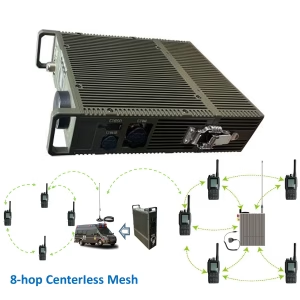
Vcan1401 supports point-to-point (P2P), point-to-multipoint, fixed multi-hop relay networks, and dynamic IP Mesh networking. Nodes automatically form a self-organizing, self-healing, and self-routing broadband network, providing strong survivability, scalability, and flexibility in mobile or disrupted environments.
Featuring an efficient MAC layer transmission protocol and Layer-2 distributed routing, the system offers excellent broadband performance with adaptive bandwidth, high spectral efficiency, long transmission distance, and strong resistance to interference, fading, and diffraction. It is capable of maintaining real-time, high-quality, two-way data and video transmission even in non-line-of-sight (NLOS) and complex terrain scenarios.
Designed according to generalized, modular, and standardized principles, Vcan1401 enables reliable long-term operation for emergency communications, unmanned systems, and industrial IoT networks. It supports real-time high-speed transmission of telemetry, remote control commands, payload data, and inter-node collaboration between unmanned platforms and ground control stations, ensuring continuous, stable, and secure communication during extended missions.
With IP67 protection, wide operating temperature components, and a communication range of up to 50 km, the Vcan1401 is built to meet the demanding requirements of defense, robotics, public safety, and industrial applications in harsh field environments.
Features
-
2×1W High Power Amplification
Ensures strong and stable long-distance communication using omnidirectional or directional antennas, suitable for mobile and NLOS environments. -
MANET (Mobile Ad-Hoc Network) & IP Mesh Networking
Fully self-organizing, self-configuring, and self-healing network. No complex setup required—nodes automatically form communication links after power-on. -
Flexible Network Topology & Multi-Hop Relay
Supports arbitrary topologies, including point-to-point, point-to-multipoint, multi-hop relay, and dynamic mesh networking. -
High-Capacity Node Connectivity
Supports up to 60 nodes in AP base station mode and ≥16 nodes in MANET self-organizing mesh networks. -
Ultra-Low Latency Video Transmission
End-to-end latency as low as 28 ms (excluding camera/monitor), ideal for UAV control, robotic teleoperation, and live HD video streaming. -
High-Throughput Broadband Performance
Peak system data bandwidth of ≥90 Mbps, supporting simultaneous video, telemetry, and payload data transmission. -
Adaptive TDD-OFDM Air Interface
Provides strong anti-interference, anti-fading, and diffraction performance, achieving up to 10× the range of conventional Wi-Fi. -
Dynamic & Static Routing Support
Supports both dynamic routing for mobile mesh networks and static routing for fixed or planned deployments. -
Secure Wireless Communication (AES-128)
Wireless channels are protected using AES-128 encryption, ensuring data security and transmission integrity. -
Multiple Data Interfaces & Interoperability
Supports serial-to-serial, serial-to-network, and network-to-network communication.
Standard interfaces include dual bi-directional RS232 and RJ45 Ethernet, with expandable support for RS485 / TTL / RS422 / S-BUS. -
High-Precision Wireless Ranging (GNSS-Free)
Enables high-accuracy inter-node distance measurement and positioning without reliance on GPS or BeiDou, suitable for GNSS-denied environments. -
Real-Time Network & Spectrum Monitoring
Real-time monitoring of RF spectrum, noise floor, SNR, signal strength, bandwidth usage, and node distance for improved situational awareness. -
Configurable Radio Parameters
Allows flexible configuration of frequency channel, bandwidth, transmit power, data rate, IP settings, and encryption keys. -
Wide Operating Temperature & IP67 Protection
Operates reliably from -40°C to +85°C, with IP67 waterproof and dustproof protection for harsh outdoor conditions. -
Multi-Power Input Design
Supports 11–28V DC input with reverse polarity protection, suitable for UAVs, UGVs, vehicles, and robotic platforms. -
Compact & Lightweight Design
Small form factor optimized for airborne systems, unmanned vehicles, and space-constrained robotic payloads. -
Default IP Configuration for Quick Deployment
Pre-configured IP addresses 192.168.17.1 (Master/Ground Unit) and 192.168.17.2 (Slave/Air Unit) enable rapid setup and simplified integration.
Specification
| Item | Specification |
|---|---|
| Model | 2×1W MANET Radio & IP Mesh Module |
| Operating Frequency | 1410–1460 MHz / 1400–1500 MHz (other frequency bands customizable) |
| Frequency Band | 1.4 GHz Band (1407–1497 MHz) |
| Channel Bandwidth | 5 / 10 / 20 / 40 MHz |
| Modulation Technology | TDD-OFDM |
| Carrier Modulation | BPSK / QPSK / 16QAM / 64QAM (adaptive or fixed) |
| Output Power | 2 × 1 W (30 dBm ±1 dB × 2, Dual PA) |
| Receiver Sensitivity | -96 dBm @ 10 MHz |
| Peak Data Throughput | Up to ≥90 Mbps (depending on bandwidth & MCS) |
| Transmission Latency | Single-hop ≤5 ms |
| End-to-End Video Latency | 20–80 ms (depending on camera & monitor) |
| Video Resolution | Up to 1080P @ 60 fps |
| Network Interface | 1 × RJ45 Ethernet (expandable to 2 ports), onboard 4-PIN LAN |
| Serial Interfaces | 2 × RS232 (bi-directional, up to 115.2 kbps, configurable) |
| Routing Capability | Dynamic routing & static routing |
| Network Entry Time | ≤1 second |
| Routing Switching Time | ≤1 second |
| Startup Time | ≤45 seconds |
| Transmission Range | Software configurable, up to 80 km (maximum setting) |
| Typical Range | Up to 30 km (omnidirectional antenna) / 50 km (directional antenna) |
| Antenna (Standard) | Omnidirectional fiberglass antenna: Air unit 2.5 dBi, Ground unit 3–5 dBi |
| RF Connector | SMA-F |
| Power Supply | DC 11–28 V |
| Power Consumption | LOW: 6 W / MAX: 14 W |
| Power Connector | XT30PW-M male (with adapter cable) |
| Operating Temperature | -35°C to +65°C |
| Protection Rating | IP67 |
| Dimensions | 72 × 48 × 10 mm |
| Weight | < 51 g |
| Indicators | Power LED, Network Link LED, Signal Quality LED |
| Expansion Ports | Refer to mechanical drawing |
Notes for Customers
-
Transmission distance depends on bandwidth, antenna type, installation height, and RF environment.
-
Software allows flexible configuration of frequency, bandwidth, power, data rate, IP, and encryption parameters.
-
Designed for UAV, UGV, USV, robotics, emergency communication, and industrial wireless networks.
Hardware Architecture & System Design
-
Proprietary MANET Technology with Domestic IP Core
Built on independently developed MANET intellectual property, integrating a dedicated SoC chipset with ADI RF modulation and demodulation, delivering high integration, stability, and long-term supply security. -
Advanced Security & Modular Hardware Design
Implements multiple encryption mechanisms with a modular, compact, low-power, fanless design, ensuring reliable operation and enhanced security for mission-critical wireless communications. -
High Shock & Vibration Resistance
One-piece integrated structure designed to withstand mechanical shock levels ≥100G, making it suitable for UAVs, UGVs, and harsh mobile platforms. -
Expandable Wireless & Communication Modules
Supports expansion for Wi-Fi, voice communication modules, and positioning modules, enabling flexible system customization for different application scenarios. -
Rich & Scalable Interface Support
Interfaces can be expanded to RS232 / RS485 / TTL / S-BUS / RS422 / RJ45, ensuring seamless interoperability with sensors, controllers, payloads, and third-party systems. -
Software-Configurable Transmission Range
Transmission distance can be configured via software, with a maximum supported range of up to 80 km (depending on environment, bandwidth, and antenna configuration). -
High-Speed Mobility Performance
Tested to support node mobility speeds of ≥250 km/h, maintaining stable links for high-speed UAVs, vehicles, and robotic platforms. -
Flexible Device Management & Control
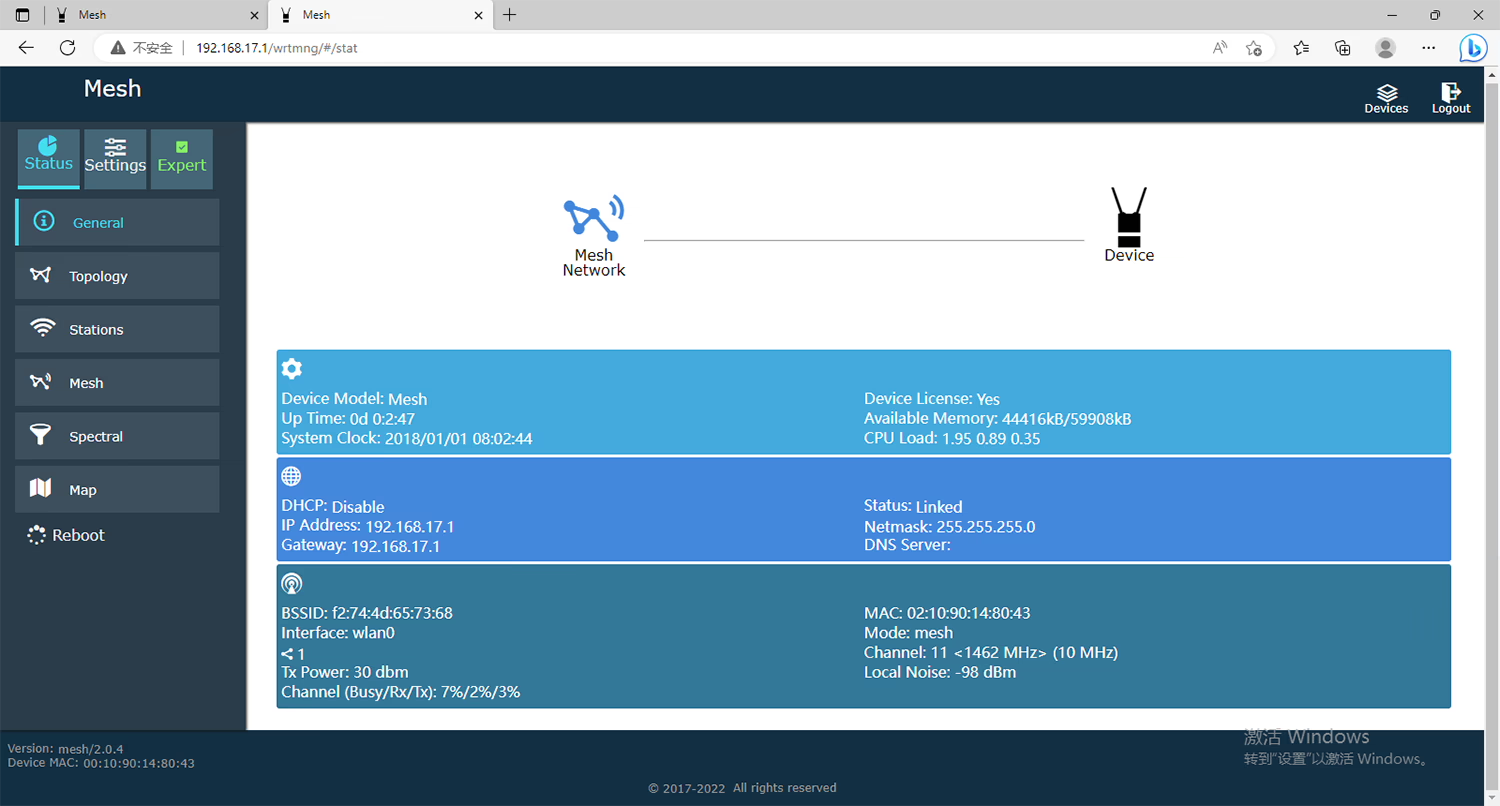
Supports Web-based management interface for visual configuration and monitoring, as well as serial AT commands for integration into automated control systems.
Transmission Performance Specifications
Data Throughput Performance
(Highlighted values indicate factory default settings)
| MCS Index | Modulation & Coding | 5 MHz | 10 MHz | 20 MHz |
|---|---|---|---|---|
| MCS0 | BPSK 1/2 | 1.7 Mbps | 3.3 Mbps | 6.5 Mbps |
| MCS1 | QPSK 1/2 | 3.2 Mbps | 6.5 Mbps | 13 Mbps |
| MCS2 | QPSK 3/4 | 4.8 Mbps | 9.8 Mbps | 19.5 Mbps |
| MCS3 | 16QAM 1/2 | 6.5 Mbps | 13 Mbps | 26 Mbps |
| MCS4 | 16QAM 3/4 | 9.7 Mbps | 19.5 Mbps | 39 Mbps |
| MCS5 | 64QAM 2/3 | 13 Mbps | 26 Mbps | 52 Mbps |
| MCS6 | 64QAM 3/4 | 14.5 Mbps | 29 Mbps | 58.5 Mbps |
| MCS7 | 64QAM 5/6 | 16 Mbps | 32.5 Mbps | 65 Mbps |
| MCS8 | BPSK 1/2 | 3.2 Mbps | 6.5 Mbps | 13 Mbps |
| MCS9 | QPSK 1/2 | 6.5 Mbps | 13 Mbps | 26 Mbps |
| MCS10 | QPSK 3/4 | 9.7 Mbps | 19.5 Mbps | 39 Mbps |
| MCS11 | 16QAM 1/2 | 13 Mbps | 26 Mbps | 52 Mbps |
| MCS12 | 16QAM 3/4 | 19.5 Mbps | 39 Mbps | 78 Mbps |
| MCS13 | 64QAM 2/3 | 26 Mbps | 52 Mbps | 90 Mbps |
| MCS14 | 64QAM 3/4 | 29 Mbps | 58.5 Mbps | — |
| MCS15 | 64QAM 5/6 | 32.5 Mbps | 65 Mbps | — |
Notes:
-
Adaptive modulation and coding (MCS) enables dynamic adjustment based on link quality.
-
Maximum system throughput reaches ≥90 Mbps under optimal conditions.
Receiver Sensitivity
Receiver Sensitivity (11n HT Mode)
| MCS Index | Sensitivity @10 MHz | Sensitivity @20 MHz |
|---|---|---|
| MCS0 | -95 dBm | -96 dBm |
| MCS1 | -94 dBm | -95 dBm |
| MCS2 | -92 dBm | -93 dBm |
| MCS3 | -88 dBm | -90 dBm |
| MCS4 | -85 dBm | -87 dBm |
| MCS5 | -81 dBm | -83 dBm |
| MCS6 | -80 dBm | -81 dBm |
| MCS7 | -77 dBm | -79 dBm |
| MCS8 | -94 dBm | -95 dBm |
| MCS9 | -92 dBm | -93 dBm |
| MCS10 | -89 dBm | -90 dBm |
| MCS11 | -86 dBm | -87 dBm |
| MCS12 | -83 dBm | -84 dBm |
| MCS13 | -78 dBm | -79 dBm |
| MCS14 | -77 dBm | -77 dBm |
Performance Highlights:
-
Excellent receiver sensitivity ensures long-range communication and reliable performance in low-SNR environments.
-
Optimized for non-line-of-sight (NLOS) and interference-prone scenarios common in UAV, UGV, and emergency communication applications.
Connector Input Output
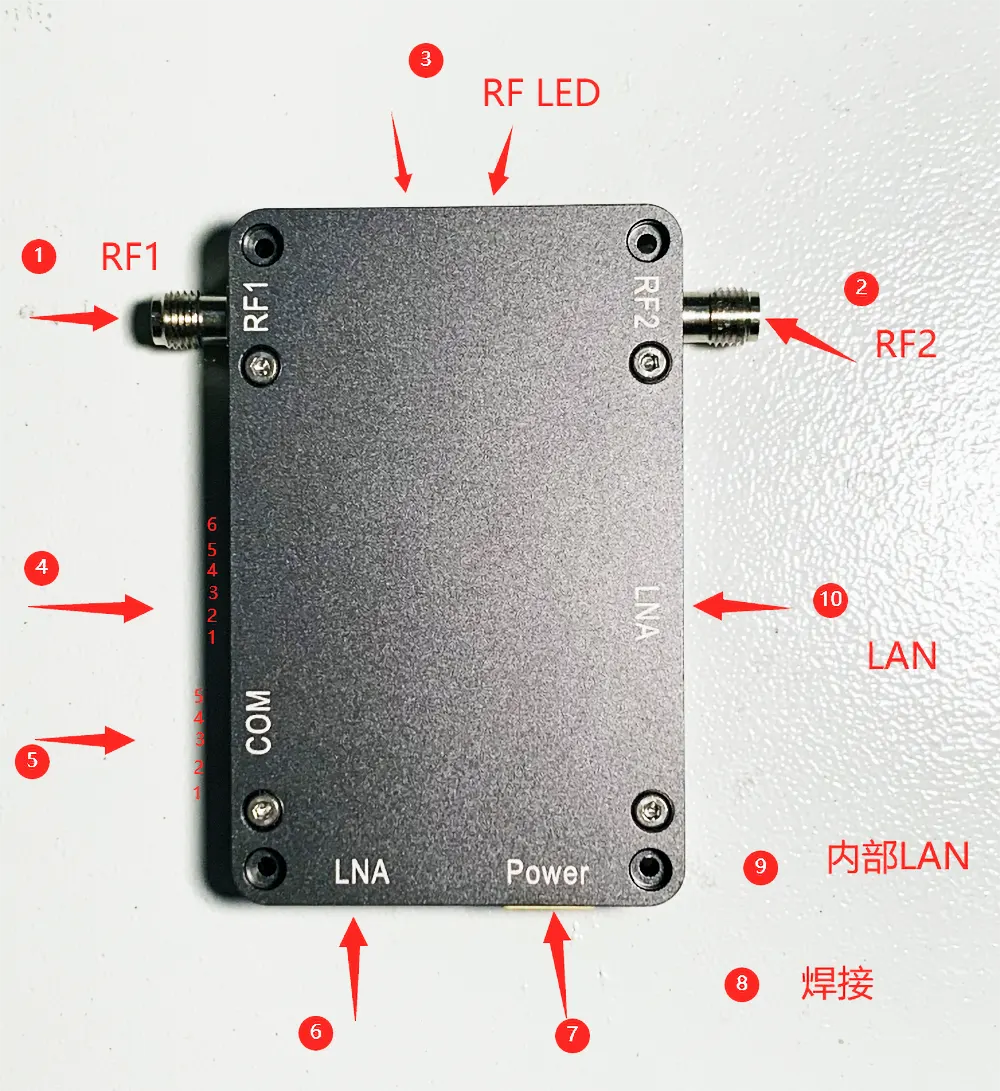
Define:
If the light is not on, it means that the wireless video data transmission has a problem, maybe the working power is too small, or the power amplifier is damaged.
| signal strength | LED P2 | LED P3 | LED P4 |
| > -70 | always | always | always |
| -71 to -75 | always | always | -75 |
| -75 to -80 | off | always | always |
| -80 to -83 | on | -80 | and |
| -83 to -88 | always | off | off |
| less than -88 | flash | off | off |
| no signal | marquee |
5, Data Serial Port, 1.25mm connector, 232 level. (some motherboards only have serial port 1, no serial port 2)
| serial number | Function |
| 1 | GND |
| 2 | 5V output |
| 3 | Serial 2 RX |
| 4 | Serial 2 TX |
| 5 | Serial 1 RX |
| 6 | Serial 1 TX |
6, 26Pin LNA 0.5mm FPC flexible cable connector, defined as follows:
| serial number | function | note |
| 1 | 5V | Output |
| 2 | 5V | output |
| 3 | NC | |
| 4 | RF1 | RF1 Switch |
| 5 | RF2 | RF2 Switch |
| 6 | ANTD | Antenna Switch |
| 7 | NC | |
| 8 | NC | |
| 9 | RESET | MESH firmware reset |
| 10 | LNA2_LED | |
| 11 | LNA1_LED | |
| 12 | GND | |
| 13 | 12V | 12V input |
| 14 | 12V | 12V input |
| 15 | GND | |
| 16 | RSSI_H | Received Signal Strength Indicator: Strong |
| 17 | RSSI_M | Received Signal Strength Indicator: Medium |
| 18 | RSSI_L | Received Signal Strength Indicator: Weak |
| 19 | ANTC | Antenna Switch on/off |
| 20 | PA1 | Power Amplifier 1 Switch |
| 21 | ANT1 | Antenna 1 Switch |
| 22 | LAN1_TX_N | Network Port |
| 23 | LNA1_TX_P | Network Port |
| 24 | GND | |
| 25 | LNA1_RX_N | Network Port |
| 26 | LNA1_RX_P | Network Port |
7, Power Input: 7-18V, the positive and negative poles are prohibited to be reversed! Otherwise, it will be damaged
Please directly weld the wire or weld the XT30 connector. The connector is also marked with positive and negative poles, don’t reverse it!
8, Onboard Pin Network Port:
Pin spacing 1.27mm, 4PIN (This network port can only configure the data of the local device and the other party, and cannot access the data of LAN6 and LAN9)
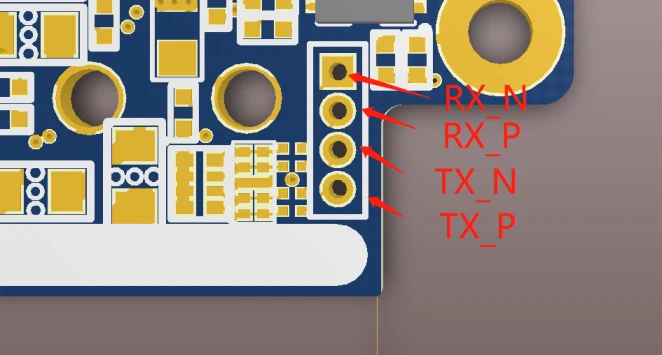
9, 20PIN 0.5mm FPC flexible cable connector, the definition is as follows: (provided later)
10, LAN port:
1.25mm connector, If it is often plugged and unplugged, it is recommended to externally connect the RJ45 socket with an isolation transformer.
- LAN-RX-P
- LAN-RX-N
- LAN-TX-P
- LAN-TX-N
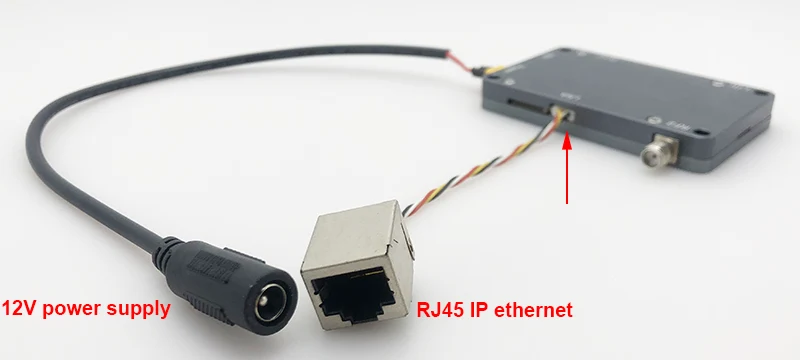
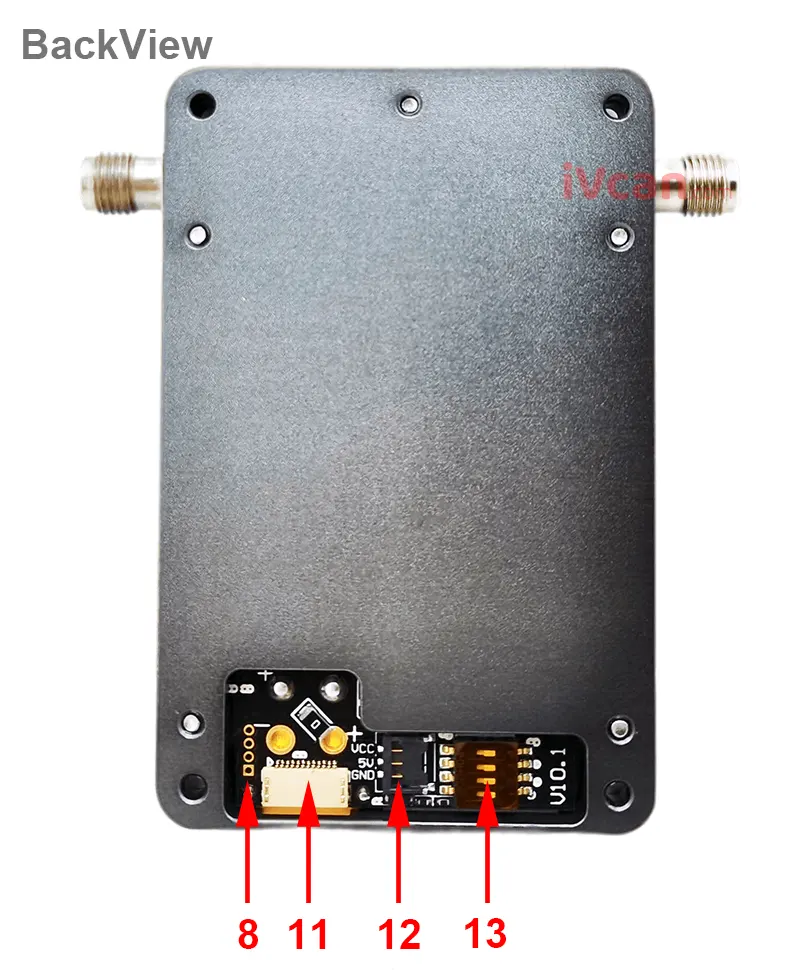
11, LAN port: 12PIN interface, PCI-E, and USB interface
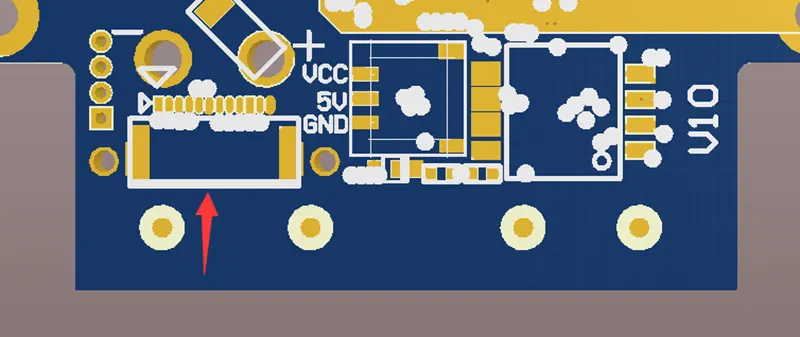
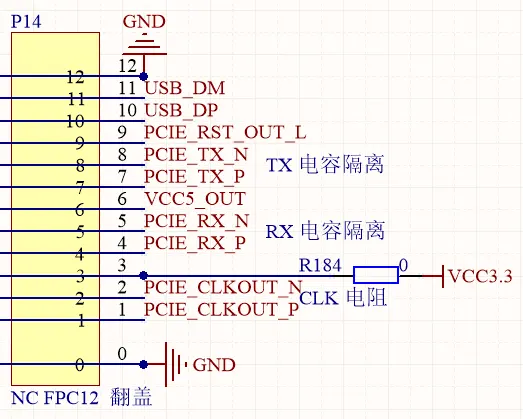
12, Fan Interface: GND is ground, 5V outputs 5V, VCC is connected to the main power supply, and the connector is 78172 series
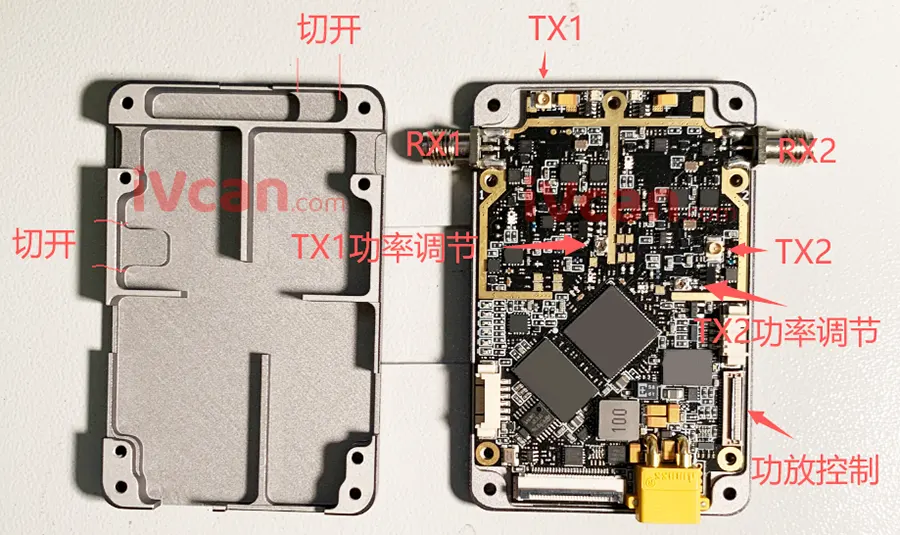
13, Jumper switch:
1. Turn it to the ON position to turn off the RF1 amplifier power.
2. Turn it to the ON position and turn off the power of the RF2 amplifier.
3, not used.
4. Restore the factory settings.
After powering on and entering the system, dial the code to 1 for more than 5 seconds, and then dial the code to 0 to restore the factory settings.
Applications
-
UAV / Drone Communication
Real-time HD video, telemetry, and control signal transmission between drone and GCS. -
UGV & Robotics Networking
Reliable two-way IP mesh network for autonomous vehicle coordination and robot swarm control. -
Public Safety & Emergency Response
Deploy mesh nodes to extend wireless video coverage in firefighting, search & rescue, or police operations. -
Industrial & Infrastructure Monitoring
Remote pipeline, factory, and energy facility inspection via long-range wireless IP camera links. -
IoT and Sensor Networks
Transmit high-rate sensor and control data across multiple nodes in dynamic environments.

Purchase Recommendation
To fully experience the advantages of the MANET Mesh network, it is recommended to purchase at least three devices.
-
Two-device setup limitation: If only two units are purchased, one acts as a transmitter and the other as a receiver. This configuration is essentially a standard point-to-point connection, and it does not demonstrate the full capabilities of a mesh network.
-
Three-device setup benefits: With three units, the third device can act as a relay node to extend coverage, enable non-line-of-sight communication, or bridge long distances between the transmitter and receiver. This is especially beneficial when all devices are moving, as no single device is fixed as a relay.
-
Mesh networking flexibility: Every device in the network can serve as a transmitter, receiver, or relay, enabling a fully self-organizing, decentralized mesh network. There is no need to pre-assign relay roles. If one device is powered off or damaged, the remaining units continue to operate seamlessly, maintaining network connectivity without interruption.
Summary: For a true mesh networking experience with maximum flexibility, reliability, and coverage, purchasing three or more units is strongly recommended.
Parameter Configuration Tool
-
Windows-based Configuration Software allows setup of frequency, bandwidth, IP, and encryption parameters.
-
Supports 1.4GHz firmware versions.
-
Compatible with P2P and Mesh networking modes.
FAQs
Q: Why is one of the RS232 ports on my Vcan1401-Mesh device not working, showing the error /EV-INFO start j $CFGSYS,h10?
A:Both RS232 ports on the Vcan1401-Mesh are fully functional. This error usually indicates a configuration issue with the specific port. Please check the port settings via the Web UI:
- Navigate to Page Settings → Tool → UART.
- Verify that the RS232 port is properly configured.
- Adjust the settings if necessary and save the configuration.
After reconfiguring, the RS232 interface should operate normally.
Q: Is the video data sent through LAN?
A: Yes. Video and all other IP data are transmitted through the LAN (Ethernet) interface. The module has an RJ45/4-pin LAN port, and the video stream enters the mesh network as standard IP packets.
Q: Can it also send text information (around 1 kB) during video transmission?
A: Yes. The system supports simultaneous transmission of video and data. You can send small text/telemetry/control data through Ethernet or the RS232 ports. A 1 kB message is very small and will not affect the video stream.
Q: Does the Radio & IP Mesh require a separate control unit, or can I retrieve data through a second radio? Is everything configured through your software?
A: No separate control unit is required. You can use a second MANET radio as the receiving unit. The devices automatically form a mesh network, and you can retrieve video and data directly from the second radio. All parameters (frequency, bandwidth, IP settings, encryption, etc.) are configured through our Windows software.
Q: Do you also sell antennas for the mesh units?
A: Yes, we can provide suitable antennas for these mesh radios. Please let us know your application (UAV/UGV, distance, installation space), and we will recommend the best antenna options.
Q: Can the UGV send video from an IP camera while also transmitting UART control data through the MANET Mesh?
Yes. This use case is fully supported by the MANET IP Mesh system.
-
The IP camera connects to the MANET radio through the LAN (Ethernet) port.
-
UART control commands can be transmitted through the Mesh using the RS232 ports, or sent as small IP packets via Ethernet.
-
On the ground/office side, a second MANET unit receives both the video stream and the UART/control data simultaneously.
This setup is widely used in UGV and robotics applications.
Q: If a UGV has two cameras, is one MANET Mesh device enough, or are two devices required?
A: One MANET device is normally sufficient.
The MANET radio can transmit multiple IP video streams at the same time, as long as the combined bitrate stays within the available Mesh bandwidth.
Typical connection options include:
-
Two IP cameras → connected to a small onboard Ethernet switch → switch to the MANET LAN port.
-
One camera connected directly to LAN, and the second via another encoder or network device.
The Mesh radio will transport both video streams together with your control/telemetry data.
You would only need two separate MANET radios if:
-
You require full physical redundancy, or
-
The total bitrate is extremely high and exceeds the Mesh channel capacity.
For most dual-camera UGV setups, a single MANET unit is enough.
Q: Do you have a 3D enclosure model for this IP MESH radio transceiver? Since it does not include a cooling fan, we need a 3D drawing to ensure proper passive heat dissipation with our enclosure.?
Yes. We can provide a 3D STEP enclosure file for this transceiver. The STEP file includes accurate mechanical dimensions and housing geometry, allowing your engineering team to:
-
Integrate the transceiver into your own enclosure design
-
Optimize physical contact and passive heat dissipation through the enclosure
-
Perform thermal simulation and mechanical fit checks during development
Please note that this product is designed for fanless operation and relies on conduction-based passive cooling. Proper thermal coupling between the transceiver housing and your enclosure (such as using aluminum housing, thermal pads, or heat-spreading structures) is recommended for optimal performance.
Q1: Does this MANET radio support IP Mesh networking?
Yes. It supports self-forming and self-healing IP Mesh networking, allowing multi-node UAV or UGV collaboration.
Q2: Can it work in Point-to-Point and Point-to-Multipoint modes?
Yes, both P2P and multipoint are supported for flexible network topologies.
Q3: What is the typical transmission latency?
Around 28ms (excluding camera/monitor delay), up to 80ms for 1080P@60fps.
Q4: Can the system operate on 2.4GHz band?
Yes, frequency customization is available on request.
Q5: Is AES encryption supported?
Yes, encryption and password configuration are available through the Windows configuration tool.
Q6: Does it support serial-over-IP (UDP broadcast)?
Yes, RS232 serial data can be mapped to IP packets for network transmission.
Q7: Can one module be used as a repeater node?
Yes, any module can serve as a repeater in a mesh network setup.
Q8: Does the RS232 port support TTL level?
No, it supports standard RS232 levels only.
Q9: We are going to use it on an aqua drone between large jetties, quays, and bridges.
Thanks. It supports.



iVcan.com –
I have been using the 2×1W MANET Radio & IP Mesh module for several weeks on both UAV and UGV platforms, and I am extremely impressed with its performance. The setup is incredibly straightforward—just power on, and the devices automatically form a stable, self-healing mesh network. Video transmission is ultra-low latency and crystal clear, even across complex terrains, which makes controlling drones and robotic vehicles much easier and safer. The build quality is excellent, compact and lightweight, yet durable enough to withstand harsh outdoor conditions. Multiple data interfaces and flexible configuration options make integration seamless, while the long-range connectivity ensures reliable communication during extended missions. Overall, this module has exceeded my expectations in terms of stability, speed, and versatility, making it an essential tool for professional UAV and robotic applications.
iVcan.com –
It is impressive the distance you got with the radio system.
Our USV works with a long range 900Mhz serial radio for data and autonomous mode, and a 2.5Ghz radio controller for remote control mode. I was looking for a video transmitter to integrate in the USV system. It seems that your radio can offer a serial port for the boat data and another 2 serial ports for tools. In addition, we will have two Ethernet ports that we can use a IP camera and others equipments.
So, we have 2 solutions:
1 – Use a single video transmitter/receiver; (do you have one like this?)
2 – Use a radio that can offer serial data and video link; ( the Digi is quoting a radio like this one, but your expertise e real test can be a differencial for us)