






Dipole Antenna Element Length and Frequency – Detailed FAQ
This FAQ provides a clear, professional, and technically accurate explanation of how the physical length of a dipole antenna affects its resonant frequency and overall RF performance. It is suitable for sharing with customers, engineers, or partners who need a deeper understanding of antenna tuning principles.
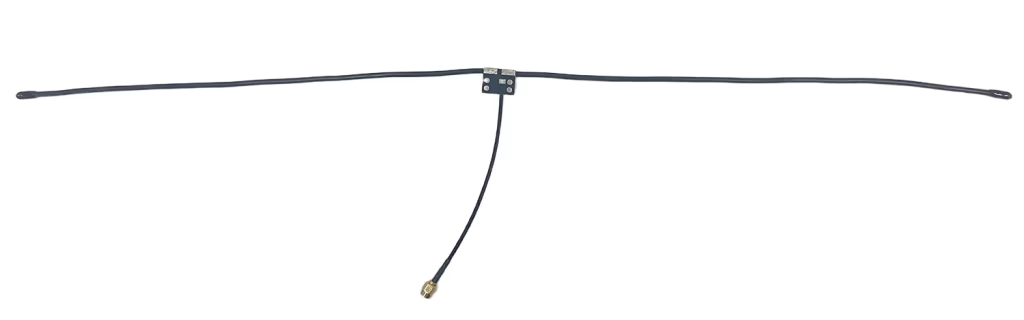
Table of Contents
1. Does the length of the two dipole elements affect antenna frequency?
Yes. The length of the two metal rods (elements) of a dipole antenna directly determines its resonant frequency. A dipole antenna behaves as a tuned electrical resonator. Its resonant frequency occurs when the total physical length of the antenna corresponds to approximately half of the operating wavelength (λ/2).
Because wavelength λ = c / f (speed of light ÷ frequency):
- Longer antenna → Lower resonant frequency
- Shorter antenna → Higher resonant frequency
Even small changes in element length can shift the resonant frequency significantly, especially at higher frequencies.
2. What is the basic formula for estimating dipole length?
The classic formula for an ideal half-wave dipole is:
L ≈ λ / 2 = 150 (meters) / f(MHz)
However, real dipoles use a slightly shorter length (typically 90–97% of the theoretical value) due to “end effects,” conductor thickness, and the surrounding environment.
Example:
At 500 MHz, the half-wave length is approximately:
150 / 500 = 0.30 m → ~30 cm total dipole length (~15 cm per side)
3. Do both dipole elements need to be the same length?
Yes. For most applications, both elements of a dipole must be:
- Equal in length
- Symmetrical around the feed point
- Made from the same material
Unequal element lengths cause:
- Impedance mismatch
- Distortion of the radiation pattern
- Higher VSWR (Voltage Standing Wave Ratio)
- Reduced transmission distance and efficiency
Symmetry is a key requirement for stable, predictable antenna performance.
4. What happens if one dipole rod is slightly longer or shorter?
If one rod is longer than the other, you may experience:
- Shifted resonant frequency
- Asymmetric radiation pattern
- Uneven current distribution
- Higher return loss
- Unstable link quality
For precision RF systems (COFDM, telemetry, video transmission), even a 2–3 mm deviation can impact performance depending on the operating band.
5. Does rod diameter affect the resonant frequency?
Yes, to a lesser degree. Thicker elements create:
- A broader bandwidth
- A slightly shorter required length
- Improved impedance stability
But diameter changes do not affect frequency as dramatically as element length.
6. What external factors can detune the dipole antenna?
Antenna performance can be altered by:
- Nearby metal structures
- Cables running parallel to the antenna
- Mounting brackets
- The ground plane or chassis
- Human body proximity
- Encapsulation materials
- Water ingress or moisture
These factors can effectively “lengthen” or “shorten” the electrical characteristics of the antenna and shift its resonant point.
7. If the customer wants a customized frequency, what information is needed?
To tune a dipole accurately for a specific frequency, you should ask for:
- Target center frequency (MHz or GHz)
- Operating bandwidth
- Installation environment (open, enclosed, handheld, UAV, etc.)
- Mounting method (horizontal, vertical, inside housing, etc.)
- Material constraints (rod diameter, type, and maximum length)
- Whether both sides can remain fully symmetrical
With these details, the antenna can be precisely cut and tested.
8. How sensitive is a dipole antenna to manufacturing tolerance?
At higher frequencies (such as 2.4 GHz, 5.8 GHz, and 6 GHz), a difference of 1 mm can cause multiple MHz of frequency shift. For lower bands (200–500 MHz), the tolerance can be around 2–5 mm.
Precision cutting and verification with network analyzers are essential for professional RF systems.
9. What is the best practice when adjusting dipole lengths?
- Start with slightly longer elements, then trim down gradually.
- Measure the antenna using a VNA (Vector Network Analyzer).
- Adjust symmetrically—trim both rods equally.
- Avoid bending or deforming the rods.
- Ensure the feed cable does not act as an unintended radiator.
This is the standard process in RF engineering to achieve an optimal match.
10. Summary
Yes, the length of the two dipole elements has a direct and critical impact on the antenna’s operating frequency. For best performance, the two rods must be:
- Correctly calculated
- Precisely cut
- Perfectly symmetrical
- Installed in a stable RF environment
Following these guidelines helps ensure low VSWR, stable links, and optimal RF transmission performance.
Ask A Question
Thank you for your response. ✨