

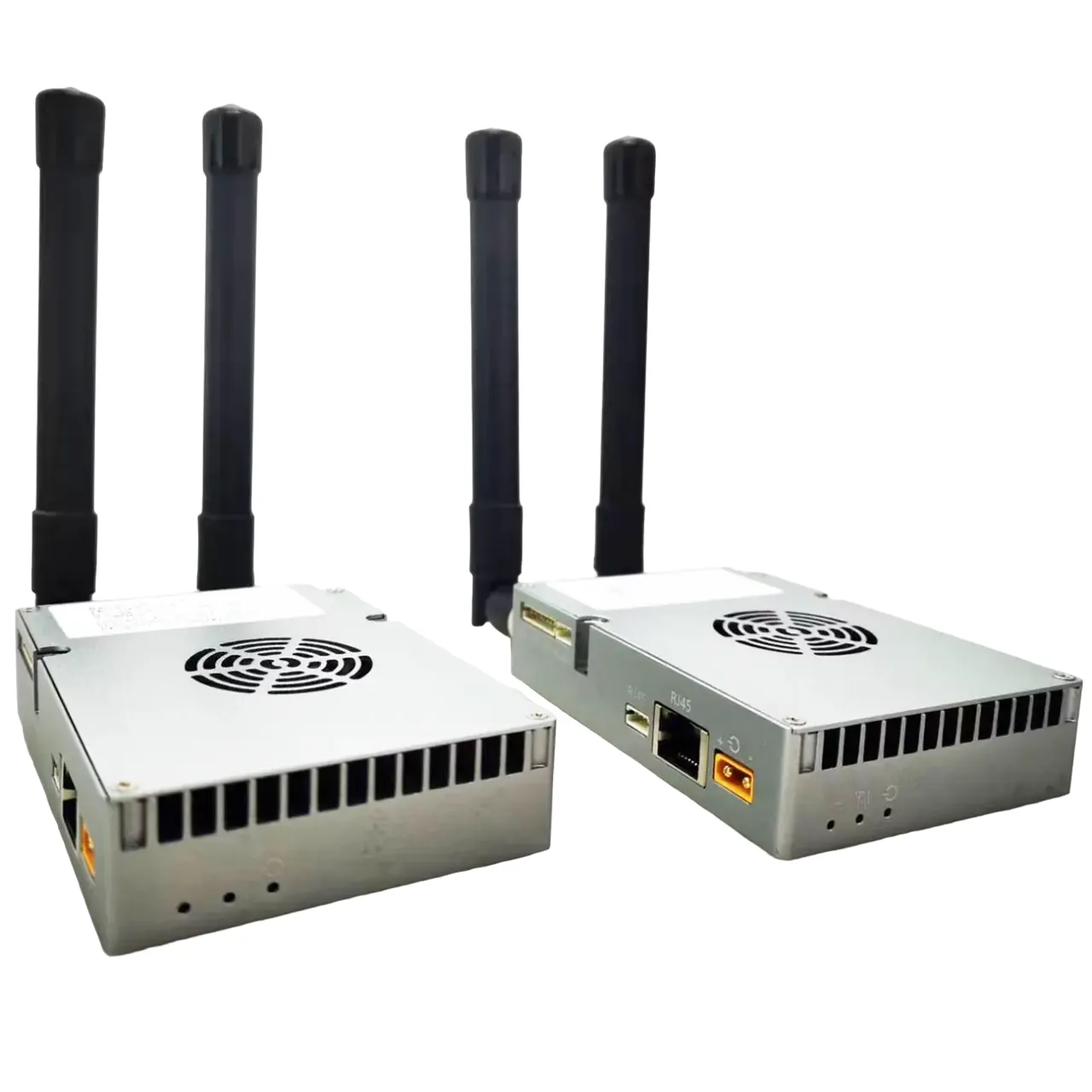
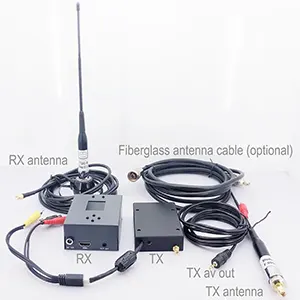


This is the Digital COFDM FPV Video Transmitter VTX Ultimate FAQ 1887.

- Q: What is the frequency range of this 50km FPV video transmitter?
A: This FPV video transmitter operates across an ultra-wide 170-860Mhz frequency range, offering great flexibility for finding clear channels. When placing an order, you need to specify the center operating frequency within the +/-15Mhz frequency range, because the built-in power amplifier and antenna will be customized according to the center operating frequency. - Q: What is the maximum power output (RF power) of this long-range VTX?
A: It features a powerful 3Watts PA (Power Amplifier), enabling exceptional long-range FPV performance up to a claimed 50km. (Default is 3-watts PA, we also can customize if according to your demand, for example 1 watt, 2 watt, 5 watts, 10 watts, 20 watts, 50 watts etc) - Q: Is a 50km range realistic for this wireless video transmitter?
A: While rated for 50km range under ideal, unobstructed Line of Sight (LOS) conditions with perfect antennas, real-world results depend heavily on antennas, interference, terrain, and weather. Expect significantly less in typical FPV environments. In actual use, the receiving antenna can be installed as high as possible, or the transmission bandwidth can be set to 2Mb to improve the diffraction capability of this wireless video transmission. - Q: Does this 3W video transmitter require a license to operate legally?
A: Yes. Transmitting at 3W (30dBm) in most popular FPV bands (like 5.8GHz is usually limited to 25mW-800mW) often requires an amateur radio (HAM) license in many countries. Always check your local RF regulations. The operating frequency range can be selected from 170-860Mhz. This is the same as the frequency range of DVB-T Europe digital standard TV, and different operating frequencies can be set to avoid mutual interference. - Q: What type of FPV camera is compatible with this video transmitter module?
A: It’s compatible with standard FPV cameras outputting analog video signals, CVBS, which stands for Composite Video Blanking and Sync, is a standard analog video signal used in television and other video systems.
- Q: Will this VTX work with my FatShark / SkyZone / DJI FPV Goggles?
A: Yes, it transmits a standard analog video signal compatible with any FPV goggles or receivers capable of the cvbs video input. Please remove your VRX module, to connect our wireless video receiver cvbs video signal. Or any HDMI or CVBS monitor as the display screen. - Q: What video transmission protocol does this long-range VTX use?
A: It uses standard analog video transmission (like NTSC/PAL), not digital protocols like DJI or Walksnail. Through VTX, the FPV video is encoded and compressed, and transmitted wirelessly like a DVB-T TV transmitter. The receiver receives the signal through an antenna just like a TV at home, and demodulates and decodes it to restore it to a clear video image. You can use uncommon frequencies or set a private AES128-bit encryption password to ensure the privacy of your video. - Q: Does this FPV transmitter module have low latency?
A: Yes, as an analog video transmitter, it provides the lowest latency (<150ms) video transmission suitable for high-speed FPV flying and racing. - Q: What input voltage (Vin) does the 3W RF transmitter require?
A: Typically, such high-power FPV VTX modules require 12V input voltage (confirm exact specs), often connected directly to a 3S-6S LiPo flight battery. - Q: How much current (amps) does the 3W PA VTX draw at full power?
A: Expect high current draw, likely 600mA – 1000mA+ at 3W RF power. Factor this into your power system and battery capacity planning. - Q: Does this wireless video transmitter get very hot?
A: Yes. A 3W power amplifier generates significant heat. Active cooling (heatsink/fan) is absolutely essential for reliable operation, especially at full power. This video transmitter is installed outside the drone, and can also use the cold wind in the air when moving at high speed to take away the temperature of the transmitter surface, thus playing a cooling role. When used in the laboratory, the transmitter needs to be placed on a metal shell to play a role in isolating temperature and dissipating heat. - Q: Is a heatsink included with the 50km range VTX module?
A: A substantial heatsink is crucial, but it is not included. An external fan is highly recommended. If the temperature continues to rise, it will automatically shut down to protect the transmitter. When working for a long time, avoid touching the surface of the transmitter directly with your hands to avoid burns. - Q: What antennas are recommended for this 170-860Mhz FPV transmitter?
A: Please confirm the working central frequency of the video transmitter, Use same frequency, high-gain, high-quality directional antennas (like Yagi, Helical, Patch) for maximum long-range performance. Change one of omnidirectional antenna to one directional antenna will drastically increase the transmission range. - Q: What antenna connector type (SMA/RP-SMA) does the VTX module have?
A: Confirm the listing (usually SMA or RP-SMA). Ensure your chosen long-range antenna has the matching connector. - Q: Can I use this VTX for drone FPV racing?
A: While possible, a 3W transmitter is extreme overkill for racing, it generates too much heat for small racers. It’s designed for long-range exploration. - Q: Is this module suitable for fixed-wing long-range FPV planes?
A: Yes. Fixed-wing planes often have the space and power for the 3W PA, heatsink, and large directional antennas, making them ideal platforms for this 50km VTX. - Q: How do I change the frequency/channel on this FPV video transmitter?
A: The optional transmitter parameter configuration board is a small tool that can modify the transmitter’s transmission frequency, bandwidth, output power, AES encryption password, etc. - Q: Does this VTX support SmartAudio or Tramp Telemetry for control?
A: Many modern long-range VTX modules do. FPV1887 does not support. - Q: What is the video resolution supported by this analog RF transmitter?
A: Standard analog resolution (typically up to 700TVL camera input), transmitting as NTSC or PAL (approx. 480i/576i). - Q: What is the typical video latency of this wireless AV transmitter?
A: < 100ms, characteristic of low latency analog transmission, suitable for real-time FPV control. - Q: Does the 50km transmitter module have multiple power output settings?
A: Almost certainly yes. You can usually the optional transmitter parameter configuration board that can modifydown from 3W to lower power levels (e.g., 1W, 500mW, 200mW, 25mW) for shorter range or legal compliance where possible. - Q: How do I set the output power on this 3W PA FPV VTX?
A: The optional transmitter parameter configuration board is a small tool that can modify output power. - Q: What is the RF output impedance of the video transmitter?
A: Standard 50 Ohm impedance, matching standard FPV antennas and coax cables. - Q: Is this module compatible with 1.2GHz/1.3GHz FPV systems?
A: Yes. The 170-860Mhz range fully encompasses the popular 1.2GHz (1240-1300MHz) and 1.3GHz (1280-1320MHz) long-range FPV bands. FPV1887 transfers the video only, you have to use another data radio link to control the fpv drone. - Q: Can I use it on 433MHz for even longer range?
A: Yes. The 170-860Mhz range includes 170-200MHz, a lower frequency known for excellent penetration and long-range, but requires large antennas and careful harmonic management. - Q: Will this VTX interfere with my 2.4GHz RC control link?
A: Potentially, yes. Harmonics from 433MHz or 1.3GHz VTX can interfere with 2.4GHz RC. A low-pass filter on the VTX and physical separation are crucial. Using 900MHz (e.g., Crossfire, ELRS) or 433MHz (LRS) control is often recommended. - Q: Do I need a low-pass filter (LPF) with this high-power VTX?
A: Strongly recommended, especially when operating on lower frequencies (like 433MHz or 1.3GHz) to suppress harmonics that can interfere with RC control (2.4GHz) or violate regulations. - Q: What is the typical transmission range at lower power settings (e.g., 200mW)?
A: Significantly less than 50km. Expect a few kilometers with good directional antennas, depending heavily on environment. The 3W PA enables the maximum possible range. - Q: How does this VTX perform for penetration (flying behind obstacles)?
A: Lower frequencies within its range (like 433MHz, 900MHz) offer much better signal penetration through trees and light structures compared to 5.8GHz. Setting the transmission bandwidth to 2Mb can also improve video transmission quality and reduce screen freezes and mosaics. - Q: What is the weight of the 3W RF video transmitter module?
A: Expect a relatively heavy module (likely 100 grams), not including the essential heatsink and potential cooling fan. Check the product listing. - Q: What are the physical dimensions (size) of the VTX board?
A: Check the listing (e.g., 50mm x 35mm). Ensure it fits your aircraft frame. High-power modules are generally larger. - Q: Is microphone audio transmission supported by this AV transmitter?
A: Most analog FPV VTX support audio transmission via a separate mic input or from the camera’s audio line. But in order to be lower latency, the audio transmission is removed, we can customize according to your demand. - Q: How do I connect an external microphone to the wireless audio video transmitter?
A: If supported, there’s usually a dedicated mic pad or audio input pin on the VTX board. Consult the manual/pinout. - Q: Does this module support Pit Mode (zero RF power output)?
A: Most modern FPV VTX modules do. - Q: What is the operating temperature range for the 3W PA?
A: Check specs. Reliable operation requires keeping it within its operating temperature range using adequate cooling (heatsink + fan). - Q: Is the VTX module protected against reverse polarity?
A: Check the specs! Not all modules have this. Always double-check wiring to avoid frying it. - Q: What kind of cooling solution is mandatory for this high-power VTX?
A: A large heatsink is essential. Adding a small 5V or 12V fan blowing directly onto the heatsink is highly recommended for sustained 3W RF power operation, especially in warm conditions or confined spaces. - Q: Can I use this for ground-based FPV (car, rover, robot)?
A: Yes, the long-range capabilities and potential for better penetration at lower frequencies make it suitable for ground FPV where range or obstacles are a challenge. - Q: Does this transmitter work with diversity receivers?
A: Yes. Any standard analog diversity receiver capable of tuning the 170-860Mhz frequency range will work with this VTX module. - Q: What is the typical video bandwidth of this analog RF transmitter?
A: Standard analog video bandwidth (approx. 6-8MHz per channel), similar to other FPV VTX. Wider bandwidth isn’t possible with analog. - Q: How susceptible is the 170-860Mhz signal to video noise?
A: Analog video is susceptible to RF noise, especially at long range or near interference sources. Using a clean power supply (LC filter) is crucial. Lower frequencies can be less noisy than crowded 5.8GHz. - Q: Do I need a separate voltage regulator or LC filter for this VTX?
A: Highly recommended. A dedicated LC filter helps minimize video noise from the power source. A voltage regulator might be needed if your input voltage is unstable or exceeds the VTX’s max Vin. - Q: Are there any known compatibility issues with specific flight controllers?
A: Compatibility issues are rare for the video signal itself. For SmartAudio/Tramp control, ensure your flight controller firmware (e.g., Betaflight, iNav) supports the protocol used by the VTX. - Q: Where can I buy high-quality antennas for 170-860Mhz FPV?
A: Look for reputable FPV retailers (RDQ, GetFPV, Pyrodrone, etc.) or antenna specialists (VAS, TrueRC, Lumenier) offering directional antennas (Yagi, Helical, Patch) specifically tuned for your chosen band within 170-860Mhz. - Q: Is the VTX module firmware upgradeable?
A: Check the product specs. Some higher-end modules offer firmware updates via USB or a dedicated port for bug fixes or feature additions. - Q: What is the expected lifespan of a 3W PA FPV transmitter?
A: Lifespan depends heavily on operating temperature. Running constantly at 3W RF power without adequate cooling will significantly shorten its life. Properly cooled and used at appropriate power levels, it should last years. - Q: Does this VTX have a microphone bias voltage?
A: If it supports an external mic, it likely provides mic bias voltage (usually 3-5V). Check the specs/pinout for the mic input. - Q: Can I use this with a DVR (Digital Video Recorder)?
A: Yes. Connect your FPV goggles’ AV output or a separate analog receiver’s output to any standard DVR to record the video signal. - Q: What are the primary advantages of this VTX over a standard 5.8GHz 600mW VTX?
A: Massively increased range potential (50km claim), significantly better signal penetration (using lower freqs like 1.3GHz/433MHz), and access to less crowded bands within 170-860Mhz. - Q: What are the main drawbacks or challenges of using this 3W 170-860Mhz VTX?
A: Legal licensing requirements (HAM), high current draw, significant heat generation needing robust cooling, large/heavy size, potential for RC interference requiring mitigation (filters, lower freq control), large directional antennas needed for max range, and complexity compared to standard 5.8GHz setups.

Ask A Question
Thank you for your response. ✨