






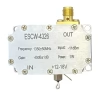

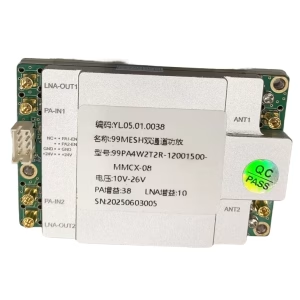
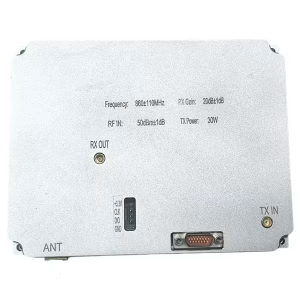
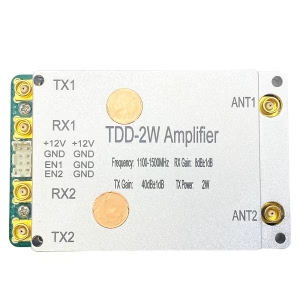
TDD 10 watts PA power amplifier 1420-1530Mhz for drone ip mesh transceiver module BDA Bi-Directional Amplifier

TDD 10W PA power amplifier for drone radio links in 566-678 MHz refers to a Time Division Duplexing (TDD)-compatible, 10-watt power amplifier designed for bidirectional wireless communication in drones.
The TDD PA10W-566-678MHz power amplifier module is used to connect to the Vcan2024 drone radio link module. The output power of the Vcan2024 wireless drone video data transceiver modules is 25±2dBm. After our amplifier is connected to the core communication module, the transmission power is increased to 10W (40dBm).
Table of Contents
Technical Indicators
- Working frequency range: 566~678MHz
- RF input: Vcan2024 transceiver module RF out (25±2dBm)
- RF output power: 10W (40dBm)
- TX gain: 18dB±1. When TDD PA10W-580-620MHz is connected to the Vcan2024 transceiver module, when the maximum output of the Vcan2024 transceiver module is set to 21~23, the transmit power after this PA output is 40dBm (10W)
- Power supply requirements: DC 24V~30V, default power supply DC28V, instantaneous peak power supply requirement can reach 1.6A@28V
- Working power consumption: With 28V power supply and 10W output power, the maximum average power consumption is within 28W (when transmitting at full load).
- Cavity size: 66*63*14mm (excluding the size of the connector extending out of the shell).
- Weight: 132 grams
PA module signal description
28V power line (red thick line): power supply VDD
Power GND line (black thick line): power supply GND
Receive/transmit switch control signal line and GND line (thin yellow line + black line in the figure): 2PIN signal, connected to the PA receive/transmit driver interface of the MorningCore module (the receive/transmit switch control signal line is connected to the 63PIN DBB_RFGPO18 or 66PIN DBB_RFGPO19 of the MorningCore CX667X/CX677X module, and GND is connected to the 68PIN GND of the MorningCore CX667X/CX677X module).
RF-IN: RF signal source input interface, IPEX socket, connects to the ANT output connector of the Vcan2024 transceiver module.
ANT: Output antenna interface, SMA external thread and internal hole socket.
PA module installation
The following is a schematic diagram of the connection between the PA10W-580-620Mhz module and the MorningCore CX667X/CX677X module:

The PA10W-580-620Mhz power amplifier module is shipped with a CNC cavity by default, and 4 M2 fixing holes (on the 4 corners).
The user needs to design a heat sink for the power amplifier module.
Please connect the antenna first before you power on the power amplifier.
TDD PA10W-566-678Mhz Dimensions (mm)


Customizable Options:
-
Operating Frequency Range
-
Standard: 1420–1530 MHz
-
Custom frequency bands can be configured to match regional regulations or specific applications.
-
-
Output Power Level
-
Default: 10 W
-
Adjustable power levels: e.g., 5 W, 15 W, or higher depending on range requirements.
-
-
Amplifier Type & Gain
-
TDD-compatible power amplifier design
-
Gain level can be customized for desired coverage and efficiency.
-
-
Input/Output Connectors
-
Standard: SMA / N-type / MCX
-
Custom connectors based on customer’s drone or RF system.
-
-
Cooling & Thermal Management
-
Passive heat sink or active cooling options
-
Compact or ruggedized designs for outdoor/mobile applications.
-
-
Size & Form Factor
-
Compact module for drone integration
-
Rack-mounted or standalone versions for BDA use.
-
-
Power Supply Options
-
Standard DC voltage: 12–18 V
-
Custom voltage ranges or PoE (Power over Ethernet) support.
-
-
Impedance Matching
-
Standard 50 Ω
-
Custom matching to specific antennas or transceiver modules.
-
-
Environmental Protection
-
IP-rated enclosure for dust/water resistance
-
Temperature range adaptation for extreme conditions.
-
-
Control & Monitoring Interfaces
-
Optional remote monitoring and control via Ethernet, RS232, or TTL
-
Integration with IP mesh network management systems.
-
-
Filter Options
-
Optional band-pass or duplex filters to reduce interference
-
Custom filtering to comply with regional regulations.
-
-
Compliance & Certification
-
CE, FCC, or other regulatory certification support based on target region
-
Military or industrial-grade ruggedization available.
-
FAQ
Q: What is a TDD 10 watts PA power amplifier for drone IP mesh transceiver modules?
Q: What frequency range does this 10 watts PA power amplifier cover?
Q: How does TDD technology benefit this PA power amplifier in drone applications?
Q: Is this 10 watts PA compatible with most drone IP mesh transceiver modules?
Q: What’s the main advantage of 10 watts output in drone IP mesh communication?
Q: Can this PA power amplifier work with small drones, or is it only for large UAVs?
Q: How does the 1420-1530MHz frequency band suit drone IP mesh networks?
Q: Will this PA power amplifier drain my drone’s battery quickly?
Q: Does the PA power amplifier affect the latency of drone IP mesh networks?
Q: Can this amplifier be used in drone swarms with multiple IP mesh nodes?
Q: What’s the maximum communication range achievable with this 10 watts PA?
Q: Is the PA power amplifier weatherproof for outdoor drone operations?
Q: How does this PA handle interference in the 1420-1530MHz band?
Q: What power supply does the 10 watts TDD PA require?
Q: Can this PA amplifier be used in both fixed-wing and multi-rotor drones?
Q: How much weight does the PA power amplifier add to a drone?
Q: Does the amplifier support dynamic power adjustment based on mesh network conditions?
Q: What’s the typical lifespan of this 10 watts TDD PA in drone operations?
Q: Is the PA compliant with global regulations for 1420-1530MHz operation?
Q: How does the PA improve signal quality in dense drone mesh networks?
Q: Can I integrate this PA with MIMO-enabled drone IP mesh transceivers?
Q: What cooling mechanism does the PA use to prevent overheating in drones?
Q: How does this 10 watts PA compare to 5 watts models for drone mesh networks?
Q: Is the PA power amplifier easy to install on a drone?
Q: Can the PA be used in military or industrial drone applications?
Q: What happens if the PA exceeds the 1420-1530MHz range?
Q: Does the PA affect the drone’s GPS or other onboard sensors?
Q: What’s the input signal level required for the PA to deliver 10 watts output?
Q: Can the PA be remotely monitored via the drone’s IP mesh network?
Q: How does the PA handle signal reflection in urban drone operations?
Q: Is there a warranty for this 10 watts TDD PA power amplifier?
Q: Can the PA operate in extreme temperatures (e.g., desert or arctic drones)?
Q: What’s the maximum data rate supported by the PA in drone IP mesh networks?
Q: Does the PA require calibration after installation?
Q: Can the PA be used with solar-powered drones?
Q: How does TDD synchronization work between the PA and transceiver module?
Q: What’s the typical latency added by the PA to the drone’s communication chain?
Q: Is the PA resistant to water or dust for outdoor drone flights?
Q: Can multiple PAs be used in a single drone for redundant communication?
Q: What’s the cost difference between this PA and lower-power alternatives?
Q: Does the PA support frequency hopping within the 1420-1530MHz band?
Q: How does the PA impact drone battery life?
Q: Can the PA be used with drone IP mesh networks that use encryption?
Q: What’s the return loss specification of the PA in the 1420-1530MHz band?
Q: Is the PA power amplifier tested for vibration resistance in drone flight?
Q: How does the PA handle voltage fluctuations in drone batteries?
Q: Can the PA be customized for specific drone IP mesh transceiver models?
Q: What documentation is provided for integrating the PA into a drone system?
Q: Does the PA comply with drone weight restrictions for commercial operations?
Q: How long is the lead time for ordering this 10 watts TDD PA power amplifier?


iVcan.com_buyer –
This 10W PA amplifier for our drone IP mesh modules has been a game-changer. Operating reliably across 1420-1530MHz, it delivers consistently strong, clear signal transmission even during complex, long-range drone operations. The robust power output (10W) significantly extends our effective comms range without introducing noticeable noise or interference. Integration was straightforward, and its performance feels incredibly stable – we’ve experienced zero signal drops or overheating issues during demanding flights. It provides rock-solid, mission-critical connectivity for our mesh network, making it an absolutely essential and trustworthy component for professional drone teams requiring dependable, high-power RF links.