


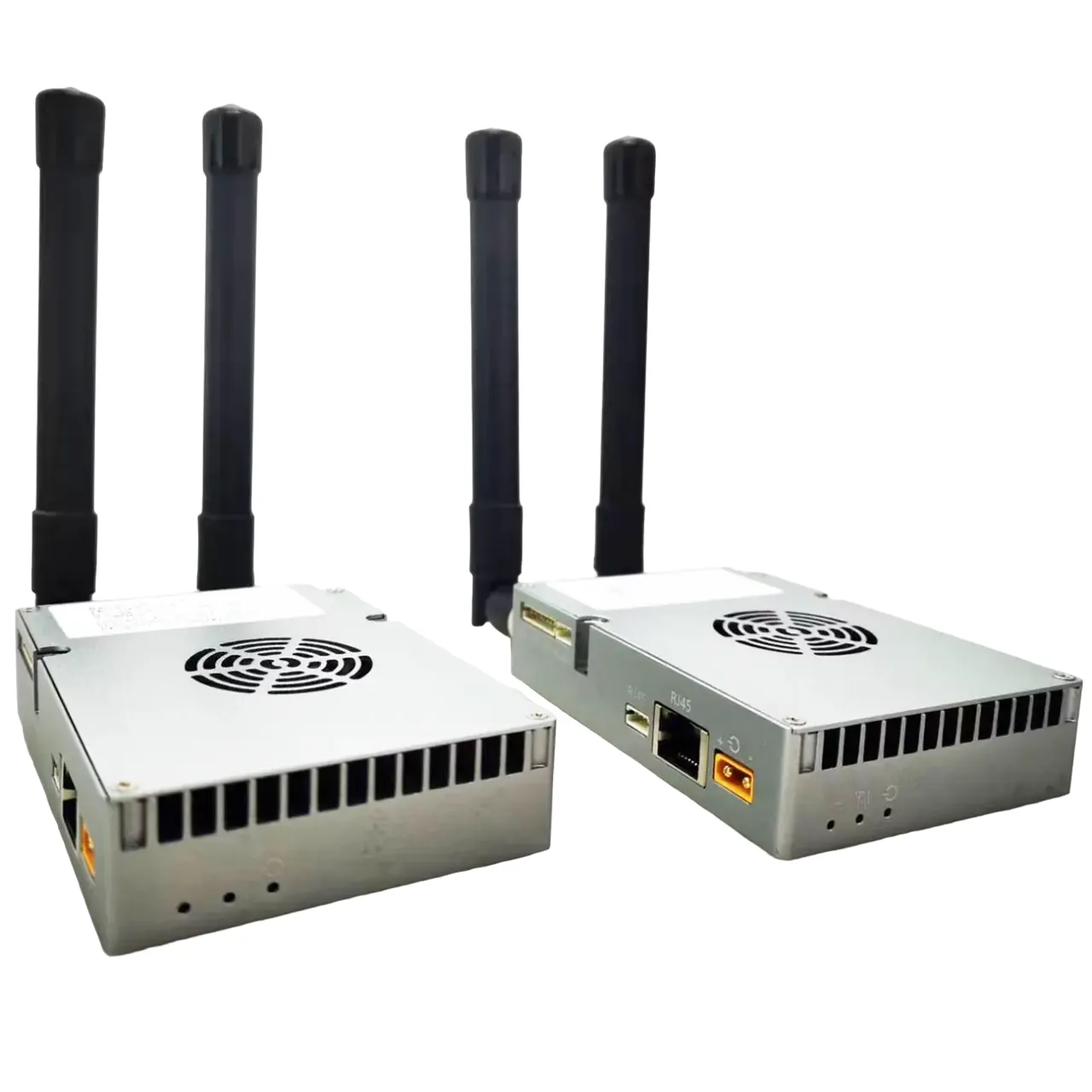
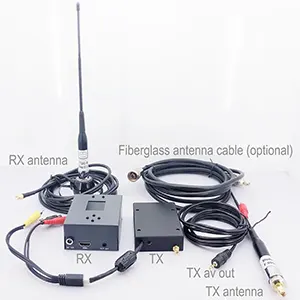



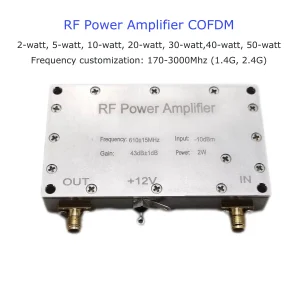
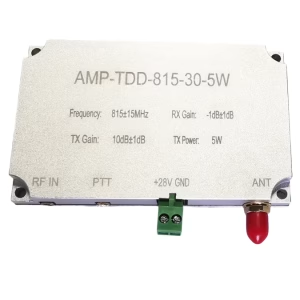
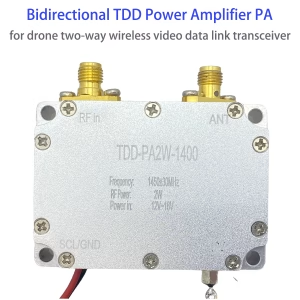
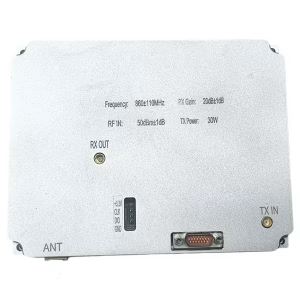
TDD 10 watts PA power amplifier 566-678MHz for drone radio link 2-5-10-20 watts optional

TDD 10W PA power amplifier for drone radio links in 566-678 MHz refers to a Time Division Duplexing (TDD)-compatible, 10-watt power amplifier designed for bidirectional wireless communication in drones.
The TDD PA10W-566-678MHz power amplifier module is used to connect to the Vcan2024 drone radio link module. The output power of the Vcan2024 wireless drone video data transceiver modules is 25±2dBm. After our amplifier is connected to the core communication module, the transmission power is increased to 10W (40dBm).
Table of Contents
Technical Indicators
- Working frequency range: 566~678MHz
- RF input: Vcan2024 transceiver module RF out (25±2dBm)
- RF output power: 10W (40dBm)
- TX gain: 18dB±1. When TDD PA10W-580-620MHz is connected to the Vcan2024 transceiver module, when the maximum output of the Vcan2024 transceiver module is set to 21~23, the transmit power after this PA output is 40dBm (10W)
- Power supply requirements: DC 24V~30V, default power supply DC28V, instantaneous peak power supply requirement can reach 1.6A@28V
- Working power consumption: With 28V power supply and 10W output power, the maximum average power consumption is within 28W (when transmitting at full load).
- Cavity size: 66*63*14mm (excluding the size of the connector extending out of the shell).
- Weight: 132 grams
PA module signal description

28V power line (red thick line): power supply VDD
Power GND line (black thick line): power supply GND
Receive/transmit switch control signal line and GND line (thin yellow line + black line in the figure): 2PIN signal, connected to the PA receive/transmit driver interface of the MorningCore module (the receive/transmit switch control signal line is connected to the 63PIN DBB_RFGPO18 or 66PIN DBB_RFGPO19 of the MorningCore CX667X/CX677X module, and GND is connected to the 68PIN GND of the MorningCore CX667X/CX677X module).
RF-IN: RF signal source input interface, IPEX socket, connects to the ANT output connector of the Vcan2024 transceiver module.
ANT: Output antenna interface, SMA external thread and internal hole socket.
PA module installation
The following is a schematic diagram of the connection between the PA10W-580-620Mhz module and the MorningCore CX667X/CX677X module:

The PA10W-580-620Mhz power amplifier module is shipped with a CNC cavity by default, and 4 M2 fixing holes (on the 4 corners).
The user needs to design a heat sink for the power amplifier module.
Please connect the antenna first before you power on the power amplifier.
TDD PA10W-566-678Mhz Dimensions (mm)


FAQ
-
Q: What is the frequency range of the TDD power amplifier for drone radio links?
A: This PA amplifier operates in the 566-678MHz band, ideal for drone radio links and compatible with our Vcan2024 IP Mesh transceiver.
-
Q: How much output power does this 566-678MHz drone PA provide?
A: It delivers 10 watts (40dBm) PA power, enhancing signal range and reliability for drone mesh networks.
-
Q: Is this amplifier designed for TDD or FDD systems?
A: It’s a TDD (Time Division Duplexing) power amplifier, optimized for bidirectional drone radio links like the IP mesh wireless video data telemetry module.
-
Q: What modulation schemes support this 10W drone amplifier?
A: It supports common schemes (QPSK, QAM) used in 566-678MHz drone radio links.
-
Q: Is this PA amplifier compatible with IP mesh drone radio link transceivers?
A: Yes, it’s engineered for seamless integration with IP mesh drone radio link transceiver modules for drone applications.
-
Q: Is this amplifier compatible with other-brand drone transmitters?
A: It works with any 566-678MHz TDD transceiver supporting 10W PA input. Before customization, please tell me, what is the default output gain of your transmitter?
-
Q: Does the amplifier require external cooling for 10W output?
A: Yes, passive/active cooling is recommended for sustained 10W PA power in drone radio links.
-
Q: What connectors are used for RF input/output?
A: Standard SMA/MMCX connectors ensure easy integration with drone mesh link hardware.
-
Q: How far can this PA extend my drone’s radio link range?
A: With 10W PA power at 566-678MHz, expect 3-5× range extension vs. standard drone transmitters (varies by environment). In our actual tests, it achieved a range of 100-150km. Your transceiver module is also important.
-
Q: What is the typical gain of this drone amplifier?
A: It offers 18dB gain, boosting weak signals from the IP mesh transceiver module (default at 23dB output).
-
Q: Does the PA support harmonic filtering for regulatory compliance?
A: Yes, built-in filters minimize harmonics, ensuring safe 566-678MHz operation per FCC/CE standards.
-
Q: How efficient is this 10W PA for battery-powered drones?
A: Efficiency exceeds 40%, minimizing power drain on drone batteries during extended flights. -
Q: Is the amplifier plug-and-play with your vcan2024 transceiver modules?
A: Yes, connect RF input/output and DC power—no coding needed for transceiver module integration. See the connection here.
-
Q: What DC voltage powers this 10W drone PA?
A: 28V DC (typical for drone systems); includes over-voltage/current protection.
-
Q: Can I mount the PA directly on a drone?
A: Yes, its compact, lightweight design suits UAV integration. Ensure heat dissipation for 10W PA workloads.
-
Q: Are configuration tools needed for TDD timing?
A: Timing syncs automatically with TDD transceivers like our transceiver module.
-
Q: Is this amplifier FCC/CE certified for drone use?
A: It is not applied for any European or American certification.
-
Q: What licenses are needed for 10W drone transmissions?
A: In most regions, 566-678MHz requires an operator license for 10W PA power (check local rules).
-
Q: Does the PA include overheat protection?
A: Yes, thermal shutdown activates above 85°C to protect drone radio link hardware.
-
Q: Are there RF exposure risks with 10W output?
A: Maintain >20cm distance during operation. Follow RF safety guidelines for high-power drone amplifiers.
-
Q: Can this PA amplify video feeds for FPV drones?
A: Absolutely! It’s ideal for HD video radio links in 566-678MHz.
-
Q: Is it suitable for industrial drone swarms?
A: Yes, its TDD design ensures low-latency communication for mesh link-based swarm control.
-
Q: Will this work for agricultural drone telemetry?
A: Perfect for long-range farm surveys—boosts transceiver module longer transmission range in rural.
-
Q: Can it handle urban drone operations?
A: Yes, but monitor interference in crowded 566-678MHz spectra. Use high-gain directional antennas for best results.
-
Q: What operating temperatures support this drone PA?
A: -20°C to +70°C—reliable for most drone environments.
-
Q: Is the amplifier waterproof?
A: IP65 optional; standard units are lightweight but not waterproof. Specify if needed for harsh drone radio link use.
-
Q: How long does the PA last under constant 10W load?
A: 10,000+ hours with proper cooling. Ideal for mission-critical mesh link transceivers.
-
Q: Does vibration affect performance in drone flights?
A: No—ruggedized design withstands UAV vibrations per MIL-STD-810G.
-
Q: Why is my PA overheating during drone flights?
A: Ensure adequate airflow.
-
Q: The radio link drops at long range—what’s wrong?
A: Check antenna alignment/SWR. Verify the transceiver output matches PA amplifier input.
-
Q: Can interference from other drones disrupt this PA?
A: Use 566-678MHz band scanning to avoid crowded channels; the PA includes basic noise filtering.
-
Q: Why is RF output below 10W?
A: Confirm input power ≥21~23dBm. Test with dummy load to isolate drone radio link issues.
-
Q: What antennas pair best with this amplifier?
A: Directional (Yagi) or omnidirectional antennas tuned to 566-678MHz for drone mesh links.
-
Q: Can I request a custom frequency version?
A: Yes—contact us for PAs in 400-600MHz, 1420-1530MHz, or other bands beyond
-
Q: Does it include a DC power cable?
A: Yes, with bare ends for easy drone integration. Optional connectors available.
-
Q: Are mounting brackets included?
A: The four corners of the standard kit housing have four Φ3.2 through holes reserved for installation.
-
Q: Where can I find the PA’s datasheet and manual?
A: Please check this products page or contact us for any specific question.
-
Q: How do I contact support for drone amplifier issues?
A: Email support@ivcan.com.
-
Q: Is there a warranty for this 10W drone PA?
A: 2-year warranty covering defects. 30-day returns for drone radio link compatibility issues.
-
Q: Can I get firmware updates?
A: Firmware isn’t required—this analog PA amplifier works without software. -
Q: What’s the price for a single 10W drone PA unit?
A: Contact us for bulk quotes.
-
Q: Do you offer bulk discounts for drone fleets?
A: Yes! Discounts for 10+ units of this 566-678MHz PA amplifier.
-
Q: How soon can I receive my order?
A: Ships in 1-2 weeks globally.
-
Q: Are samples available for testing?
A: Yes.
-
Q: What’s the PA’s noise figure in drone applications?
A: <4dB NF ensures minimal signal degradation in 566-678MHz mesh links.
-
Q: How does TDD switching handle latency for drones?
A: <1ms switching time.
-
Q: Can I cascade multiple PAs for more power?
A: Not recommended. Use a single 10W PA to avoid instability in TDD systems.
-
Q: What’s the maximum VSWR supported?
A: 2.0:1. Protect your PA amplifier with antennas rated for 566-678MHz.
-
Q: Does it support MIMO for drone networks?
A: No—this is a single-chain PA. Use multiple units for mesh link MIMO configurations.
-
Q: Where is this amplifier manufactured?
A: Designed and produced in China.


iVcan.com_buyer –
This TDD 10W PA has been an absolute game-changer for my long-range drone operations! The crystal-clear, rock-solid video link throughout the 566-678MHz band, even at extreme distances, is incredible. I love the effortless power switching between 2W, 5W, 10W, and 20W – it’s perfect for adapting instantly to different environments and regulations. Setup was surprisingly simple, and the peace of mind knowing my control and video feeds won’t break up during critical cinematic shots or challenging missions is invaluable. It delivers exceptional, interference-free performance exactly when you need it most. A must-have upgrade for serious pilots wanting maximum, reliable range.