






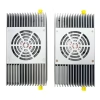
UAV drone video data transmitter-relay-receiver 2T2R 2WPA 60km
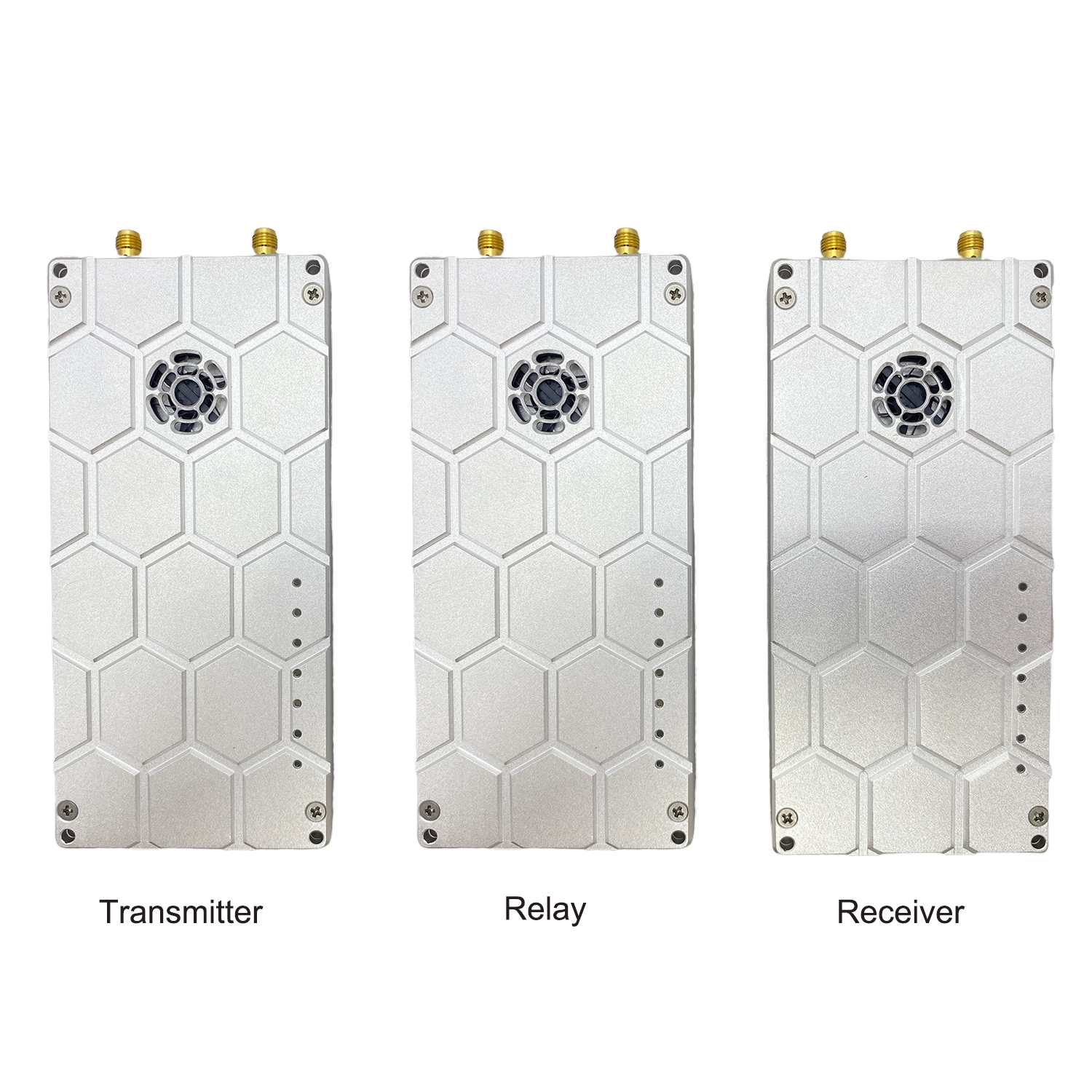
Table of Contents
Feature
- Frequency customized. The default is 1.4 GHz. 1350-1470Mhz.
- This system supports transmitting video from an IP camera, as well as control and missions. But to increase the range, it includes a repeater, which also transmits video from its camera.
- Every transceiver node has two SBus ports. So, the ground receiver unit supports controlling the repeater airplane and the transmitter airplane — two drones via the remote control.
- Transmit video from the IP camera to RTSP and control. The point-to-point version is 16.8 Mbps. The point-to-multi-point version is 26.4 Mbps.
Introduction
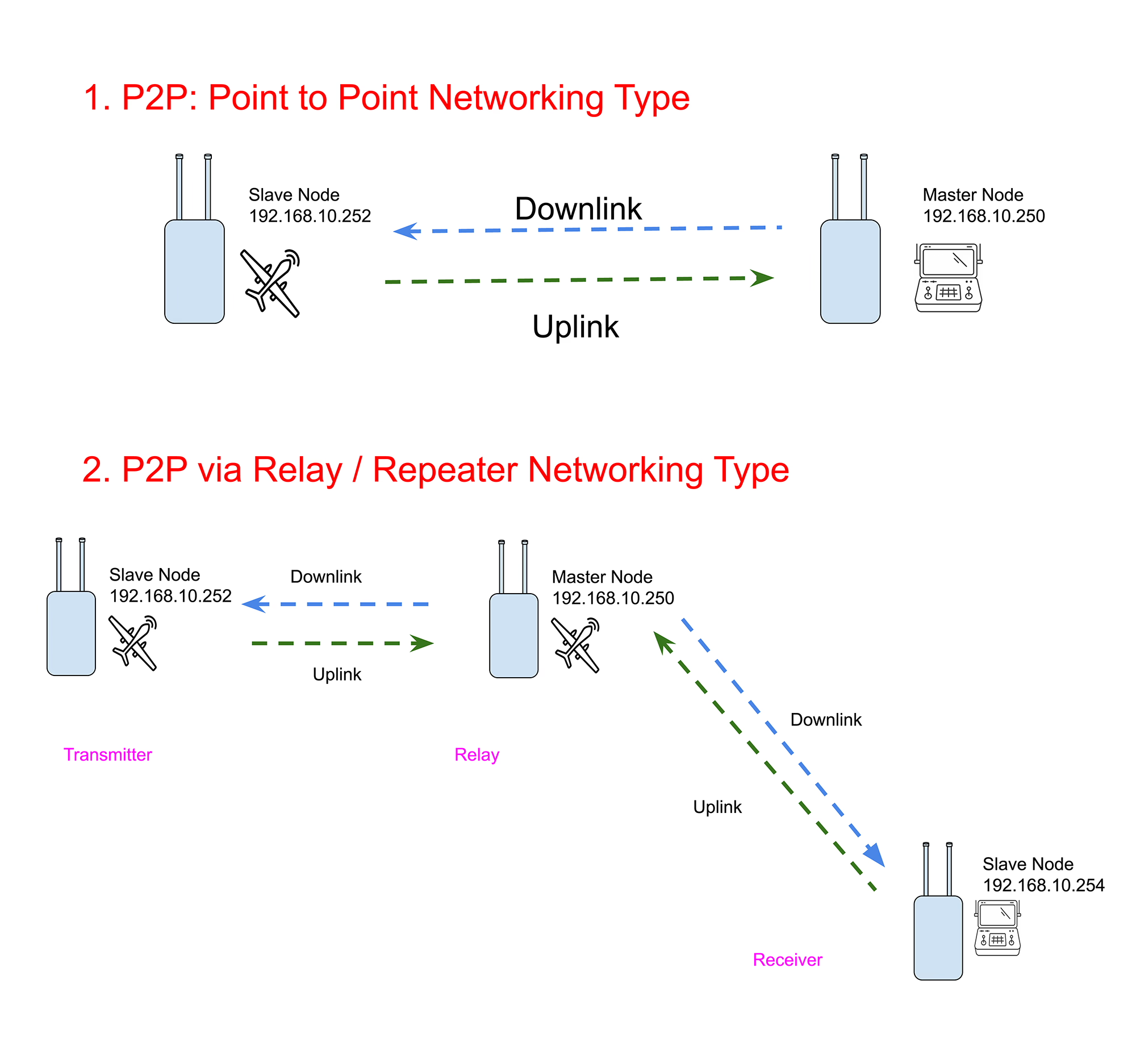
There is a star networking no-mesh system for transmitting video over long distances relay. The first transceiver node is on a mission airplane, and second transceiver node is installed on the repeater airplane, and the third transceiver node is installed at the ground station. The distance from the mission airplane to the ground station is about 20 – 60 km; the maximum range can expand to 60+60=120km without signal interference. The system supports an IP camera on board the airplane, and RTSP transmission. The ground station connects to a PC and outputs the live video as an RTSP stream from on board the airplane.
With the second transceiver as a repeater to increase the range. conditional another plane will fly closer. Roughly speaking, ground station -> Plane 1 (You also need to see the video from it) -> Plane 2. You can use aerial relay drones to cross obstacles such as mountains, or hide the true location of the ground station to protect the safety of pilots.
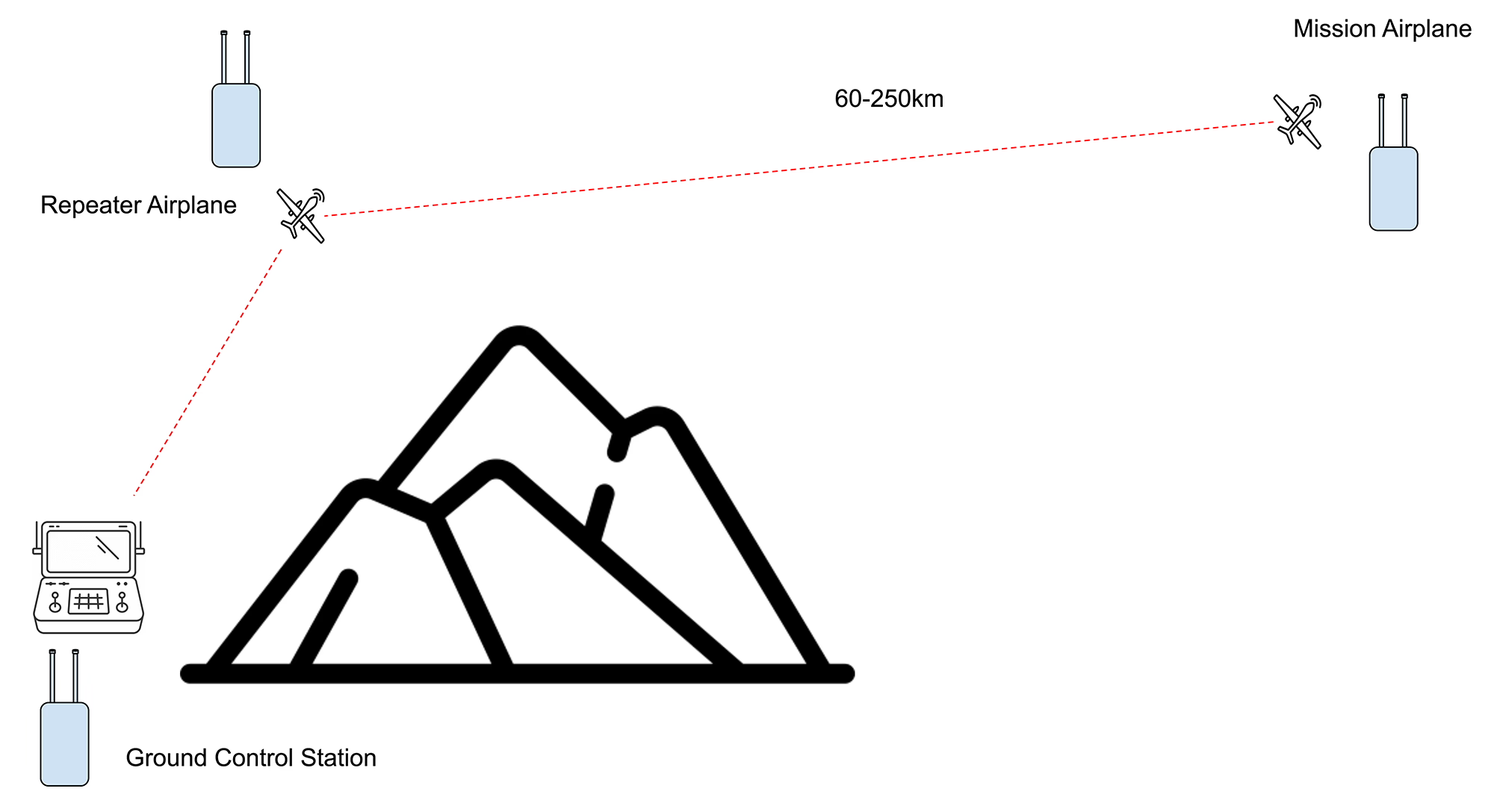
This radio communication system consists of three nodes: a ground station, a retransmitter, and an end node, which is the mission plane. The ground unit should be 40-60km from the retransmitter, which in turn should be 50-60km from the end node (mission drone). The minimum data throughput over these distances is 10-16MB per second, and the working frequency band is 1350-1470MHz.
Customizable Items:
-
Frequency Range
-
Adjustable operating frequency (e.g., 1.2–1.5 GHz, 2.4 GHz, 5.8 GHz)
-
Compliance with regional regulations (FCC, CE, etc.)
-
-
Transmission Power
-
Output power customization (e.g., 100 mW–20 W) to extend range
-
Power amplifier inclusion for long-distance communication
-
-
Video Format & Resolution
-
Support for SD, HD, Full HD, or 4K video
-
Compatibility with HDMI, SDI, or analog CVBS video input/output
-
-
Network & Protocol
-
IP streaming (RTSP, UDP, H.264/H.265)
-
Mesh network vs. point-to-point relay configuration
-
Support for diversity reception for better signal stability
-
-
Relay/Repeater Features
-
Multi-hop relay capability
-
Adjustable number of relay nodes
-
Automatic failover or signal redundancy options
-
-
Antenna Options
-
Directional vs. omnidirectional antennas
-
Custom gain (dBi) and physical form factor
-
Polarization type and connector customization
-
-
Receiver Features
-
Number of diversity channels
-
HDMI, SDI, CVBS, or Ethernet outputs
-
Integration with NVR or computer for live monitoring
-
-
Power Supply & Consumption
-
Voltage range (e.g., 7–28 V)
-
Low-power versions for extended drone flight
-
Battery vs. external DC/AC options
-
-
Control & Interface
-
Remote on/off control
-
OSD (On-Screen Display) overlays for telemetry data
-
Web or app-based configuration interface
-
-
Environmental & Mechanical
-
Waterproof or dustproof casing (IP65/IP67)
-
Lightweight or compact design for UAV payload constraints
-
Mounting options for drones, vehicles, or fixed stations
-
-
Encryption & Security
-
Video/audio encryption options
-
Password-protected streaming
-
Secure network protocols for sensitive operations
-
-
Special Features
-
Low-latency mode for real-time control
-
Adjustable compression settings
-
Dual-mode transmitter/receiver operation (optional)
-
FAQ
1. What is the frequency range of the 1.4GHz drone video transmitter?
The frequency range is 1350-1470MHz, optimized for long-range drone video and data transmission. We also can customize special frequency for you, for example, 2.1~2.3GHz (2100~2300MHz), 1.7~1.9GHz (1700~1900MHz), 5.7GHz (5700MHz), dual frequency (600MHz downlink + 1400MHz uplink) etc.
2. What is the maximum transmission distance?
The 2WPA 2-watt power amplifier maximum line-of-sight range is up to 60km under optimal conditions. It also supports 5-8WPA 80-100KM, 10WPA 150km, 20WPA 200km and 40WPA 300km.
3. Is this drone transmitter suitable for video and data transmission?
Yes, it supports both real-time video streaming and telemetry data.
4. What does 2T2R mean in this product?
2T2R stands for 2 Transmitters and 2 Receivers for enhanced MIMO performance and link stability.
5. What is the RF output power of the transmitter?
It features a 2W power amplifier (PA) for stronger signal strength over long distances. 2WPA 33dBm, 5WPA 37dBm, 8WPA 39dBm, 10WPA 40dBm, 20WPA 43dBm and 40WPA 46dBm,
6. Can this be used as a drone relay station?
Yes, the device can function as a drone relay to extend communication coverage. Please order 3 units: one as a transmitter, one as a receiver, and another as a relay station.
7. Does it support non-line-of-sight (NLOS) transmission?
It performs best in line-of-sight, but can handle limited NLOS scenarios with reduced range. So we recommend that choose one more unit as a repeater.
8. Is encryption supported on this video transmitter?
Yes, AES encryption is available for secure video and data transmission.
9. What video resolution is supported?
It supports up to 1080p HD video transmission with low latency.
10. What is the typical latency of the system?
The end-to-end latency is typically under 100ms, ideal for FPV and real-time control.
11. What kind of antenna is recommended?
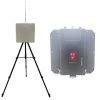
High-gain directional or omnidirectional antennas are recommended for optimal performance. At the ground control station, we recommend using this omnidirectional and directional antenna.
12. Is this system compatible with all drones?
It is compatible with most UAVs with available power supply and video/data output interfaces. Special fixed-wing UAV for long-range and long term flying.
13. Can the system work in mesh mode?
No, this model is primarily point-to-point or point-to-multi-point (including relay), not mesh networking. Please check mesh types.
14. What is the input video format?
It typically supports 1080p 1920×1080 HDMI or SDI input depending on the configuration.
15. Is the system weatherproof?
In order to reduce its weight, we added a perforated cooling fan, which is not waterproof. If you need to use it for USV surface ships, we can customize a special waterproof, moisture-proof and dust-proof shell.
16. Can it transmit through obstacles like trees?
Some signal loss will occur, but the high-power amplifier helps in partially obstructed environments. If there are obstacles such as trees, try to increase the transmitter’s power amplifier or use a repeater to overcome the signal blockage caused by the obstacles.
17. Does the receiver support diversity reception?
Yes, it features dual antenna diversity to enhance signal reliability. It support 2T2R, means two RF on every units has two transmitting and two receiving function.
18. What power supply is required for the transmitter?
Usually 12V-24V DC is needed, compatible with drone onboard power.
19. Can this transmitter be used for fixed-wing drones?
Yes, it is suitable for both multirotor and fixed-wing UAVs.
20. Is it compatible with COFDM modulation?
Yes, the system uses OFDM modulation for robust, interference-resistant transmission.
21. How heavy is the transmitter unit?
The transmitter is lightweight, typically under 227 grams for drone compatibility.
22. Can the transmitter-receiver system be customized?
Yes, customization for frequency, power amplifier, bandwidth, and interfaces is available on request.
23. What is the bandwidth of the transmission channel?
It typically supports 10-20MHz bandwidth configurations.
24. Can it carry multiple video streams?
It can transmit a single video stream with data telemetry combined. Depending on the redundancy of the transmission rate, more IP cameras can also be added.
25. Is there a relay mode to extend range beyond 60km?
Yes, by setting up a relay drone or ground station, the range can be extended 60+60km. If using 40WPA, relay can extend 300+300km in theory.
26. Does the system support bi-directional data communication?
Yes, it supports full-duplex communication for control and telemetry.
27. What is the modulation type?
It uses COFDM with QPSK, 16QAM, or 64QAM for modulation.
28. Is there an app or software for monitoring?
Optional software tools are available for signal monitoring and diagnostics. We always use normal RTSP, Easyplay or VLC player.
29. What temperatures can the system operate in?
It works in -20°C to +60°C operating environments.
30. Can this be used for law enforcement or military applications?
Yes, it’s ideal for tactical drones, surveillance, and special operations. Our products are intended for civilian use and are prohibited from being used in the military field.
31. What is the typical use case for this transmitter?
Long-range drone video transmission, border patrol, and aerial inspections.
32. What is the receiver interface output?
It usually uses an Ethernet cable to connect to Mission Planner or QGC QQroundControl on the computer.
33. Can this system be mounted on vehicles?
Yes, with proper mounting, it can be used on ground vehicles for relay purposes.
34. What frequency license is required?
1.4GHz typically requires a license; users should check local RF regulations.
35. Does it support frequency hopping?
Optional frequency hopping spread spectrum (FHSS) is available.
36. How long is the video transmission stable at 60km?
Stability depends on altitude, antenna alignment, and environmental interference.
37. Can I integrate this system with my existing ground station?
Yes, it’s designed for easy integration with custom ground control stations. or use our https://ivcan.com/p/integrated-ground-receiver-and-antenna-with-tripod/
38. Does the system support IP video streams?
Yes, video-over-IP transmission is supported via Ethernet interfaces.
39. How do I upgrade firmware?
Firmware can be updated via USB or network interface.
40. What is the difference between this and 5.8GHz transmitters?
1.4GHz offers better range and penetration compared to 5.8GHz frequencies.
41. What certifications does the system have?
CE, FCC, and ROHS certifications are available based on production batches.
42. Is customer support available for integration help?
Yes, technical support and integration guidance are provided.
43. What is the maximum data rate?
Data rates up to 12Mbps for combined video and data are achievable. The point-to-point version is 16.8 Mbps. The point-to-multi-point version is 26.4 Mbps.
44. How many drones can connect to one receiver?
Typically designed for point-to-point, but multi-point setups are possible with configuration.
45. Can I adjust the output power?
Yes, output power levels can be configured to optimize performance and power consumption.
46. Is low latency guaranteed under all conditions?
Low latency is typical under good RF conditions, but may increase with interference.
47. Is there a portable ground receiver option?
Yes, handheld and portable receiver versions are available.
48. What’s included in the transmitter-receiver kit?
Usually includes the transmitter, receiver, antennas, cables, and power adapters.
49. What video compression is used?
The system typically uses H.264 or H.265 compression for efficient streaming.
50. Where can I buy the 1.4GHz drone video transmitter?
You can purchase directly from specialized RF communication suppliers or the manufacturer.
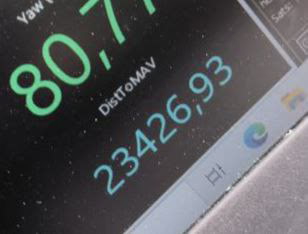
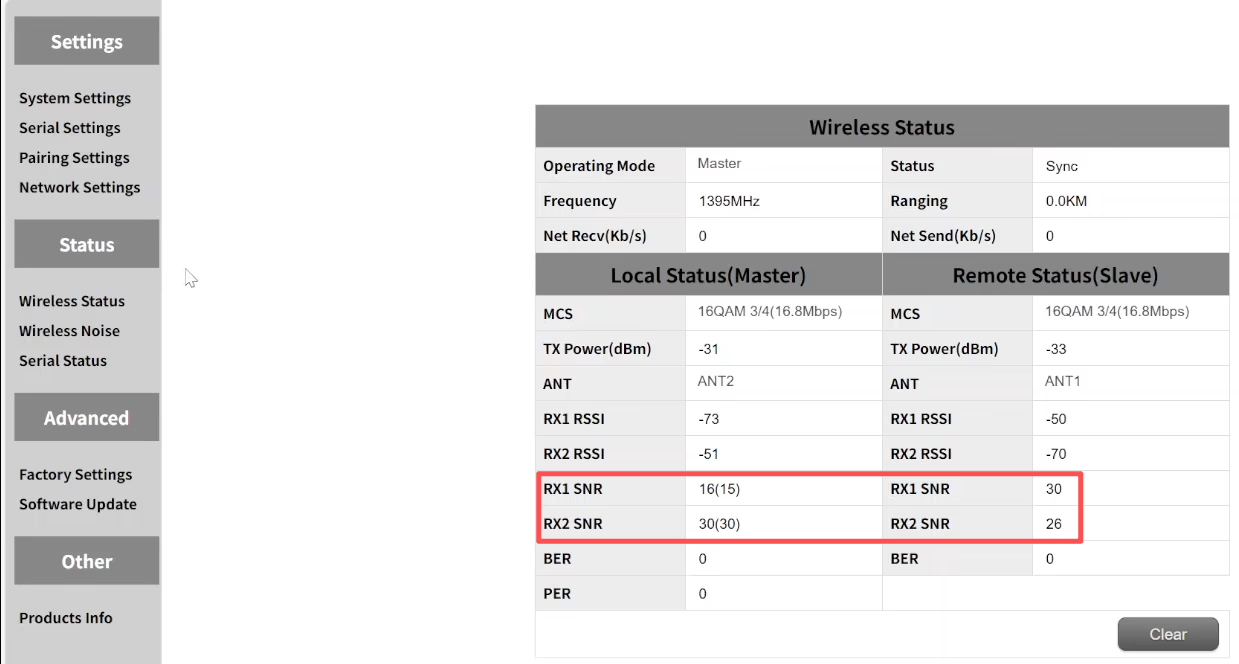
51. How far can we fly with a directional antenna before the wireless link disconnects?




iVcan.com –
I recently tested the 1.4G drone video data transmitter-relay-receiver with 2T2R and 2W PA for up to 60km, and I am very satisfied with the results. The transmission quality is excellent, providing clear and stable video feeds even at long distances. The two-way communication works flawlessly, ensuring smooth control and reliable data exchange throughout the flight. Its relay capability is especially useful for extending coverage in challenging environments. The device is easy to integrate with UAV systems and performs consistently without signal drops. Overall, this product offers professional-grade performance and significantly improves long-range drone operations.