






AI Tracking Flight Control Module for FPV Drones
AI Tracking Module Intelligent Recognition Including Flight Control Two-in-One for FPV Drones
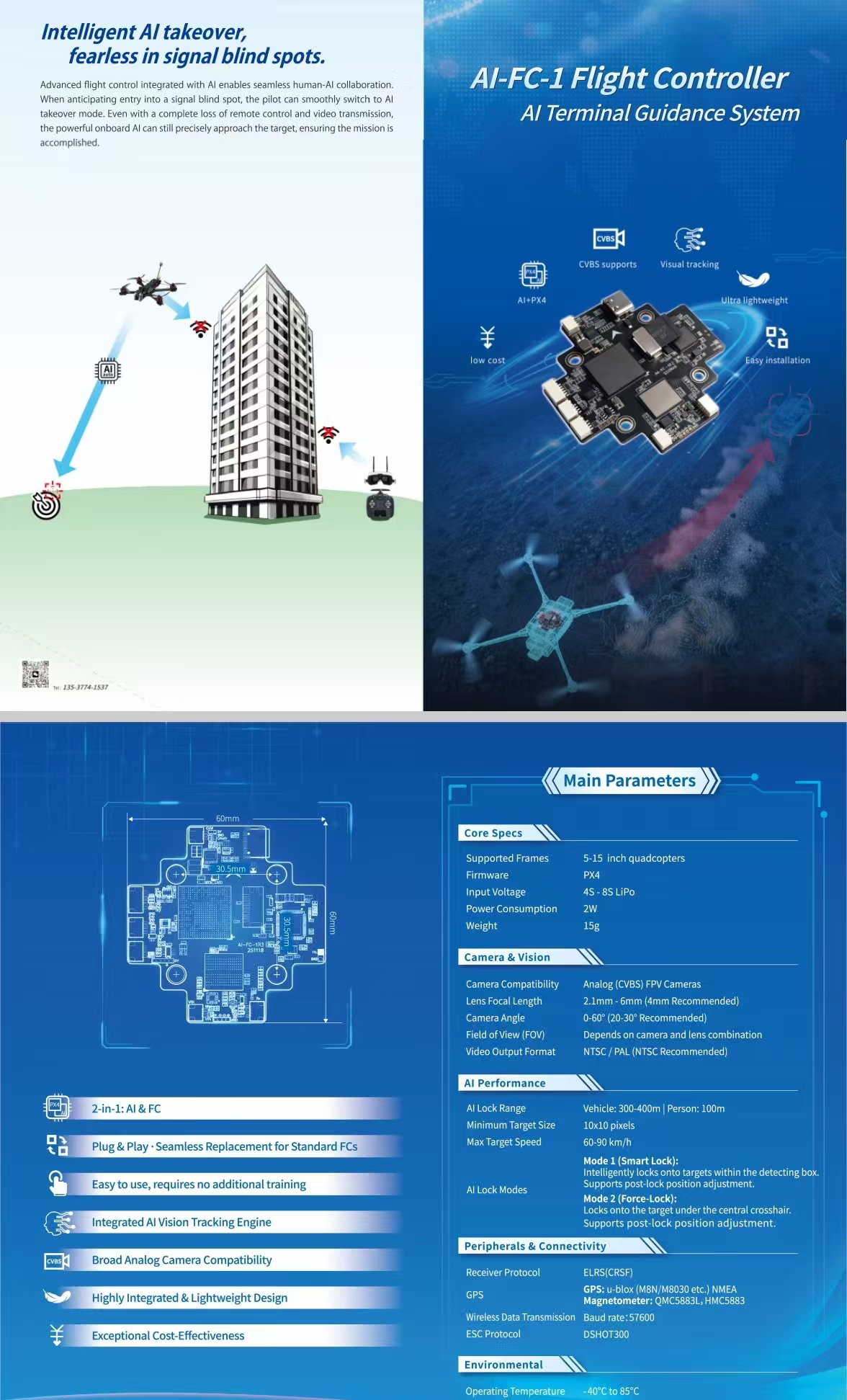
Table des matières
Aperçu
le AI Tracking Module Intelligent Recognition with Integrated Flight Control is a revolutionary two-in-one solution designed specifically for FPV drones and UAV applications that require autonomous tracking, target recognition, and intelligent control. By combining advanced artificial intelligence algorithms with a built-in PX4-based flight control system, this compact module offers users a powerful yet cost-effective upgrade from traditional flight controllers.
Unlike conventional FPV systems that require multiple components for image tracking, flight stabilization, and navigation, this all-in-one unit integrates AI image recognition, object tracking, et flight control management into a single lightweight 15-gram device. It is ideal for drone developers, intégrateurs de systèmes, and hobbyists who demand precision tracking, ultra-low latency response, et ease of installation without the need for complex setup or specialized training.
Le module prend en charge CVBS analog cameras, making it compatible with a wide range of FPV and surveillance cameras. With its built-in AI engine, it can detect, lock, and track both human and vehicle targets in real time — maintaining consistent focus even under challenging conditions such as fast movement or changing light. The intelligent tracking system automatically adjusts flight position and orientation based on the locked object, ensuring smooth pursuit.
This AI Tracking Flight Controller is engineered for drone target-following, autonomous inspection, FPV racing enhancement, et tactical applications such as reconnaissance, patrouille, and target locking. It represents a new era of compact, efficace, and intelligent UAV control systems.
Key Features
-
Two-in-One Design
-
Integrates AI object tracking and PX4 flight control system in a single compact module.
-
Replaces traditional flight controllers directly, minimizing system complexity.
-
-
Ultra-Lightweight Structure
-
Weighs only 15 grammes, reducing total drone payload and improving flight time.
-
Ideal for lightweight drones, fixed-wing UAVs, and small FPV aircraft.
-
-
Built-in PX4 Flight Control
-
Based on the open-source PX4 firmware, supporting GPS, CRSF receiver protocol, and standard telemetry.
-
Offers advanced flight stability, waypoint navigation, and return-to-home functions.
-
-
AI Object Tracking
-
Real-time recognition and locking for véhicules (300–400 m) et humans (150–200 m).
-
Intelligent algorithm supports dynamic target tracking at speeds up to 50–70 km/h.
-
Automatically corrects flight position when object moves out of center (multi-correction lock mode).
-
-
Installation simple & Opération
-
Plug-and-play replacement for ordinary flight control boards.
-
Prise en charge CVBS analog cameras et NTSC/PAL video output, compatible with most FPV setups.
-
No additional training or calibration required — ready to use out of the box.
-
-
Faible consommation d'énergie
-
Consumes only 2 watts, suitable for compact power systems using 4S–8S LiPo batteries.
-
Efficient performance ensures longer drone operation time.
-
-
Durable and Reliable
-
Operational temperature range: -25°C à +85°C, ensuring reliability in harsh environments.
-
Designed with high-performance AI chip and stable power management circuit.
-
-
Advanced AI Modes
-
Central Locking Mode: Automatically centers the locked target in the frame.
-
Lock-in with Multi-Correction: Adjusts trajectory dynamically as target moves.
-
-
Large compatibilité
-
Works with most FPV drones, fixed-wing, et plates-formes multirotors.
-
Supports external GPS module for location-based flight assistance.
-
Caractéristiques
| Paramètre | La description |
|---|---|
| Built-in Flight Control Firmware | PX4 |
| Poids | 15 g |
| AI Lock Target Range | Véhicule: 300–400 m; Humain: 150–200 m |
| Operation Voltage | 4S–8S LiPo battery |
| Consommation d'énergie | 2 W |
| Distance focale | 4 mm – 6 mm |
| Champ de vision (Champ de vision) | 66° × 40° |
| Minimum Tracking Pixel | 10 × 10 pixels |
| Dynamic Target Tracking Speed | 50–70 km/h |
| AI Operation Mode | Central locking; lock with multiple correction |
| Format de sortie vidéo | NTSC / COPAIN |
| Supported Camera Type | Caméra analogique CVBS |
| GPS Support | Oui |
| Radio Receiver Protocol | CRSF |
| Operating Temperature | -25°C ~ +85°C |
| Dimensions | Compact integrated design, lightweight PCB structure |
Précautions
un. Prend en charge les angles d'installation de la caméra de 0 à 30°, avec un angle recommandé de 10 à 15°.
b. Prend en charge le type de caméra CVBS; formats vidéo CVBS pris en charge: NTSC (fortement recommandé) et PAL.
c. Prend en charge les focales de 2.1 mm à 6 mm; 4 mm est recommandé pour une qualité d'image optimale.
d. Après avoir changé l'appareil photo ou le format vidéo, veuillez redémarrer le contrôleur de vol.
Récepteur: Prise en charge ELRS uniquement.
Transmission vidéo: Prise en charge transmission vidéo analogique uniquement.
ÉCHAP: Prise en charge protocole quadrirotor DSHOT300.
Applications
-
Drones FPV & Racing Drones
-
Enhance flight intelligence and improve object-following performance.
-
Enable drones to automatically track moving subjects during high-speed racing.
-
-
Photographie Aérienne & Videography
-
Maintain subject-centered framing automatically, even during motion.
-
Ideal for solo shooting without manual camera control.
-
-
Sécurité & Surveillance Drones
-
Used in patrolling missions, following suspicious targets or vehicles.
-
Supports continuous tracking under varied lighting and environments.
-
-
Agricultural Drones
-
Track vehicles or personnel in farmland for inspection and monitoring tasks.
-
Useful in automation for area scanning or livestock monitoring.
-
-
Industriel & Infrastructure Inspection
-
Track dynamic objects such as moving vehicles during inspection missions.
-
Helpful in maintaining focus on key targets during flight.
-
-
Chercher & Rescue Operations
-
Detect and follow humans automatically in rescue missions.
-
Significantly reduces operator workload and improves mission efficiency.
-
-
Military and Tactical Applications
-
Ideal for reconnaissance drones and intelligent tracking of moving targets.
-
Compact, léger, and suitable for embedded UAV systems.
-
Accessoires en option
-
Module GPS – For navigation, positionnement, and return-to-home support.
-
High-Resolution CVBS Camera – 4mm–6mm focal length, optimized for AI tracking.
-
Mounting Bracket Kit – For secure installation on multirotor or fixed-wing platforms.
-
Extended Cable Set – For flexible wiring in different drone layouts.
-
External Telemetry Receiver (CRSF) – To integrate with TBS Crossfire or other compatible systems.
Typical System Setup
-
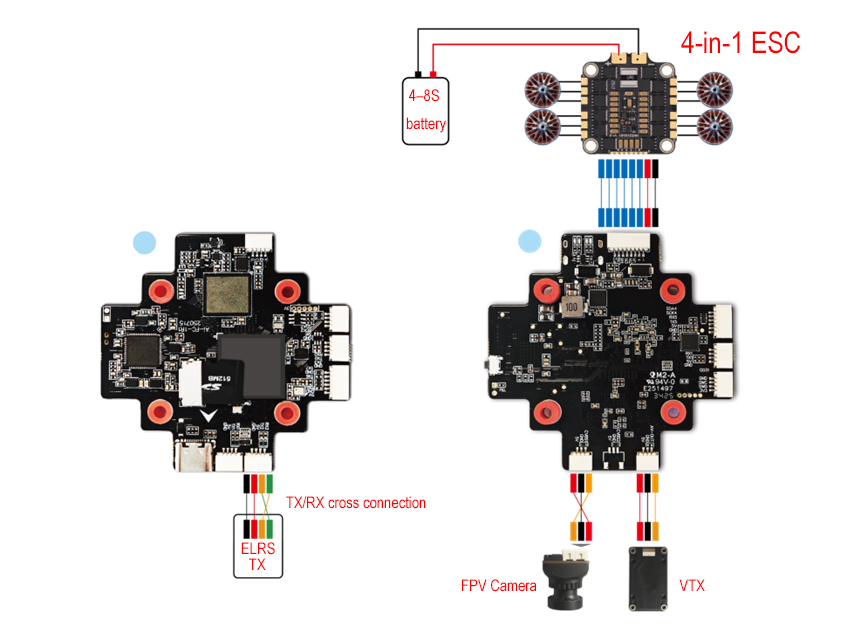
Connect CVBS Camera → Plug the analog video signal directly into the AI Tracking Module.
-
Connect Power Supply → Support 4S–8S LiPo battery (nominal 14.8V–29.6V).
-
Attach GPS (Facultatif) → For flight path correction and return-to-home.
-
Bind Receiver (CRSF) → Ensure stable communication between controller and flight system.
-
Activate AI Tracking Mode → Choose central lock or multi-correction mode.
-
Launch Drone → The module automatically locks onto the selected target and adjusts flight accordingly.
Foire aux questions (FAQ)
Q: Do you support secondary development or adding my own AI model to your boards?
UN: Désolé, our boards do not support secondary development. The firmware and system are pre-configured by the manufacturer and are not open for users to modify or install custom AI models.
If you have specific functional requirements, please let us know your application details. We can recommend the most suitable model from our existing products or check with our engineers if any customization is possible.
Q: Does the module come with an FPV camera?
UN: Non, the module does not include a camera. It supports input from an externe Caméra analogique CVBS, which must be purchased separately.
Q: Does the module come with firmware pre-installed?
UN: Oui, the module comes with PX4 flight control firmware and AI tracking firmware pre-installed. The module is essentially plug-and-play.
- Firmware updates can be performed via micro-USB or serial connection if needed.
- No separate installation is required for basic operation.
Q: Is the module plug-and-play?
UN: Oui. Once power, entrée de la caméra, and RC signals are connected according to the instructions, the module is ready to operate without additional calibration.
Q: How can I configure parameters?
UN: Users can connect the module to QGroundControl (QGC) to view or adjust PX4 parameters.Everything is preset.
Q1: Can the AI tracking work in low light or night conditions?
A1: The module relies on visual contrast and pixel-based recognition, so adequate lighting is recommended. With a low-light CVBS camera, limited night tracking is possible.
T2: Can it track multiple targets simultaneously?
A2: The current firmware supports single-target locking. Cependant, the tracking algorithm can dynamically reassign the target if multiple objects are detected in motion.
T3: Is calibration required before use?
A3: No calibration is needed. The AI module is pre-configured for plug-and-play operation. Users only need to connect power and video input.
T4: Can it work with HD or IP cameras?
A4: It supports analog CVBS video input only. For HD or IP video, an encoder or converter would be required.
Q5: How does it interface with other flight systems?
A5: The built-in PX4 flight control allows integration with standard telemetry, GPS, and CRSF receiver systems. It can also communicate via MAVLink protocol for advanced users.
Q6: What happens if the target leaves the frame?
A6: The system will perform predictive movement analysis and attempt to reacquire the target once it re-enters the camera’s field of view.
Q7: Is firmware upgradable?
A7: Oui, the PX4 flight firmware and AI module firmware can be updated via a micro-USB interface or serial port.
Q8: What is the difference between this module and a regular flight controller?
A8: Regular flight controllers only manage drone stability and navigation, while this module combines those features with real-time AI vision tracking — offering both control and intelligent target pursuit.
Q9: How does it handle fast-moving targets?
A9: The AI algorithm supports motion prediction up to 70 km/h. It continuously adjusts gimbal angles and drone attitude to maintain stable tracking.
Q10: Is it suitable for professional or industrial use?
A10: Absolument. The module is designed for both consumer FPV drones and professional UAV systems used in surveillance, inspection, et opérations tactiques.
Conclusion
le AI Tracking Module Intelligent Recognition Including Flight Control Two-in-One is a next-generation innovation in the field of unmanned aerial vehicles. Combining AI-based target recognition, suivi autonome, et PX4 flight control within a single ultra-light unit, it dramatically simplifies UAV design while enhancing capability.
From drone racing enthusiasts to professional UAV integrators, this compact module provides a cost-effective, intelligent, et fiable solution for autonomous flight and real-time visual tracking. Its plug-and-play design, broad compatibility, and robust AI performance make it an essential upgrade for any FPV or smart drone platform.
Que ce soit pour Drones FPV, patrouilles de sécurité, ou industrial applications, this module represents a new benchmark in AI-driven drone intelligence — transforming ordinary flight into intelligent pursuit.
Configuration de la station de contrôle au sol pour la carte contrôleur de vol AI
-
Installer QGroundControl (QGC) sur votre ordinateur. Téléchargez-le depuis https://qgroundcontrol.com/.
-
Après avoir installé QGC, connectez la carte du contrôleur de vol à l'ordinateur via le Port TYPE-C en utilisant un câble USB.
Lancez le logiciel QGC et attendez que la barre de progression termine le chargement (environ 20 secondes). - Cliquez sur le Logo « QGC » dans le coin supérieur gauche pour saisir le menu de configuration.
- Cliquez sur la configuration du véhicule
- Accédez au menu de configuration du véhicule
- Sélectionnez le « Capteurs » menu de configuration, et calibrer le gyroscope, accéléromètre, et nivellement de l'horizon respectivement. Pour des instructions détaillées, veuillez vous référer à « Vidéo de référence 1 ».
-
Étalonnage de la télécommande
Cliquez pour entrer le Télécommande menu de configuration. Avec la télécommande allumée, connectez le contrôleur de vol au récepteur (récepteur connecté au port RX2), puis effectuez l'étalonnage de la télécommande. Pour des instructions détaillées, veuillez vous référer à « Vidéo de référence 2 ». -
Configurer les modes de vol, Interrupteur de bras, et interrupteur d'arrêt d'urgence
-
Définir le canal de commutation du mode de vol (par défaut, Stabilisé le mode est sélectionné; Acro/Manuel le mode est également disponible)
Note:-
Dans Stabilisé mode, les moteurs commencent à tourner après l'armement, et l'avion décolle lorsque l'accélérateur est appliqué.
-
Dans Acro mode, les moteurs ne tournent pas après l'armement; l'avion décolle immédiatement lorsque la manette des gaz est appliquée.
-
-
Réglez le bras (ouvrir) changer de canal
-
Définir la mise à mort d'urgence (arrêt du moteur) changer de canal
-
- Configuration de la batterie (Note: Une configuration incorrecte peut empêcher l'avion de décoller)
-
Configuration du moteur
Connectez la batterie et calibrez le séquence des quatre moteurs.
Note: Retirez les hélices pendant ce processus pour éviter les blessures.
Configuration et utilisation de la fonction de suivi AI
Configurer le commutateur AI sur la télécommande
-
Attribuer deux canaux d'interrupteur à bascule (10 et 11) sur la télécommande comme commutateurs de commande AI.
le Contrôleur de vol AI-FC-1 prend en charge deux modes de verrouillage:-
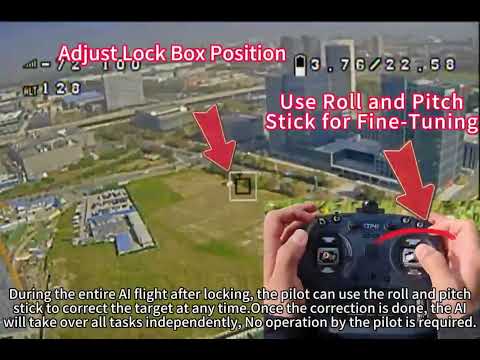
Canal 10: Verrouillage ou déverrouillage intelligent avec le cadre de délimitation AI, prend en charge le réglage fin de la position du cadre de délimitation après le verrouillage.
-
Canal 11: Verrouillage ou déverrouillage forcé avec le réticule dans le cadre de délimitation, prend en charge le réglage fin de la position du cadre de délimitation après le verrouillage.
-
-
Pendant le vol du drone FPV, alignez simplement le cadre de délimitation du flux vidéo avec la cible, puis basculez sur l'un ou l'autre canal 10 ou 11 selon votre préférence.
-
Cela se verrouillera sur la cible et s'en approchera automatiquement.
-
Même si le signal est perdu, le contrôleur de vol AI poursuivra les actions suivantes.
-
-
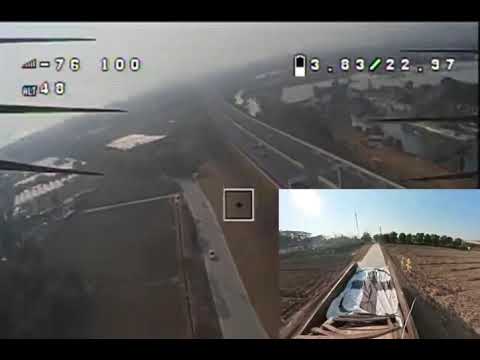
Après le verrouillage de l'IA, le cadre de délimitation peut être affiné à l'aide de l'outil bâtons de roulis/tangage. Pour des instructions détaillées, voir « Vidéo de référence 3 ».
-
Après le déverrouillage, le drone reviendra en mode vol avant le verrouillage.
Conseils:
-
Changer de mode de vol pendant le suivi du verrouillage AI fera également sortir le verrouillage.
-
En utilisant le Interrupteur d'arrêt d'urgence lorsqu'il est verrouillé, il forcera les moteurs à s'arrêter.
Solution pour QGC ne se connectant pas au contrôleur de vol
-
Installez la dernière version de QGroundControl (QGC). Téléchargez-le depuis https://qgroundcontrol.com.
-
Supprimez les dossiers de cache QGC situés dans:
-
C:\Users\%USERPROFILE%\AppData\Local\QG*** -
C:\Users\%USERPROFILE%\AppData\Local\cache\QG***
-
-
Redémarrez le logiciel QGC.
Why recommend this product
Unlock next‑level aerial intelligence with the AI Tracking Flight Control Module for FPV drones — a cutting‑edge AI flight controller that combines autonomous tracking, smart vision targeting for FPV drones, et AI object detection module for FPV drones capabilities into one ultra‑lightweight package. Designed as an AI targeting upgrade kit for FPV drones, this all‑in‑one module integrates advanced artificial intelligence algorithms with a PX4‑based flight control system to deliver real‑time FPV drone tracking and responsive target lock behavior without needing separate components.
Weighing just 15 g and engineered for seamless integration with analog CVBS cameras, ce FPV AI module empowers pilots and developers to add autonomous subject following and intelligent pursuit to any compatible quadcopter or fixed‑wing UAV. With its built‑in AI engine, the system recognizes, locks, and follows both human and vehicle targets in dynamic environments, making it ideal as an AI‑assisted targeting module for FPV racing drones, aerial cinematography rigs, autonomous inspection drones, or security UAVs.
With simple plug‑and‑play installation, support for GPS/CRSF telemetry, and ultra‑low latency response, ce FPV AI tracking module elevates your drone with FPV drone with autonomous tracking and targeting performance — all in a compact, cost‑effective upgrade that replaces traditional flight controllers while boosting flight intelligence and mission versatility.
abc
Articles connexes
Tutorial Video





iVcan.com –
I’ve been using the AI Tracking Module with integrated PX4 flight control for a few weeks, and it has completely transformed my FPV drone experience. The installation was super easy — just plug it in and it worked immediately. The AI tracking is impressively accurate, locking onto vehicles and people smoothly even when moving fast. I’m especially impressed by how lightweight it is and how stable the flight feels during tracking. It’s a perfect blend of smart recognition and flight control, making my drone feel truly autonomous. Fortement recommandé!