浅谈COFDM PA功率放大器
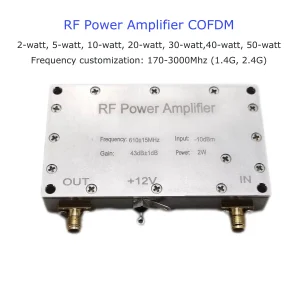
COFDM PA 功率放大器
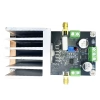
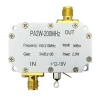
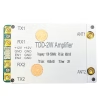
作为无线视频和数据收发器的专业供应商, 很多客户会询问功率放大器,以增加无线发射器的覆盖范围,增强无线信号强度. 功放可以说是很多射频工程师无法回避的一道坎. 功能, 分类, 性能索引, 电路组成, 效率提升技术, 发展趋势... 关于射频功率放大器你需要知道的一切你都知道吗? 来补课吧!
RF PA 的两个关键规格: 功率和线性度
在射频功率放大器中, 功率效率 (佩) 定义为输出信号功率与输入信号功率之差与直流电源功耗的比值, 即:
PAE= (脉冲输出 - 普芬)/PDC= (脉冲输出 - 普芬)/(VDC*IDC)
射频功率放大器RF PA的功能
射频功率放大器RF PA是传输系统的主要部分, 其重要性不言而喻. 在发射机的前级电路中, 调制振荡电路产生的射频信号功率很小, 需要经过一系列的放大缓冲阶段, 中间放大阶段, 最后的功率放大级,在将辐射馈送到天线之前获得足够的射频功率. 为了获得足够大的射频输出功率, 必须使用射频功率放大器. 功率放大器通常是最昂贵的, 最耗电的, 以及固定装置或终端效率最低的组件.
调制器产生射频信号后, 射频调制信号被 RFPA 放大到足够的功率, 通过匹配网络, 然后由天线发射.
放大器的作用是将输入内容放大并输出. 输入和输出, 我们称之为 "信号," 通常表示为电压或功率. 为一个 "系统" 例如放大器, 它是 "贡献" 是为了提高某个水平 "吸收" 和 "产量" 对外界. 这个 "改进贡献" 是个 "意义" 放大器的存在. 如果功放能有好的性能, 那么它可以贡献更多, 反映了它自己的 "价值". 如果初期出现一些问题 "机构设计" 放大器的, 然后开始工作或工作一段时间后, 不仅无法提供任何 "贡献", 但有些出乎意料 "冲击" 可能会发生. "震惊" 对外界或放大器本身来说都是灾难性的.
射频功率放大器RF PA的分类
根据不同的工况条件, 功率放大器分类如下:
射频功率放大器的工作频率非常高, 但频段比较窄. 射频功率放大器一般采用选频网络作为负载电路. 射频功率放大器可分为三种工作状态: 一个 (一个), 乙 (乙), 和C (C) 根据电流导通角. A类放大器电流的导通角为360°, 适用于小信号低功率放大. B类放大器电流的导通角等于180°, C类放大器电流的导通角小于180°. B级和C级均适用于大功率工作条件, C类工况的输出功率和效率是三种工况中最高的. 大多数射频功率放大器工作在 C 类, 但C类放大器的电流波形失真太大, 因此它们只能通过使用调谐电路作为负载谐振来放大功率. 由于调谐环路的滤波能力, 环路电流和电压仍然接近正弦波形,失真很小.
除上述按电流导通角分类的工作状态外, 还有D类 (ð) 放大器和 E 类 (Ë) 使电子设备工作在开关状态的放大器. D类放大器的效率高于C类放大器.
射频功率放大器RF PA性能指标
射频功率放大器RF PA的主要技术指标是输出功率和效率. 如何提高输出功率和效率是射频功放设计目标的核心. 通常在射频功率放大器中, LC谐振电路可以选择基频或某个谐波,实现不失真放大. 一般来说, 评价放大器大概有以下几个指标:
- 获得. 这是输入和输出之间的比率,代表放大器的贡献. 一个好的放大器就是贡献尽可能多的 "产量" 尽可能在其范围内 "自身能力范围".
-工作频率. 这代表了放大器对于不同频率信号的承载能力.
- 工作带宽. 这决定了放大器的范围 "贡献". 对于窄带放大器, 即使自己的设计没有问题, 它的贡献可能是有限的.
-稳定. 每个晶体管都有潜力 "不稳定地区。" 该 "设计" 放大器需要消除这些潜在的不稳定性. 放大器稳定性有两种类型, 潜在不稳定和绝对稳定. 前者在某些条件和环境下可能会显得不稳定, 而后者在任何情况下都能保证稳定性. 稳定性问题很重要,因为不稳定意味着 "振荡", 当放大器不仅影响其自身时, 但也输出不稳定因素.
- 最大输出功率. 该指标决定了 "容量" 放大器的. 对于 "大系统", it is hoped that they can output more power at the expense of certain gain.
-效率. Amplifiers must consume a certain amount of "energy" and also achieve a certain amount of "贡献". The ratio of its contribution to consumption is the efficiency of the amplifier. A good amplifier is one that contributes more and consumes less.
- 线性. Linearity characterizes the correct response of the amplifier to a large number of inputs. A deterioration in linearity means that the amplifier "distorts" 要么 "distorts" the input in the presence of excess input. A good amplifier should not exhibit this "freaky" nature.
Circuit Composition of RF Power Amplifier RF PA
There are different types of amplifiers. 简, the circuit of the amplifier can be composed of the following parts: transistors, bias and stabilization circuits, and input and output matching circuits.
1. Transistor
There are many kinds of transistors, including transistors with various structures that have been invented. 本质上, a transistor works as a controlled current or voltage source by converting the energy of an empty direct current into a "useful" 产量. DC energy is obtained from the outside world, and the transistor consumes it and converts it into useful components. A transistor, we can regard it as "a unit". Different "capabilities" of different transistors, such as their ability to withstand power are different, which is also due to their ability to obtain DC energy; 例如, their response speed is different, which determines how wide and high it can work In the frequency band; 例如, the impedances facing the input and output ports are different, and the external response capabilities are different, which determines the difficulty of matching it.
2. Bias and stabilization circuit
Biasing and stabilization circuits are two different circuits, but because they are often difficult to distinguish and the design goals converge, they can be discussed together.
The operation of the transistor needs to be under certain bias conditions, which we call the static operating point. This is the foundation of the transistor and its own "定位". Each transistor has a certain positioning for itself, and different positioning will determine its own working mode, and there are also different performances in different positioning. Some positioning points have small fluctuations, which are suitable for small signal work; some positioning points have large fluctuations, which are suitable for high-power output; some positioning points have less demand, pure release, and are suitable for low-noise work; some positioning points, Transistors are always hovering between saturation and cutoff, in a switching state. An appropriate bias point is the basis for normal operation.
The stabilization circuit must be before the matching circuit, because the transistor needs the stabilization circuit as part of itself, and then contacts the outside world. In the eyes of the outside world, the transistor with the stabilization circuit is a "全新" transistor. It makes certain "sacrifices" to gain stability. Mechanisms that stabilize the circuit keep the transistors running smoothly and steadily.
3. Input and output matching circuit
The purpose of the matching circuit is to select an accepted mode. For those transistors that want to provide more gain, the approach is to accept and output across the board. This means that through the interface of the matching circuit, the communication between different transistors is smoother. For different types of amplifiers, the matching circuit is not the only design method that is "accepted in its entirety". Some small tubes with small DC and shallow foundation are more willing to do a certain amount of blocking when receiving to obtain better noise performance. 然而, the blocking cannot be overdone, otherwise it will affect its contribution. For some giant power tubes, you need to be cautious when outputting, because they are more unstable, 同时, a certain amount of reservation helps them to exert more "undistorted" energy.
Realization of Stability of RF Power Amplifier RF PA
Every transistor is potentially unstable. Good stabilizing circuits can be fused with transistors to form a "continuous work" 模式. The implementation of stabilization circuits can be divided into two types: narrow-band and wide-band.
The narrowband stabilization circuit consumes a certain amount of gain. This stable circuit is realized by adding certain consumption circuits and selective circuits. This circuit allows the transistor to contribute only a small frequency range. Another broadband stabilization is the introduction of negative feedback. This circuit can work over a wide range.
The source of instability is positive feedback, and the idea of narrow-band stability is to curb some of the positive feedback. 当然, this also suppresses the contribution. Negative feedback, done well, has many additional gratifying advantages. 例如, negative feedback may prevent transistors from being matched, neither needing to be matched to interface well with the outside world. 此外, the introduction of negative feedback will improve the linear performance of the transistor.
Efficiency Improvement Technology of RF Power Amplifier RF PA
Transistor efficiency has a theoretical limit. This limit varies with the selection of the bias point (static operating point). 此外, if the peripheral circuit is not well designed, its efficiency will be greatly reduced. 现在, there are not many ways for engineers to improve efficiency. There are only two kinds here: envelope tracking technology and Doherty technology.
The essence of envelope tracking technology is to separate the input into two types: phase and envelope, and then amplify them separately by different amplifier circuits. 这样, the two amplifiers can focus on their respective parts, and the cooperation of the two amplifiers can achieve the goal of higher efficiency utilization.
The essence of Doherty technology is: using two transistors of the same type, only one works when the input is small, and works in a high-efficiency state. If the input increases, both transistors work simultaneously. The basis for the realization of this method is that the two transistors should cooperate with each other tacitly. The working state of one transistor will directly determine the working efficiency of the other.
Testing Challenges for RF PAs
Power amplifiers are very important components in wireless communication systems, but they are inherently non-linear, causing spectral growth phenomena that interfere with adjacent channels, and may violate statutory-mandated out-of-band emission standards. This characteristic can even cause in-band distortion, which increases the bit error rate (BER) and reduces the data transmission rate of the communication system.
Under the peak-to-average power ratio (辣椒), the new OFDM transmission format will have more sporadic peak power, making the PA difficult to be segmented. This degrades spectral mask compliance and increases EVM and BER across the waveform. To solve this problem, design engineers usually deliberately reduce the operating power of the PA. Unfortunately, this is a very inefficient approach, since the PA reduces 10% of its operating power and loses 90% of its DC power.
Most of today's RF PAs support multiple modes, 频率范围, and modulation modes, making more test items available. Thousands of test items are not uncommon. The use of new technologies such as crest factor reduction (CFR), digital predistortion (DPD) and envelope tracking (ET) can help optimize PA performance and power efficiency, but these technologies will only make the test more complicated and greatly prolong the test time. Design and test time. Increasing the bandwidth of the RF PA will result in a five-fold increase in the bandwidth required for DPD measurements (possibly exceeding 1 千兆赫), further increasing test complexity.
According to the trend, in order to increase efficiency, RF PA components and front-end modules (FEM) will be more closely integrated, and a single FEM will support a wider range of frequency bands and modulation modes. Integrating an ET power supply or modulator into the FEM can effectively reduce the overall space requirements inside the mobile device. Increasing the number of filter/duplexer slots to support a larger operating frequency range will increase the complexity of mobile devices and the number of test items.
Mobile Phone RF Module Power Amplifier (PA) Market Situation
The field of mobile phone power amplifiers is currently a component that cannot be integrated in mobile phones. Mobile phone performance, footprint, call quality, mobile phone strength, and battery life are all determined by the power amplifier.
How to integrate these power amplifiers of different frequency bands and standards is an important subject that the industry has been studying. 目前, there are two solutions: one is the fusion architecture, which integrates RF power amplifiers PA of different frequencies; the other architecture is the integration along the signal chain, 那是, the PA and the duplexer are integrated. Both schemes have advantages and disadvantages, and are suitable for different mobile phones. Converged architecture, high integration of PA, has obvious size advantage for more than 3 频带, and obvious cost advantage for 5-7 频带. The disadvantage is that although the PA is integrated, the duplexer is still quite complicated, and there is switching loss when the PA is integrated, and the performance will be affected. For the latter architecture, the performance is better. The integration of the power amplifier and the duplexer can improve the current characteristics, which can save tens of milliamperes of current, which is equivalent to extending the talk time by 15%. 因此, industry insiders suggest that when there are more than 6 频带 (excluding 2G, referring to 3G and 4G), a converged architecture is adopted, and when less than 4 frequency bands are used, PAD, a solution integrating PA and duplexer, is used.