





When customers search for NLOS wireless video transmission, one of the most common requirements we hear is:
“We need wireless Full HD video, 非视距, distance 1–5 km.”
This request is very common in applications such as 无人机视频下行, 机器人技术, 公安, 军队, 和工业监控. 然而, unlike line-of-sight (视距) 传播, NLOS wireless video performance cannot be defined by distance alone.
To accurately evaluate feasibility and recommend the right solution, the following key information is essential.
1. Transmission Scenario: Air-to-Ground or Ground-to-Ground
The first question for any NLOS wireless video system is the physical deployment.
目录
Air-to-Ground Wireless Video Transmission
典型应用:
- 无人机 / 无人机视频下行
- Aerial surveillance
- Emergency response
特征:
- Fewer obstacles
- Partial line-of-sight often exists at altitude
- Longer transmission distance is usually achievable
Ground-to-Ground Wireless Video Transmission
典型应用:
- Vehicle-to-vehicle
- Robot to control center
- Fixed installations
特征:
- More obstructions at the same height
- Stronger signal attenuation and multipath effects
- NLOS distance is usually more limited
Even with the same equipment, these two scenarios can produce very different results.
2. What Does “NLOS” Mean in the Real Environment?
“NLOS” (非视距) is a general term. 在实践中, the type of obstruction matters more than the label.
Important questions include:
- What blocks the signal?
- Concrete or brick walls?
- Multiple buildings?
- Trees or dense vegetation?
- Terrain such as hills or slopes?
- Is the environment:
- 户外的?
- 室内的?
- Indoor-to-outdoor?
- Inside a vehicle or closed room?
例如:
- Penetrating one wall is completely different from penetrating multiple reinforced concrete buildings.
- Transmitting from inside a closed room has much higher signal loss than outdoor NLOS transmission.
这就是为什么 NLOS wireless transmission distance varies greatly between projects.
3. 视频分辨率, 比特率, and Latency Requirements
Another critical factor is the video performance requirement:
- 全高清 (1080p) 与. 较低的分辨率
- Ultra-low latency vs. standard latency
- Real-time control vs. monitoring only
Higher resolution and lower latency require more bandwidth, which directly impacts achievable NLOS range.
在很多情况下, optimizing bitrate and latency settings can significantly improve system stability.
4. Why “1–5 km NLOS” Is Not a Fixed Specification
Many customers search for:
- “1 km NLOS wireless video”
- “5 km NLOS video transmitter”
- “long range non line of sight wireless video”
In real-world deployments:
- 1 公里非视距 can already be challenging in dense urban or indoor environments
- Multi-kilometer NLOS transmission usually requires:
- Lower operating frequencies
- Higher RF output power
- Proper antenna selection and placement
- Favorable terrain conditions
This is why distance alone is not a reliable specification without context.
5. Why We Ask for Detailed Application Information
Wireless signal penetration and diffraction depend on:
- 频带
- Modulation and coding
- 发射功率
- Antenna height and gain
- 环境条件
Without understanding the actual usage scenario, any range estimate would be theoretical and potentially misleading.
Providing detailed information allows us to:
- Select the most suitable frequency band
- Design a realistic and stable system
- Avoid overpromising and underperforming
- Improve project success rate
结论: The Environment Defines NLOS Performance
When planning an NLOS wireless Full HD video transmission system, the most important factor is not just distance—but where and how the system is used.
If you are evaluating an NLOS wireless video solution, please be prepared to describe:
- Deployment scenario (air-to-ground or ground-to-ground)
- Obstacle types and environment
- Video quality and latency requirements
- Target distance under real conditions
有了这些信息, a reliable and practical solution can be designed.
LOS vs NLOS Wireless Video Transmission: 主要差异, 挑战, and Real-World Performance
当选择一个 无线视频传输系统, one of the most important concepts to understand is the difference between 视距 (视线) 和 NLOS (非视距) 传播.
Many customers use these terms interchangeably, but in real-world wireless systems—especially for Full HD or low-latency video—the performance difference between LOS and NLOS can be significant.
This article explains what LOS and NLOS mean, how they affect wireless video performance, and why NLOS transmission requires more careful system design.
LOS test Video

NLOS test Video

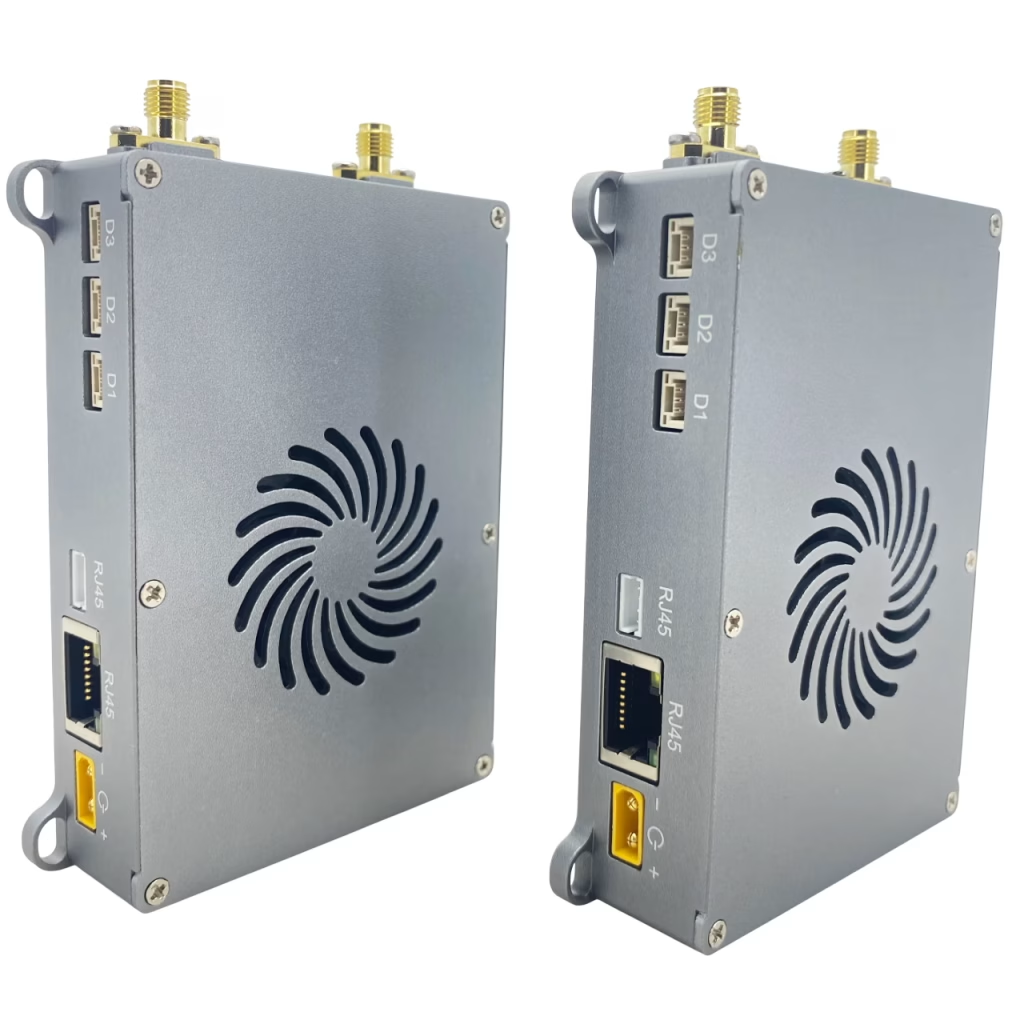
The product in the test video is here. TX900
1. What Is LOS (视线) 无线传输?
视距 (视线) means there is a clear, unobstructed path between the transmitter and the receiver.
Typical LOS Scenarios
- Drone or UAV transmitting video to a ground station
- Point-to-point wireless links with elevated antennas
- Open fields, 农村地区, or sea environments
Characteristics of LOS Transmission
- Minimal signal attenuation
- Stable link quality
- Longer achievable distance
- Higher data rates possible
- Lower latency and packet loss
In LOS conditions, wireless video systems can often achieve their maximum specified range.
2. What Is NLOS (非视距) 无线传输?
NLOS (非视距) means the direct path between transmitter and receiver is blocked by obstacles.
Common NLOS Scenarios
- Urban environments with buildings
- Indoor transmission between rooms or floors
- Ground-level transmission with vehicles or terrain blocking the path
- Indoor-to-outdoor or vehicle-to-control-room links
Characteristics of NLOS Transmission
- Signal attenuation due to obstruction
- 反射, 衍射, and multipath interference
- Reduced effective range
- Higher sensitivity to environment changes
Unlike LOS, NLOS transmission performance varies greatly depending on the surroundings.
3. LOS vs NLOS: Key Technical Differences
| 方面 | 视距 | NLOS |
|---|---|---|
| Signal Path | 直接的, unobstructed | Blocked or indirect |
| Transmission Distance | 更长 | 较短 (environment-dependent) |
| 链路稳定性 | 高的 | Variable |
| 视频比特率 | 更高 | Often limited |
| 延迟 | 降低 | May increase |
| Predictability | 高的 | 低的 |
这就是为什么 LOS distance specifications cannot be directly applied to NLOS scenarios.
4. Why NLOS Wireless Video Is More Challenging
In NLOS conditions, wireless signals rely on:
- Diffraction (bending around obstacles)
- 反射 (from walls, 地面, 建筑物)
- Scattering (from trees, rough surfaces)
Each obstacle introduces signal loss. 例如:
- One concrete wall may cause moderate attenuation
- Multiple reinforced concrete buildings can cause severe signal loss
- Indoor NLOS typically performs worse than outdoor NLOS
因此, two NLOS applications with the same distance may have completely different outcomes.
5. Frequency Matters More in NLOS Transmission
Frequency selection plays a critical role:
- Lower frequencies
- Better penetration and diffraction
- Longer NLOS range
- Lower available bandwidth
- Higher frequencies
- Higher data rates
- Poor penetration
- Shorter NLOS range
This trade-off is why NLOS wireless video systems often operate at lower frequency bands, especially for ground-to-ground applications.
6. 典型应用: LOS vs NLOS
LOS-Dominant Applications
- 无人机视频下行
- Long-range surveillance
- Temporary event broadcasting
NLOS-Dominant Applications
- Robotics and UGVs
- Public safety and emergency response
- Tactical or military operations
- Industrial inspection and monitoring
Each application requires a different balance between 范围, 延迟, 视频质量, and robustness.
7. Why NLOS Distance Cannot Be Guaranteed
Customers often ask:
- “Can you guarantee 5 公里非视距?”
- “What is the maximum NLOS distance?”
在实践中, NLOS distance cannot be guaranteed without knowing the environment.
Factors that directly affect NLOS performance include:
- Obstacle type and density
- Antenna height and placement
- Transmit power and frequency
- Video bitrate and latency settings
This is why professional wireless system design always starts with scenario analysis, not distance alone.
结论: LOS Is Predictable, NLOS Is Scenario-Driven
In wireless video transmission:
- LOS performance is predictable and repeatable
- NLOS performance is highly scenario-dependent
Understanding the difference between LOS and NLOS helps set realistic expectations and leads to better system design decisions.
If your application involves non-line-of-sight wireless video, providing detailed environmental information is essential for selecting a reliable solution.
问一个问题
感谢您的回复。 ✨