





When customers search for NLOS wireless video transmission, one of the most common requirements we hear is:
“We need wireless Full HD video, non-line-of-sight, distance 1–5 km.”
This request is very common in applications such as Downlinks de vídeo UAV, robótica, segurança pública, militares, e monitoramento industrial. However, unlike line-of-sight (LOS) transmissão, NLOS wireless video performance cannot be defined by distance alone.
To accurately evaluate feasibility and recommend the right solution, the following key information is essential.
1. Transmission Scenario: Air-to-Ground or Ground-to-Ground
The first question for any NLOS wireless video system is the physical deployment.
Índice
Air-to-Ground Wireless Video Transmission
Aplicações típicas:
- Drone / UAV video downlink
- Aerial surveillance
- Emergency response
Características:
- Fewer obstacles
- Partial line-of-sight often exists at altitude
- Longer transmission distance is usually achievable
Ground-to-Ground Wireless Video Transmission
Aplicações típicas:
- Vehicle-to-vehicle
- Robot to control center
- Fixed installations
Características:
- More obstructions at the same height
- Stronger signal attenuation and multipath effects
- NLOS distance is usually more limited
Even with the same equipment, these two scenarios can produce very different results.
2. What Does “NLOS” Mean in the Real Environment?
“NLOS” (Sem linha de visão) is a general term. Na prática, the type of obstruction matters more than the label.
Important questions include:
- What blocks the signal?
- Concrete or brick walls?
- Multiple buildings?
- Trees or dense vegetation?
- Terrain such as hills or slopes?
- Is the environment:
- Ar livre?
- Interior?
- Indoor-to-outdoor?
- Inside a vehicle or closed room?
Por exemplo:
- Penetrating one wall is completely different from penetrating multiple reinforced concrete buildings.
- Transmitting from inside a closed room has much higher signal loss than outdoor NLOS transmission.
É por isso NLOS wireless transmission distance varies greatly between projects.
3. Resolução de vídeo, Taxa de bits, and Latency Requirements
Another critical factor is the video performance requirement:
- Full HD (1080p) contra. lower resolution
- Ultra-low latency vs. standard latency
- Real-time control vs. monitoring only
Higher resolution and lower latency require more bandwidth, which directly impacts achievable NLOS range.
Em muitos casos, optimizing bitrate and latency settings can significantly improve system stability.
4. Why “1–5 km NLOS” Is Not a Fixed Specification
Many customers search for:
- “1 km NLOS wireless video”
- “5 km NLOS video transmitter”
- “long range non line of sight wireless video”
In real-world deployments:
- 1 km NLOS can already be challenging in dense urban or indoor environments
- Multi-kilometer NLOS transmission usually requires:
- Lower operating frequencies
- Higher RF output power
- Proper antenna selection and placement
- Favorable terrain conditions
This is why distance alone is not a reliable specification without context.
5. Why We Ask for Detailed Application Information
Wireless signal penetration and diffraction depend on:
- Banda de frequência
- Modulation and coding
- Potência de transmissão
- Antenna height and gain
- Condições ambientais
Without understanding the actual usage scenario, any range estimate would be theoretical and potentially misleading.
Providing detailed information allows us to:
- Select the most suitable frequency band
- Design a realistic and stable system
- Avoid overpromising and underperforming
- Improve project success rate
Conclusão: The Environment Defines NLOS Performance
When planning an NLOS wireless Full HD video transmission system, the most important factor is not just distance—but where and how the system is used.
If you are evaluating an NLOS wireless video solution, please be prepared to describe:
- Deployment scenario (air-to-ground or ground-to-ground)
- Obstacle types and environment
- Video quality and latency requirements
- Target distance under real conditions
With this information, a reliable and practical solution can be designed.
LOS vs NLOS Wireless Video Transmission: Principais diferenças, Desafios, and Real-World Performance
When selecting a sistema de transmissão de vídeo sem fio, one of the most important concepts to understand is the difference between LOS (Linha de visão) e NLOS (Sem linha de visão) transmissão.
Many customers use these terms interchangeably, but in real-world wireless systems—especially for Full HD or low-latency video—the performance difference between LOS and NLOS can be significant.
This article explains what LOS and NLOS mean, how they affect wireless video performance, and why NLOS transmission requires more careful system design.
LOS test Video

NLOS test Video

The product in the test video is here. TX900
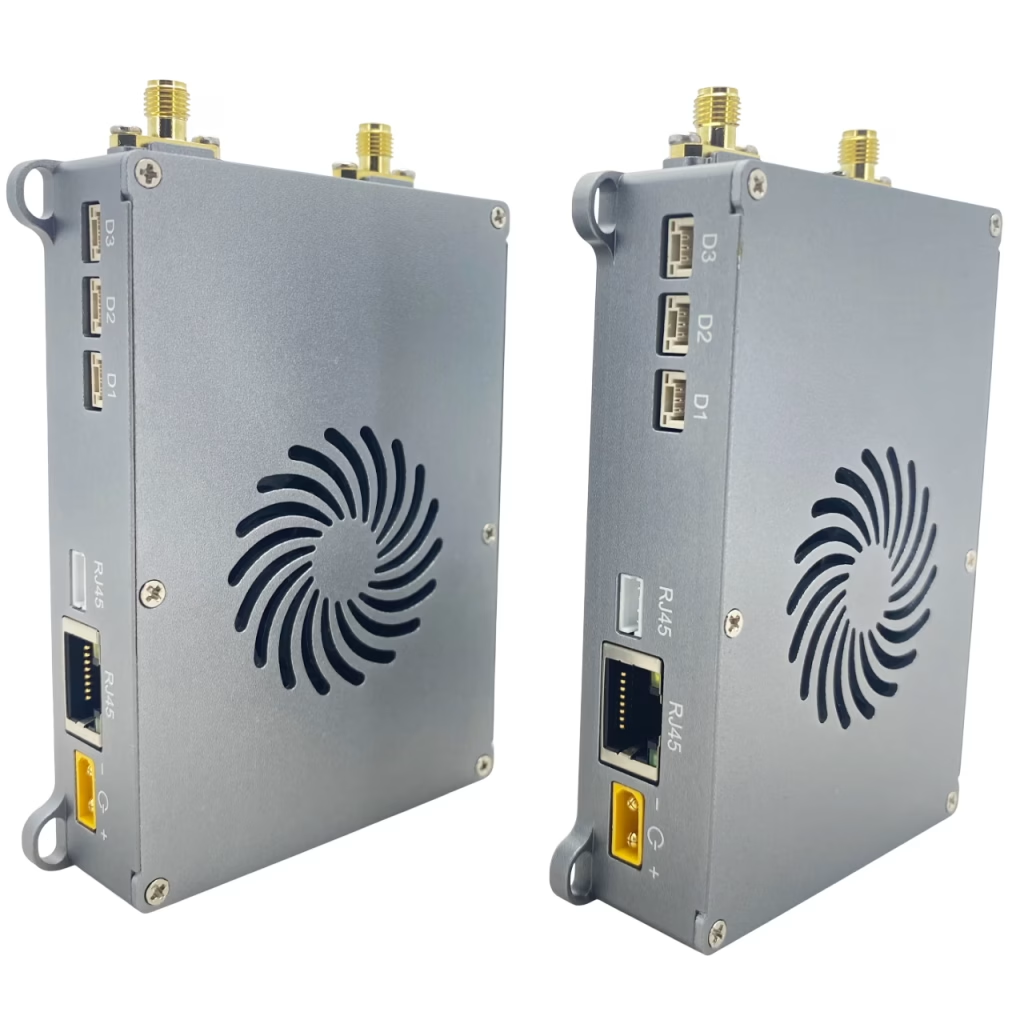
1. What Is LOS (Linha de visão) Transmissão sem fio?
LOS (Linha de visão) means there is a clear, unobstructed path between the transmitter and the receiver.
Typical LOS Scenarios
- Drone or UAV transmitting video to a ground station
- Point-to-point wireless links with elevated antennas
- Open fields, áreas rurais, or sea environments
Characteristics of LOS Transmission
- Minimal signal attenuation
- Stable link quality
- Longer achievable distance
- Higher data rates possible
- Lower latency and packet loss
In LOS conditions, wireless video systems can often achieve their maximum specified range.
2. What Is NLOS (Sem linha de visão) Transmissão sem fio?
NLOS (Sem linha de visão) means the direct path between transmitter and receiver is blocked by obstacles.
Common NLOS Scenarios
- Urban environments with buildings
- Indoor transmission between rooms or floors
- Ground-level transmission with vehicles or terrain blocking the path
- Indoor-to-outdoor or vehicle-to-control-room links
Characteristics of NLOS Transmission
- Signal attenuation due to obstruction
- Reflexão, difração, and multipath interference
- Reduced effective range
- Higher sensitivity to environment changes
Unlike LOS, NLOS transmission performance varies greatly depending on the surroundings.
3. LOS vs NLOS: Key Technical Differences
| Aspecto | LOS | NLOS |
|---|---|---|
| Signal Path | Direto, unobstructed | Blocked or indirect |
| Distância de transmissão | Mais longo | Mais curto (environment-dependent) |
| Link Stability | Alto | Variable |
| Taxa de bits de vídeo | Mais alto | Often limited |
| Latência | Mais baixo | May increase |
| Predictability | Alto | Baixo |
É por isso LOS distance specifications cannot be directly applied to NLOS scenarios.
4. Why NLOS Wireless Video Is More Challenging
In NLOS conditions, wireless signals rely on:
- Difração (bending around obstacles)
- Reflexão (from walls, chão, edifícios)
- Scattering (from trees, rough surfaces)
Each obstacle introduces signal loss. Por exemplo:
- One concrete wall may cause moderate attenuation
- Multiple reinforced concrete buildings can cause severe signal loss
- Indoor NLOS typically performs worse than outdoor NLOS
Como resultado, two NLOS applications with the same distance may have completely different outcomes.
5. Frequency Matters More in NLOS Transmission
Frequency selection plays a critical role:
- Frequências mais baixas
- Better penetration and diffraction
- Longer NLOS range
- Lower available bandwidth
- Frequências mais altas
- Higher data rates
- Poor penetration
- Shorter NLOS range
This trade-off is why NLOS wireless video systems often operate at lower frequency bands, especially for ground-to-ground applications.
6. Aplicações Típicas: LOS vs NLOS
LOS-Dominant Applications
- UAV video downlink
- Long-range surveillance
- Temporary event broadcasting
NLOS-Dominant Applications
- Robotics and UGVs
- Public safety and emergency response
- Tactical or military operations
- Industrial inspection and monitoring
Each application requires a different balance between faixa, latência, qualidade de vídeo, and robustness.
7. Why NLOS Distance Cannot Be Guaranteed
Customers often ask:
- “Can you guarantee 5 km NLOS?”
- “What is the maximum NLOS distance?”
Na prática, NLOS distance cannot be guaranteed without knowing the environment.
Factors that directly affect NLOS performance include:
- Obstacle type and density
- Antenna height and placement
- Transmit power and frequency
- Video bitrate and latency settings
This is why professional wireless system design always starts with scenario analysis, not distance alone.
Conclusão: LOS Is Predictable, NLOS Is Scenario-Driven
In wireless video transmission:
- LOS performance is predictable and repeatable
- NLOS performance is highly scenario-dependent
Understanding the difference between LOS and NLOS helps set realistic expectations and leads to better system design decisions.
If your application involves non-line-of-sight wireless video, providing detailed environmental information is essential for selecting a reliable solution.
Faça uma pergunta
Sua mensagem foi enviada