





Table des matières
OFDM Technology Introduction
OFDM (Orthogonal frequency-division multiplexing, orthogonal frequency division multiplexing) is a multi-carrier digital modulation technology.
OFDM differs from AM/FM because it can transmit multiple high-speed signals using different frequencies at the same time. The result is bandwidth-efficient use of burst communications amid noise and other interference.
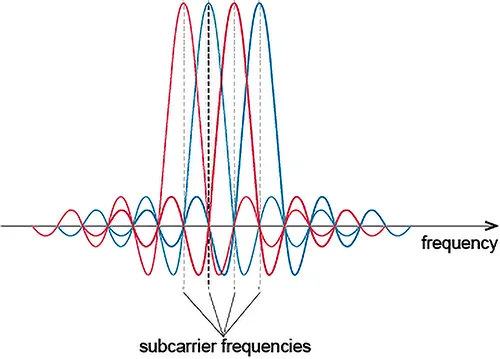
Traditional FDM (frequency division multiplexing) divides the bandwidth into several sub-channels, with guard bands in the middle to reduce interference, and they send data simultaneously. Tuning your receiver to the right station is necessary to watch cable TV or analog wireless broadcasts.
Using interference-free technology makes the use of available spectrum more efficient because guard bands aren’t needed. OFDM systems require much less bandwidth than traditional FDM systems.
OFDM Technical Characteristics
Anti-multipath fading and efficient use of frequency band resources
Based on the cyclic prefix, multipath interference is converted into useful signal multipath reception, reducing the impact of self-coherent interference and inter-symbol interference, and improving the channel’s ability to resist multipath fading. It is particularly suitable for use in high-rise buildings, lieux densément peuplés et géographiquement importants, et les zones où les signaux se propagent.
Efficient use of frequency band resources
OFDM technology uses FFT/IFFT algorithms to transform frequency domain signals, allowing multiple sub-carrier signals to be transmitted in parallel on a broadband channel, thus improving spectrum utilization efficiency. This is particularly important in wireless environments with limited spectrum resources.
Strong resistance to narrow-band interference
In a single-carrier system, un seul affaiblissement ou interférence peut entraîner la défaillance de l'ensemble du lien de communication, but in a multi-carrier system, only a small portion of the carriers will be interfered with. Error correction codes can also be used for error correction on these sub-channels. This technology can automatically detect which specific carrier under the transmission medium has high signal attenuation or interference pulses, and then take appropriate modulation measures to enable successful communication on the carrier at the specified frequency.
High flexibility
OFDM technology can adjust the number and spacing of sub-carriers in different application scenarios to adapt to different bandwidth requirements and has good flexibility.
OFDM Feature Products
-
 22KM 55 km 80 km 100 km 150 km Transmission de transmission de récepteur vidéo sans fil à longue distance 150 km
 -
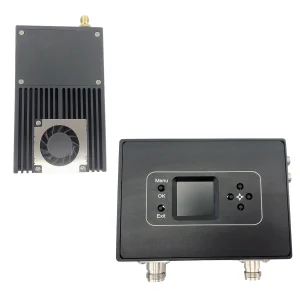
10W PA – liaison de données vidéo aéroportée, 150KM, UAV à longue portée, transmission sans fil, émetteur-récepteur, poignée tactique à large bande
-
Émetteur-récepteur ad hoc maille IP récepteur émetteur OFDM Transmission de données vidéo sans fil pour caméra IP drone
-
Modulateur d'encodeur SDI ou HDMI vers IP CVBS H.265 H.264, carte d'encodage pcba Ethernet RSTP UDP pour drone robotique UAV
-
Émetteur-récepteur de réseau de données vidéo maillé IP Réseau ad hoc radio haut débit
-
80Émetteur-récepteur sans fil KM, système de Transmission de données vidéo RC, HDMI SDI, longue portée, faible latence, Vcan1702
-
7Système de Transmission de données vidéo sans fil KM, longue portée, faible latence, HDMI SDI, 15km OFDM Vcan1643
-
Carte d'encodeur HDMI de taille Mini sur IP Ethernet, modulateur de sortie RJ45 H.265 HTTP RSTP UDP ONVIF TCP


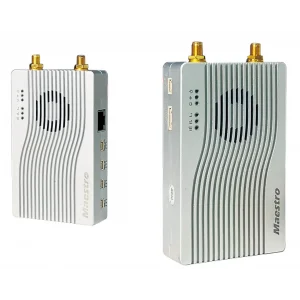
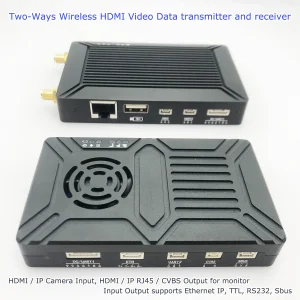
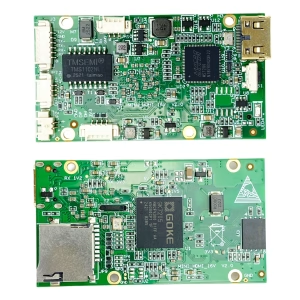
COFDM Technology Introduction
COFDM is coded OFDM (OFDM codé). Some channel coding is added before OFDM modulation (error correction coding and guard interval are added before orthogonal modulation) to make the signal more reliable and effective transmission.
Applications of COFDM
OFDM, as a high-speed transmission technology that can effectively combat interference between signal waveforms, is more widely used in the field of broadband mobile communications. Pure OFDM wireless transmission systems are rarely used in actual systems, and are basically based on COFDM technology, such as DVB (Diffusion vidéo numérique), LTE (4G), and WIFI.
Early COFDM wireless image transmission equipment mostly used improved DVB solutions, but there were problems such as two-way transmission, bande de fréquence, coût, etc., and it is rarely used in the current market. The bottom layer of common ad hoc network technologies on the market is mostly improved from LTE or WIFI technology.
WiFi technology is mainly used in stationary short-range and common applications. Its pilot subcarriers used for channel estimation are relatively sparse (seulement 4 pilots under 20Mhz bandwidth). It is not effective in mobile scenarios such as UAV image data transmission and emergency communications. ideal;
LTE is designed for complex high-speed mobile long-distance scenarios, has a high pilot density (200 pilots under 20Mhz bandwidth), has stronger signal recovery capabilities, and is more suitable for areas such as occlusion and high-speed movement.
Conclusion
En résumé, COFDM is coded OFDM, which adds channel coding to OFDM to provide communication system bit error performance. Our ad hoc network is based on LTE underlying technology (channel coding technologies such as OFDM multi-carrier, convolutional coding/TURBO coding) and is optimized and designed for complex scenarios such as drones and emergency communications.
COFDM Feature Products
-
Module émetteur vidéo FPV 170-860Mhz transmetteur audio vidéo RF sans fil pour caméra FPV 3W PA 50km
-
Emetteur-récepteur vidéo COFDM entrée AV sortie HDMI FPV, Sans fil 10km-15km-30km longue portée moins cher et plus long COFDM-912T
-
30Émetteur et récepteur vidéo sans fil COFDM HDMI longue distance Km, ensemble complet Audio-vidéo TX RX pour Drone UAV 1080P 908T
-
Émetteur et récepteur vidéo sans fil pour caméra, HDMI HD H265 264 encodeur 1W/2.5W PA 1080P60 Vcan1726
-
30-milliseconde Drone UAV HDMI Transmetteur vidéo sans fil Système de transmission sans fil à très faible latence Vcan1729
-
COFDM Modulateur Démodulateur Module Encodeur Décodeur HDMI CVBS Entrée AV AES 256 Diffusion RF FHD
-
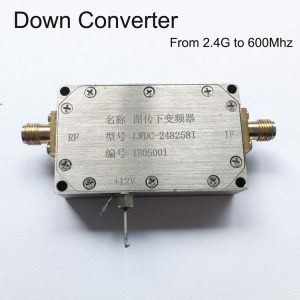
Transmission vidéo sans fil RF, convertisseur numérique vers le bas, fréquence de transfert COFDM 2.4G à 600Mhz, faible BDC
-
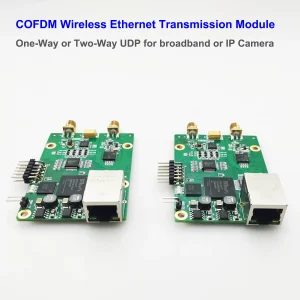
Module de transmission transparent Ethernet sans fil COFDM émetteur et récepteur de données vidéo 100M bps RJ45 FDD
-
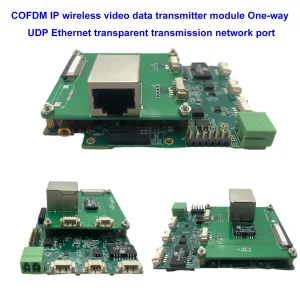
Module émetteur de données vidéo sans fil COFDM IP port réseau de transmission transparent Ethernet unidirectionnel vcan1816



Poser une question
Merci pour votre réponse. ✨