





线性功率放大器与. TDD 双向功率放大器: 真正的区别是什么?
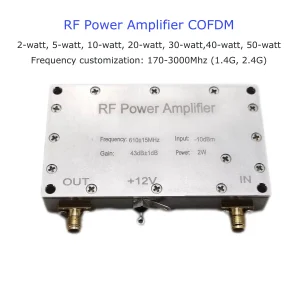
In modern wireless communication systems, 功率放大器 (不是) play a critical role in determining both signal quality and overall system performance. Terms like 线性功率放大器 和 TDD Bi-Directional Power Amplifier are often used interchangeably, but in reality, they describe different concepts at different levels of system design.
This article explains the differences, relationships, and practical use cases of linear PAs and TDD bi-directional PAs, from an RF engineering perspective.




目录
Understanding the Core Difference
At a high level:
- 线性功率放大器 指的是 performance characteristic — how faithfully a signal is amplified.
- TDD Bi-Directional Power Amplifier 指的是 系统架构 — how transmission and reception share RF hardware over time.
These two concepts are not mutually exclusive. 实际上, they are often combined in real-world designs.
What Is a Linear Power Amplifier?
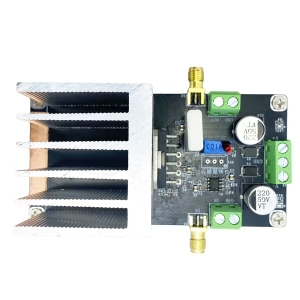
一个 线性功率放大器 is designed to amplify RF signals while preserving the original waveform’s amplitude and phase relationship. High linearity is essential for modern digital modulation schemes.
主要特点
- 低的 误差矢量幅度 (评估值)
- 低的 相邻通道泄漏比 (ACLR)
- 支持 wideband and high-order modulation (OFDM, QAM)
优点
- Excellent signal fidelity
- Suitable for spectrally efficient communication systems
- Complies more easily with regulatory emission limits
Trade-Offs
- Lower efficiency compared to saturated or switching amplifiers
- Higher power consumption and heat dissipation
- Typically operates in Class A or Class AB modes
典型应用
- LTE / 5G NR
- ISDB-T / DVB-T
- 软件无线电 (特别提款权)
- Base stations and test equipment
What Is a TDD Bi-Directional Power Amplifier?
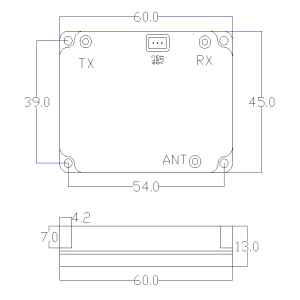
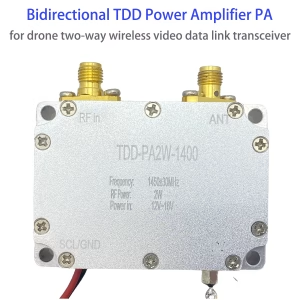
一个 时分双工 (时分双工) Bi-Directional Power Amplifier is part of a system where 发送 (TX) 并收到 (RX) functions share the same RF path and antenna, but operate at different times.
Instead of separate uplink and downlink frequency bands, TDD systems alternate between TX and RX in the time domain.
Typical Architecture
TX → PA → RF Switch → Antenna
RX ← LNA ← RF Switch ← Antenna
Key Design Considerations
- Fast TX/RX switching speed
- High isolation between transmit and receive paths
- Protection of sensitive RX components during TX operation
优点
- Reduced component count
- Smaller module size and lower system cost
- Efficient use of spectrum and hardware
挑战
- More complex RF switching design
- Risk of RX damage if isolation is insufficient
- PA must tolerate rapid on/off operation
典型应用
- TDD LTE and 5G private networks
- Wireless broadband and point-to-point links
- Radar and telemetry systems
- FPV and industrial wireless solutions
Linear PA vs. TDD 双向 PA: A Direct Comparison
| 方面 | 线性功率放大器 | TDD 双向 PA |
|---|---|---|
| Primary Focus | Signal linearity | 系统架构 |
| Defines | 信号质量 | TX/RX sharing method |
| Concerned With | 评估值, ACLR, distortion | 交换, 隔离 |
| Mutually Exclusive? | 没有 | 没有 |
| Can Be Combined? | 是 | 是 |
How They Work Together in Practice
In most modern TDD communication systems, 这 ideal solution is a linear TDD bi-directional PA.
例如:
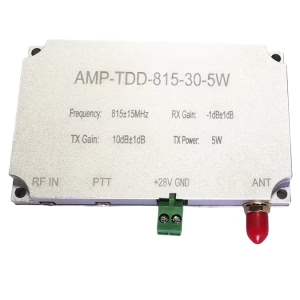
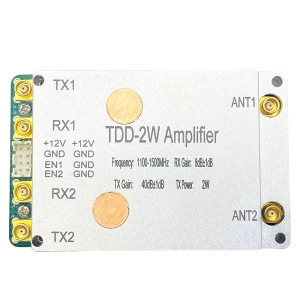
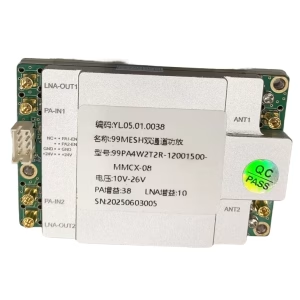
- 一个 2T2R TDD Linear Power Amplifier Module
- Each channel delivers 5W output power
- Supports OFDM-based modulation
- Uses RF switches to bypass or protect the PA during RX periods
This combination ensures:
- High signal integrity during transmission
- Efficient hardware reuse
- Compact and cost-effective system design
选择正确的解决方案
- 如果您的首要任务是 signal quality and modulation accuracy, focus on 线性度.
- If your system operates in TDD mode with a shared antenna, 一个 bi-directional architecture 是必不可少的.
- For modern wireless systems, both are usually required.
- Check more PA power amlifier at 这里.
问一个问题
感谢您的回复。 ✨