







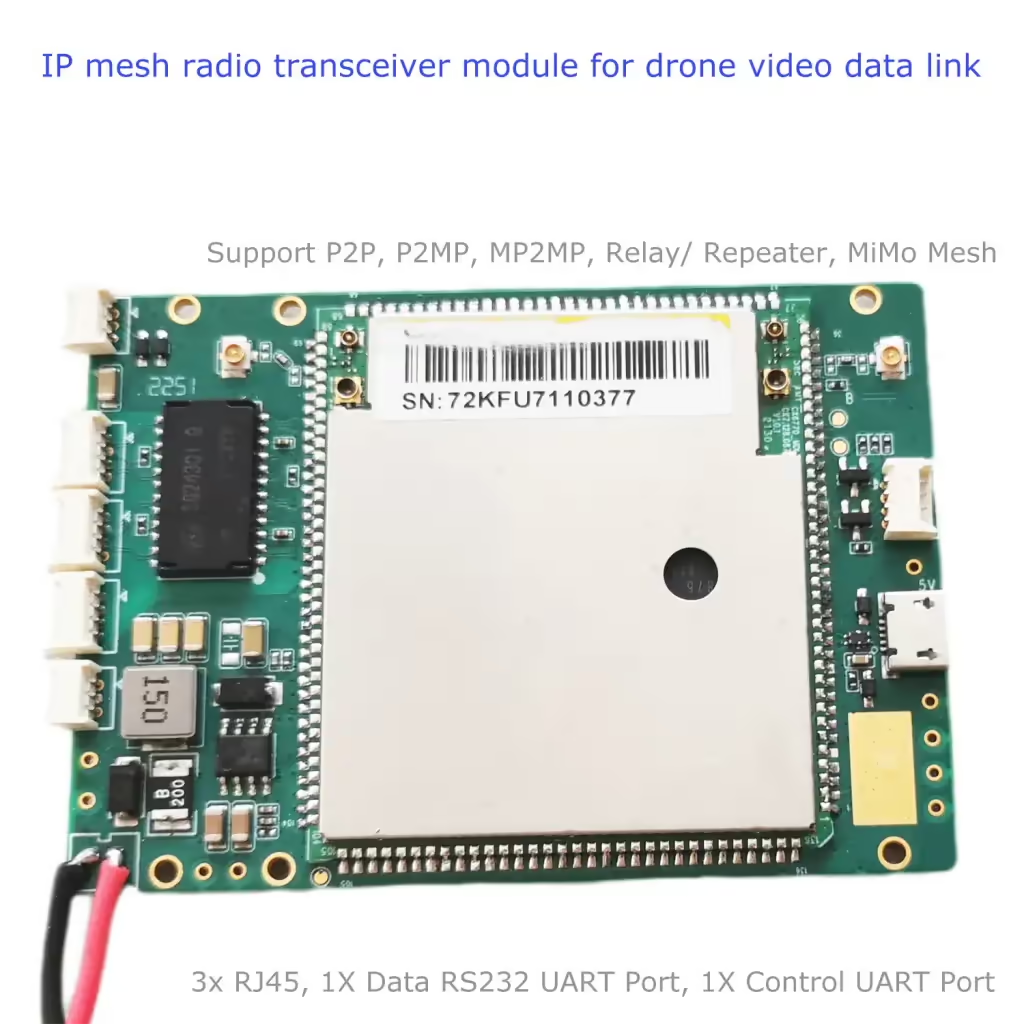
IP mesh radio transceiver module for drone video data link UHF
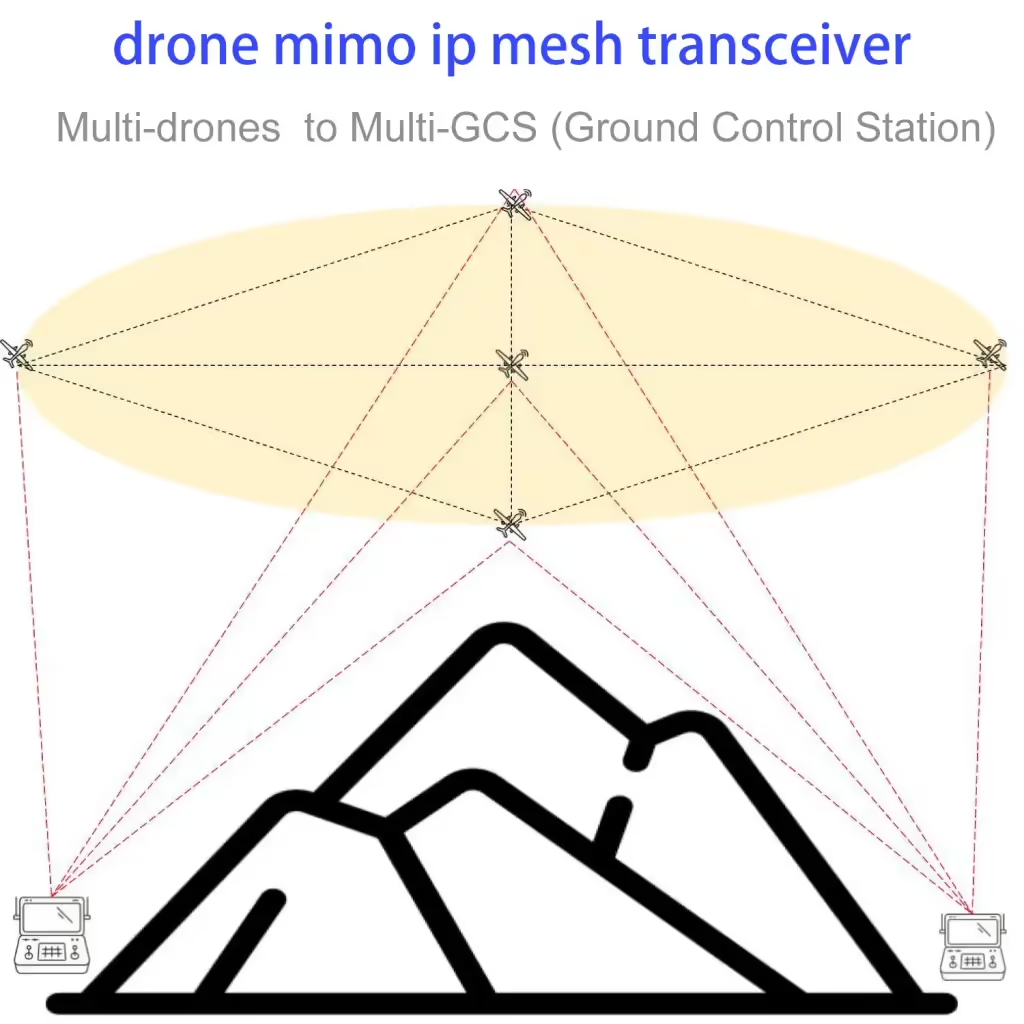
IP mesh radio transceiver module is suitable for point-to-multi-point or multi-point-to-multi-point network requirements.
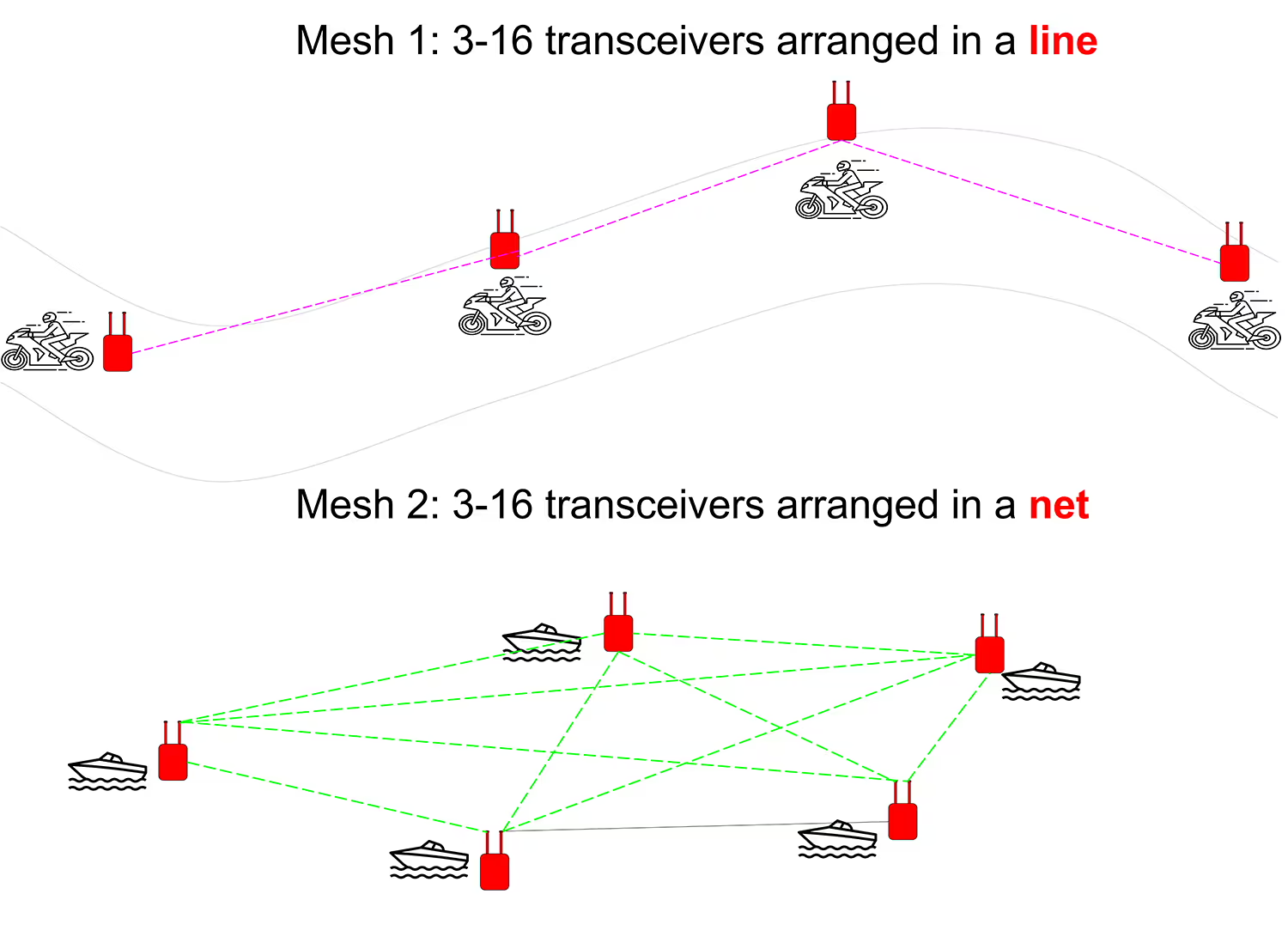
Per esempio, your project requires multiple transmitters and multiple receivers. Each node can act as a relay for other nodes. Each node cannot be individually defined as a transmitter, ricevitore, or repeater. Each node is a transmitter, un ricevitore, and a repeater, such as security squads, bicycle racing, 2+ drones in the sky, 2+ receivers on the ground, e altre applicazioni.
 Caratteristica
- Two-way bidirectional transmission video data download and upload
- TDD OFDM full-duplex IP Mesh radio wireless transceiver module for video and data transmission
- Dual RF Power: 24±1dBm, 2-canale
- Sensibilità:-102dBm(1Mbps@20MHz bandwidth)
- Support transmit distance: 500~2000 meters (terra-terra), 5~22km (UAV-terra); For a longer range, we needed the extra power amplifier support. (2watt, 5watt, 10watt)
- Fornitura 3 Wireless transparent transmission Ethernet RJ45 ports,1 Wireless transparent transmission serial port rs232 UART data link, E 1 Configuration serial UART (TTL) porta.
- Doppie antenne: main and auxiliary antennas, which can be configured as dual transmitting and dual receiving, single transmitting and dual receiving, or single transmitting and single receiving.
- Support wireless working frequency bands:566~678 MHz e 1420~1530 MHz
- Supports 110Mhz automatic frequency hopping within and between frequency bands
- Wireless bandwidth configurable:1.4MHz、3MHz、5MHz、10MHz、20MHz、40MHz, the maximum air interface rate can reach 100Mbps.
- Metodo di modulazione: QPSK/QAM16/QAM64 Automatic adaptation
- Supporta la crittografia e la decrittografia del collegamento wireless
- Support wireless ad hoc network Mesh Communication method, fino a 32 node network.
- All node communications share the working bandwidth and the system’s maximum sharing rate of 100Mbps. Adaptively distribute system rates equally.
- Supports multi-hop routing topology, fino a 32 nodes 31-hop routing. Fixed route configuration is supported and takes effect permanently.
- Support the highest300km/h moving speed.
- This board supports the CX6779K modem.
- One-way delay index formula(Signorina): 6*H + (5/2) * N/2 * H * 3, the two-way delay multiplied by 2(N is the number of nodes within two hops, the number of hops is H). The optimized delay between two nodes: One-hop one-way delay between two nodes≤10ms; Four-node chain optimization delay: four-node three-hop single-hop one-way delay≤10ms; 6 Point chain networking,3 salto, one-way delay50ms;8 punti, one hop for all points, one-way delay36ms;8 punti, serial7 hop, one-way delay170ms;32 punti, one hop for all points, one-way delay120ms;32 punti, serial31 Jump one-way delay3750ms。
- Logical master node power-on network construction delay20s~80s(There are no restrictions on modules. Generalmente, the logical master node is powered on first.); Cold start, delay from node startup to network access<30s Received logical master node signal; hot start, slave node startup network access delay<1s(Ordinary one-hop node networking scenario); Hot start, power on the node from a single frequency point and connect to the network<480Signorina + 160ms*H(H is the hop count)。
 FHSS Frequency Hopping
 FHSS Frequency Hopping
- We designed this wireless video and data transmission with uplink and downlink for those who need the frequency automatic hopping function.
- With frequency hopping technology (Questo modello è stato progettato per la trasmissione wireless di video e dati con un collegamento dati wireless bidirezionale) to ensure better stable signal communication, when the current frequency signal is worse, the system will automatically change the working frequency to another frequency for a better signal.
- This bidirectional OFDM radio module can work from 566Mhz to 678MHz or from 1420Mhz to 1530MHz bandwidth. So the frequency range has 110Mhz bandwidth change or hopping. If you set the frequency bandwidth at 10 MHz, then there are 11 frequency points for hopping.
Specifica
- Modulazione TDD OFDM (Need FDD COFDM model?)
- Supporta 2 Frequency ranges (566~678MHz/1420~1530MHz)
- Supports FHSS frequency automatic hopping function
- 4/3/5/10/20/40Larghezze di banda MHz
- Max 100Mbps throughput
- Dual RF transmission power: 24±1dBm, 2-channel for uplink and downlink
- Costellazione: QPSK, 16QAM, 64QAM, autoadattamento
- Sensibilità: -95dBm (20Larghezza di banda MHz)
- Supports IP Video Data Transmission (3 Porta Ethernet)
- Supporta la trasmissione dati seriale (1X RS232, 1X TTL)
- Without extra PA, Up to 22km LOS (UAV-terra) e 2 km LOS(terra-terra)
- Can add 2watts, 5watt, O 10 watts to support longer range
- Web UI and control UART for management
- Crittografia AES128
- Controllo del flusso uplink e downlink (Video stream needs more and data streaming needs less)
- Modalità di rete: One-to-one P2P, one-to-many P2MP, many-to-one MP2P, relay/repeater, mesh or swarm network。
- Consumo energetico: <7W
- Dimensioni: 80 x 57 x 9.1mm
- Peso: 41g
- Working Temperate: -20℃ ~ +65 ℃
- Storage Temperate: -40℃ ~ +80 ℃
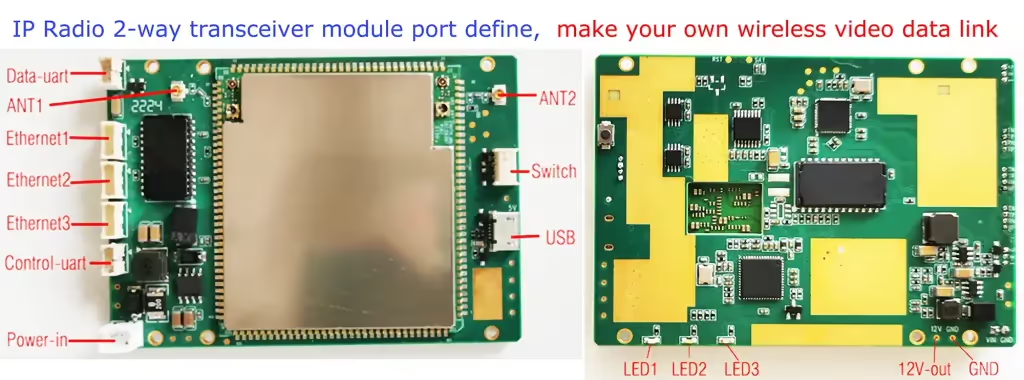
IP Radio Module Connector (Ingresso / Produzione)
| Accensione | 2PIN PH2.0mmConnector, Ingresso CC:9~30 V |
| Ethernet-1 | 4Connettore PIN PH1,25 mm |
| Ethernet-2 | 4Connettore PIN PH1,25 mm |
| Ethernet-3 | 4Connettore PIN PH1,25 mm |
| Dati UART | 3Connettore PIN PH1,25 mm, RS232(or TTL 3.3V) |
| Controllare l'UART | 3Connettore PIN PH1,25 mm, TTL 3,3 V |
| USB | Micro USB Connector, per l'aggiornamento del software |
| Interruttore | Segnale di controllo Tx/Rx per l'amplificatore di potenza esterno |
| Main-Antenna | Porta dell'antenna Tx/Rx, IPEX |
| Seconda antenna | Porta dell'antenna Tx/Rx, IPEX |
| 12V fuori | Uscita 12V integrata(<200mA), per l'alimentazione della ventola fredda |
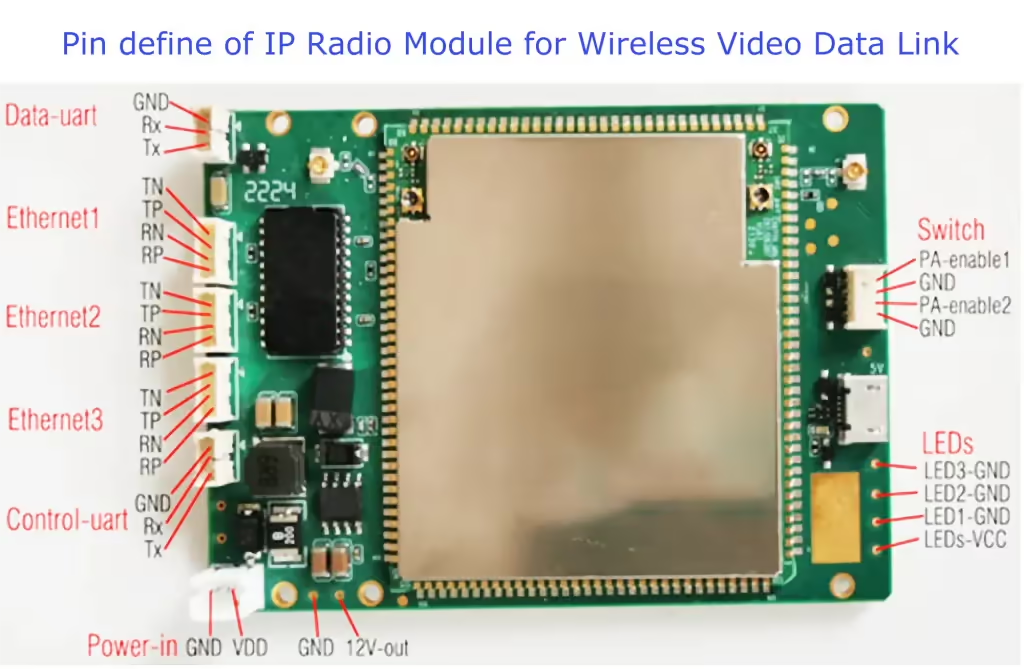
Ethernet1, Ethernet2 and Ethernet3
The three Ethernet ports on board are bridged connections, so their IP addresses are the same. The photo below shows the 4PIN signals of the Ethernet port.
 Switch Port
 Switch Port
This port is a TX transmitter / RX receiver control signal for the extra power amplifier. The maximum RF transmission power of our module is 24±1dBm two channels, We also provide the correct power amplifier to increase the RF Power to 2-watt / 5-watt /10-watt if you need a longer range than 22km.
The below diagram shows how to add a power amplifier outside extra of this IP Radio Module.
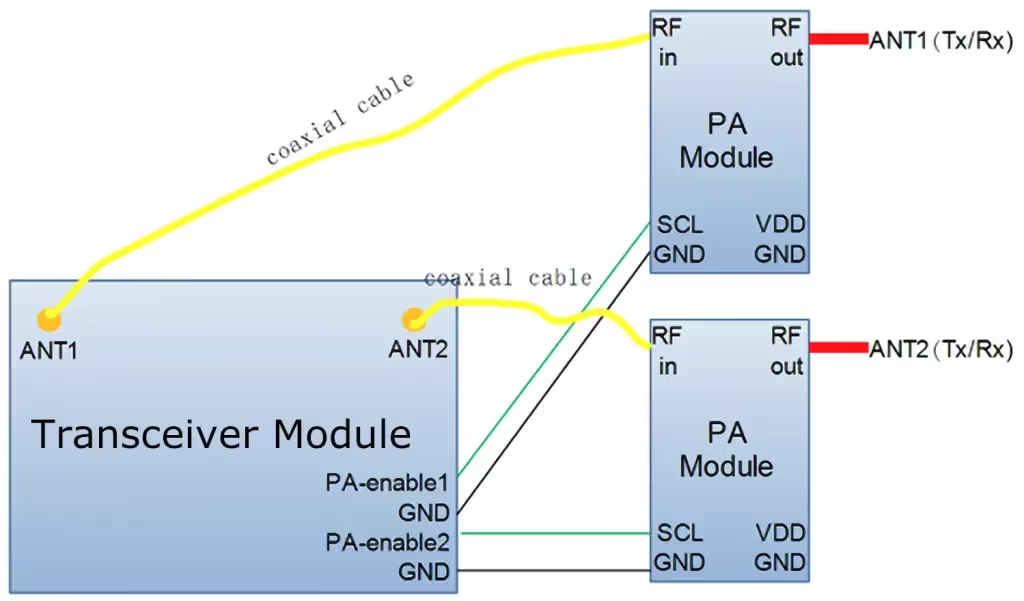 This operation is for your reference only. If you need to add an external power amplifier, it is best to tell us and we will configure it for you, or ask a professional to operate it, Altrimenti, the PA will be easily burned.
| Segnale | Electrical level | I/O | Descrizione | mark |
| PA-enable1 | 1.8V | O | High electrical level: data transmitting, change to high electrical level at 3.19us before transmitting and to low electrical level at 0.26us after transmitting finished. | High-Tx
Low-Rx |
Dati UART
- The data UART is RS232 as default.
- We also can change the data port from RS232 to TTL 3.3V UART before the cargo delivery.
- The baud rate of data UART can be set as 115200, 57600, 38400, 19200, 9600, 4800, 2400, E 1200.


Control UART and USB port
Only one of these two ports is valid at the same time. Control UART is valid by default shipment. Please contact us if you need to use a USB UART. You can manage our module with Web UI or AT command via control UART.
LEDs light
LED1: LED di alimentazione, rosso, luce accesa normalmente.
LED2: blue, LED3: verde, LED2 and LED3 indicate the wireless working status as described in the below table.
| Central node | Blue LED2 light on all the time and green LED3 is not light |
| Access node | Green LED3 lights on all the time when the access node is connected to the central node. |
| The blue LED2 indicates the access node linking signal status with the central node.
When the wireless linking signal is strong, blue LED2 blinks every 30 secondi; When the wireless linking signal is middle, blue LED2 blinks every 6 secondi; When the wireless linking signal is weak, blue LED2 blinks every 1 secondo. |
Sometimes customers may need to assemble the indicating LEDs on their housing case panel, so our board also provides a soldering hole for the three LED signals. The LED signal is described in the below table.
| GUIDATO | Descrizione | Representation soldering hole |
| LED1 | LED di alimentazione | LED1-GND and LEDs-VCC |
| LED2 | Wireless indicating LED | LED2-GND and LEDs-VCC |
| LED3 | LED3-GND and LEDs-VCC |
Wireless networking with the IP MESH Radio Module
- Our module supports two operating modes: Nodo di accesso e nodo centrale. It can be managed through Web UI or AT command via control UART.
- Our module supports features of a maximum of 63 Nodi di accesso collegati a un nodo centrale. All the Nodes are in the same wireless LAN and share the whole transmission bandwidth (maximum 100Mbps throughout).
- We call downlink data from the Central Node to the Access Node, and we call uplink data from the Access Node to the Central Node.
- Il rapporto del flusso di uplink e downlink può essere controllato tramite l'interfaccia utente Web o il comando AT.
- When using our module for point-to-point transmitting, uplink e downlink condividono l'intera larghezza di banda di trasmissione (maximum 100Mbps throughout).
- Our module supports networking modes: Punto a punto, Point-to-Multi-point, Relè, e Maglia (specificare la versione mesh al momento dell'ordine).
Tipo di rete
This module supports star networking and Mesh networking, and the prices vary greatly. Please choose the appropriate networking method according to your application.
- Rete di stelle
- P2P: Point-to-Point Networking Type
- P2P Via Relay / Repeat Networking Type
- MP2P: Multi-Point-to-Point Networking Type
- MP2MP: Multi-Point-to-Multi-Point Ad Hoc Mesh Networking type.
- In this Ad Hoc networking type, there is no central node, and each node can connect to the surrounding nodes to form a network. If one of the nodes fails or is out of range, the other nodes can re-network without being affected.
- Any node can be a transmitter, un ricevitore, or a repeater. No prior settings are required. The role of each node is dynamic and can adjust itself to changes in real-time.
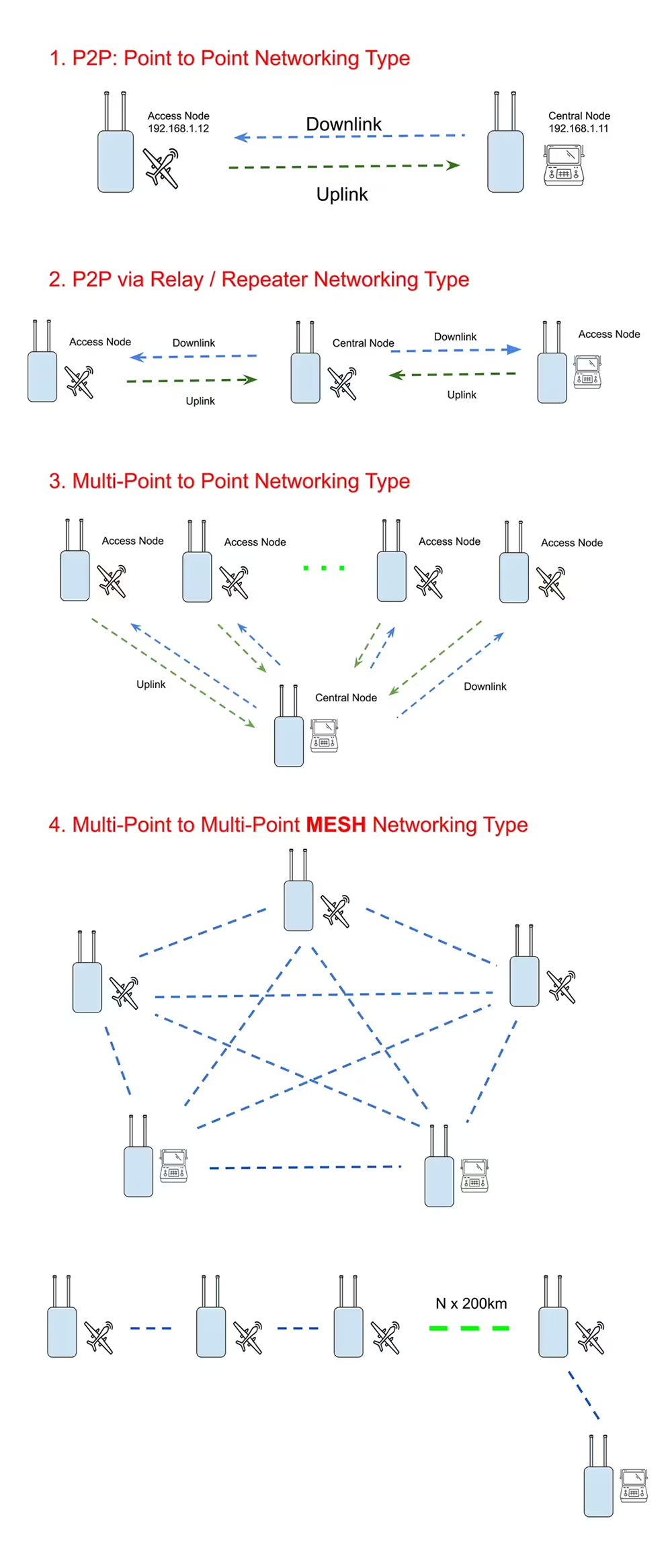
MESH Centerless Networking

FAQ
Q1: Can this mesh version be set to a P2P or P2MP model?
A1: sì.
Q2: How many nodes does it support in one network?
A2: This star network has a maximum of 64 nodi, and the Mesh network has a maximum of 32 nods.
Q3: Can you provide options for amplifiers for ip mesh drone video data telemetry transceiver modules?
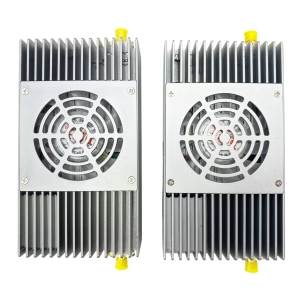
A3: We have 2 watt, 5 watt, E 10 Amplificatore di potenza PA da watt for this module. Each PA power amplifier we can make it at 600Mhz (566-678Mhz) or 1.4Ghz (1420-1530Mhz). There are two RF connectors for transmitting, so you’d better to add two power amplifiers for each module. In order to support frequency hopping at two bands (600Mhz and 1.4Ghz), so it is recommended that you add two power amplifiers: one is for 600Mhz, another is for 1.4Ghz. If your environment is electromagnetically clean but you need the highest bitrate, you can also use two 600Mhz or 1.4GHz amplifiers.
Posta relativa
- Need a case that’s waterproof, antipolvere, and fogproof?
- Mesh Radios AT commands Manual
- How to set and use the UART of drone wireless video data telemetry radio link?





iVcan.com –
I have been using this IP Mesh radio transceiver module for several drone video projects, and it is exceptional. The module delivers stable long-range video and data transmission, whether in point-to-point, punto-multipunto, or full mesh network configurations. Frequency hopping ensures a reliable connection even in complex electromagnetic environments, and the dual RF channels provide excellent throughput up to 100Mbps. Setup is straightforward via Web UI or UART, and the support for multiple nodes with automatic routing makes it perfect for multi-drone or ground-to-drone applications. Highly recommended for professional UAV and telemetry systems.