





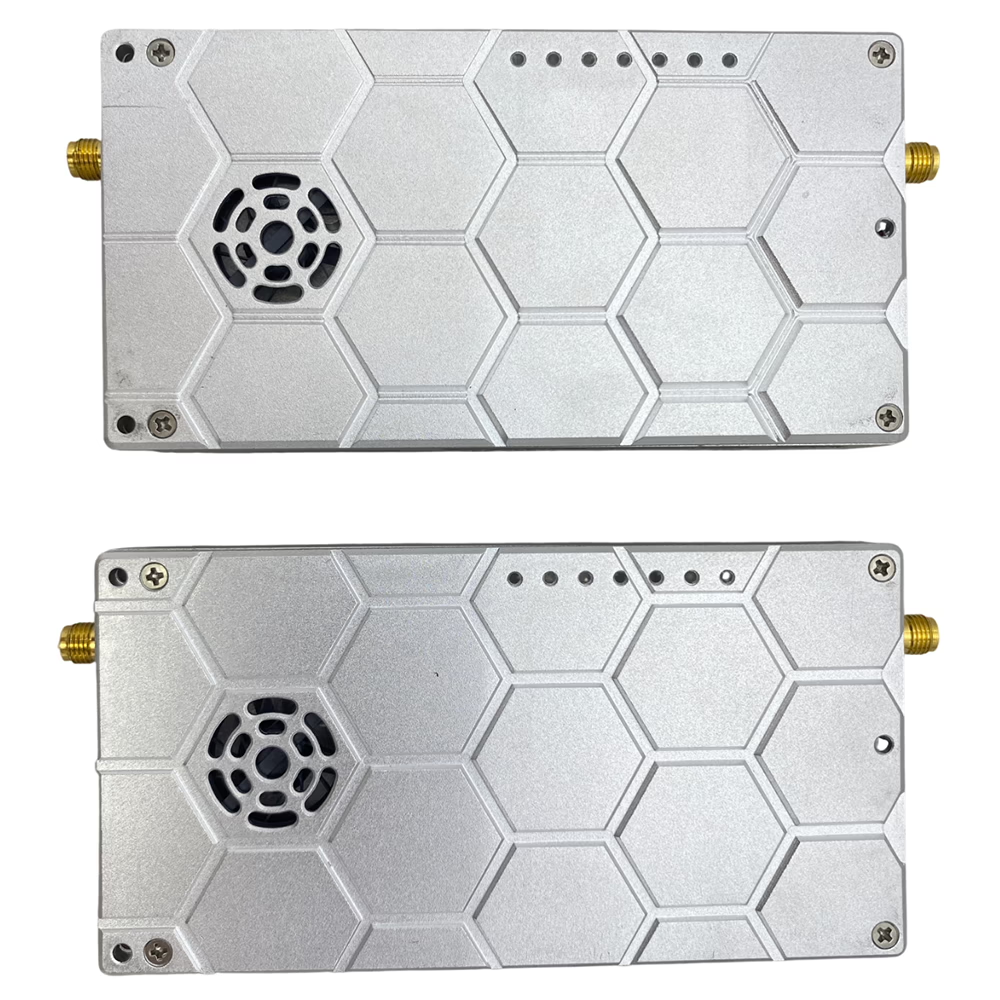
Drone Video Data Télémétrie émetteur-récepteur-récepteur UAV Radio Link TDD Émetteur-récepteur
Table des matières
Caractéristiques du produit
-
Compatibilité des caméras
-
Recommandé: HD web camera with Ethernet (Caméra IP), most gimbal cameras have an Ethernet video output. (such as SIYI or Viewpro).
-
If your camera has only HDMI or CVBS output, un HDMI / CVBS encoder is required to convert video/audio to digital data before transmission.
-
At the receiver side:
-
Direct connection to computer for Mission Planner or QGC, or NVR via Ethernet.
-
For HDMI monitor output, un IP to HDMI decoder est requis.
-
-
-
Interfaces
-
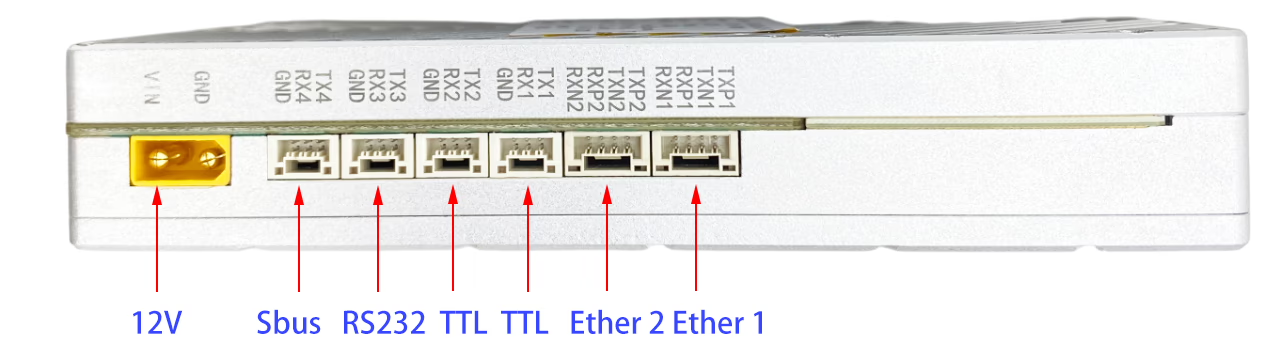
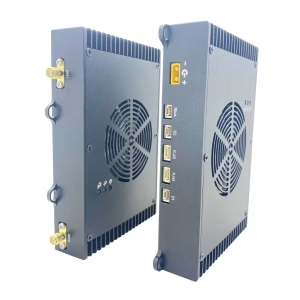
2 × Ethernet ports
-
4 × Data ports (default is 2x TTL, 1x RS232, 1x Sbus)
-
Default Data Interface: RS422 or other (optional TTL, SBus, UART, or RS485 upon request).
-
TTL compatible with flight controllers such as PixHawk and Sbus compatible with remote control.
-
-
Débit en bauds du port de données
-
Port de données 1: 1200, 2400, 4800, 9600, 19200, 38400, 57600, 115200.
-
-
Wireless Technology
-
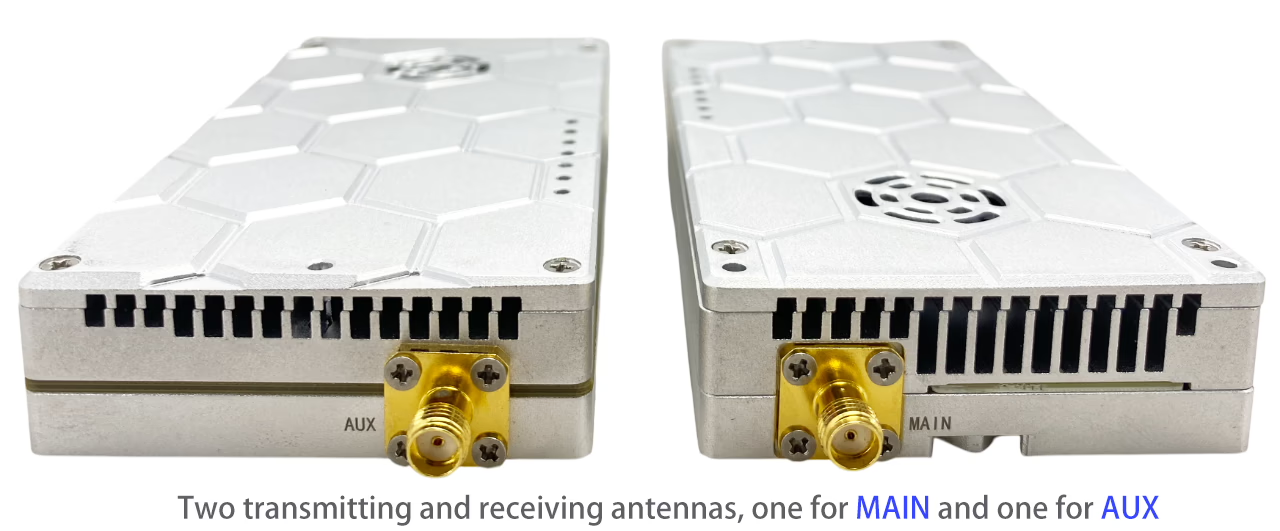
Antennes doubles:
-
ANT Main (Connecteur SMA): Transmettre & Recevoir
-
ANT AUX: Recevoir uniquement (diversity with ANT Main)
-
-
Bandes de fréquences (avec saut de fréquence automatique):
-
1420–1530 MHz (1.4G, défaut)
-
806–826 MHz (800M) (800MHz, facultatif)
-
2401.5–2481.5 MHz (2.4G, facultatif)
-
-
Bandwidth options: 3 / 5 / 10 / 20 MHz
-
System throughput: Jusqu'à 30 MBps (shared)
-
Modulation: Adaptive QPSK / 16QAM / 64QAM
-
Réseautage: point à point, point-to-multipoint star topology (par ex., 6 caméras + 1 transmitter to 1 récepteur)
-
Puissance de transmission: 2-watt (5W or 10W is optional)
-
Sensibilité du récepteur: -103 dBm @ 10 Bande passante MHz
-
Sécurité: AES128 encryption/decryption
-
-
Transmission Distance Options
-
20 km / 50 km / 100 km / 150 km
-
-
Pouvoir & Consommation
-
2En PA: 12-16V, 33dBm, Émission <12W, RX <10W (Connecteur: XT30PW / XT60PW)
-
5En PA: 24–25V, 37dBm, Émission <22W, RX <16W
-
10En PA: 24–30V, 40–41dBm (recommandé 28V), max 1.4A @28V, peak 2.8A @28V
-
Without external PA: 300mW, 25dBm
-
-
Management & Surveillance
-
Configuration and status monitoring via Interface utilisateur Web (default login: admin/admin).
-
Visite 192.168.10.230 on a browser to log in to the Web UI (Maître / Central Node for the ground unit)
- Visite 192.168.10.231 on a browser to log in to the Web UI (Esclave / Access Node for the air unit),
-
-
Physical Specs
-
Taille: 115 × 59 × 21 mm (hors connecteurs)
-
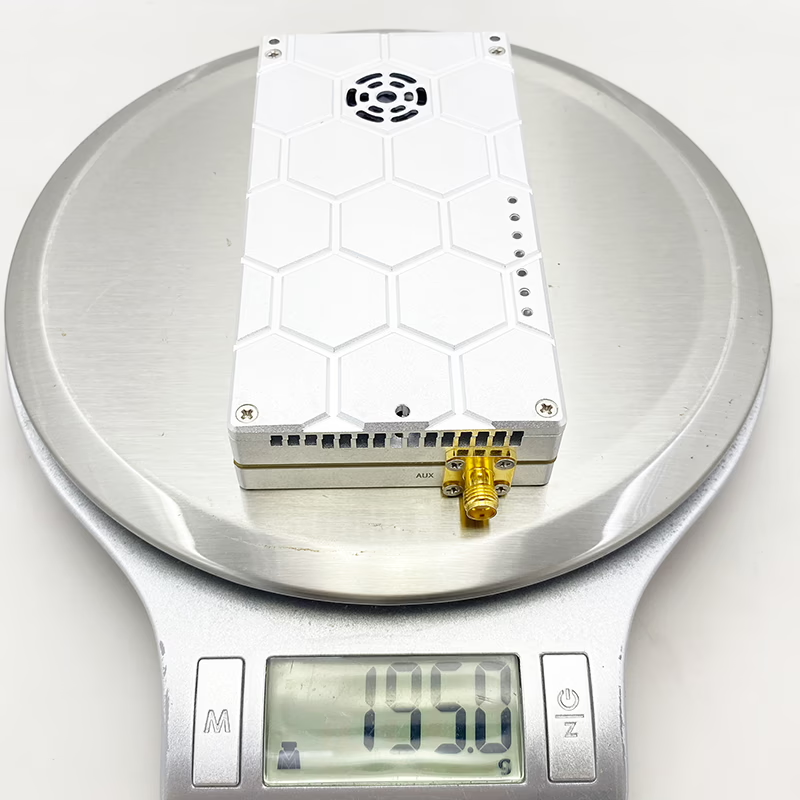
Poids:
- 2W: 195 grammes
-
spécification
| System parameter | Technical index | |||
| Equipment type | Vcan2122 | |||
| Working frequency | 5655~5775MHz | |||
| RF channel | 2T2R | |||
| Puissance d'émission | 30dBm (1W) | |||
| Distance de transmission | Air to ground 15KM+(LA) | |||
| Bande passante du canal | 10/20MHz | |||
| Mode modulation | QPSK/16QAM | |||
| Maximum speed | 23.9Mbit/s à 20 MHz | |||
| Le chiffrement | AES256 | |||
| Transmission delay | ≤10ms | |||
| Interface RF | SMA*2 | |||
| Device interface | Ethernet *1 | |||
| TTL/RS232 *1 | ||||
| TTL/RS232/SBUS*1 | ||||
| Consommation | ≤ 25W @4Mbps (unité aérienne) | |||
| ≤ 10W @1Mbps (unité au sol) | ||||
| Dimension(L*L*H) | 98.5*65.5*27mm | |||
| Poids | 198g | |||
| Tension de fonctionnement | DC 9~26V, Valeur typique : +12V@3A | |||
| Température de travail | -40~+70℃ | |||
| Tableau 2 MCS and total throughput (10/20MHz bandwidth) | ||||
| Non | MCS | 10M Total throughput(Mbit/s) | 20M Total throughput (Mbit/s) | |
| 1 | BPSK1/3 | nonsupport | 3.5 | |
| 2 | BPSK1/2 | nonsupport | 4.8 | |
| 3 | BPSK2/3 | nonsupport | 5.9 | |
| 4 | BPSK3/4 | nonsupport | 6.8 | |
| 5 | QPSK1/3 | 4.0 | 7.0 | |
| 6 | QPSK1/2 | 5.8 | 9.7 | |
| 7 | QPSK2/3 | 7.1 | 11.9 | |
| 8 | QPSK3/4 | 8.1 | 13.7 | |
| 9 | 16QAM1/3 | 8.0 | 11.7 | |
| 10 | 16QAM1/2 | 11.6 | 16.9 | |
| 11 | 16QAM2/3 | 14.2 | 20.8 | |
| 12 | 16QAM3/4 | 16.4 | 23.9 | |
Dimension and weight
Dimensional diagram
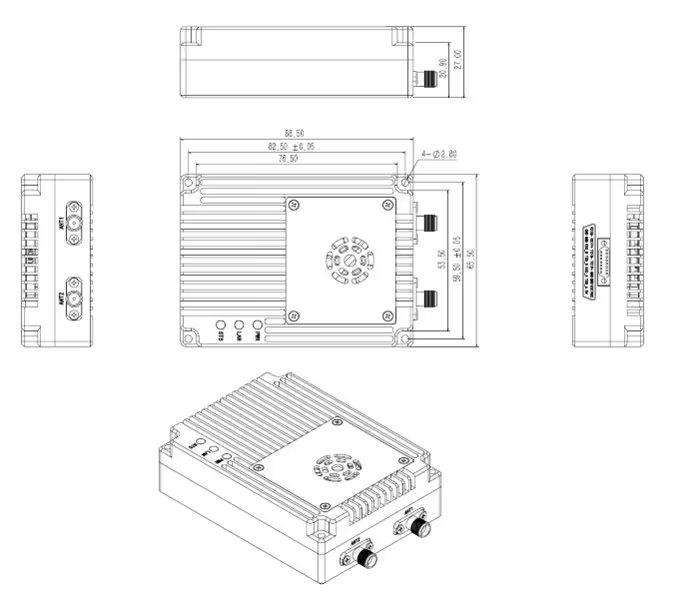
Dimension and weight
- Dimension: 98.5mm*65.5mm*27mm(include SMA 10mm)
- Poids: 198g
Interface Definition
Interface diagram
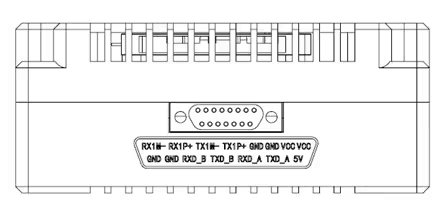
The interface of the device adopts J30J-15PIN, avec 1 alimentation, 1 port réseau, 1 RS232/TTL, et 1 RS232/TTL/SBUS.
Définition de l'interface
| Ordre linéaire | Nom de la broche | Définition de l'interface | Description de l'interface | Sens du signal |
| 1 | VCC |
Pouvoir DC 9~26V
|
Puissance positive | je |
| 2 | VCC | Puissance positive | je | |
| 3 | GND | Puissance négative | je | |
| 4 | GND | Puissance négative | je | |
| 5 | TX1P+ |
Ethernet *1
|
Émission+ | Ô |
| 6 | TX1M- | Émission- | Ô | |
| 7 | RX1P+ | RX+ | je | |
| 8 | RX1M- | RX- | je | |
| 9 | 5V | 5Sortie V | Sortie SBUS 5V | Ô |
| 10 | TXD_A | Port série 1
RS232/TTL |
Port série 1 Émission | Ô |
| 11 | RXD_A | Port série 1 RX | je | |
| 12 | SBUS /TXD_B | Port série 2
SBUS/TTL/RS232 (NOTE 3) |
Port série 2 Émission | Ô |
| 13 | SBUS /RXD-B | Port série 2 RX | je | |
| 14 | GND | Port série 2 Sol | Ô | |
| 15 | GND | Sol | Port série 1 Sol | Ô |
Note 1: Signal direction I indicate radio input and direction O shows radio output.
Note 2: Port série 1 peut être utilisé uniquement avec RS232/TTL, PIN10,11,15. Delivery is determined by the hardware. Note 3: Port série 2 peut être utilisé comme RS232/TTL/SBUS. L'usine est déterminée par le matériel. TTL et SBUS peuvent être commutés par logiciel.
Note 4: Lorsque le port série 2 uses one SBUS, PIN9,13,14 is used at the ground end. Use PIN12,14 for the sky end. Note 5: If two SBUS are required, configure pin12->pin12 for the sky SBUS mapping. pin13->pin13.
Description of the product status indicator
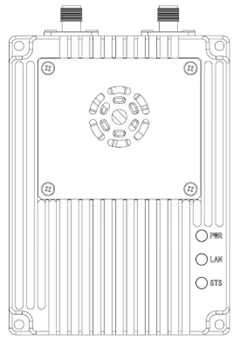
The device is powered on, and the PWR keeps on.
LAN(green light)
The network port indicator blinks when data is being sent
or received。
STS(Four-colour light)
Different colored lights indicate the current signal quality.
| Le voyant STS représente la taille SNR du signal reçu | |
| Couleur STS | RSB |
| Bleu | Aucune connexion n'est établie |
| vert | RSB>10dBm |
| jaune | 6dBm<RSB<10dBm |
| rouge | RSB<6dBm |
| Type de module | Mode | REP | Réseau local | STS |
| maître | non synchronisé | Le feu vert est allumé fixe | Les données sont transmises et clignotent | Blue light on |
| maître | synchronisation | Le feu vert est allumé fixe | Les données sont transmises et clignotent | (green/yellow/red)
Proportionnel à la force du signal reçu |
| esclave | non synchronisé | Le feu vert est allumé fixe | Les données sont transmises et clignotent | Blue light on |
| esclave | synchronisation | Le feu vert est allumé fixe | Les données sont transmises et clignotent | ( green/yellow/red )
Proportionnel à la force du signal reçu |
Lorsque les appareils principal et secondaire ne sont pas synchronisés, l'indicateur d'alimentation PWR des appareils principal et secondaire est allumé en permanence, et le voyant bleu STS de l'appareil principal est toujours allumé. The blue light from the device’s STS flashes. When the master and slave are synchronized, the master and slave’s STS light becomes a
three-color light, and the green light is displayed if the signal quality is good. A yellow
light indicates moderate communication quality. A red light indicates poor communication quality. When the network port is sending or receiving data, the LAN indicators of the primary and secondary devices blink.
Options personnalisables
Caméra & Video Input
-
Compatible with IP cameras (Ethernet).
-
Optional HDMI or CVBS encoder for analog cameras.
-
Custom encoder integration upon request.
Interfaces & Data Ports
-
Défaut: 2 × TTL, 1 ×RS232, 1 × Sbus.
-
Facultatif: RS422, UART, RS485, or fully customized data interface mapping.
-
Adjustable baud rates for flight controller or telemetry integration.
Wireless Frequency Bands
-
Défaut: 1420–1530 MHz (1.4G).
-
Facultatif: 806–826 MHz (800M) or 2401.5–2481.5 MHz (2.4G).
-
Custom frequency range available for government/military projects (upon request).
Bande passante & Modulation
-
Selectable bandwidth: 3 / 5 / 10 / 20 MHz.
-
Modulation adaptative: QPSK / 16QAM / 64QAM.
-
Option to lock fixed modulation for specific environments.
Modes de mise en réseau
-
Point-to-point link.
-
Réseau en étoile point à multipoint (par ex., multiple cameras to one receiver).
-
Custom mesh networking support upon request.
Transmit Power Levels
-
Default 2W output.
-
Optional 5W or 10W external PA (custom voltage and connector options available).
-
Special configurations for low-power portable or long-distance applications.
Distance de transmission
-
Standard: 20 km / 50 km / 100 km / 150 km.
-
Extended distance customization with directional antennas or higher gain PAs.
Sécurité
-
Default AES128 encryption.
-
Option to upgrade to AES256 or proprietary encryption methods.
Management & Surveillance
-
Standard Web UI (IP configurable).
-
Custom firmware branding or management interface available for OEM projects.
-
Surveillance à distance & telemetry API integration available.
Physique & Pouvoir
-
Default compact module: 115 × 59 × 21 mm.
-
Power input options: 12-16V (2W), 24–25V (5W), 24–30V (10W).
-
Connector customization: XT30PW / XT60PW or user-defined.
-
Enclosure and heat dissipation design can be tailored for UAV, véhicule, or maritime use.
Applications
-
Drone and UAV Video Transmission
-
Real-time aerial video streaming for surveillance, cartographie, et inspection.
-
Used in agriculture, construction, et surveillance des infrastructures.
-
Supports FPV (Vue à la première personne) for drone pilots.
-
-
Security and Surveillance Systems
-
Wireless transmission from CCTV cameras to remote monitoring stations.
-
Useful for large campuses, factories, or outdoor areas where cabling is difficult.
-
-
Broadcasting and Live Event Streaming
-
Live video transmission for concerts, événements sportifs, and TV productions.
-
Can replace traditional wired systems for temporary setups.
-
-
Robotics and Remote Control Vehicles
-
Transmits camera feeds from ground robots, véhicules autonomes, or ROVs (Remote Operated Vehicles).
-
Enables real-time monitoring and control in hazardous environments.
-
-
Industrial Monitoring and Inspection
-
Wireless video for pipelines, lignes électriques, wind turbines, and other industrial assets.
-
Provides remote observation in hard-to-reach locations.
-
-
Emergency and Public Safety Applications
-
Video feeds from drones or portable cameras for disaster response, lutte contre les incendies, ou des opérations de police.
-
Rapid deployment in areas without infrastructure.
-
-
Research and Scientific Exploration
-
Real-time video transmission from wildlife cameras, underwater ROVs, or other field equipment.
-
Allows remote data collection without disturbing the environment.
-
-
Education and Training
-
Wireless video for classrooms, training centers, or virtual reality simulations.
-
Enables instructors to provide live demonstrations remotely.
-
FAQ
Q: I’m searching for a wireless video telemetry system, including both ground and air units, that can transmit and receive over a 22km distance, using a 2-watt PA.
UN: Oui. This upgraded model is specifically designed for long-range wireless video telemetry applications and includes both airborne and ground units. While the previous version supported up to 22 km, the latest optimized version, equipped with a 2W power amplifier (Pennsylvanie), can now achieve transmission distances of up to 30 km under optimal conditions.
The performance improvement comes from enhancements to the system’s core communication technology, resulting in:
- Greater transmission efficiency
- Improved signal stability over long distances
- Better overall link reliability
Please note that actual range may vary depending on factors such as terrain, line-of-sight conditions, and the surrounding electromagnetic environment.
Q: Why do both the 5W and 10W PA versions have the same rated range of 55 km?
UN: The maximum transmission range is intentionally capped at 55 km due to limitations set within the core communication module, ensuring stable and reliable performance.
While the 10W version delivers significantly higher signal strength compared to the 5W version, this additional power does not extend the nominal range. Plutôt, il fournit improved signal robustness and better resistance to interference.
En pratique, the 10W option is better suited for environments with:
- High levels of electromagnetic interference (EMI)
- Signal congestion or complex RF conditions
- Potential counter-drone or signal suppression systems
Finalement, the choice between 5W and 10W depends on your operating environment. If you expect a relatively clean signal environment, 5W is typically sufficient. For more challenging or unpredictable conditions, 10W offers greater stability and reliability.
Q: Does this transmitter–receiver support ISM 2.4 GHz?
UN: Oui, the system can operate in the 2401.5–2481.5 MHz (2.4 GHz ISM band). Cependant, for long-range UAV video and data transmission, we generally recommend using 1420–1530 MHz instead.
le 2.4 GHz band is widely used by devices such as Wi-Fi and Bluetooth, making it relatively crowded. In real-world environments, this can lead to interference, signal congestion, perte de paquets, higher latency, and reduced link stability. En revanche, le 1.4 GHz band is typically less congested and offers better propagation characteristics. Lower frequencies experience less path loss and provide improved diffraction over terrain, resulting in more stable and reliable long-distance links.





iVcan.com –
I have been using the drone video data telemetry transmitter-receiver UAV radio link (2En PA, 20KM range) for several weeks, et cela a dépassé mes attentes à tous points de vue. The video transmission is extremely stable and clear, with no noticeable latency even at long distances. The system works perfectly with my IP camera setup, and I also tested it with HDMI using an encoder—both delivered excellent results. The dual Ethernet ports and multiple data interfaces (SBus, RS232, Durée de vie) make integration with Pixhawk and ground control software very smooth. I especially appreciate the long-range capability and AES128 encryption, which give me both performance and security. The unit is lightweight at only 195 grammes, yet powerful enough for demanding UAV missions. Dans l'ensemble, this transmitter-receiver is reliable, efficace, and ideal for professional drone applications.