





Inhaltsverzeichnis
So messen Sie die Sendeleistung, um die drahtlosen COFDM-Videosender zu überprüfen‘ real power amplifier inside?
To transmit wireless video signals farther, the transmitter needs a powerful power amplifier.
So how do we measure the power amplifier of a wireless transmitter? Im obigen Video, we have measured three times COFDM-908T, which was ordered from our customer. This client needs a 10-watt power amplifier for ground wireless video transmission. So we measure the transmitter TX power for him.
We have to use specialized instruments to test the RF output power of wireless video amplifiers.
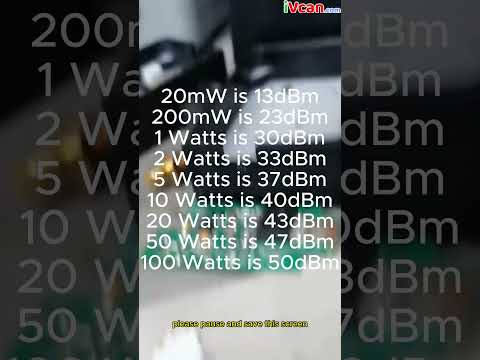
Erste, we need to know a table of output power and power amplifier power. Hier sind einige Entsprechungen zwischen der Ausgangsleistung und den vom Instrument angezeigten dBm-Parametern.
20mW beträgt 13 dBm
200mW beträgt 23 dBm
1 Watt beträgt 30 dBm
2 Watt beträgt 33 dBm
5 Watt beträgt 37 dBm
10 Watt beträgt 40 dBm
20 Watt beträgt 43 dBm
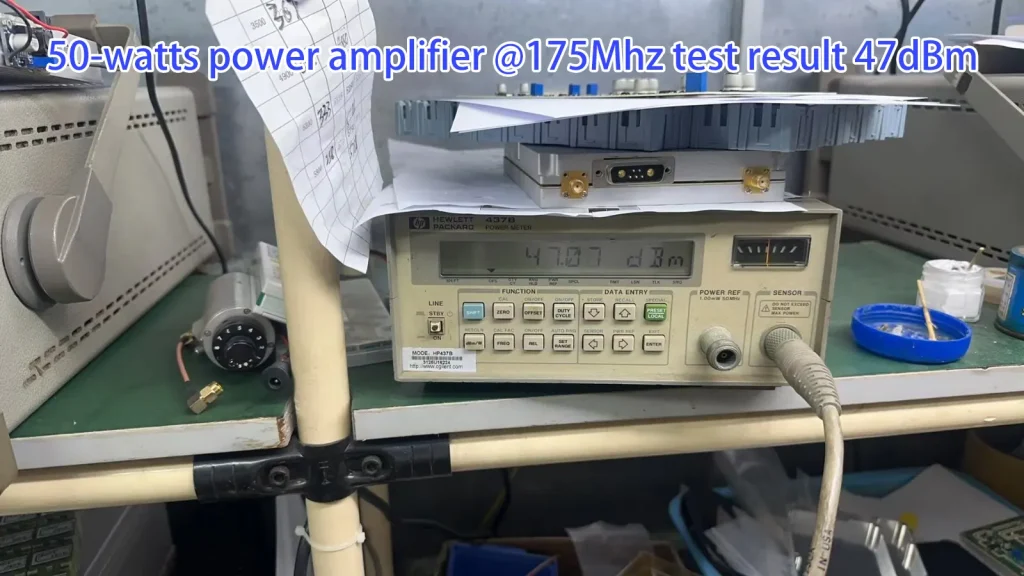
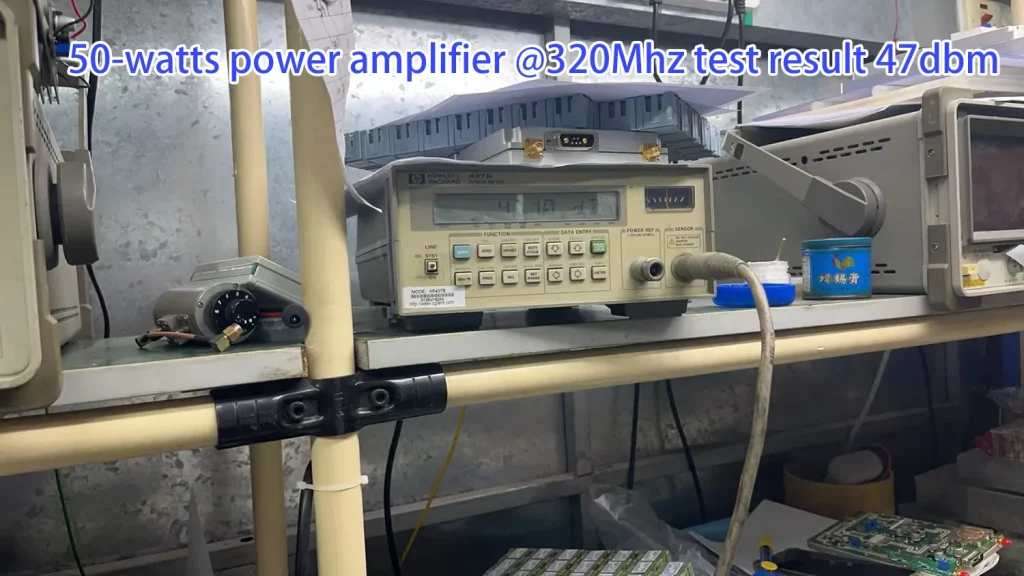
50 Watt beträgt 47 dBm
100 Watt beträgt 50 dBm
The transmitters in the video all have built-in 10-watt power amplifiers, and the corresponding instrument should measure 40dBm.
Gleichzeitig, our equipment has a 40dBm attenuator added, so the instrument should show a performance of around 0dBm.
You can see the performance indicators in the video: one is 0 dBm, one is 0.07 dBm, and one is 0.18 dBm. From the table, we can see 0 dBm, They all have built-in 10-watt power amplifiers.
In the next video, we will demonstrate how to modify the output power through the parameter modification board.
We will show you how to change the wireless video transmitter from a 2-watt amplifier to a 1-watt one.
Please remember to follow our YouTube channel. If you have any suggestions for the COFDM wireless video transmitter and receiver, please feel free to communicate with us.
To measure the RF output power of a wireless video transmitter, you must use a power meter and a power sensor that are compatible with the transmitter’s signal format and modulation type.
To achieve proper power transfer, you must also match the impedance of the transmitter and the power sensor. Here are some procedures to follow:
- Turn on the power meter and connect the power sensor. Check that they are correctly calibrated and configured.
- Using a coaxial cable, connect the transmitter output to the power sensor input. To protect the power sensor from damage caused by high power levels, use an attenuation or a dummy load if possible.
- Set the transmitter’s frequency and modulation mode as desired. As needed, adjust the output power level.
- Pay attention to the power value displayed on the power meter. This is the transmitter’s RF output power in watts or decibels (dBm). If you have an oscilloscope, you may also use the peak-to-peak voltage formula to compute power.
- A directional coupler or a reflectometer is required to monitor the voltage standing wave ratio (VSWR), which indicates how well the transmitter and the power sensor are matched.
- These devices can calculate the VSWR by measuring both forward and reflected power. A low VSWR indicates a good impedance match and low power loss.
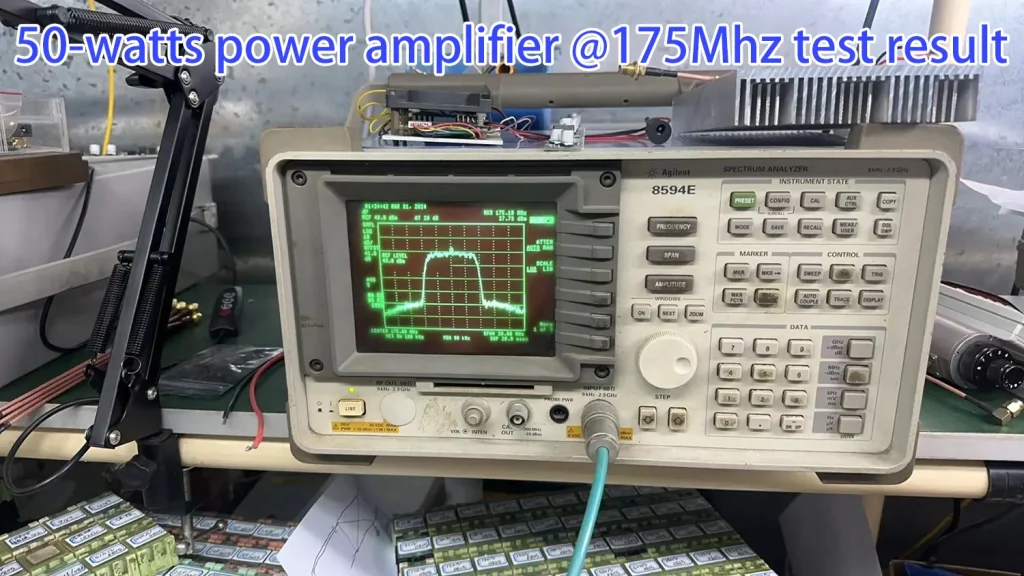
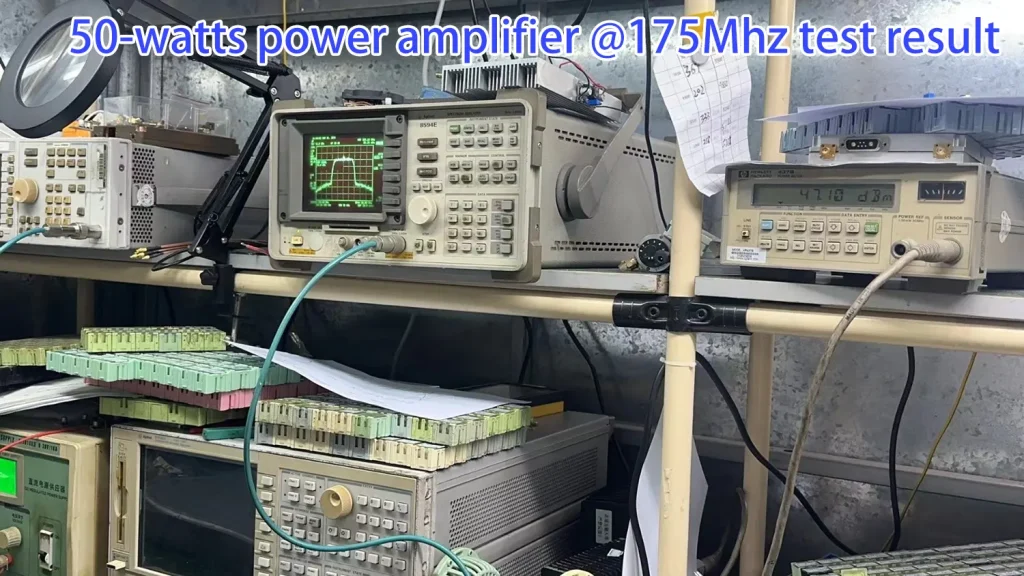
50-watt power amplifier at 175Mhz
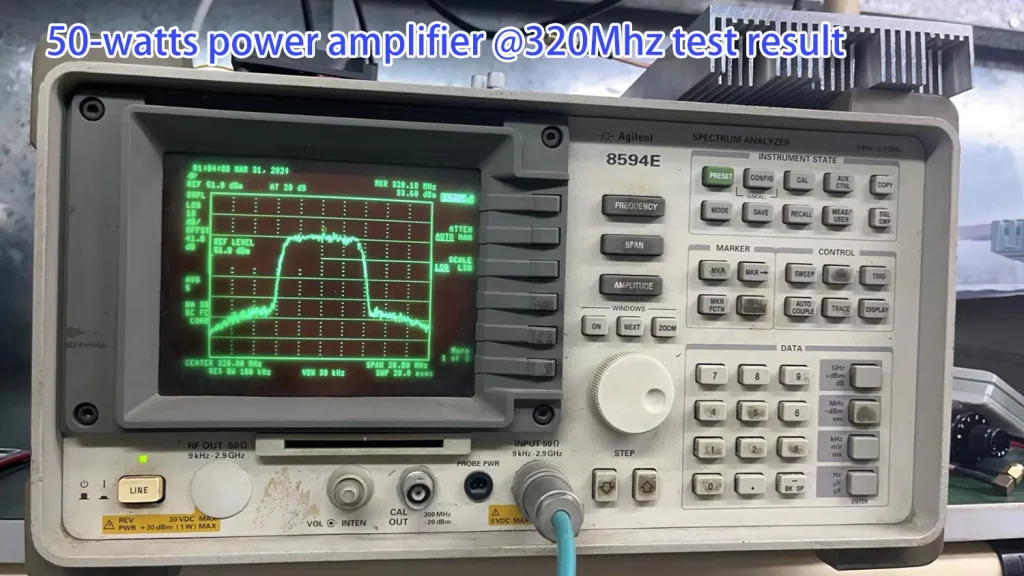
50-watt power amplifier at 320Mhz

Stelle eine Frage
Vielen Dank für deine Antwort. ✨