





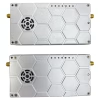
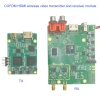
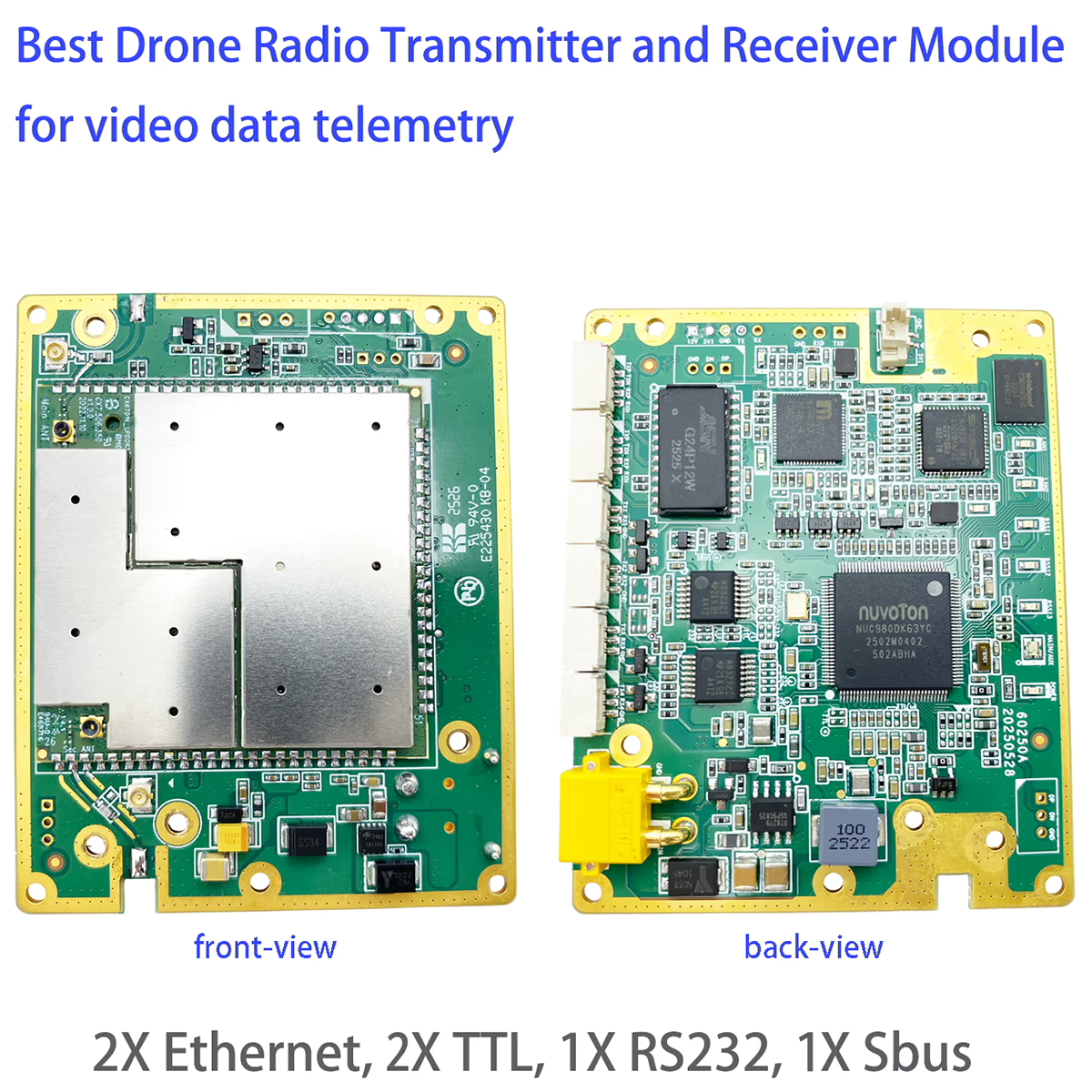
Bestes Drohnen-Funksender- und -empfängermodul für Videodatentelemetrie
Inhaltsverzeichnis
Überblick
Das Vcan2122 ist ein kompakter, medium-power bidirectional wireless data transmission module designed for reliable long-range communication in complex and interference-prone environments. Bezogen auf OFDM TDD wireless communication technology, it delivers strong anti-interference capability, excellent penetration performance, and highly stable data transmission.
Das Modul unterstützt multiple transmission modes, einschließlich Punkt-zu-Punkt, point-to-multipoint, und trunk communication, and enables star network topologies mit bis zu 16 Knoten in a single network. Thanks to its miniaturized design, geringer Stromverbrauch, und multiple data interfaces, Vcan2122 is well suited for Mobile, in der Luft, and embedded applications where reliability and flexibility are critical.
Das Vcan2122 Ist by default available in a wideband configuration, operating over a frequency range of 1420–1530 MHz. Within this single continuous band, the module provides up to 110 MHz of selectable frequency range, ermöglichen Automatisches Frequenzspringen with significantly greater flexibility to avoid interference and maintain stable links in complex RF environments.
In addition to the wideband version, optional single-band variants are also available in the following frequency ranges: 806–825.9 MHz, 1427.9–1467,9 MHz, 2401.5–2481.4 MHz. Each optional variant supports single-band operation only.
Under good line-of-sight (LOS) air-to-ground conditions, the transmission distance can reach 10-20 km oder mehr, depending on high gain antenna configuration and external power amplifier support.
Merkmale
-
Star Networking Capability
Supports point-to-multipoint communication with up to 16 Knoten. -
High Bandwidth Transmission
Maximum data rate up to 30 Mbit/s @ 20 MHz. -
Flexible Channel Bandwidth
Unterstützt 3 / 5 / 10 / 20 MHz bandwidth modes. -
Automatische Frequenzauswahl
Automatically detects interference and selects the optimal frequency point in real time. -
Koexistenz mehrerer Systeme
Multiple Vcan2122 systems can operate simultaneously on fixed frequencies. -
Mehrere Datenschnittstellen
Integriert Dual 100 Mbps Ethernet ports und TTL / RS232 / SBUS serial interfaces. -
Geringe Wartezeit
End-to-end transmission delay ≤ 20 Frau. -
Sichere Kommunikation
Unterstützt AES-128-Verschlüsselung. -
Kompakt & Leichtes Design
Nur 35 G, suitable for UAVs and other weight-sensitive platforms. - Web UI page to configuration the parameter.
Provide a user-friendly web UI for configuring module parameters. Users can easily manage settings and modify parameters visually through the web page, without the need for complex AT commands or command-line instructions.
Technische Daten
System Parameters
| Artikel | Spezifikation |
|---|---|
| Modell | Vcan2122 |
| Betriebsfrequenz | 1420-1530MHz (default and recommended)
oder The user can freely select one of the three available frequency bands for operation. 806–825.9 MHz / 1427.9–1467,9 MHz / 2401.5–2481.4 MHz |
| RF-Kanal | 1T2R |
| Ausgangsleistung | 25 dBm (0.3 W) |
| Modulation | OFDM |
| Kanalbandbreite | 3 / 5 / 10 / 20 MHz |
| Maximale Datenrate | 30 Mbit/s @ 20 MHz |
| Übertragungsentfernung | ≥10 km (Luft-Boden, LOS) |
| Empfangsempfindlichkeit | Refer to the table below of Channel Bandwidth & Empfindlichkeit |
| Verschlüsselung | AES-128 |
| Übertragungsverzögerung | ≤20 ms |
| RF-Schnittstelle | IPEX ×2 (Hauptsächlich + AUX) |
| Ethernet-Schnittstelle | 100 Mbps ×2 |
| Serielle Schnittstellen | TTL ×2, RS232 ×1, SBUS ×1 |
| Stromverbrauch | ≤5 W (Air @ 4 Mbps), ≤5 W (Boden) |
| Eingangsspannung | DC 9–15 V (Typisch: 12 V @ 1 EIN) |
| Maße | 73 × 59 × 10 Millimeter |
| Gewicht | 35 G |
| Betriebstemperatur | -20 ℃ to +55 ℃ |
Kanalbandbreite & Empfindlichkeit
| Channel BW | Datenrate | Empfindlichkeit |
|---|---|---|
| 20 MHz | 10 Mbps | -94 dBm |
| 20 MHz | 5 Mbps | -97 dBm |
| 10 MHz | 10 Mbps | -91 dBm |
| 10 MHz | 5 Mbps | -96 dBm |
| 5 MHz | 10 Mbps | -84 dBm |
| 5 MHz | 5 Mbps | -93 dBm |
| 3 MHz | 5 Mbps | -87 dBm |
| 3 MHz | 2 Mbps | -98 dBm |
Schnittstellen
-
Stromschnittstelle: XT30, DC 9–15 V
-
Antennenschnittstelle: IPEX ×2
-
MAIN: Must be connected
-
AUX: Receive diversity only
-
-
Datenschnittstellen:
-
Ethernet: 100 Mbps ×2
-
Seriell: TTL ×2, RS232 ×1, SBUS ×1
-
Schnittstellendefinition
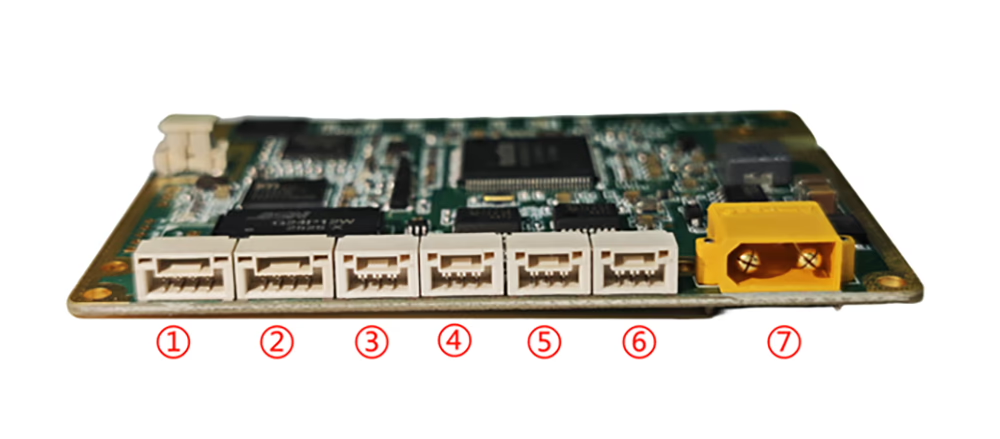
| Lineare Ordnung | Pin-Name | Schnittstellendefinition | Schnittstellenbeschreibung | Signalrichtung |
| 1 | TXP1+ |
Ethernet 1
|
TX+ | O |
| TXM1- | TX- | O | ||
| RXP1+ | RX+ | ICH | ||
| RXM1- | RX- | ICH | ||
| 2 | TXP2+ |
Ethernet 2 |
TX+ | O |
| TXM2- | TX- | O | ||
| RXP2+ | RX+ | ICH | ||
| RXM2- | RX- | ICH | ||
| 3 | TX1 | Serieller Anschluss 1
TTL |
TX | O |
| RX1 | RX | ICH | ||
| GND | Boden | O | ||
| 4 | TX2 | Serieller Anschluss 2
TTL |
TX | O |
| RX2 | RX | ICH | ||
| GND | Boden | O | ||
| 5 | TX3 | Serieller Anschluss 3
RS232 |
TX | O |
| RX3 | RX | ICH | ||
| GND | Boden | O | ||
| 6 | TX4 | Serieller Anschluss 4
SBUS |
SBUS-OUT | O |
| RX4 | SBUS-IN | ICH | ||
| GND | Boden | O | ||
| 7 | PWR | DC 9~15V
|
Macht positiv | ICH |
| GND | Macht negativ | ICH |
Wir können auch einen TTL-Port auf RS422 umwandeln, und zusätzlich, Wir können eine RS232-zu-RS485-Konverterplatine hinzufügen, um RS485 zu unterstützen, Dies wird häufig zur PTZ-Steuerung von Kameras verwendet.
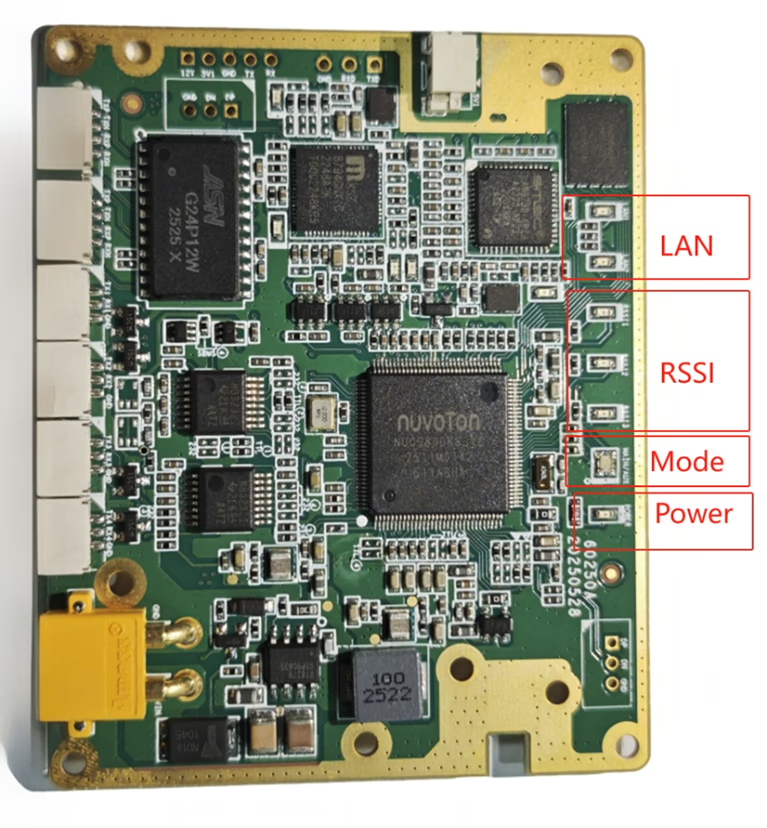
Statusanzeigen
-
PWR (Grün)
ON indicates the device is powered. -
MODE (Rot / Grün)
-
Red ON: Master mode (Grount Unit, Empfänger)
-
Green ON: Slave mode (Lufteinheit, Sender)
-
-
LAN1 / LAN2 (Grün)
Blinks when Ethernet data is transmitted or received. -
RSSI 1–3 (Grün)
Indicates received signal quality:-
3 LEDs ON: SNR > 14
-
2 LEDs ON: 10 < SNR < 14
-
1 LED ON: 2 < SNR < 10
-
|
Modultyp |
Modus | light status | |||
| PWR | MODE | LAN1 LAN2 |
RSSI 123 |
||
| Master | unsynchronisiert | Powered on | red light Powered on | Daten werden übertragen und blinken | Searching |
| Master | synchronisiert | Powered on | green light Powered on | Daten werden übertragen und blinken | Proportional zur Stärke des empfangenen Signals |
| Sklave | unsynchronisiert | Powered on | red light Powered on | Daten werden übertragen und blinken | Searching |
| Sklave | synchronisiert | Powered on | green light Powered on | Daten werden übertragen und blinken | Proportional zur Stärke des empfangenen Signals |
When the primary (Master, Bodeneinheit, Empfänger) and secondary devices (Salve, Lufteinheit, Sender) Sind not synchronized, Die PWR (Leistung) indicators on both devices remain steadily lit. Das MODE indicator Ist Rot on the primary device and Grün on the secondary device. Zu diesem Zeitpunkt, Die RSSI lights on both devices are in a searching state.
Once the master and slave devices are synchronisiert, Die RSSI lights display the received signal strength for each device. When data is being sent or received over the network, Die LAN1 indicators on both devices light up, während die LAN2 indicators blink to indicate network activity.
Anwendungen
Das Vcan2122 is suitable for a wide range of professional wireless data transmission applications, einschließlich:
-
UAV / Drone Data Links
-
Brandbekämpfung & Emergency Communication
-
Öffentliche Sicherheit & Strafverfolgung
-
Inspektion & Monitoring Systems
-
Robotik & beim UGV
-
Temporary Wireless Networks
-
Industrial and Environmental Monitoring
FAQ
Q: What are the main and secondary antennas used for in a 1T2R UAV video data module?
EIN: This module adopts a 1T2R (1 Übertragen, 2 Erhalten) architecture.
- Hauptantenne (Primary RF path):
Responsible for both Übertragung (TX) und Rezeption (RX).
It is connected through a T/R (Senden/Empfangen) switch, which routes the RF path either to the power amplifier during transmission or to the receiver chain during reception. - Secondary antenna (Diversity receive path):
Used only for reception (RX only).
It improves link reliability by providing räumliche Vielfalt, helping mitigate:- Multipath fading
- Signal blockage (e.g., drone body shadowing)
- Orientation-dependent signal loss
Gesamt, the dual-receive design significantly improves link stability and robustness in mobile UAV scenarios.
Q: Can I modify the RF front-end by adding an up/down converter, PA, and LNA, and convert the system into a 1T1R architecture?
EIN: Theoretisch, adding an external frequency conversion stage (up/down conversion) plus PA (Leistungsverstärker) und LNA (Low Noise Amplifier) can be implemented as part of a custom RF front-end. aber, converting a 1T2R system into 1T1R is generally not recommended for UAV video links. Key impacts of switching to 1T1R:
- Reduced receiver sensitivity: Typically degraded by ~3–5 dB, due to the loss of spatial diversity gain.
-
Lower link robustness in motion: UAV environments involve: Rapid movement / Orientation changes / Multipath fading, A single receive chain (1T1R) is more vulnerable to intermittent signal drops.
- Weaker anti-interference and fading resistance: Without dual receive antennas, the system loses diversity combining benefits.
Q: What is the maximum OFDM Peak-to-Average Power Ratio (PAPR) of this wireless video/data telemetry module?
EIN: The maximum OFDM PAPR of this module is typically: 11.5 dB. When designing an external RF front-end (such as PA, LNA, or frequency converter), sufficient PA back-off and linearity margin should be reserved to avoid signal distortion and spectrum degradation.
Q: Does Vcan2122 support video transmission?
Vcan2122 is a wireless data transmission module. Video transmission depends on external IP cameras or video encoders connected via Ethernet.
Q: Can this module support IP MESH MANET functionality?
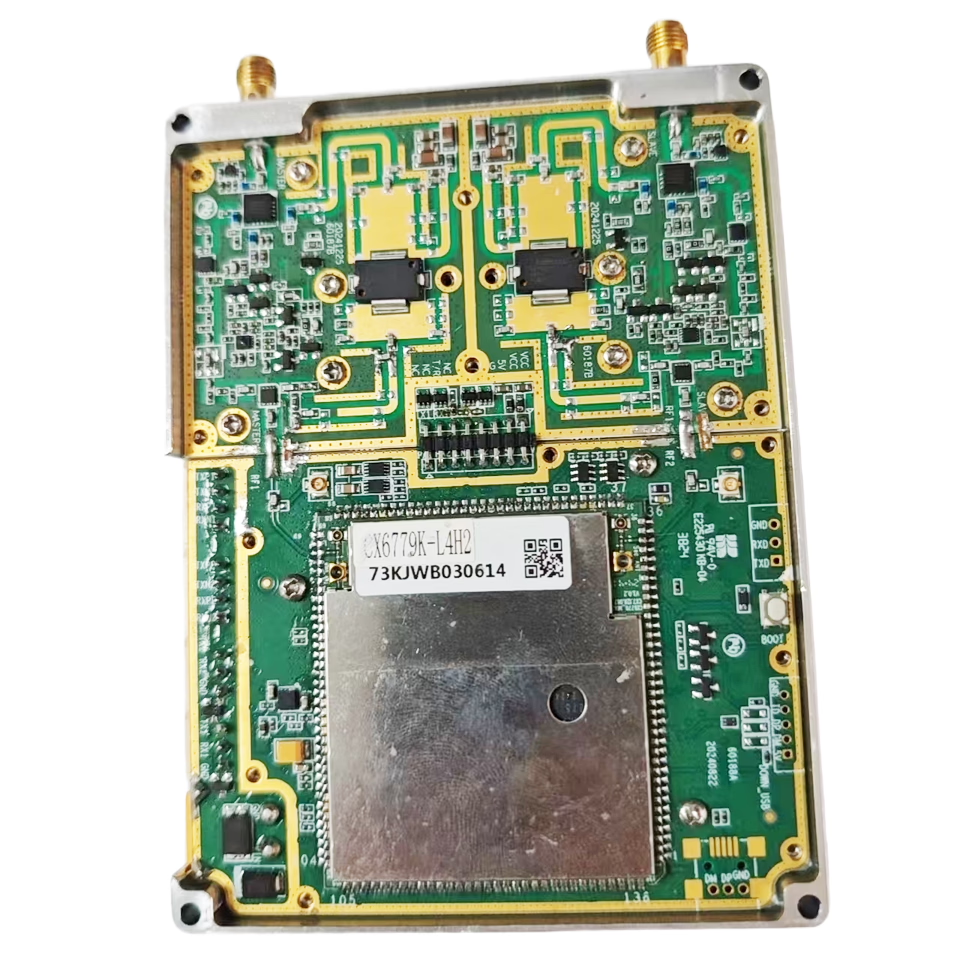
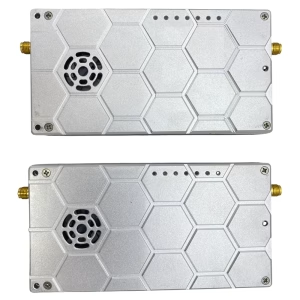
Nein, default module is star networking type. Wenn Sie brauchen, we also can do IP MESH MANET (Mobiles Ad-hoc-Netzwerk) fucntion (use CX6702, CX6702 module). Momentan, we provide it as a finished product rather than as a standalone development module. Please refer to the product image below for your reference. (CX6779-L4H2)
Q: Can multiple Vcan2122 systems operate in the same area?
Ja. Fixed-frequency operation allows multiple systems to coexist with minimal interference.
Q: Does one unit support multiple frequency bands?
Nein. Each Vcan2122 unit supports one single frequency band only.
Q: Is diversity reception supported?
Ja. The AUX antenna provides receive diversity to improve link reliability.
Q: What is the typical latency?
The typical end-to-end transmission delay is ≤20 ms.
Einführung
Das Vcan2122 is the latest drone transmitter and receiver module designed for UAV video, Daten, and telemetry transmission.
Es verfügt über zwei 100 Mbps Ethernet ports for connecting IP cameras, Bodenstationscomputer, or NVRs. Zusätzlich, es bietet four serial data ports, configurable as:
-
Two TTL ports for connecting a drone’s flight controller
-
One SBus port for connecting a drone remote controller
-
One RS232 port for other devices
-
Alternativ, one port can be configured as a third TTL port
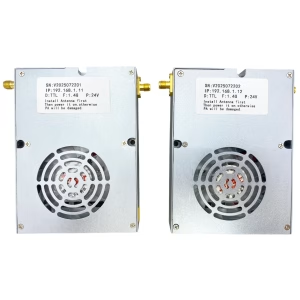
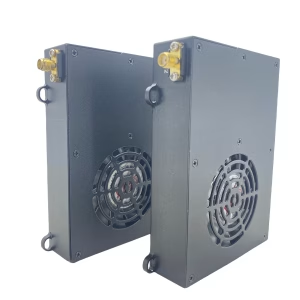
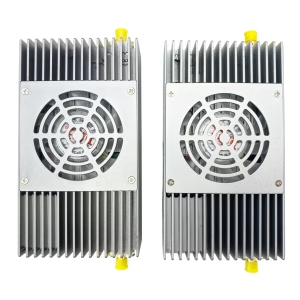
The module includes a eingebaut 300 mW amplifier, and for extended transmission distances, ein external amplifier (2 W, 5 W, oder 10 W) can be used.
Entwickelt für drone enthusiasts, manufacturers, Ingenieure, und Forscher, the Vcan2122 supports a wide operating frequency range of 1420–1530 MHz mit einem optionalen 110 MHz-Bandbreite, allowing automatische Frequenzauswahl to avoid interference and maintain strong signal quality.
Es unterstützt transmission distances from 10 km up to 150 km. For long-range applications or environments with severe electromagnetic interference, ein external power amplifier is recommended.
All module parameters can be easily configured through a user-friendly Web UI, bereitstellen visual management of settings without the need for complex AT commands.





iVcan.com –
I recently started using the Best Drone Radio Transmitter and Receiver Module for video, Daten, and telemetry, und ich bin sehr beeindruckt von seiner Leistung. The dual Ethernet ports make it easy to connect with IP cameras and ground station computers, while the multiple serial ports give me flexibility for flight controllers and other devices. The built-in 300mW amplifier provides stable transmission, and with an external amplifier, I can extend the range even further, making it suitable for both short and ultra-long-distance missions. I especially like that it can automatically switch frequencies to reduce interference, ensuring reliable and clear signal transmission. This module is an excellent choice for drone enthusiasts, Ingenieure, and researchers who need a professional, high-performance wireless link.