數據完整性, 重放攻擊防護, and Protocol Details in Drone Wireless Video Data Links
目錄
概觀
When integrating wireless video data links into professional systems—such as UAVs, 機器人技術, or remote video transmission platforms—engineers often raise concerns about data integrity, replay attack protection, 和 security of Ethernet communication protocols.
This article provides clear answers to frequently asked questions from our customers, based on our engineering team’s detailed technical explanations.
1. How does your wireless video data link ensure the integrity of transmitted messages?
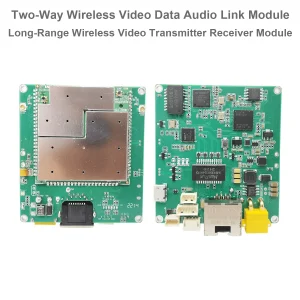
Our drone UAV OFDM-based wireless video data link is designed with a transparent transmission architecture. Both the serial port and Ethernet port work as transparent channels, 意義:
- Whatever data is input at the air-side transmitter is delivered unchanged to the ground-side receiver.
- The system does not modify, compress, or interpret the data in any way.
- It does not insert additional metadata such as timestamps, sequence numbers, or encryption information.
The design philosophy behind this approach is to achieve 超低延遲 和 maximum compatibility. By eliminating unnecessary processing layers, the system can maintain delays as low as 30 毫秒, making it ideal for real-time video, 控制, and telemetry applications.
然而, this also means that message integrity verification is not handled by the data link itself. Any mechanisms for detecting or preventing data tampering should be implemented in the user’s own application layer.
2. Can your system resist a replay attack?
A replay attack occurs when a malicious actor captures a valid data transmission and later replays it to deceive the receiving system.
Our wireless video data link, being a transparent bridge, 做 not include built-in protection against replay attacks. It forwards all data as it is received, without timestamp verification or authentication checking.
If protection against replay attacks is required, we recommend implementing one of the following solutions at the application or network layer:
- Add a timestamp or sequence number within each data frame to allow the receiver to detect duplicates or delayed packets.
- Use encryption and authentication mechanisms such as TLS (Transport Layer Security) or DTLS (Datagram TLS).
- Employ a challenge–response protocol between the transmitter and receiver to confirm message freshness.
This approach allows developers to tailor the security features to their own operational requirements without affecting the core transmission performance of the wireless link.
3. Does your system include any timestamp information in the data?
沒有. The data link does not embed any timestamp or time-related information in the transmitted data stream.
If your application requires synchronization or event tracking, 你可以 add timestamp headers to your own data packets. 例如, you can prepend each serial data frame with a small header that contains a timestamp or sequence counter.
This method allows the receiving system to verify message order, calculate latency, and detect potential replay attempts.
4. Is TLS or any other encryption protocol used in Ethernet communication?
預設情況下, our Ethernet interface uses standard transparent IP transmission—that is, raw data packets are transmitted without encapsulation or encryption.
有 no TLS or DTLS layer built into the wireless link module itself. This design ensures compatibility with various data types (視頻流, 遙測, command packets, 等等) and allows users to freely define their preferred communication protocol.
If encryption or message authentication is required, users can easily implement these security layers in their own software. 例如:
- 使用 TCP with TLS to ensure both reliability and confidentiality.
- 使用 UDP with application-level integrity checks (CRC, HMAC, 等等) for lower latency while maintaining partial protection.
5. What happens if the wireless signal becomes weak or disconnected?
If the wireless link experiences degraded signal quality or a temporary disconnection, any data that fails to transmit will simply be discarded.
The system does not buffer or retransmit the unsent data. This ensures that the data stream remains real-time and free from latency accumulation, which is especially critical for drone flight control, 實時視頻傳輸, and real-time telemetry.
If your application requires guaranteed delivery or buffering, you can switch to TCP-based communication, as TCP/IP provides built-in retransmission and flow control mechanisms.
6. Can you provide proof that the system detects data tampering?
Since the link performs raw transparent forwarding, it does not detect or log data tampering by itself.
If you wish to verify message integrity, you should add your own application-level checks, 如:
- CRC (循環冗餘檢查) for basic data integrity verification;
- HMAC (Hash-Based Message Authentication Code) for stronger authentication and tamper detection;
- Digital signatures if data authenticity must be cryptographically guaranteed.
These measures allow the receiver to detect any unauthorized modifications that may have occurred during transmission.
7. What protocol is used for Ethernet communication?
The Ethernet communication is based on a standard IP network protocol. The system does not encapsulate data into any specific higher-level format such as TLS, DTLS, 或專有加密.
簡單來說, the device functions as a transparent bridge between serial or IP-based interfaces. You can transmit video streams (例如, 即時傳輸/即時傳輸協議), 遙測數據, or custom TCP/UDP packets directly through it.
This flexibility allows developers to integrate the wireless link into a wide variety of systems—from drone payloads and gimbals to surveillance and industrial control applications.
8. 概括
Our Drone UAV wireless video data link is designed with high stability, 超低延遲, and transparent data transmission 考慮到.
To summarize:
| 特徵 | 內建 | User Implementable |
|---|---|---|
| 時間戳 / Replay Protection | ❌ Not included | ✅ Add via application layer |
| 資料加密 (TLS/DTLS) | ❌ Not included | ✅ Supported through user software |
| Message Integrity Check | ❌ Not included | ✅ Implement via CRC / HMAC |
| 緩衝 / Retransmission | ❌ Not included | ✅ Use TCP for buffering |
| 潛伏 | ✅ Ultra-low (≈30ms) | — |
This architecture provides the user with maximum control and flexibility — you can design your own protocol stack, 加密, or authentication mechanism according to your project’s requirements.
9. 結論
本質上, our wireless video data link serves as a 高性能, low-latency transparent transmission channel. It guarantees that your data is transmitted as-is, without alteration or added delay.
For applications that demand additional 安全, integrity, or replay protection, we recommend implementing these mechanisms at the application or network layer, allowing you to achieve both safety and performance based on your specific needs.

問一個問題
感謝你的回應。 ✨